I. INTRODUCTION
Distributed generators are gaining popularity in the power system industry as they are helping to modernize the traditional energy network. Distributed generators are classified as dispatchable units like a gas turbine and non-dispatchable units like PV solar and wind turbine, located near the consumer's site to enhance distribution systems performance.
Technological innovation in energy systems like the Internet of Things (IoT) is at the forefront of this modernization for the real-time monitoring, situational awareness and intelligence, and control of such resources. In this scenario, a group of interconnected distributed generators and loads can create microgrids with unified characteristics [1]. Microgrids improve overall power system efficiency as they enhance the system reliability, resiliency, power quality, power losses, and operational costs [2]. Energy management strategies using real-time monitoring and control with IoT technology depend on the type of DERs, load requirements, and the expected operational scenarios [3]. Since there are uncertainties in the renewable-based DGs, it is challenging for the power system operators to balance the load and generators inside the microgrid, especially if it disconnects from the grid as island during an extreme event. Therefore, while there is excess energy with one microgrid and a deficit in the other, it would be beneficial for those to share their excess to supply remaining loads. This energy sharing strategy between MGs in a multi-MG power distribution system significantly enhances the system performance and efficiency when compared to a single MG [4].
Energy sharing and scheduling between different DGs in multi-MGs is the crucial step for enhancing overall system performance. Distributed energy generation's location and their corresponding generation capacities based on hourly load demand, helps to reduce system losses and improve system efficiency. If there is any time delay between load demand signal and generation adjustment process, the system reliability and efficiency would be affected. Introduction of IoT technology in power systems facilitates the real-time monitoring and control of load and generation. IoT in multi-MGs supports DGs and loads in maintaining generation-consumption balance and implement intelligent energy management strategies in real time to enhance system efficiency.
Different types of distributed generators and their corresponding scheduling are addressed in the literature for the optimal operation of MGs using IoT. For instance, the authors in [5] proposed a model for a virtual microgrid that divides a distribution system as a set of sub-grids, making the autonomous grid more resilient. Reference [6] uses the IoT technology for microgrid controls and remote monitoring purposes. The authors in [7] apply the IoT to make real-time communication among DGs in MGs considering energy management for tertiary controlling purposes. The authors in reference [8] propose scheduling plans for the existing distributed generators located in MGs for its economic and stable operation. The objective of their research is to minimize the microgrid operational costs, especially during the islanded mode, having no power from the primary grid and making the MG more stable. A retroactive regime-based energy scheduling applicable in small-scale MGs, is proposed in [9], where the practical implementation does not need much information for the uncertain generation's capabilities. The authors in [10] propose a two-stage stochastic mixed-integer programming method for optimal distributed generators operations while considering their best locations in the microgrids during the microgrid operation. This research aimed to operate the distributed generators in such a way that help to run the microgrid with lower operating costs and make the microgrid system more resilient. The authors in [11] propose a PSO-based optimization methodology by considering the DGs locations and corresponding capacities based on the profile of load demand in the microgrid system. This research aimed to minimize the microgrid energy loss for a given period by considering the DGs and load uncertainties. The authors in [12] present an energy management strategy in a campus microgrid for controlling the distributed generators included in that MG. The objective of this research is to minimize the system operating costs and maximize renewable integration. A novel distributed event-based energy management strategy is proposed in [13] by optimally scheduling distributed generators to balance load generation while minimizing the total system costs. Note that the literature review here considers optimal scheduling of single MG. More system benefits are possible by considering the energy sharing between multiple MGs, which help the overall system to be more reliable, resilient, and efficient.
In [14], a game theoretic-based distributed coordination control strategy is proposed, which ensures the self-benefit of each MG during the global benefit for the multi-MG. In [15], a multi-MG operation uses a co-optimization model by energy sharing between existing MGs. This model proposes a lower pricing cost and maintains good computational efficiency. A local market-based energy sharing model between multiple MG is developed in [16] to minimize the operational costs for each MG and among MGs. In this model, optimal scheduling of DG within MG is done using the market clearing process. A cooperative game-based optimization model proposes a joint operation between a distribution network and rural multi-MG is proposed in [17]. The objective of this joint operation between the distribution network and multi-MG is to maximize the benefit of each MG and improve the distribution network efficiency and reduce the overall system operational costs. More research is performed in the literature in the context of multi-MG to improve system overall performance [18]-[19]. Furthermore, the authors in reference [20] propose a dynamic microgrid by considering a flexible boundary among MGs based on the allocation and coordination of agents to achieve boundary mobility. This flexibility of boundaries may affect the overall system management between multi-MG operations. In [21], the authors develop a mixed-integer linear programming-based operational framework model to provide reliable service restoration using the advantages of flexible DGs within MGs. The authors in [22] propose a model to form a flexible MG condition to improve the overall system reliability using a demand response program.
Literature review shows that much research is conducted on DGs controls and operations, energy sharing using IoT and energy management in microgrid and multi-MGs. Nevertheless, further investigation is needed for IoT and energy management applications on multi-MGs, especially in the perspective of flexible boundary conditions. Multi-MG operation within the distribution system without any time delays is required to have a more efficient energy system that will ensure real-time feedback between generations and load. IoT is utilizing the concept of such advanced techno-logical opportunities. This research expands the IoT applications' impact with energy management on improving microgrids' performance. Dispatchable gas turbines, non-dispatchable PV and wind turbines, and energy storage within multi-MGs as distributed energy resources are considered in the research. The Pacific Gas and Electric Company (PG&E) 69-bus power distribution system is selected, and the energy resources' optimal locations and capacities are found using a relatively new hybrid PSO-TS optimization method to increase the overall system efficiency considering flexible boundary conditions within MGs. The developed model promotes the in-vestment in the optimal generation facilities among profit-oriented entities for utilities or system operators and the consumers. Energy management strategy considering IoT is applied for the scheduling of energy resources without any time delay of energy generation and load forecasting. Thus, the main contribution of this paper is summarized as follows:
Develop a model for finding optimal operation of distributed energy resources in terms of their locations and capacities, considering flexible boundary conditions within multi-MGs to improve the overall system performance.
Formulate the algorithm of distributed energy resources planning and operation while considering no time delay between generation and loads using IoT inside multi-MGs.
Apply energy management to get maximum IoT support for rescheduling DGs operations for a flexible multi-MG boundary to improve the multi-MGs system's efficiency.
Present case studies for different capacities of energy resources with uncertain parameters within flexible boundary multi-MGs systems with and without IoT.
The rest of the paper is organized as follows. Section 2 describes the energy management and IoT in power distribution network. Section 3 describes the system modelling for both dispatchable and non-dispatchable generators as well as loads. Problem formulation and optimizing solution algorithm is presented in section 4 and section 5 respectively. Multi-MGs power distribution system are analyzed in section 6 where the results and simulation of this paper is presented in section 7. Impact of IoT in multi-MG is discussed in section 8 and finally conclusion of this paper is presented in section 9.
II. ENERGY MANAGEMENT AND IOT IN POWER SYSTEM
In multi-MG, the optimal scheduling of distributed energy resources is necessary to improve the system's performance. This scheduling of energy resources is a challenging task, especially in an uncertain load and generation scenario. It would be even more challenging in the case of multi-MG DGs scheduling and operation. Therefore, energy management is necessary in multi-MGs to ensure a proper balance between energy generation and load. Since there is usually more potential for power generation in a plan at certain times than power consumption, there is more than one option for reaching such balance. Since solar PV, wind turbines, and load used in this research have uncertainty in nature, considering states for these uncertainties is important for proper energy flow. Thus, controlling the DGs and getting power for delivering at the loads at a particular time can significantly impact the multi-MG operations and performance. Due to such significant impacts of DGs scheduling in multi-MGs operations, considering the energy management strategies is a crucial need for the microgrids de-signers and operators.
IoT in power networks provide a sustainable solution to enhance the multi-MG operation. In this research, IoT and energy management aim to utilize distributed energy resources for their optimal operation in real-time to minimize system operating costs and reduce carbon emissions while enhancing the overall system efficiency. Multi-MGs are present in this research to optimize power flow so that maximum power is obtained from the MGs with excess capacity and minimum power is obtained from the primary grid if there is availability. The target is to reduce energy dependency from the primary grid toward MGs, especially by energy management for DGs operations. In this case, flexibility in microgrid boundaries facilitates achieving this goal of improving the system's overall efficiency. The power exchanges to-and-from the multi-MGs are done in real-time with real-time rates using IoT. With IoT, the multi-MG system will become more efficient, cost-effective, and less pollutive especially considering flexible boundaries. IoT in a multi-MG system network provides real-time feed-back to the multi-MG and utility operators, which better serves customers through controlling functionalities [23]. The application of IoT and energy management help to improve system's performance, which is shown in detail in Section 7.
III. SYSTEM MODELING
In this research, multiple microgrids are considered inside a distribution system. There are gas turbines, PV solar, wind turbines, and energy storage located in each MG. All microgrids are connected and can exchange power while needed. These multiple MG operations form multi-MGs, and energy can share within this multi-MG. All microgrids are also associated with the primary grid and can transfer power with the main grid. This section discusses the modeling for gas turbines, PVs, wind turbines, and energy storage in detail.
a) Distributed Generators
This research uses gas turbines as dispatchable distributed generators and active power sources, ensuring continuous energy if the fuel is available. Because of these dispatchable characteristics are the active power source that can provide specific power for the operators. Because of sustained power availability, the operational costs from this dispatchable generator measure per kWh. The difference between renewables-based DGs with the gas turbine is that it creates environmental emissions due to its natural gas fuel consumption.
The model for the gas turbine can be represented as [23].
Here is the price for natural gas, is a coefficient, and represents the efficiency.
Be noted that the initial investment costs of each dispatchable distributed generator have been ignored in this research since it won't affect the goals of energy management as an operational issue. The energy sharing between dispatchable and non-dispatchable generators happens within the multi-MGs by considering tertiary controls of these DGs and optimizing operational goals.
Moreover, this research uses wind turbines and PV solar as the non-dispatchable distributed generators for the multi-MGs application. Wind turbines and PVs are clean sources of energy, which are comparatively cheap and environmentally friendly. The problem with these types of distributed generators is that they are uncertain. Since these distributed generators show nondispatchable characteristics, their output power is indefinite for different times of 24 hours. The uncertain ability of the wind turbine is mainly the wind speed and features of the wind turbine module itself while delivering its output power. Moreover, PV's output power also depends on the outside whether like sunshine, temperature, and the PV module itself. In this case, it is essential to model these distributed generators with their uncertain behavior.
In this research, the wind speed of wind turbines is modeled hourly by the Weibull PDF using historical data [24].
Where represents the wind's cut-in speed, and are the rated speed and cut-out speed of the wind, respectively. and are the wind's output power and average wind speed for the state .
For modeling PV, the solar irradiance of the PV module is modeled hourly for 24 hours by the Beta PDF using historical data [24].
where represents the solar irradiance, is the beta distribution function and and are the corresponding Beta PDF function parameters that can be calculated by equation (4).
Energy storage is gaining popularity in power areas as it works as both load and generator and can operate in an economic way, considering charging and discharging functions. Energy storage can act as a dispatchable distributed generator since it can deliver continuous power if the charge is available. The optimal storage operation is influenced by the hourly availability of wind and solar PV power and price from the utilities and the optimization objectives. An energy management system using IoT schedules energy storage and other DGs operations in the multi-MGs. In parallel with other DGs in the design, ESS operations also happen to minimize the distribution system operational costs. The ESS maintained two satisfying constraints represented by equations (5) and (6) during the charging and discharging periods.
where represents the ESS power at time , and represents power supply from the storages at time period . The amount of stored energy for the ESS is presents by in this equation with time . and represent the charging efficiency and discharging efficiency, respectively.
b) Loads
The load data in this paper takes from the IEEE RTS [25]. In this model, the hourly peak load is a percentage of the daily peak load. Based on the load variation in 24 hours, the scheduling of different distributed generators obtains. This research considers the probabilistic nature of load in 24 hours to get a more accurate result.
IV. PROBLEM FORMULATION
This section describes the problem formulation for the distributed energy resources optimal scheduling within multi-MG. Also, this section presents the energy management objective function using IoT for distributed energy resources operations which are minimizing the system losses and costs together. Moreover, the formulation is presented for multi-MG system operation considering flexible boundaries within MGs based on DGs contributions. Moreover, there are several constraints for solving the optimization problem discussed at the end of this section.
a) Distributed Energy Resources Energy Management Objective Function
The application of energy management is first to find the optimal locations of the distributed energy resources. Then, considering IoT in multi-MGs having no time delay, energy management schedules such distributed energy resources for 24 hours. Based on this scheduling of the resources, multi-MG power network operational performance is calculated. Since this research considers a flexible boundary based on energy exchanges between MGs, there is a possibility to improve the multi-MGs power network operational performance. The objective function for finding the optimal locations of these distributed energy resources to minimize the system losses and operating costs together and can be formulated as follows by equation (7):
In this research, PV solar and wind turbines work as non-dispatchable, having chances of uncertainty during their operation. Thus, this objective function needs modification, and uncertainty states will be in front. So, the first part of the equation (8) will be
Where is the total number of uncertainty states used in the multi-MGs; and work for only dispatchable distributed generators and for dispatchable DGs and and will be equal to 1.
Thus, the final objective function for finding the optimal locations of these distributed energy resources can be present by equation (9).
Where is the multi-MGs power network system operational costs, which is described in the next section in detail.
b) Multi-MGs System Performance Assessment
This section evaluates the multi-MG power distribution network's performance regarding total system operational costs, which combines operating costs, losses, and environmental emissions. Environmental emissions are basically from the dispatchable gas turbines used inside the MGs and from the utility. The total system operational cost depends on several factors such as generators used for power generation, contributions of non-dispatchable generators and their uncertainty parameter, real-time pricing from the utilities, etc. Thus, scheduling the energy resources located in multi-MGs and their energy sharing is a significant factor for minimizing system operating costs. Scheduling would be more beneficial by providing extra flexibility for the distributed energy resources due to the boundary condition. If the distributed energy resources can have flexibility, more management is necessary between microgrids and would be more challenging for the power system operator. Interestingly, due to technological advancement, the situation is improving nowadays. In this research, the operational performance of a multi-MG power distribution system assesses due to the optimal distributed energy resources operations and multi-MG flexible boundary consideration. If the multi-MGs power distribution system already has some installed generators, the operational cost can be calculated from (10) for 24 hours considering the operating costs of such DGs. As mentioned previously, the DGs considered in this research are both dispatchable and non-dispatchable types.
where represents the total power generated at time , represents the corresponding system losses at time , and is power costs at time . and are the base DGs power and energy for per unit at time , and is the total number of base DGs. is the generation from the dispatchable and non-dispatchable generators.
The operating cost (OC) of a multi-MG power distribution system is calculated by equation (10) for the energy storage charging period. Since this research considers energy storage as a supportive resource for renewable energy sources, the calculation would be different during the charging mode and discharging mode of the energy storage. Energy storage can charge as a load during cheap price hours obtained from real-time data for the utility, typically during the off-peak period of the day. On the other hand, it can integrate into the multi-MG operation while more energy is needed from the utility, and there is no transformable energy between the MGs. Be noted that this research did not consider the initial energy storage investment costs; instead, it weighed only operational costs, and this would not affect the energy management process during its optimal operations and energy sharing within multi-MGs.
As explained, equation (12) calculates a multi-MG power systems network's operational cost (OC) for the energy storage dis-charging period.
Where is the energy storage's real power in kW, is the per unit costs for the energy storages, is the total number of energy storage reforms inside the microgrid in the power distribution system, and is the discharging efficiency.
One of the main concerning issues for the utilities and dispatchable generator owners is emissions. Equation (13) calculates the emissions from those generators in a multi-MGs power system [24], [26]:
Where (E_{p} ) is the emission price in terms of (\(/kg, ) and (S ) is the emission coefficient in (kg/kwh. )
c) Optimization Constraints
In this research, several constraints have been considered for using the optimization algorithm for solving the optimization problem, summarized as follows [24]:
Power flow equations should be modified to consider the real and reactive power generated by the energy sources.
The power limit for distributed energy resources integrates into the power network should be maintained the following constraints.
The penetration level of different types of energy resources (ERs) such as gas turbines, wind turbines, and PV solar capacities are another constraint.
Voltage limit at all the system buses and current limit at all the power line should be maintained.
V. OPTIMIZING SOLUTION ALGORITHM
In this research, optimization has been done for optimal energy resources operations regarding their locations and capacities.
In this case, the aim was to reduce the multi-MG energy losses and operating costs. Particle Swarm Optimization and Tabu Search Methods are two well-known optimization algorithms with unique features. Combining the two methods as explained below would improve the overall efficiency of the optimization process. Generally, particle swarm optimization (PSO) and Tabu Search (TS) are popular optimization methods used by many researchers. For any big or complex problem, PSO can easily find the optimal best locations [23]. PSO typically starts with a simple concept by considering two parameters, position, and velocity, while searching the object. At the beginning of its search, the initial position is chosen randomly from the defined areas selected by the operators. At this stage, the velocity is considered as zero. After a while, when PSO offers the best initial local and global solution from the searching spaces, it changes the best position and velocity. When it reaches convergence, PSO will choose the best result, and no more best results will come even after further iterations. Interestingly, TS can find the solution from his neighboring areas and use various memory structures to make the solution more economical and practical. The advantage of these memories is that they can easily avoid the target already in the tabu list and continue the search within other spaces effectively using different memory structures. The problem with these two types of algorithms, along with most other metaheuristics, is that they cannot claim the global optimum solution for a large dimension complex problem [23]. Therefore, this research uses a comparatively new method, namely hybrid PSO-TS, by taking benefit of those two methods principles. The proposed method can work and offer perfect results even in large scale optimization problems.
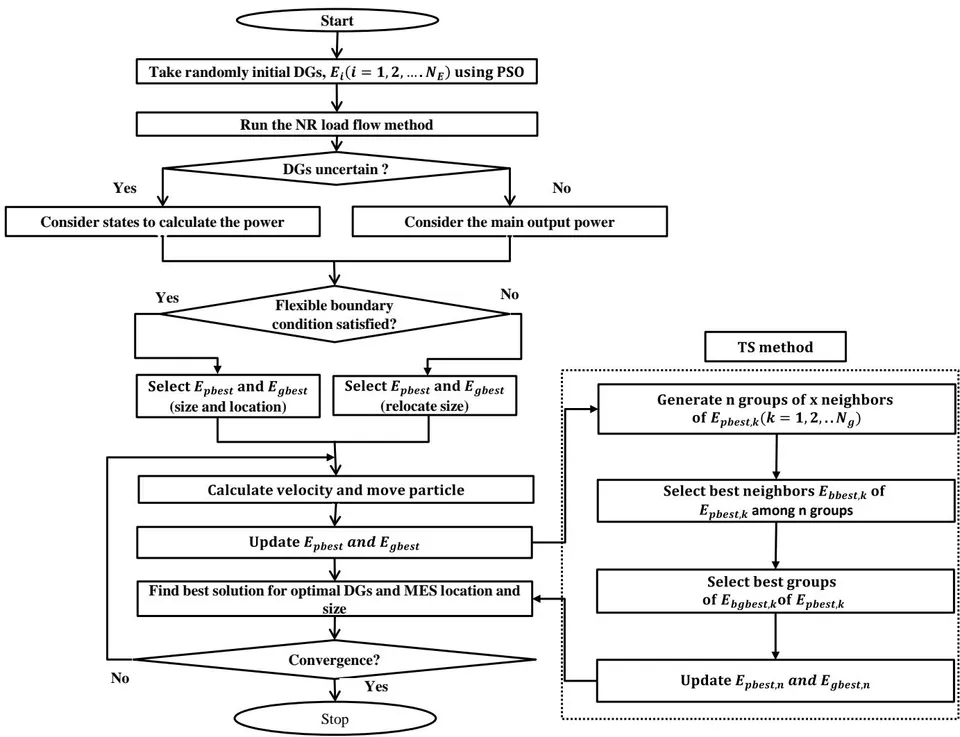
In this hybrid PSO-TS method, PSO is responsible for finding the initial solution and sent to the TS. Depending on the multi-MG flexible boundary condition, PSO will decide whether size and location will be fixed or need relocation of distributed energy resources before dispatch to the TS. TS will search for optimal results using memory structures. If TS can offer the better results from its experience than PSO, that will be considered for the next steps and forward to the PSO. This collaboration process between PSO and TS will continue until this hybrid method ensures the particles' own best and global best among all the particles in the searching spaces. The detailed steps regarding the hybrid PSO-TS algorithm and its application for optimal distributed energy storage location and operation in multi-MGs power distribution are illustrated in Fig. 1. It should be noted that the Newton Raphson's (NR) load flow method is chosen for power flow calculations in the multi-MGs system.
VI. MULTI-MG POWER DISTRIBUTION SYSTEM UNDER STUDY
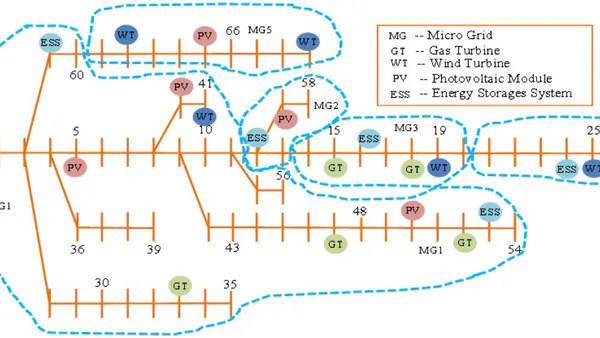
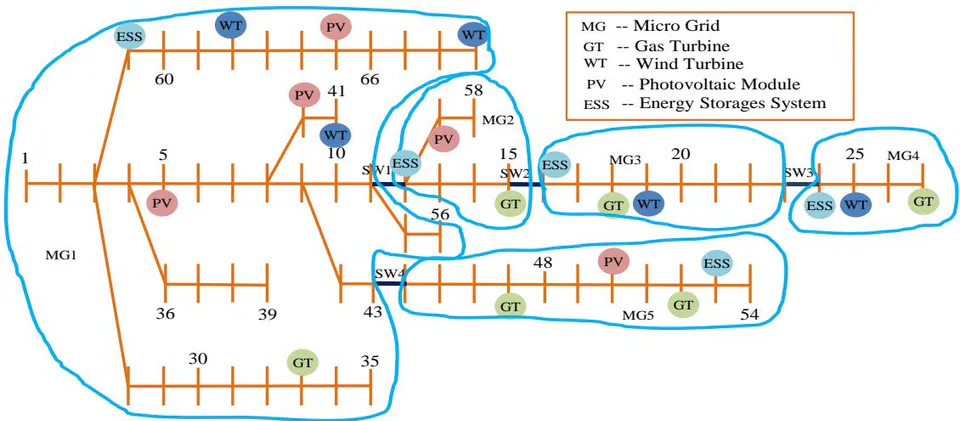
The well-known PG&E 69-bus power distribution system with five different microgrids is selected for simulations and case studies. The energy sharing from the distributed energy resources form multi-MGs for optimal operations of those energy resources. This research considers gas turbines, PVs, wind turbines, and energy storage systems inside microgrids to make the method practical. To create a sample multi-MG power distribution system, four arbitrary switches are allocated between the microgrids and the bus numbers 11-12, 15-16, 23-24, and 43-44. This four-switch positions make five microgrids. Further details on creating a multi-MG system in a power distribution grid can be found in [19]. The locations and capacities of each distributed energy resource are selected optimally based on minimizing multi-MG system losses and operating costs together. These locations are chosen for two different capacities of energy resources, 1125 kW and 2250 kW, shown in Table 1 and Table 2 in the results and discussion section. When the microgrids operate between themselves and share their energy based on energetic economic, available generations, etc., it's called multi-microgrids. A flexible boundary condition will allow the distributed energy resources to share their energy more efficiently. The multi-MG power distribution system's standard operational costs can be calculated by using per kWh per unit for 24 hours. Similar 24-hour periods are considered for the calculations of system losses and system environmental emissions, and the data is taken based on reference [24]. Since there are uncertainties in the load generation states, because of renewables generators and load variations, in this research, their corresponding uncertain behaviors are also considered to get faster, accurate results. Fig. 2 shows the system under study with a multi-MGs-based power distribution system having multiple distributed generators located inside the microgrids.
VII. RESULTS AND DISCUSSION
a) Distributed Energy Resources Optimal Locations and Capacities inside Multi-MGs
Two cases have been considered for finding optimal locations and capacities of distributed energy resources in this research.
Case I: 1125 kW of Distributed Energy Resources Operation: For the first cases, a total of 1125 kW of distributed energy resources integrates into multi-MGs where the contribution from the gas turbine is 500 kW, PV solar and wind turbine is 250 kW each, and energy storage is 125 kW. For the second case, a total of 2250 kW of distributed energy generators integrates into multi-MGs. In this case, there are 1000 kW of gas turbines, 500 kW of PVs and wind turbines, and 250 kW of energy storage present in the multi-MGs.
When a total of of distributed energy resources is included in multi-MGs, Table 1 shows corresponding capacities and locations. Before applying energy management in the operational setting, the planning stage is finding places and powers based on minimizing the multi-MG system losses and operating costs.
| DG Name | Total Capacity | Locations (Bus) | Capacities (kW) |
| Gas Turbine | 500 kW | 15, 33, 47, 52, 18 | 100, 100, 100, 120, 80 |
| PV | 250 kW | 5, 57, 40, 30, 65 | 50, 50, 50, 70, 30 |
| Wind Turbine | 250 kW | 41, 69, 19, 25, 63 | 50, 50, 50, 50, 50 |
| Energy Storage System | 125 kW | 53, 59, 12, 24, 16 | 25, 25, 25, 40, 10 |
Table 1 shows the maximum capacity of gas turbines placed in bus number 52, where the lowest ability shows in bus number 18. A total of gas turbines contributed to the system based on other distributed energy resources, capacities, and overall depend on system objectives. For PV solar, the maximum and minimum capacity is and , located in bus numbers 50 and 65, respectively. Noticeable that wind turbines are the same capacities in each location which is . Interestingly, the lowest power ever shown for the energy storage system is , which is on bus number 16.
Case II: 2250 kW of Distributed Energy Resources Optimal Operation: In this case, a total of 2250 kW of distributed energy resources integrates into multi-MGs, and Table 2 shows their corresponding locations and capacities. Gas turbines are a total of 1000 kW with five different areas.
| DG Name | Total Capacity | Locations (Bus) | Capacities (kW) |
| Gas Turbine | 1000 kW | 15, 33, 47, 52, 18 | 200, 200, 200, 240, 160 |
| PV | 500 kW | 5, 57, 40, 30, 65 | 100, 100, 100, 140, 60 |
| Wind Turbine | 500 kW | 41, 69, 19, 25, 63 | 100, 100, 100, 100, 100 |
| Energy Storage System | 250 kW | 53, 59, 12, 24, 16 | 50, 50, 50, 80, 20 |
The highest power of the gas turbine is in bus number 52 with , and the lowest capacity gas turbine is in bus number 18 with . PV is in bus numbers 5, 57, 40, 50, and 65, where bus number 30 shows the highest capacity of . Like the previous case, wind turbine capacities are the same in all five locations. Also, the maximum and minimum energy storage is in bus numbers 8 and 16 with and , respectively.
b) Multi-MGs Power Distribution System Operational Performance
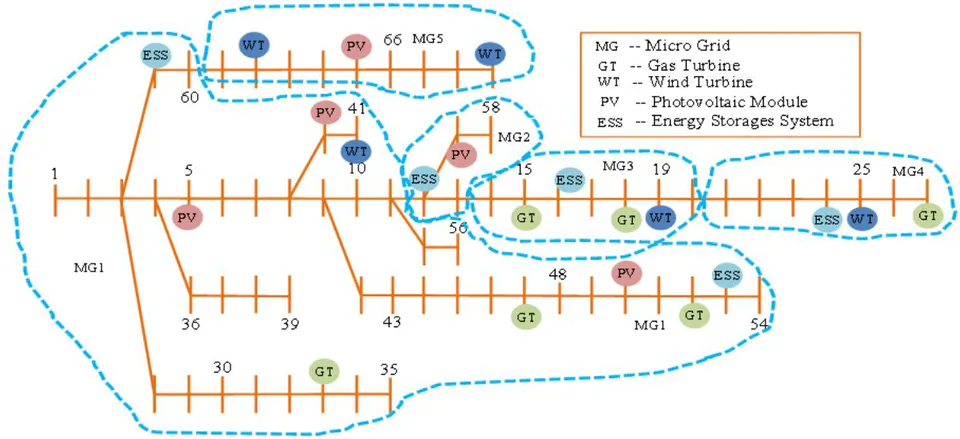
When of distributed energy resources operate in multi-MGs, the corresponding multi-MGs operating performance indices are summarized in Table 3. The multi-MG operational commissions were calculated for two cases with and without considering flexible boundary condition. The reason for choosing the two mentioned cases was to see the contributions of flexible boundary condition in multi-MG controls and operations. Fig. 3 shows the multi-MG system with flexible boundary having multiple distributed generators located inside the microgrids.
| Flexible Boundary | Emission | System Loss | Total cost |
| No | $ 211.5 | $ 325.7 | $ 7635 |
| Yes | $ 205.6 | $ 98.7 | $ 7175 |
It is seen from Table 3 that the total operating costs for multi-MGs reduced to 7635 due to the advantages of flexible boundary conditions inside multi-MGs. The significant changes happen for the multi-MG operating loss reduction where it reduces from 98.7 for optimal operation of existing distributed resources considering flexible boundaries. A similar deduction is observed for system emissions.
Moreover, when 2250 kW of distributed energy resources operate in multi-MGs, the corresponding multi-MGs operational performance indices are summarized in Table 4. Like as 1125 kW of distributed energy resources operations, for the case of , this research also considers the same two cases with and without considering flexible boundary conditions for finding multi-MGs operating performance indices.
| Flexible Boundary | Emission | System Loss | Total cost |
| No | $ 193.8 | $ 267.6 | $ 6201.2 |
| Yes | $ 189 | $ 81.6 | $ 5824.2 |
For the operation of 2250 kW of distributed energy resources in multi-MGs, the system gets more benefit in terms of operational performance. For instance, the results presented in Table 4 show that the total operating costs reduced to 6201.2 due to the advantages of flexible boundary conditions inside multi-MGs. Like the previous case of 1125 kW, significant changes happen for the loss reduction where the loss reduces from 81.6 for optimal operation of existing distributed resources considering flexible boundaries, which is also less than the previous case of 1125 kW. A similar deduction is observed for system emissions as well.
VIII. IMPACT OF IOT IN MULTI-MGS OPERATIONS
In this research, IoT plays a crucial role in the real-time operation and is controlled for multi-MGs. If IoT is not implemented for microgrid operation, there will be a delay in communication, causing delays in detection of load and generation changes. This would affect the overall system performance and lower its efficiency. In previous sections, IoT is considered to ensure that there will not be any delays between generations and loads while performing simulations. This section is specifically showing and comparing the impacts of having or not having IoT for operation of multi-MGs, with and without flexible boundaries. For case 1, of distributed energy resources operation in multi-MGs, the results would be worse than expected, if IoT is not considered.
| Flexible Boundary | Emission | System Loss | Total cost |
| No | $ 218.2 | $ 347.1 | $ 7887.5 |
| Yes | $ 211.8 | $ 104.6 | $ 7396.8 |
Table 5 shows that the total operating costs go higher to 7635 with the same distributed energy generation operation capacities in multi-MGs without considering flexible boundary conditions. Even for the relaxed boundary condition, operating costs increase to 7175 due to not considering IoT for multiMG operations. Similar increment patterns are showing for the system loss and emissions as well.
| Flexible Boundary | Emission | System Loss | Total cost |
| No | $ 199.94 | $ 284.98 | $ 6406.1 |
| Yes | $ 194.75 | $ 86.67 | $ 6004.3 |
For the operation of 2250 kW of distributed energy resources in multi-MGs, operational costs, losses, and emissions are worse than before. In this case, Table 6 shows that the total operating expenses go higher to 6201 shown in Table 4 with the same distributed energy generation operation capacities in multi-MGs without considering flexible boundary conditions. Similarly, even for the relaxed boundary condition, operating costs go high to 5824.2 shown in Table 4 due to not considering IoT for multi-MG operations. Similar increment patterns are offered for the system loss and emissions as well.
IX. CONCLUSIONS
This research develops a model for optimal operation of various distributed energy resources in a multi-MG power distribution network which helps for increasing multi-MG system efficiency. The model explores energy management, IoT, and flexible boundary conditions during distributed energy resources operation. It is seen that more benefits are achievable during energy sharing between microgrids operating as multi-MGs. A comparatively new hybrid PSO-TS algorithm is used for optimizations in the PG&E 69-bus multi-MG distribution system. Case studies show that optimal operating strategies between various energy resources in a multi-MG reduce the total operating costs to 7635 due to flexible multi-MGs boundary conditions for 1500 kW energy resources. More benefits can be obtained from the application of IoT with flexible boundary MGs, where the total operating costs further reduces to 7396.8. Since there are uncertainties related to renewable-based energy re-sources, corresponding uncertainty parameters are included during system modeling to ensure accurate results. Future work may consist of multi-MG system resiliency and reliability as an objective function while considering IoT and flexible boundary within multi-MG.