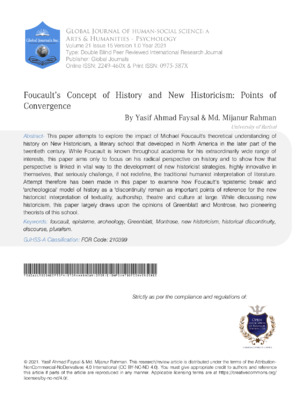
Foucault’s Concept of History and New Historicism: Points of Convergence

1
Yasif Ahmad Faysal
Yasif Ahmad Faysal
2
Md.Mijanur Rahman
Md.Mijanur Rahman
1 Barishal University, Barishal, Bangladesh

Send Message

To: Author

GJHSS Volume 21 Issue A15

Article Fingerprint

ReserarchID

X7H9Y

Foucault’s Concept of History and New Historicism: Points of Convergence Banner
  • English
  • Afrikaans
  • Albanian
  • Amharic
  • Arabic
  • Armenian
  • Azerbaijani
  • Basque
  • Belarusian
  • Bengali
  • Bosnian
  • Bulgarian
  • Catalan
  • Cebuano
  • Chichewa
  • Chinese (Simplified)
  • Chinese (Traditional)
  • Corsican
  • Croatian
  • Czech
  • Danish
  • Dutch
  • Esperanto
  • Estonian
  • Filipino
  • Finnish
  • French
  • Frisian
  • Galician
  • Georgian
  • German
  • Greek
  • Gujarati
  • Haitian Creole
  • Hausa
  • Hawaiian
  • Hebrew
  • Hindi
  • Hmong
  • Hungarian
  • Icelandic
  • Igbo
  • Indonesian
  • Irish
  • Italian
  • Japanese
  • Javanese
  • Kannada
  • Kazakh
  • Khmer
  • Korean
  • Kurdish (Kurmanji)
  • Kyrgyz
  • Lao
  • Latin
  • Latvian
  • Lithuanian
  • Luxembourgish
  • Macedonian
  • Malagasy
  • Malay
  • Malayalam
  • Maltese
  • Maori
  • Marathi
  • Mongolian
  • Myanmar (Burmese)
  • Nepali
  • Norwegian
  • Pashto
  • Persian
  • Polish
  • Portuguese
  • Punjabi
  • Romanian
  • Russian
  • Samoan
  • Scots Gaelic
  • Serbian
  • Sesotho
  • Shona
  • Sindhi
  • Sinhala
  • Slovak
  • Slovenian
  • Somali
  • Spanish
  • Sundanese
  • Swahili
  • Swedish
  • Tajik
  • Tamil
  • Telugu
  • Thai
  • Turkish
  • Ukrainian
  • Urdu
  • Uzbek
  • Vietnamese
  • Welsh
  • Xhosa
  • Yiddish
  • Yoruba
  • Zulu

This paper attempts to explore the impact of Michael Foucault’s theoretical understanding of history on New Historicism, a literary school that developed in North America in the later part of the twentieth century. While Foucault is known throughout academia for his extraordinarily wide range of interests, this paper aims only to focus on his radical perspective on history and to show how that perspective is linked in vital way to the development of new historicist strategies, highly innovative in themselves, that seriously challenge, if not redefine, the traditional humanist interpretation of literature. Attempt therefore has been made in this paper to examine how Foucault’s ‘epistemic break’ and ‘archeological’ model of history as a ‘discontinuity’ remain as important points of reference for the new historicist interpretation of textuality, authorship, theatre and culture at large. While discussing new historicism, this paper largely draws upon the opinions of Greenblatt and Montrose, two pioneering theorists of this school.


Funding

No external funding was declared for this work.

Conflict of Interest

The authors declare no conflict of interest.

Ethical Approval

No ethics committee approval was required for this article type.

Data Availability

Not applicable for this article.

Yasif Ahmad Faysal. 2022. \u201cFoucault’s Concept of History and New Historicism: Points of Convergence\u201d. Global Journal of Human-Social Science - A: Arts & Humanities GJHSS-A Volume 21 (GJHSS Volume 21 Issue A15): .

Download Citation

High-quality academic research on history and new intersections of historical points of convergence.
Issue Cover
GJHSS Volume 21 Issue A15
Pg. 9- 17
Journal Specifications

Crossref Journal DOI 10.17406/GJHSS

Print ISSN 0975-587X

e-ISSN 2249-460X

Keywords
Classification
GJHSS-A Classification: FOR Code: 210399
Version of record

v1.2

Issue date

January 18, 2022

Language

English

Experiance in AR

The methods for personal identification and authentication are no exception.

Read in 3D

The methods for personal identification and authentication are no exception.

Article Matrices
Total Views: 1754
Total Downloads: 822
2026 Trends
Research Identity (RIN)
Related Research

Published Article

This paper attempts to explore the impact of Michael Foucault’s theoretical understanding of history on New Historicism, a literary school that developed in North America in the later part of the twentieth century. While Foucault is known throughout academia for his extraordinarily wide range of interests, this paper aims only to focus on his radical perspective on history and to show how that perspective is linked in vital way to the development of new historicist strategies, highly innovative in themselves, that seriously challenge, if not redefine, the traditional humanist interpretation of literature. Attempt therefore has been made in this paper to examine how Foucault’s ‘epistemic break’ and ‘archeological’ model of history as a ‘discontinuity’ remain as important points of reference for the new historicist interpretation of textuality, authorship, theatre and culture at large. While discussing new historicism, this paper largely draws upon the opinions of Greenblatt and Montrose, two pioneering theorists of this school.

Our website is actively being updated, and changes may occur frequently. Please clear your browser cache if needed. For feedback or error reporting, please email [email protected]
×

This Page is Under Development

We are currently updating this article page for a better experience.

Request Access

Please fill out the form below to request access to this research paper. Your request will be reviewed by the editorial or author team.
X

Quote and Order Details

Contact Person

Invoice Address

Notes or Comments

This is the heading

Lorem ipsum dolor sit amet, consectetur adipiscing elit. Ut elit tellus, luctus nec ullamcorper mattis, pulvinar dapibus leo.

High-quality academic research articles on global topics and journals.

Foucault’s Concept of History and New Historicism: Points of Convergence

Yasif Ahmad Faysal
Yasif Ahmad Faysal Barishal University, Barishal, Bangladesh
Md.Mijanur Rahman
Md.Mijanur Rahman

Research Journals