
Free Cash Flow and Earnings Management in Brazil: The Negative Side of Financial Slack

§ Fucape Business School

Send Message

To: Author

Free Cash Flow and Earnings Management in Brazil: The Negative Side of Financial Slack

Article Fingerprint

ReserarchID

MBR564T5

Free Cash Flow and Earnings Management in Brazil: The Negative Side of Financial Slack Banner

AI TAKEAWAY

Connecting with the Eternal Ground
  • English
  • Afrikaans
  • Albanian
  • Amharic
  • Arabic
  • Armenian
  • Azerbaijani
  • Basque
  • Belarusian
  • Bengali
  • Bosnian
  • Bulgarian
  • Catalan
  • Cebuano
  • Chichewa
  • Chinese (Simplified)
  • Chinese (Traditional)
  • Corsican
  • Croatian
  • Czech
  • Danish
  • Dutch
  • Esperanto
  • Estonian
  • Filipino
  • Finnish
  • French
  • Frisian
  • Galician
  • Georgian
  • German
  • Greek
  • Gujarati
  • Haitian Creole
  • Hausa
  • Hawaiian
  • Hebrew
  • Hindi
  • Hmong
  • Hungarian
  • Icelandic
  • Igbo
  • Indonesian
  • Irish
  • Italian
  • Japanese
  • Javanese
  • Kannada
  • Kazakh
  • Khmer
  • Korean
  • Kurdish (Kurmanji)
  • Kyrgyz
  • Lao
  • Latin
  • Latvian
  • Lithuanian
  • Luxembourgish
  • Macedonian
  • Malagasy
  • Malay
  • Malayalam
  • Maltese
  • Maori
  • Marathi
  • Mongolian
  • Myanmar (Burmese)
  • Nepali
  • Norwegian
  • Pashto
  • Persian
  • Polish
  • Portuguese
  • Punjabi
  • Romanian
  • Russian
  • Samoan
  • Scots Gaelic
  • Serbian
  • Sesotho
  • Shona
  • Sindhi
  • Sinhala
  • Slovak
  • Slovenian
  • Somali
  • Spanish
  • Sundanese
  • Swahili
  • Swedish
  • Tajik
  • Tamil
  • Telugu
  • Thai
  • Turkish
  • Ukrainian
  • Urdu
  • Uzbek
  • Vietnamese
  • Welsh
  • Xhosa
  • Yiddish
  • Yoruba
  • Zulu
Font Type
Font Size
Font Size
Bedground

Abstract

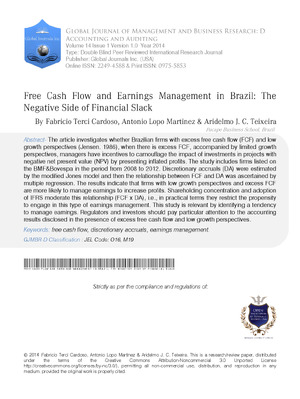
The article investigates whether Brazilian firms with excess free cash flow (FCF) and low growth perspectives (Jensen. 1986), when there is excess FCF, accompanied by limited growth perspectives, managers have incentives to camouflage the impact of investments in projects with negative net present value (NPV) by presenting inflated profits. The study includes firms listed on the BMF&Bovespa in the period from 2008 to 2012. Discretionary accruals (DA) were estimated by the modified Jones model and then the relationship between FCF and DA was ascertained by multiple regression. The results indicate that firms with low growth perspectives and excess FCF are more likely to manage earnings to increase profits. Shareholding concentration and adoption of IFRS moderate this relationship (FCF x DA), i.e., in practical terms they restrict the propensity to engage in this type of earnings management. This study is relevant by identifying a tendency to manage earnings. Regulators and investors should pay particular attention to the accounting results disclosed in the presence of excess free cash flow and low growth perspectives.

References

27 Cites in Article
  1. Mary Barth,Wayne Landsman,Mark Lang (2008). International Accounting Standards and accounting quality.
  2. C Becker,M Defond,J Jiambalvo,K Subramanyam (1998). The Effect of Audit Quality on Earnings Management.
  3. Amalendu Bhundia (2012). A Comparative Study between Free Cash Flows and Earnings Management.
  4. Siti Choiriah (2009). Effect of Leverage and Free Cash Flow on Earnings Management with an Independent Audit Committee as a Moderation.
  5. Richard Chung,Firth,; Michael,Kim,Jeong-Bon (2005). Earnings management, surplus free cash flow, and external monitoring.
  6. Harry Deangelo,Linda Deangelo,Douglas Skinner (1994). Accounting choice in troubled companies.
  7. Patricia Dechow,Ilia Dichev (2002). The Quality of Accruals and Earnings: The Role of Accrual Estimation Errors.
  8. Patricia Dechow,Scott Richardson,Irem Tuna (2003). Why Are Earnings Kinky? An Examination of the Earnings Management Explanation.
  9. Patricia Dechow,Weili Ge (2006). The persistence of earnings and cash flows and the role of special items: Implications for the accrual anomaly.
  10. Patricia Dechow,Ge,; Weili,Catherine Schrand (2010). Understanding earnings quality: A review of the proxies, their determinants and their consequences.
  11. Patricia Dechow,Amy Hutton,Jung Kim,Richard Sloan (1995). Detecting Earnings Management: A New Approach.
  12. Patricia Dechow,Richard Sloan,Amy Sweeney (1996). Causes and consequences of earnings manipulation: An analysis of firms subject to enforcement actions by the SEC.
  13. Paul Healy,James Wahlen (1999). A Review of the Earnings Management Literature and Its Implications for Standard Setting.
  14. Todd Houge,Tim Loughran (2000). Cash Flow Is King? Cognitive Errors by Investors.
  15. Michael Jensen (1986). Agency cost of free cash flow, corporate finance, and takeovers.
  16. Michael Jensen (2005). Agency Costs of Overvalued Equity.
  17. Michael Jensen,Meckling,H William (1976). Theory of the firm: Managerial behavior, agency costs and ownership structure.
  18. P Jiraporn,G Miller,S Yoon,Y Kim (2008). Is earnings management opportunistic or beneficial? An agency theory perspective.
  19. Jennifer Jones (1991). Earnings management during import relief investigations.
  20. Kenneth Lehn,Annette Poulsen (1989). Free Cash Flow and Stockholder Gains in Going Private Transactions.
  21. A Martinez (2008). Detectando earnings management no Brasil: estimando os accruals discricionários.
  22. A Martinez,Novo Mercado (2009). auditoria e o gerenciamento de resultados por escolhas contábeis e por decisões operacionais no Brasil.
  23. Comissão Mobiliarios,Valores (2007). Instrução CVM nº 457.
  24. Tim Opler,Sheridan Titman (1993). The Determinants of Leveraged Buyout Activity: Free Cash Flow vs. Financial Distress Costs.
  25. Scott Richardson (2006). Over-investment of free cash flow.
  26. Vernon Richardson (2000). Information asymmetry and earnings management: Some evidence.
  27. Katherine Schipper,Linda Vincent (1989). Earnings Quality.

Funding

No external funding was declared for this work.

Conflict of Interest

The authors declare no conflict of interest.

Ethical Approval

No ethics committee approval was required for this article type.

Data Availability

Not applicable for this article.

How to Cite This Article

Antonio Martinez, Fabricio Cardoso, Aridelmo Teixeira. 2014. "Free Cash Flow and Earnings Management in Brazil: The Negative Side of Financial Slack". Global Journal of Management and Business Research, Global Journal of Management and Business Research - D: Accounting & Auditing GJMBR-D Volume 14 (GJMBR Volume 14 Issue D1).

Download Citation

Journal Specifications

Crossref Journal DOI 10.17406/GJMBR

Print ISSN 0975-5853

e-ISSN 2249-4588

Keywords
Classification
GJMBR-D Classification JEL Code: O16
M19
Version of record

v1.2

Issue date
March 25, 2014

Language
English
Experiance in AR

Explore published articles in an immersive Augmented Reality environment. Our platform converts research papers into interactive 3D books, allowing readers to view and interact with content using AR and VR compatible devices.

Read in 3D

Your published article is automatically converted into a realistic 3D book. Flip through pages and read research papers in a more engaging and interactive format.

Article Matrices
Total Views: 1.6K
Total Downloads: 107
All Trends

Request Access

Please fill out the form below to request access to this research paper. Your request will be reviewed by the editorial or author team.
X

This is the heading

Lorem ipsum dolor sit amet, consectetur adipiscing elit. Ut elit tellus, luctus nec ullamcorper mattis, pulvinar dapibus leo.


High-quality academic research articles on global topics and journals.

Free Cash Flow and Earnings Management in Brazil: The Negative Side of Financial Slack

Antonio Martinez
Antonio Martinez Fucape Business School
Fabricio Cardoso
Fabricio Cardoso
Aridelmo Teixeira
Aridelmo Teixeira