This article presents a research study on the representation of aging women on Instagram, focusing on the content of four specific influencers. The study utilizes content analysis and categorization to understand the themes and subthemes present in the influencers’ posts. The research methodology follows the principles of content analysis and aims to provide both quantitative and qualitative insights into the representation of aging women on the platform. The article also presents the use of a coding book to guide the categorization process and ensure the reliability and validity of the study. Additionally, it highlights the complexity and diversity of experiences related to aging women, as well as the challenges and opportunities of conducting research in the online environment. The study ultimately aims to contribute to a better understanding of the representations of aging women in digital spaces.
## I. INTRODUCTION
Brazil has experienced, in recent decades, a rapid aging process, characterized by the increase in life expectancy in the country, which increased (from 46.8 in 1950 to 75.5 in 2020 - IBGE - Brazilian Institute of Geography and Statistics). The growth trend of the population over 60 years old, in addition to being verified in the census, has been addressed by gerontology studies since the 1980s and 1990s, a period in which the UN predicted that, in 40 years, Brazil would become the oldest country in Latin America (Magalhães, 1989).
The changes in the Brazilian age pyramid, in addition to having occurred very quickly, were not accompanied by equivalent interest from the government, and resulted in the conception of old age only as a "social problem". In the field of social science studies, old age is discussed as a social construction, as well as childhood, the result of major changes that occurred between the seventeenth and nineteenth centuries. (1998).
The object of this study is the result of this movement. The hypothesis of this research dialogues with the idea that the images shared on social networks "become naturalized among us, with an unusual speed, starting to play a fundamental role in the daily life of anyone". (Sibilia, 2016, p. 42). We use the expression "from grandmother to blogger" to refer to the new dynamic that can be seen on social media (Instagram). If in previous decades the elderly life was marked, above all, by the almost seclusion to the private space, today with the expansion of increasingly popular and low-cost media and information technologies, it is possible to recognize that older people also integrate and participate in public life.
By transitioning from grandmother to blogger, the elderly digital influencers who make up the sample of this research share their private life with their followers and, consequently, offer new images of female aging.
As it will be explained in the methodology, the selection of influencers was intentional, taking into account a series of criteria, such as gender, age, and shared themes. Therefore, for the present chapter, we are interested in discussing the women behind the profiles that will be analyzed in the next semester. Thus, our intention was to follow over the course of a semester, four bloggers in age considered as third age or elderly: Dona Dirce, Coracy Arantes and Joan Macdonald.
## II. METHODOLOGICAL MOVEMENTS
The methodology of this research follows the content analysis (Bardin, 1988) "aimed at the investigation of symbolic phenomena through various research techniques" (Júnior, 2010, p. 280), carried out through verifiable data, bringing both aspects of the exact sciences and the human sciences. Developed in the United States initially with research focused on public opinion and political propaganda, content analysis has also become an appropriate methodology for studies carried out on and about the internet. The option for content analysis reinforces the duality of the research, between quantitative and qualitative methods, which can be understood "as complementary approaches, to be mobilized according to the objectives of each research, in an integrated way or in successive stages". (Fragoso et al., 2011, p. 67, Hooper, 2019).
This is the case of this research, which used the internet (Instagram) as a place and also as the main research tool.
The constitution of the corpus of this analysis was done through the rule of representativeness, which, according to Junior (2010, apud Bardin, 1988) and Barros and Targino (2000), consists of a sample.[^2] The selection criteria were mainly based on the availability of human and time resources to carry out this research. The material to be considered includes images, videos and captions of the posts published during the analyzed period – in order to solve the question that justifies this study.
In the study of social networks, "by studying the structures resulting from the actions and interactions between social actors, it is possible to understand elements about those groups and, equally, generalizations about them". (Fragoso et al., 2011, p. 115).
The internet research methods used here aim to understand the impact of images shared on Instagram on representations of female aging, since the online methodology is not unrelated to the offline. It is necessary to highlight that the methods and objects related to the Internet are new, are not yet consolidated and face great difficulty in this process, since the speed with which technological means are developed challenges any stability of the available instruments. This is not only a matter of considering "a field in development" (Fragoso et al., 2011, p. 31), but of a difficulty in delimiting what the object is and the relevant methodological possibilities in the different studies of the humanities and social sciences. The method chosen is that of content analysis by thematic categories.
As part of the methodological procedures, an initial quantitative-qualitative survey of digital influencers over 50 years old was carried out through Google searches, based on the terms "mature influencers", "elderly influencers", "senior influencers", "old influencers", "grandfluencers" and "senior influencers", which resulted in a list consisting of 130 Instagram accounts, three of which were couples, 14 male and 113 female. Regarding the survey carried out, it is possible to see that fashion and lifestyle are the categories of content that most appear among the influencers found, with issues related to body and age being more common in accounts managed by women.
The sample that composes this study was not chosen randomly. The "elements are selected according to criteria that derive from the research problem". (Fragoso et al., 2011, p. 78). The sample subtype was chosen by criterion. We discarded celebrity profiles, which are previously known personalities, such as actresses and singers. In this way, only IGs composed of previously anonymous women were elected, who shared their personal lives on Instagram and, thanks to this blog/profile, gradually became public figures.
Another decisive factor in the choice of the empirical object concerns the content theme shared by the influencers. As this is a research on the representations of female aging, priority was given to profiles that addressed themes such as body and age, and subthemes of larger categories, such as fashion, lifestyle, politics, humor, among others. It is noteworthy that the selected profiles were found through the profile survey, carried out in the second half of 2021 (Table 1).
Table 1: Selected Profiles from the Survey
<table><tr><td>No</td><td>Name</td><td>IG</td><td>Gender</td><td>Followers</td></tr><tr><td>1</td><td>Michelle Obama</td><td>@michelleobama</td><td>Female</td><td>47,6 M</td></tr><tr><td>2</td><td>Madonna</td><td>@madonna</td><td>Female</td><td>16,8 M</td></tr><tr><td>3</td><td>Julia Roberts</td><td>@juliaroberts</td><td>Female</td><td>9,3 M</td></tr><tr><td>4</td><td>Viola Davis</td><td>@violadavis</td><td>Female</td><td>8,4 M</td></tr><tr><td>5</td><td>Nicole Kidman</td><td>@nicolekidman</td><td>Female</td><td>7,9 M</td></tr><tr><td>6</td><td>Sarah Jessica Parker</td><td>@sarahjessicaparker</td><td>Female</td><td>7,5 M</td></tr><tr><td>7</td><td>Cindy Crawford</td><td>@cindycrawford</td><td>Female</td><td>5,7 M</td></tr><tr><td>8</td><td>Celine Dion</td><td>@celinedion</td><td>Female</td><td>4,8 M</td></tr><tr><td>9</td><td>Nair Donadelli</td><td>@vovostiktokens</td><td>Female</td><td>3,5 M</td></tr><tr><td>10</td><td>Helen Ruth Elam</td><td>@baddiewinkle</td><td>Female</td><td>3,4 M</td></tr><tr><td>11</td><td>Ary Fontoura</td><td>@aryfontoura</td><td>Male</td><td>3,1 M</td></tr><tr><td>12</td><td>Sharon Stone</td><td>@sharonstone</td><td>Female</td><td>2,8 M</td></tr><tr><td>13</td><td>Angela Bassett</td><td>@im.angelabassett</td><td>Female</td><td>2,8 M</td></tr><tr><td>14</td><td>Iris Apfel</td><td>@iris.apfel</td><td>Female</td><td>2,1 M</td></tr><tr><td>15</td><td>Julianne Moore</td><td>@juliannemoore</td><td>Female</td><td>2,1 M</td></tr><tr><td>16</td><td>Carine Roitfeld</td><td>@carineroitfeld</td><td>Female</td><td>2,1 M</td></tr><tr><td>17</td><td>Jane Fonda</td><td>@janefonda</td><td>Female</td><td>1,8 M</td></tr><tr><td>18</td><td>Joan MacDonald</td><td>@trainwithjoan</td><td>Female</td><td>1,5 M</td></tr><tr><td>19</td><td>Susan Sarandon</td><td>@susansarandon</td><td>Female</td><td>1,5 M</td></tr><tr><td>20</td><td>Marisa Tomei</td><td>@marisatomei</td><td>Female</td><td>1,5 M</td></tr></table>
We carried out a manual collection, which would result in a sample composed of 32 publications, eight from each profile analyzed. Subsequently, we started collecting data using software, which proved to be more effective. Reaching 290 publications, shared by the four selected profiles, in the first six months of 2022.
The data collection was, at first, divided into three periods, in order to obtain a sample with a greater variety of themes among the contents, avoiding seasonalities, such as commemorative dates and trends[^1]. To this end, the first half of 2022 was divided into three moments: January/February, March/April, and May/June, respectively.
For this collection, Instagram itself was used, opting for the selection of the most "liked" posts during the first half of 2022, respecting the subclippings of analysis proposed. In the first four months, the three posts with the highest number of likes were collected. For May and June, unlike in previous months, it was decided to collect two publications, totaling eight contents per profile and 32 in total. The entire procedure was performed over the internet and recorded in a spreadsheet2. For the video posts, the SnapInsta website3 was used to download the contents.
For comparative purposes, since this study also aims to expose the differences between the themes addressed by the profiles analyzed on Instagram, a brief survey was carried out focused on the distinctions of the contents that made up the research. As this is a specific objective and complementary to the issue that governs this research, the methodological procedures will be the same as those used for female profiles. We analyzed not only the points of similarity, but also the distinctions found, understanding the importance of not limiting the sample of this work to the most liked posts, bringing to light the need to use technological mechanisms for data collection, carried out through the Python programming language.
The period analyzed did not change. However, we were willing to analyze all the publications shared in the first half of 2022, and not just the eight most liked posts from the monitored profiles. For this analysis, analytical categories were previously defined and constructed, based on a coding book, responsible for guiding the methodological procedures of this research and the way in which coding and reliability will be done.
## III. CATEGORIESIZATION AND THE CODING BOOK
This is a fundamental phase of Content Analysis as a methodology. It is a categorization of the collected materials by means of a set of categories. According to Carlomagno and Rocha (2016), this stage must follow some fundamental rules, namely: 1) Clear rules of inclusion and exclusion in the categories; 2) Categories need to be mutually exclusive (exclusivity); 3) Categories cannot be too broad in order to maintain differences. 4) The categories must include all possible groups, and the "other" must be residual (exclusivity); 5) Objectivity, without subjectivism ("reliability"). The appropriate categories are then composed of rules, here called coding book, which enable a reliable and valid analysis. In addition to categories related to the origin and date of the post, we will analyze the types of publications (photo, video or photo and video) and the topics covered here. Also with regard to the categories, set out below (table 1), "they cannot have elements that overlap, that is, redundant, (it is also possible to make another category) (Carlomagno & Rocha, 2016, p. 6). For this reason, we chose to categorize posts into themes and subthemes, since the same subject can be approached from different perspectives.
Table 2: Analytic Categories
<table><tr><td colspan="2">Analytic Categories</td></tr><tr><td>1.</td><td>Profile</td></tr><tr><td>2.</td><td>Publication Date</td></tr><tr><td>3.</td><td>Content Type</td></tr><tr><td>4.</td><td>Theme (body, old age...)</td></tr><tr><td>5.</td><td>Subtheme (health, fitness...)</td></tr></table>
The categories presented here were subjected to a reliability test by a "third party" that identified a need for change in the coding book. The "experience" item has moved from a subitem to an item.
The coding book, responsible for delimiting the categories, is a set of questions (codes) that guide the classification of the collected materials, a set of predetermined alternatives to classify the contents in a clear and objective way.
Because it deals with female aging, whose research corpus is composed of materials that address issues such as body, aesthetics and experience, understanding the idea of wisdom constantly linked to the elderly population, those themes, as well as subjects directly or indirectly related to them, make up the coding form of the study.
Coding forms (tables 3 to 7) are an essential tool for content analysis, as they provide a systematic and consistent approach to the coding process. This helps to ensure that the study is conducted reliably and validly, as it provides transparency to the research process.
Table 3: Coding Form - Profile
<table><tr><td colspan="2">Coding Form</td></tr><tr><td>Code</td><td>PROFILE</td></tr><tr><td>1</td><td>@donadirceferreira</td></tr><tr><td>2</td><td>@avosdarazao</td></tr><tr><td>3</td><td>@blogdacora</td></tr><tr><td>4</td><td>@trainwithjoan</td></tr></table>
Table 4: Coding Form – Publication Date
<table><tr><td colspan="2">Coding Form</td></tr><tr><td>Code</td><td>Publication Date</td></tr><tr><td>1</td><td>January</td></tr><tr><td>2</td><td>February</td></tr><tr><td>3</td><td>March</td></tr><tr><td>4</td><td>April</td></tr><tr><td>5</td><td>May</td></tr><tr><td>6</td><td>June</td></tr></table>
Table 5: Coding Form - Content type
<table><tr><td colspan="2">Coding Form</td></tr><tr><td>Code</td><td>Content Type</td></tr><tr><td>1</td><td>Photo</td></tr><tr><td>2</td><td>Video</td></tr><tr><td>3</td><td>Photo & Video</td></tr></table>
Table 6: Coding Form - Theme
<table><tr><td colspan="2">Coding Form</td></tr><tr><td>Code</td><td>Theme</td></tr><tr><td>1</td><td>Body</td></tr><tr><td>2</td><td>Oldness</td></tr><tr><td>3</td><td>Aesthetics</td></tr><tr><td>4</td><td>Experience</td></tr><tr><td>5</td><td>Other</td></tr></table>
Table 7: Coding Form - Subtheme
<table><tr><td colspan="2">Coding Form</td></tr><tr><td>Code</td><td>Subtheme</td></tr><tr><td>1</td><td>Health</td></tr><tr><td>2</td><td>Fitness</td></tr><tr><td>3</td><td>Sexuality issue</td></tr><tr><td>4</td><td>Acceptance</td></tr><tr><td>5</td><td>Fashion</td></tr><tr><td>6</td><td>Generational</td></tr><tr><td>7</td><td>Other</td></tr></table>
a) On Representativeness and Proportionality
- As pointed out in the methodological procedures, 290 publications were analyzed in order to understand how female aging is represented on Instagram. As it is a quantitative-qualitative methodology, this analysis was divided into two parts. Quantitatively, we are interested in understanding the representativeness of the contents analysed – we mean, here, the numbers found. Qualitatively, the focus is on the themes and subthemes addressed by influencers on their Instagram – not just the subject exposed, but how to approach it.
b) About the Frequency of Posts
The number and regularity of posts shared showed a certain pattern. Dona Dirce, Coracy Arantes and Joan Macdonald shared an approximate number of content on their social networks. Although the posts of "Avós da razão" (grandmothers of reason) correspond to more than $40\%$ of the content analyzed, this profile, unlike the others, is composed of three influencers, resulting in an average of 40 posts per influencer, slightly below the general average, which is 48 posts per influencer. For publications per profile, the average is 72 pieces of content in the analyzed period, or 12 posts per month, rounding the values.
Of the 290 publications analyzed, IG @avosdarazao shared 122 pieces of content, including photos and videos. @donadirceferreira was responsible for 66 posts, followed by @trainwithjoan, who shared 57. Finally, with fewer publications than the others, there is the @blogdacora, with 45 contents published in the period analyzed.
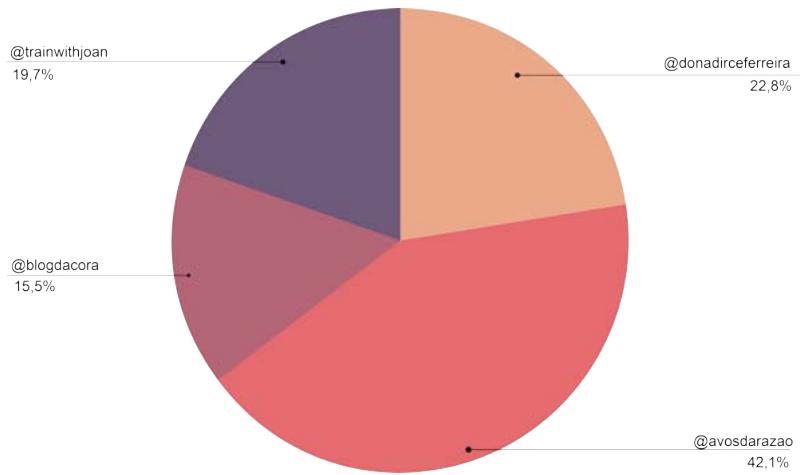 Figure 1: Posts per Profile
### c) Dates and Consistency of Publications
Regarding the frequency of content shared per month, we noticed an approximation in the number of posts shared. The average is 48 posts per month, with
May being the month with the highest number of posts shared (54) and February the month with the lowest number of shares (43).
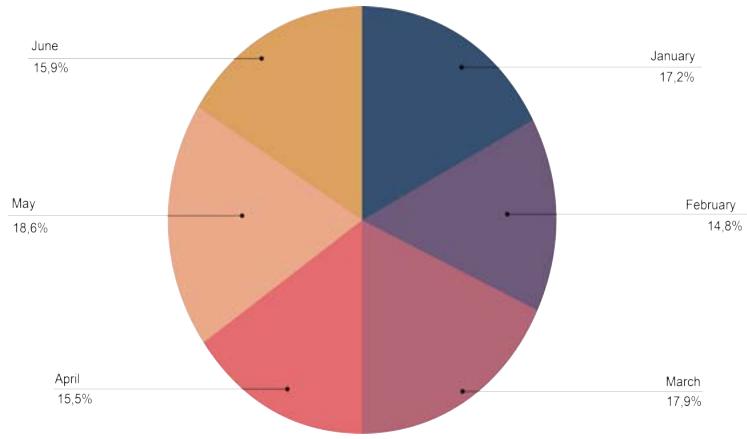 Figure 2: Posts per Month – Publication Date
With regard to this category, it is inferred, from those results, that seasonalities, such as commemorative dates, do not impact the routine of production and publication of content of those influencers.
### d) Content Types: Photo, Video, or Photo and Video
Regarding the type of post, three possibilities were considered. Posts composed of photo, video or photo and video were analyzed here. For the analytical categories, it was decided not to treat the carousel type publications[^4] as a code, only the type of media analyzed. It was noted that, although publications of this type are frequent in profiles of younger influencers, among the content analyzed, only 22 were motorcycles, and most were composed only of images.
Video posts were predominant in the content analyzed. Of the 290 posts that make up this analysis, 203 were made in video format, 84 were made through photos and only three were mixed, bringing photo and video in the same carousel.
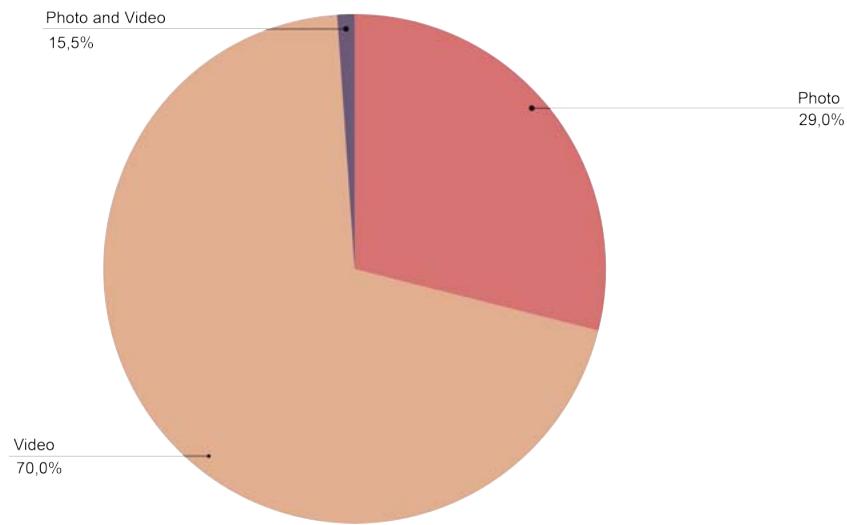 Figure 3: Posts - Content Type
### e) Themes of Female Aging
The category of themes was constructed from the subjects that are directly related to this research: body, old age, aesthetics, experience.
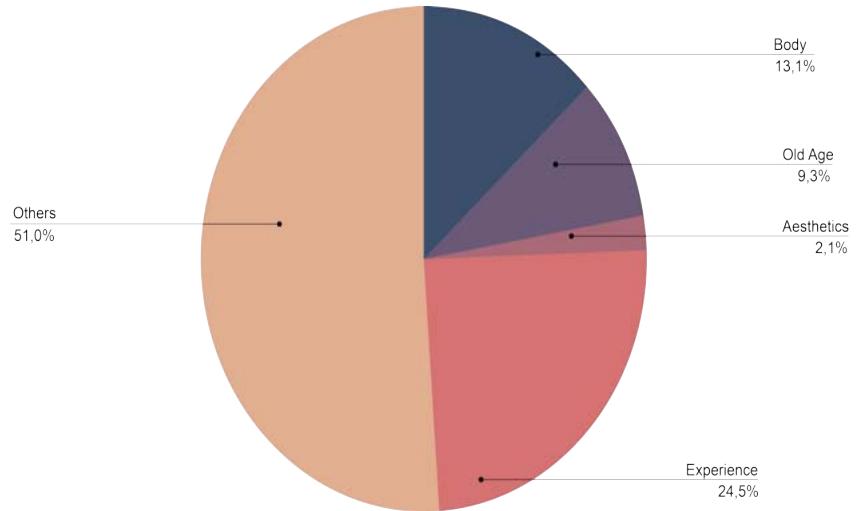 Figure 4: Posts - Themes
The prevalence of posts in the "other" group, contrary to what is generally expected for content analysis, does not necessarily indicate that the analytical categories and the coding book did not bring sufficient results to the study. The existence of a category of subthemes provided that, in addition to the main themes, issues related to female aging could appear in publications that did not address the mapped subjects
directly. In qualitative terms, the joint analysis of the results found for the categories of "themes" and "subthemes" reveals the multiplicity of representations and possibilities of aging as a woman. In the same way that content about the body can be approached from the perspective of fitness, as is often done by influencer Joan Macdonald, the topic can be discussed from the perspective of self-acceptance, as is done countless times by the profiles of Dona Dirce, Coracy Arantes and, eventually, Avós da Razão.
### f) Subthemes and Possibilities of Thematic Construction
It is in the subthemes that the variety of agendas related to the analyzed profiles is best perceived. The prevalence of posts categorized as "other" is repeated here, and in many cases, a post with themes about body, old age, aesthetics or experience can be related to different subjects, such as the promotion of a product or service, in a sponsored post. An example of this is in "Avós da Razão", which, in some of its content, share tips on books and movies. In those contents, the influencers share an experience, from the perspective of wisdom in old age, but without fitting into the mapped subthemes.
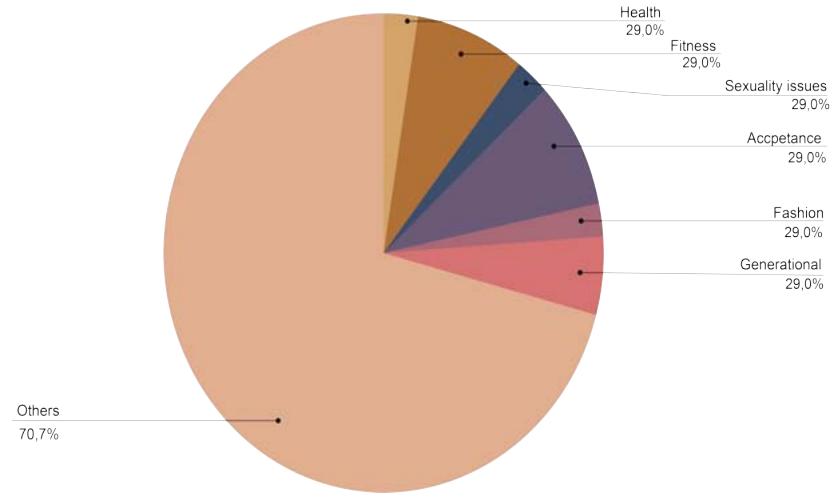 Picture 5: Posts - subthemes
The coding book for this analytical category could cover a number of possibilities, but they would not fit in this dissertation. In addition to the mapped themes, we understand the recurrence of distinct themes and subthemes in the monitored profiles, which is, for us, a consequence of the different possible discussions within aging in the digital world.
## IV. CONCLUSION
This work and its conclusion are the result of a series of contributions and changes that led us to infer that, in fact, Instagram contributes to the emergence of new images of female aging.
Aging still appears to have a strong connection with the economic issue. Retirement appears, in a predominant way, often accompanied by agendas such as social classes and other cutouts that could be analyzed from the perspective of intersectionality[^4]. Our approach, however, did not follow this path and we restricted ourselves to observing a particular dynamic: new profiles on the internet-Instagram that address aging. Thus, our contribution focuses on the processes of online interaction, whose dynamics seem to be becoming a space for coexistence and exchange of new experiences for the scenario of the Brazilian population, which is aging and still maintaining vitality.
Regarding the results found, two aspects stand out: the prevalence of female profiles and, within the few male profiles, the little variety of topics addressed. With regard to the low diversity of themes in the male profiles, the absence of content related to the age issue was noted. If in the female profiles they talk about age, family and a series of other issues related to aging, in the male profiles the focus is different, with publications related to fashion and lifestyle, portraying parties, trips and, often, younger women. It is a subject that has attracted attention, but given its dimension it would require further research.
The data are intriguing but not conclusive. Firstly, ageing has been experienced differently between men and women. It is tacit knowledge that this fact is not new. What the research reveals, however, is a permanence of certain male models versus the expansion of female issues in relation to aging.
Although the comparison of content shared by men and women was discarded from the specific objectives of this research, the differences were noticed throughout the survey and are seen as a possible development for future research.
Regarding content analysis, quantitative data shows that the number of posts per Instagram profile and frequency per month were similar, which suggests a balanced data set. As for themes and subthemes, most of the posts were classified as "other," suggesting that there is a wide variety of content being shared on Instagram. Even when the posts didn't explicitly discuss issues around aging, they still shared experiences related to topics like body, age, and other topics that provide insight into the ways women are represented and portrayed on social media.
An example of this is the IG @avosdarazao publications, which are mostly composed of themes and subthemes classified as "other", but always highlighting the central agenda of your profile, through the hashtag longevity, present in all the content analyzed.
Although most of the contents analyzed oppose the idea of the old body as a traitor, present in the ageist discourse exposed by Featherstone and Wernick (1995), this finding is significant, as it suggests that the representations of female aging are not limited to explicit discussions about aging and body image. Instead, they are woven into a wider range of topics and experiences, highlighting the complexity and diversity of experiences to be had by women as they age.
The diversity of themes is noticeable in the content shared between the four profiles analyzed. Although all influencers address common themes, such as the body and old age, their content, and especially the niche in which those profiles operate, are not necessarily similar.
With regard to the third specific objective of this research, the similarities are most noticeable between the posts shared by Dona Dirce and Coracy Arantes, since both share trend videos, lingerie photos and beauty content on their social networks. Themes such as the body, aesthetics and the issue of sexuality are often addressed in both profiles, mostly through the logic of self-acceptance.
In turn, the differences are more noticeable when Brazilian IGs are compared with that of Joan Macdonald, a Canadian influencer. Although they have all been established as a brand, Joan sells workouts, promotes her daughter's work and has published a book about her fitness journey, with the aim of motivating her followers and promoting her product. With a different niche from the others, the influencer shares content more focused on the perspective of health and exercise and addresses, directly or indirectly, the issue of the body. The difference in this profile may raise the hypothesis about the national cultural difference in future research.
With agendas sometimes similar to the other profiles analyzed, "Avós da Razão", as the name suggests, through a pun on the expression "the voice of reason",[^5] are seen mainly from the perspective of wise old age. Influencers are references for those who follow them, not only for the theme of aging, but also for cultural content, such as movies and books. Here, traditional ideas such as wisdom draw attention for the modifications to which they are subjected. If in works of sociology and anthropology those concepts are worked through the idea of authority, in the digital those themes are submitted to other types of interpretation. In different times and societies, knowledge linked to the old was, above all, political. At present, this idea seems to take on new configurations and themes. For "Avós da Razão", wisdom and knowledge are linked to culture, art, cinema, and not to a form of power.
For us, this analysis provides valuable insights into the ways in which older women are represented on social media, and highlights the importance of considering a wide range of themes and topics when studying representations of female old age.
Understanding the question that gives rise to this study goes, in fact, far beyond an analysis of four profiles. However, the impact of the platform on identity construction and interpersonal relationships is undeniable. The impact of the media and the internet on daily life has been pointed out by several authors. When it comes to the representations of female aging, it is no different.
Not only the profiles analyzed, but also countless others found in the course of the research, are composed of women who seek to "make their own lives a concrete example that it is possible to age well without placing oneself as a suffering and invisible victim". (Wiechmann et al., 2023, p.10). This is how what Mirian Goldenberg calls the revolution of beautiful old age is built[^6], when she talks about the need to rethink old age.
Not necessarily every mature influencer addresses the topics discussed here on their social networks. However, the present analysis and the existing materials on the influence of social networks lead us to believe that Instagram, as well as other platforms, contributes to the emergence of new images of aging.
[^1]: Trends are the tendencies of the moment within an app. Users and the social network itself call trends all content that is on the rise, such as challenges, songs, choreographies, makeup tutorials or dubbing that are being reproduced en masse within a certain platform. _(p.3)_
[^4]: A kind of album, in which it is possible to insert up to 10 items in the same post, just by dragging to the side to see the images or videos of the sequence. _(p.7)_
[^5]: In this study, the term refers solely to the overlapping or intersection of factors or variables and is not understood as part of theories about social identities and related systems of oppression, domination, or discrimination. (Crenshaw, 1991). _(p.8)_
[^6]: Available at: https://tribunaonline.com.br/cidades/vivemos-uma-revolucao-da-velhice-diz-anthropologa-mirian-goldenberg-118533. Accessed on: April 26, 2023. _(p.9)_
[^2]: Some content was excluded from the initial survey, after considering that the platform makes it possible to hide the number of likes of publications. _(p.3)_
[^3]: Instagram content downloader site in high quality. _(p.3)_
Generating HTML Viewer...
References
14 Cites in Article
M Carlomagno,L Rocha (2016). Como criar e classificar categorias para fazer análise de conteúdo: uma questão metodológica.
Kimberle Crenshaw (1991). Mapping the Margins: Intersectionality, Identity Politics, and Violence against Women of Color.
G Debert (1998). Antropologia e o estudo dos grupos e das categorias de idade.
J Duarte,A Barros,Orgs (2010). Métodos de pesquisa em comunicação política.
S Fragoso,R Recuero,A Amaral (2011). Métodos de pesquisa para internet.
Silvana Hooper (2019). Novas tecnologias da informação, escalabilidade e métodos quantitativos e qualitativos nas ciências humanas.
Instagram (2022). IG @avosdarazao.
(2022). IG @blogdacora.
(2022). IG @donadirceferreira.
Janet Cruz,Zahab Bs,Aksheta Vasireddy,Kaleigh Russell,Mallory Stuparich,Samar Nahas,Sadikah Behbehani (2022). Instagram Cysters: What information is available on Polycystic Ovarian Syndrome on Instagram.
W Júnior,A Barros,Orgs (2010). Métodos de pesquisa em comunicação política.
D Magalhães (1989). A invenção social da velhice.
A Moraes (2021). Unknown Title.
Redação Vogue (2020). Sucesso na web! Conheça a influenciadora fitness de 74 anos que dá um show de autoestima.
Explore published articles in an immersive Augmented Reality environment. Our platform converts research papers into interactive 3D books, allowing readers to view and interact with content using AR and VR compatible devices.
Your published article is automatically converted into a realistic 3D book. Flip through pages and read research papers in a more engaging and interactive format.
This article presents a research study on the representation of aging women on Instagram, focusing on the content of four specific influencers. The study utilizes content analysis and categorization to understand the themes and subthemes present in the influencers’ posts. The research methodology follows the principles of content analysis and aims to provide both quantitative and qualitative insights into the representation of aging women on the platform. The article also presents the use of a coding book to guide the categorization process and ensure the reliability and validity of the study. Additionally, it highlights the complexity and diversity of experiences related to aging women, as well as the challenges and opportunities of conducting research in the online environment. The study ultimately aims to contribute to a better understanding of the representations of aging women in digital spaces.
Our website is actively being updated, and changes may occur frequently. Please clear your browser cache if needed. For feedback or error reporting, please email [email protected]
Thank you for connecting with us. We will respond to you shortly.