
I. INTRODUCTION
In response to skewed representations of Africa and Africans in narratives by Western missionaries and colonialists (Loti, 1881/1992; de Nerval, 1851/1998; Defoe, 1719/1994 or Conrad, 1899/1999), Chinua Achebe resolved to write a novel, on the continent, from an insider's point of view. Achebe undertook to deconstruct views of the colonized subject as barbaric; a rationale that justified the imperial ideology of the British civilizing mission. Things Fall Apart (1958), Achebe's first novel, chronicles the early encounter between people from Umuofia and the British colonizers as they settle in present-day Nigeria around the turn of the 19th century. Following the lives of Okonkwo and his fellow Igbo community members as they navigate their ways through the advent of a new language, a new religion, and new ways of life, Things Fall Apart constitutes a landmark piece in African literature. The novel received praises on the ways it un-silenced and centered indigenous voices as well as the original language of the narration as worth objects of study. Achebe challenges a Western-centered hermeneutic of life as he captures and foregrounds Igbo cosmology and worldview in the novel.
More often than not, when discussing the form of Things Fall Apart, it is the different methods by which Achebe indigenizes the English language that are studied (Hyde, 2016; Kunal and Bhabani, 2020). A closer look however at the linguistic cartography of the novel reveals that Achebe's fiction, though written in a recognizable English language with a strong presence of lgbo lexicon, is actually better understood as an original lgbo production where the author realizes, on the page, the world as it is for the lgbo. The different languages as well as the various registers used by Achebe's characters mirror the way actual people in the author's environment, at the time the narrative took place, spoke.
In Things Fall Apart, Achebe moves past the controversial debate on language choice in African literature (The Makerere Writers' Conference, 1962; wa Thiong'o, 1986). In accordance with his belief that "language is a weapon [...] and there is no point in fighting it" (qtd in Gallagher, 1997, p. 260), he took a stance in favour of the English language and against advocates of native vernaculars in African literature. Indeed, contrary to Ngugi wa Thiong'o (1986) or even his fellow Nigerian Obi Wali (1997), Achebe had faith in the ability of the English language to carry his narrative, the themes of which are deeply rooted in his African experience. By writing a novel about his native culture, in English, yet an English filled with Igbo xenims, proverbs as well as attributes of his native oral culture, Achebe uses language in a way that enables him to successfully engage his Western "outside" audience at the same time not alienating his primary local readership. Achebe writes to his fellow Africans, but he chose English as his authorial medium so as to export his subject matter beyond the Igbo community and allow the world to take part in the indigenous narrative. This paper analyzes how a local Igbo fabulation leads to a worldwide celebration.
Achebe writes Things Fall Apart with deliberate linguistic intents. A multi-faceted scholar, his command of the English language suffered from no doubts. His incorporation of a non-English lexicon and obvious markers of orality participate in an overt wish to produce a work of fiction that is representative of his African culture (Watts, 2010; Chakravorty, 2012). On the content, he manages to capture the experiences of the Igbo both before and after the implantation of the British in Nigeria. In a writing style that captures the rhythm of his people, Achebe depicts the unique ways in which the Igbo view their world. By making the Igbo vernacular and its associated culture the focal points of his narrative, he rehabilitates and validates the African man as an intelligent human being. Achebe saw himself as an African writer who used the English language for the enhancement of African art hence his painstaking efforts to represent, right alongside the English of the narration, his native local lgbo language, highly oral in nature and the cultural spaces that language points to. With an unsentimental omniscient narrator, the reader is provided with an inside look into the linguistic, social, judicial and religious changes that Okonkwo and his peers go through as a result of imperialism.
a) References to Nigeria's Colonial Past
Things Fall Apart, as John Povey rightly summarizes, "describes the effect of British missionaries and administrators on a typical village tribal society; the dislocation that change, religious and educational, brings to historic certainties" (1989, p. 258). Imperialism and the advent of missionaries constitute a focal point for Achebe; and references to Nigeria's colonial past are plentiful in the novel.
In Things Fall Apart, it is through the voice of the District Commissioner that the colonial status of the nine lgbo villages is conveyed. Emphasizing the new law in effect in Umuofia to the group of men who destroyed the Church, the local British administrator argues: "That must not happen in the dominion of our queen, the most powerful ruler in the world" (Achebe, 1958, p. 167). Nigeria, we know, was a colony of Britain; the dominion status alluded to in this quote refers to the political structure in effect in the northern part of the country preceding the official birth of Nigeria in 1914 (Temple, 2012). This seemingly straightforward statement, beyond the historical piece of information it carries, speaks to Achebe's deeper political concerns. In setting his fiction in a "dominion," not the "colony" Nigeria is known to have been, Achebe locates his narrative at a time preceding the formal birth of the federation of Nigeria as it is known today. The name Nigeria is actually never mentioned by either the narrator or any other characters; the novel is set in the nine villages surrounding Umuofia. By entertaining an intentional factual blurring over the actual colonial status of Nigeria, Achebe challenges the historical legacy of colonization.
One thing however that suffers from no doubt in the District Commissioner's statement is the position of Britain as the leading world power of the time. Indeed, in the nineteenth century, the British Empire ruled and administered, at its height, about one fifth of the world's population (Johnston, 1969; Christopher, 1988); and Nigeria (whether a colony or a dominion) was just a small part of that large Empire. In Things Fall Apart, more than the alienating effects of the English language, it is the introduction of a new religion, and a new overall social order among his fellow Igbo that Chinua Achebe deals with.
b) Umuofia: A Traditional Igbo Community
To a Western eye, life in Umuofia appears problematic in many respects. Nothing in how the village operates is reminiscent of typical Western order. From an economic, social, judicial or even religious point of view, the various modus operandi of Umuofia find their relevance in lgbo's traditions and culture. What the British in Things Fall Apart perceive as unorthodox and chaotic, is in fact a well-thought-out organization that suits the lgbo on many levels. The stories of Okonkwo and his fellow countrymen are told from an insider's point of view with an omniscient narrator able to fill the reader in on every aspect of the lgbo culture.
Umuofia is a rural village where people live mainly on agriculture and hunting. Achebe repeatedly writes about the importance of yams, something that is only understood in reference to the lgbo culture. Considered the "the king of crops" (1958, p. 21), yams indeed constitute for the lgbo not only a source of income, but a measure of a person's manhood and respectability to a large extent. For the lgbo's youth, the art of preparing yams is considered a rite of passage (Korieh, 2007); Nwoye and Ikemefuna learn it the hard way when they failed to accomplish the task according to Okonkwo's high expectations (p. 28). The ability to plant and harvest extended amounts of crops, of yams principally, loudly speaks to a man's worth. Okonkwo, we remember, lacked respect for his father Unoka, not just because he had no titles, but because of his laziness and his inability to grow a good crop of yams and properly feed his family. In the novel, the narrator affirms: "Yam stood for manliness, and he who could feed his family on yams from one harvest to another was a very great man indeed" (p. 28). With Okonkwo and his peers, the "king of crops" is not only a measure of greatness; it represents the very symbol of life. Recounting Ikemefuna's smooth integration into Okonkwo's family, the narrator compares him to a piece of yam. He writes, "Ikemefuna grew rapidly like a yam tendril in the rainy season and was full of the sap of life" (p. 32).
The importance of agriculture in Things Fall Apart, beyond its informative value about the rural nature of the lgbo, is a way for Achebe to highlight strong work ethics in his community. The lgbo indeed are a society which values hard work. The greatness of a person is measured in direct ratio with how hard he/she is willing to work. Greatness among the lgbo is not a matter of class and is not passed down from one generation to another; rather it is a personal achievement. By allowing his protagonist to be judged solely on the basis of his own deeds and merits, Achebe deconstructs slanted stereotypical representations of Africans as lazy. Speaking to the differences between Okonkwo and his father, the narrator argues that among the lgbo, "a man was judged according to his worth and not according to the worth of his father" (p. 7).
On a different register, but still emphasizing the all-important role of farming within the lgbo, the narrator talks about how people in Umuofia resort to agriculture for purposes they do not have proper tools for. Important events in Things Fall Apart are never accurately dated. The narrator, regardless of his omniscience and his strong grasp of all events past and present, only provides approximate dates, even for the most important events in the novel. For example, Ikemefuna, we read, "came to Umuofia at the end of the care-free season between harvest and planting" (p. 24). The reader cannot tell exactly when Ikemefuna actually joined Umuofia, but he/she gains an inside knowledge of the activities the lgbo consider of importance. This rather unorthodox way of situating important events in relation to farming seasons is very indicative of a community where orature is the norm.
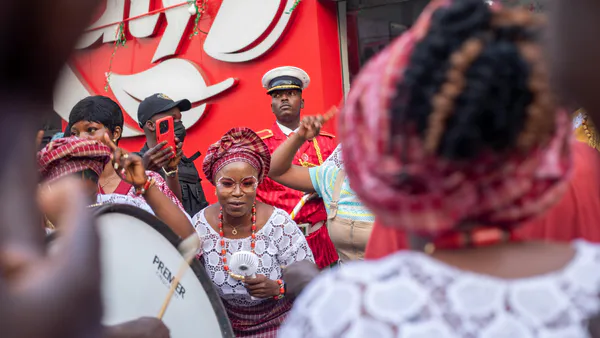
All throughout the novel, Achebe provides ample evidence attesting to the oral nature of the lgbo society. In Things Fall Apart, lgbo imagery, onomatopoeias, songs, proverbs as well as short stories are extensively used to capture the tone and rhythm in the village of Umuofia and to give a greater sense of authenticity to Achebe's narrative. As early as the opening pages of the novel, the reader gauges the all-important role that drums play in this traditionally oral community. With the lgbo indeed, drums, just like humans, do speak and have a language of their own. Be it at wrestling contests (p. 1), to convene important meetings (p. 7), or simply to announce big events (p. 78), the lgbo people learn how to listen to the sounding of the drums in order to interpret messages and respond to calls for community meetings. While expressions like "Gome, gome, gome, gome" (p. 7), and "Diim! Diim! Diim!" (p. 106) obviously imitate the sounds of drums, phrases like "Aru oyim de de de dei!" (78), "Oji odu achu ijiji-o-o!" (p. 100) and "Umuofia obodo dike" (p. 106), for which Achebe provides no translation or definition, capture the esoteric language of the spirits English could not capture, but lgbo could.
With drums and other musical instruments like "ekwe," "udu," or "ogene" (p. 4), Achebe describes a community for whom hearing is of paramount importance. With phrases such as "the story was told," (p. 23) Achebe makes an overt nod to his African oral traditions and reaffirms the importance of storytelling in Igboland. On various instances, animal images are used not only to tell stories, but also to teach important lessons to audiences in attendance. Throughout Things Fall Apart, Achebe saturates his narrative voice with characteristics of spoken discourse indicative of an initial lgbo utterance in a deliberate gesture to reinforce the validity of his native culture. More than just characteristics of orature, Achebe also incorporates songs, litanies and incantations to speak to his people's religious beliefs.
The populations of Umuofia, the reader learns from Achebe's language, are deeply rooted in their traditions and culture. Throughout the novel, the narrator recounts in detail how the spirits and deities of this polytheist society influence the lives of people in Umuofia. Extensive descriptions of sacrifices and rituals to appease and please supernatural entities are provided (p. 91). Ani, the Goddess of the Earth, principally, is the object of much veneration for the land needs to be blessed, in part, because of the all-importance of agriculture mentioned earlier. The Igbo, we remember, allotted the evil forest, a haunted piece of land to the White man, to build their church on. People from Umuofia did not take any concrete action to prevent the British from settling in their village. They had faith in the spirits and left it up to the power of their gods to drive the White man out.
The lgbo are also depicted as a very superstitious community who believe in supernatural powers. The existence of the "chi" (p. 14) attests more than anything else to the "irrational" belief system in Umuofia. The "chi" is thought of as some kind of personal spirit that everyone carries about him/herself and which requires appeasement in order to avoid causing ill fortune. One among many examples provided by Achebe, and which speaks to the reality of "irrational" belief among the lgbo, is the phenomenon of the "Ogbanje" (p. 68). The narrator goes into detail to explain not only what an "Ogbanje" means, but also how to stop its vicious cycle. While these pieces of information might sound surreal or even laughable to a Western (rationale) audience, they remain nonetheless an essential aspect of the social fabric of people in Umuofia; a system of belief that cannot be understood within Western paradigms.
Another characteristic of the lgbo society that Achebe describes in detail is the traditional system of kinship and a strong emphasis on community. In Umuofia, indeed, community was the rule. The political organization in place in the village prior to the arrival of the British finds its relevance in the lgbo notions of kinship, a concept at the opposite of more typical organizations like the government the British would later import. Though lacking what is commonly considered a more traditional political system, the people in Umuofia still have structure as they obey authority and are very respectful of their traditional ruling body. Umuofia is run not by a typical Western government, but by a council of elders called "ndichie" (p. 10) who are assisted in their tasks by an eclectic number of priestesses and deities. As early as the opening scene of the novel, the narrator depicts the tight relations between the individual and the rest of the community he belongs to. By defeating Amalinze the Cat, Okonkwo does not just achieve a personal prowess; he makes the whole community proud. With a concept like the "eggewu," Achebe demonstrates the validity of the local political system in place prior to colonization. By specifically naming these structures in their original lgbo terms, Achebe uses language to further make his point about the relevance of traditional practises.
Still in terms of the lgbo social structure, the reader also learns that Umuofians are a very patriarchal society. Not only are men allowed and expected to marry multiples wives, but everything in the village is depicted in terms of gender. The uneven relationship between men and women is communicated in the language Achebe uses. The symbolism of male domination in Umuofia is reflected in all aspects of life, from agriculture where "yams" constitute the "king of crops" to the judicial system where a female "ochu" is considered less sinful and reprehensible, and consequently less severely punished than a male "ochu." Okonkwo's father, we also remember, was described using female characteristics. Unoka was a physically able man and did not look feminine by all external standards; but he took pleasure in activities traditionally reserved of women. Unoka liked to play instruments, especially the flute, an activity that is customarily reserved to women. Still on the subject of Achebe's use of language in relation to gender problematics, the xenism "agabala" is used to address both women and weak men who hold no titles. This duality of meanings here is not random. With the lgbo, more often than not, weakness is infused with female attributes; "efulefus" (p. 124) are criticized not so much for failing to be manly enough, but mostly for embodying characteristics similar to ones expected in women.
Throughout the novel, Achebe consistently and repetitively uses local xenisms and phrases in lieu of more common and readily understandable English words in a wish to bring more exposure to his native language and have the audience garner respect for the lgbo culture as he/she becomes an active reader. Achebe's language for example, when talking about food and people's daily lives, tends to be in verbatim lgbo. The Western audience thus achieves, through the novel, a greater awareness of lgbo's customs. Achebe depicts the lgbo's reaction to the British, not just by validating their pre-colonial structures, but also by immersing non-lgbo speakers into the community's local language. Because Things Fall Apart is first and foremost a narrative about the lgbo traditions, Achebe did not hesitate to saturate his narrative with local lexicon, pidgin vocabularies, or even attributes of his oral culture. With his writing style, it is the whole narrative that comes alive with vivid descriptions that encapsulate the life in Africa, and of the lgbo in particular, prior to the arrival of the missionaries.
Sometime into the narrative, with the arrival of the first missionaries in Umuofia, the narrator's extensive descriptions of precolonial social structures subside in favour of a more overt linguistic parallelism. In fact, prior to the encounter between the Igbo and the British, Achebe never bothered to specify which language any of his characters spoke. While the reader might have known all along that Okonkwo and his peers did not express themselves in the English of the narration, he/she is given a confirmation only with the advent of the interpreters. It is in fact only with the interpreters, located in the "interlangue," that Achebe namely addresses the linguistic competences of his characters. The interpreters as well as the "mixed" tongue they speak, by definition, signal the presence of at least two mutually unintelligible languages. Igbo and British were foreigners to each other despite the Europeans' alleged knowledge of Africa and Africans. Achebe specifically uses the symbolism of language to address the lack of mutual understanding between the two people. The British did not just look different to the Igbo who associated the whiteness of their skin with leprosy; they spoke a different language and were unable to comprehend their culture (p. 151).
Things Fall Apart, as argued earlier, is a novel in response to stereotypical, often negative representations of Africa and Africans. To supposedly self-proclaimed European specialists of Africa, Achebe responds with a much more realistic, though fictionalized, account of lgbo life. With a very detailed narrative, he offered an insight into the different social, political, judicial and even religious structures of his people. If need still be, Achebe reinforced to his public the worth of his lgbo culture. Many years after Things Fall Apart came out, in light of his memoirs published in 2012 entitled, There Was a Country: A Personal History of Biafra (2012), one cannot help but wonder if there was not a second level of resistance to Things Fall Apart; a reading of the novel that presents the lgbos and lgboland as a potentially autonomous and a self-reliant entity altogether.
The relationships between the lgbo and the other tribes in Nigeria, especially the Yorubas, have historically been through some rocky times, the worst of which being the Biafran War, a war Achebe qualified in his memoirs as a "genocide" against the lgbo. Back in his 1968 interview, talking about his newly seceded lgbo state, and his life in Lagos prior to the war, Achebe confessed he had been living in a "strange place," a place he did not consider home (2012, p. 32). All through his interview, very consistently, Achebe put in direct opposition Nigeria and Nigerians with the lgbo and Biafrans, two entities he could only see as "two states living side by side" (p. 35). And looking back at Things Fall Apart, one notices that the name Nigeria is never specifically mentioned in the novel even when the narrator talked about the distant lands that have been visited and won over by the colonizers (1958, p.166). Without going as far as calling Achebe a tribalist or a nationalist (Kioga, 2012), Things Fall Apart, the reader remarks, is primarily a novel about all things lgbo. With the stories of Okonkwo and his fellow countrymen, it is the lgbo identity and culture that is presented. For these reasons, Achebe's novel could be read, not just as a narrative of resistance to Europeans' misrepresentation of Africans and Africa, but also as a reaffirmation of an ethnic group that has somehow always felt persecuted (Nwafor-Ejelinma, 2012).1
On the strictly aesthetic aspects of the novel, Achebe's understanding of the relationship between language and culture is a complex one. Contrary to linguistic purists like Ngugi wa Thiong'o (1986) who believe in a fatal subjugation of African literature if written in English, Achebe not only recognized, but claimed a more utilitarian aspect of the language. In Things Fall Apart, he did more than add palm oil to the English language to help it carry his subject matter; he takes advantage of his plurilingual capability to represent, within his fiction, the cosmology of Igboland. By making the English of the narration share the literary space with both lgbo and the Pidgin of the interpreters, Achebe provides a realistic portrayal of the plurilingual nature of his society. In response to self-proclaimed, Western specialists, who were quick to label the African as savage and in need of redemption and salvation (Conrad, 1899/1999), Achebe offers valuable information on his native tribe, both at the levels of language and culture. With Things Fall Apart, the animal, at last, seizes the opportunity to tell his story; for, as the saying goes among the lgbo: "Until the lions produce their own historian, the story of the hunt will glorify only the hunter" (Achebe, 2000, p. 73). With the foregrounding of local languages and experiences, readers become better equipped to tell hunting stories from an animal perspective.
Achebe's foregrounding of his indigenous lgbo language and culture is not purely aesthetic; he presents a direct counter-narrative to colonial representation of Africans and Africa. With his plurilingual, mostly lgbo, text, the author of Things Fall Apart contests the cultural hegemony of the colonial British culture. More than just a showcasing of the lgbo language, it is a whole lgbo way of life that is represented in the novel. To an audience mostly used to Western methods of government, Achebe opposes a council of elders with the "eggewu." To a formal judiciary system, he responds by an emphasis on community rule. To an organized monotheistic religion, he opposes faith in a plurality of gods and goddesses and a belief in the supernatural. In Things Fall Apart, Achebe indeed provides a prime example of the new English he had, up to then, only talked about in theory (Achebe, 1997). With his linguistic detour strategies that mainly consist of incorporating his lgbo oral language into his narrative, Achebe shows one of the many ways the inherited English language can be stripped of its hegemonic undertone and made able to carry local subject matters. As Karin Barber and Paulo Fernando de Moraes Farias put it, with Achebe, "the periphery now takes on the culture and language of the center and transforms it, breaking it, infusing it with local registers, and refashioning it so that it speaks with the voice of the marginalized" (1989, p. 6). By writing a novel in English with an obvious presence of his native lgbo, Achebe deliberately challenges a Western referential model as he reinstates the validity of a pre-colonial social order. In so doing, he challenges and puts to rest the underlying rationale that justified colonization in the first place.
Footnotes
Without clear determination of their origins, the lgbo have been referred to as the "lost tribe of Israel" (Nwafor-Ejelinma, 2012, p. 5); a comparison to Israel and the conditions of the Jews which speaks to the issue of persecution earlier mentioned. (p.5) ↩