
Frontier Chemistry Aspects
Ordin S. V.
I. INTRODUCTION
A lot of time has passed from the general definition of Chemistry by Lomonosov as the Science of Mixing-alloy (metals) and Separation. And during this time, there has been a significant detailing of the mixing/separation processes in liquid, gaseous, and even in solid solutions. And the general patterns of "mixing/separation" were found and fairly strictly described in both equilibrium and nonequilibrium processes. In initially within the framework of equilibrium thermodynamics, which stood out as an independent section of science. And then in nonequilibrium thermodynamics, which has become a continuation of the section that has arisen, which is more correctly called thermostatics, as involved in the calculations of thermodynamic equilibrium. Then, even in stationary flows, the appearance of both concentration solitons [1] and dissipative structures in the energy flow of the chemist Prigozhin [2] is possible. So, to describe the mixing/separation processes, a set of specific invariants has been formed, both spatial and temporal. These invariants, in their peculiar chemical way, reflected the essence/quintessence of understanding of Nature, which was basically implied by the word Chemistry. But, at the same time, the detailing and expansion of
Chemistry went not only in the functional plan described above but also in the direction of determining MIXING ELEMENTS. This road was not always broad and straight - there were fantasies, like the same particles of phlogiston. Although their analysis was not at all useless and, one might say, formed the basis of that part of thermodynamics, which later migrated to physics. But the reincarnation of ancient Greek ideas about atoms was supplemented by a fundamentally new invariant molecule, the formula of which became the major "mathematical" tool, which distinguished Chemistry from the theories generated by it, which became sections of physics. The systematization of atoms by the periodic table and the introduction of the concept of chemical bonds made it possible to describe almost all of the observed substances. It was the FAITH in the Chemical Formula that even allowed the creation of boron nitride, non-existent on Earth, created in laboratory work by a -year student of the Leningrad Technological Institute B.N. Sharupin [3].
But this Faith in the Chemical Formula was already perceived as Scientific Truth due to extensive and precise physical research, and atoms, and molecules, and clusters, and single crystals. Even a macroscopic single crystal, say silicon, can be defined by the elementary chemical formula . More precisely, by the formula , where k is the number of atoms in the formula in the unit cell. So it was the chemical approach that determined the relationship of quantum-mechanical calculations [4, 5] with the macroscopic properties of materials [6]. Conversely, physical investigation of dynamics, primarily the vibrations of atoms and electrons in various substances, made it possible to realize why and how atoms form molecules, i.e. understand the chemical bonds themselves, leading to the formation of the studied substances [7, 8,9].
a) Classical and quantum physical characteristics of chemical bonds
One can say even in ancient Greek ideas about atoms in an implicit plan there are the Principle of Logarithmic Relativity for spatial scales - tangible and observable "particles" -stones were projected onto the unobservable (previously) microworld of sandals worn to the invisibility of stones. Moreover, the behavior of microparticles was described like macroscopic description, but with a scale factor. And the scale factor was also borrowed from available limiting observations. Say, the difference in the relative thickness of the legs of an ant and an elephant is determined by the dependence of volume/mass on the cube of size obtained in macroscopy. In this regard, even purely classical atomic models in the form of balls, and the representation of chemical bonds by springs, allow us to describe lattice vibrations of crystals (Fig. 1) in the framework of an elementary? harmonic oscillator [11, 12] and, thus, say about hardness and strength crystal, about its heat capacity and heat resistance. In the end, and the rigidity and strength of the chemical bond itself. So, the "spring" stiffness used in the oscillator model determines the frequency of the transverse phonon , which strictly corresponds, as shown in Fig. 1. for model reflection (pink curve enveloping the experimental reflection spectrum for cubic boron nitride), in simple crystals, to the low-frequency edge of the peak of lattice reflection.
An insignificant quantitative difference between the dome of the model spectrum of the lattice reflection (thin pink line) and the experimental spectrum of cubic nitride is associated with a small concentration of defects in the sample obtained by the explosion method from the rhombohedral modification. Whereas for the initial perfect sample of rhombohedral boron nitride and silicon carbide, the reflection spectra shown in Fig. 1 coincide with the experimental accuracy with the model spectra.
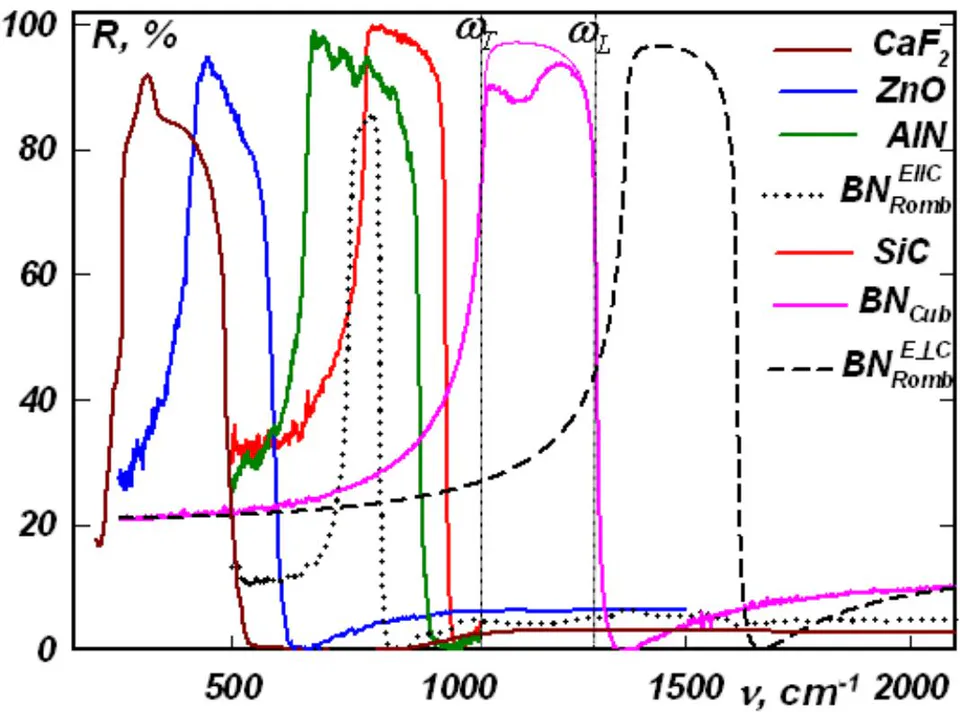
But all the lattice reflection spectra of crystals with a simple unit cell are shown with high accuracy to determine which is determined by the rigidity of chemical bonds - springs and the reduced mass of atom balls.
So, this alone is enough to understand a lot. In particular, for isotropic crystals, their rigidity, which is of the utmost importance as in diamond, is an analog of cubic boron nitride. On the other hand, as can be seen from the figure, the stiffness of chemical bonds inside the atomic layers of hexagons is higher than the stiffness of bonds in a cubic modification. Also it can be seen from the figure that the interlayer interaction in rhombohedral boron nitride and in its conducting analog of graphite is determined by a small concentration of very hard chemical bonds . Their stiffness is approximately equal to the stiffness of bonds in silicon carbide, which is several orders of magnitude tougher than the van der Waals interaction, which is often used to describe the two-dimensionality of some crystals (which directly contradicts their high heat resistance).
Moreover, as specially carried out studies of the size effect in the lattice absorption of silicon carbide have shown [16, 17, 18], the dipole vibration frequency in monotonously lay samples varies from the transverse frequency in a SiC single crystal to the vibration frequency in a molecule in a polycarbosilane molecule (Fig. 2).
The high-frequency edge of the grating reflection peaks is determined by the so-called plasma addition due to the charge of the Sighetti dipole — the shift of the electron density towards one of the atoms of the chemical unit cell formula and the concentration of dipoles in the crystal lattice. This plasma addition to the transverse frequency determines the frequency of the longitudinal phonon , which determines the high-frequency edge of the lattice reflection
The frequency of the longitudinal phonon directly characterizes the tensile strength of the chemical bond — the maximum energy of its breaking and, thereby, the strength of the material and its melting temperature. A plasma additive is directly related to the strength of the oscillator in the single-oscillator model used for simple crystals.
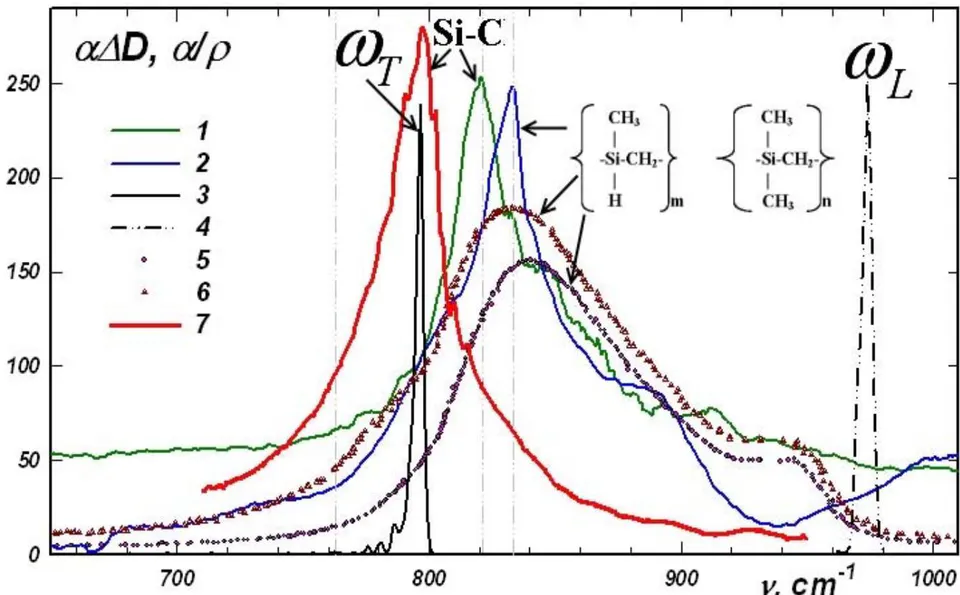
The single-oscillator model of lattice reflection can be described for most crystals. But the absorption maxima shown in Fig. 2 corresponds only to electroactive vibrations, whereas, as is well known in materials, there is a rich set of atomic vibrations from zero frequency to . Not all vibrational levels are IR-active - have an impulse not equal to the impulse of light used for the diagnosis of infrared radiation. But all of them are transformed from individual resonances into zones of allowed wave oscillations. Based on a single-oscillator model, all these wave oscillations can be qualitatively calculated in the form of phonon spectra :
Where - ion bond stiffness, and - ion masses, - reduced mass of ions. Expressions for the phonon frequencies at the boundary of the Brillouin zone: ,
The branches of transverse optical and acoustic phonons calculated using this formula, taking into account the corresponding SiC parameters, are presented in Fig. 3.
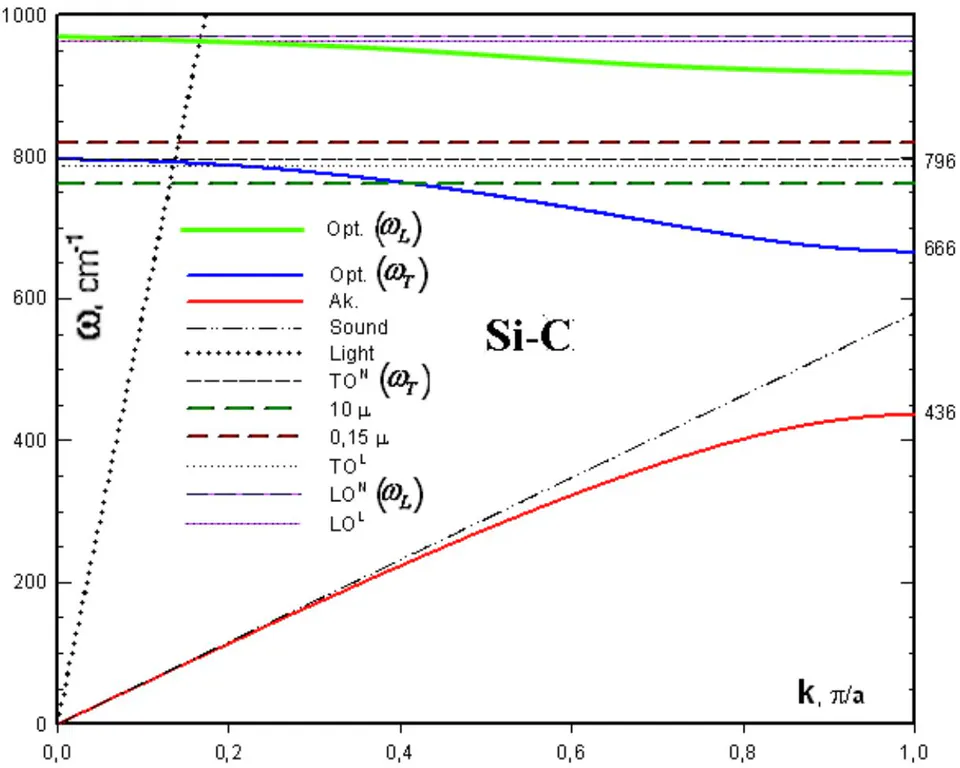
The highest line corresponds to the frequency of the longitudinal optical phonon
The slope of the lower asymptotics (dash-dotted line) determines the speed of sound :
The interaction of light with a lattice demonstrates the intersection of the law of dispersion of light (dashed line):
with the branch of transverse phonons (blue line).
Figure 3 shows the frequency range of the allowed transverse vibrations in SiC. The asymptotics for sound (dash-dotted line) and the conditional dependence for light intersecting with the branch of transverse optical phonons are also shown. The dashed horizontal lines show the frequencies TO and LO at E perpendicular to the C axis, and dots at E parallel to the C axis for the 6H-SiC crystal. These lines show the maximum frequency range observed on single crystals.
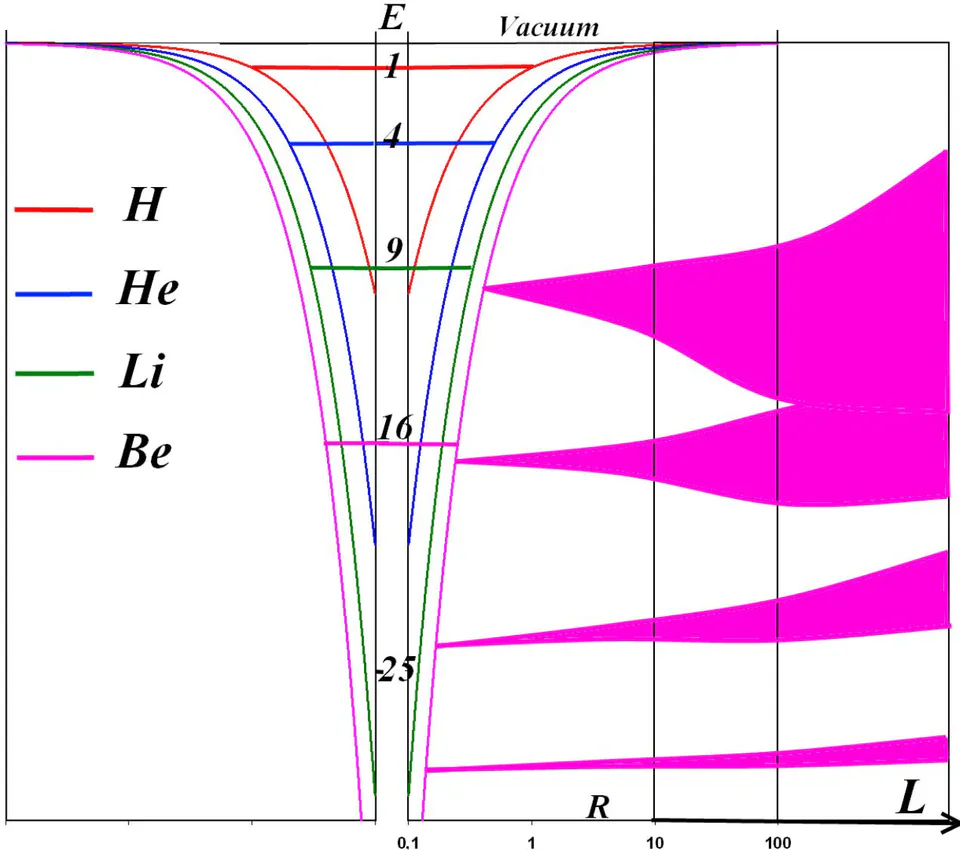
The above analysis (possibly somewhat redundant for chemists) simply demonstrates that RESOLVED ENERGETIC ZONES (frequency bands are thick colored lines) ARE TRANSFORMED (due to the interaction of individual frequency levels) RESONANT LEVELS (Fig. 4). And, as shown in the book [8], the calculations of phonon spectra based on a quantum oscillator violate this causal relationship.
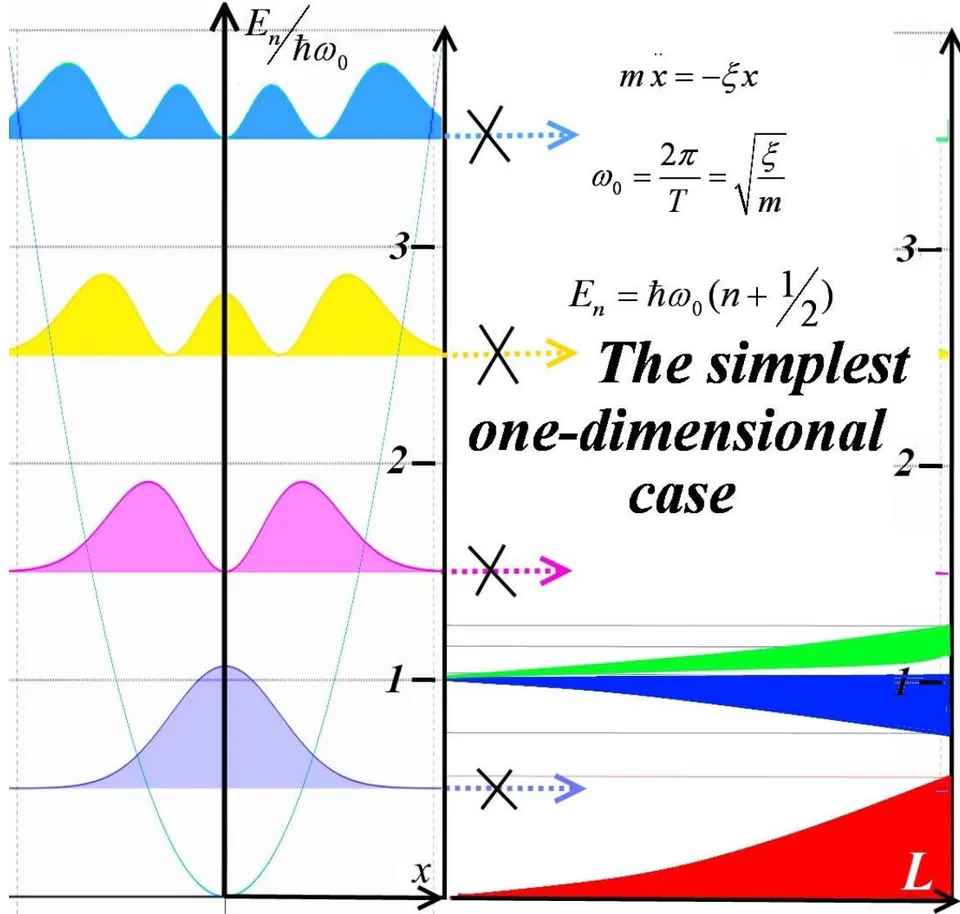
The parabolic potential which is well shown in Fig. 4 gives a purely harmonic oscillation of a classical linear oscillator at a frequency (and 0) with the possibility of a continuous change in its oscillation amplitude A and its energy:
But when rewriting the equations for the classical oscillator in the operator (Schroedger) form, second quantization is obtained, in which only spasmodic energy transitions between the energy levels shown in Fig. 4 are possible. At the same time, they received the first allowed level, which was attributed to unobservable ZERO vibrations. Whereas the transformation of the classical (first) level of vibrations into the zones of allowed energy states (Fig. 3) shown in
Fig. 4 with an increase in the size of the (linear) particle L from an individual dipole to a single crystal corresponds to polaritons observed in lattice reflection and absorption (Fig. 1 and 2). Also, not mystical, but normal zero-point vibrations and they are also well studied in crystals, acoustic waves determine the lower allowed zone. Discrepancies in the fundamentals of second quantization indicated that in the case of operator overwriting even elementary equations, inaccuracy/non-rigor was allowed. But we will consider this contradiction in more detail in the analysis of atomic orbitals themselves, based on of which covalent or ion-covalent orbital-chemical bonds are formed.
For crystals having a complex unit (translatable) cell containing more than one dipole, instead of a continuous IR grating reflection band, we have, as shown in the example of quartz in Fig. 5, a whole set of oscillators associated with various atomic vibrations in the crystal lattice.
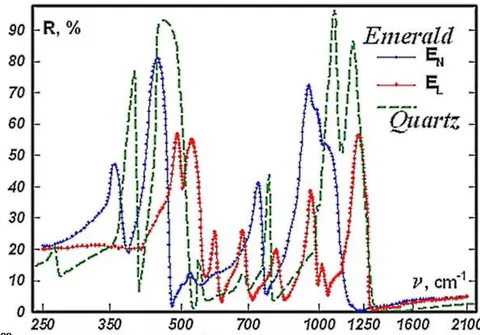
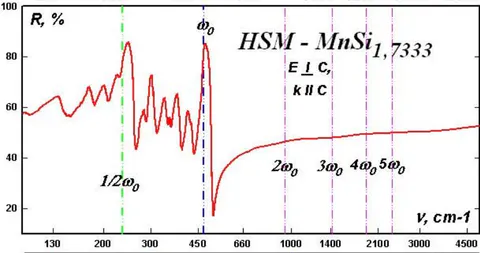
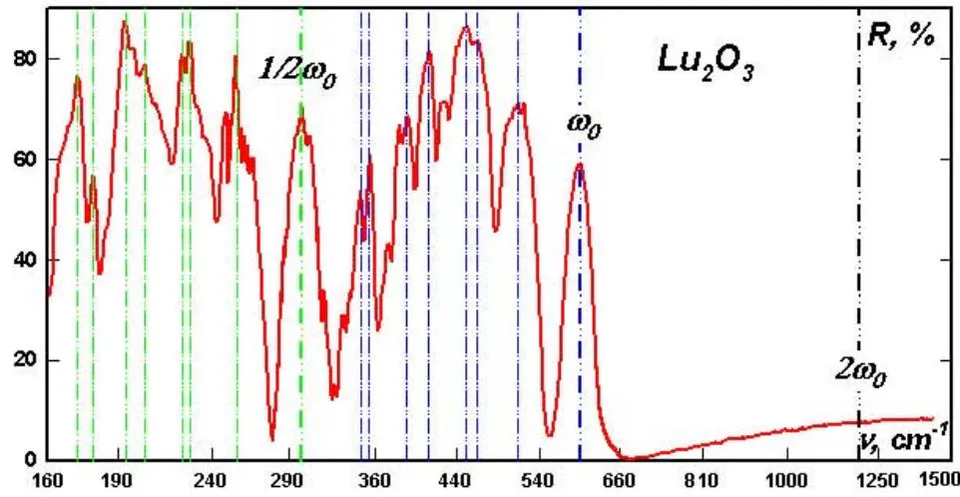
And this complex set of oscillators observed in Fig. 5 is also described classically but by multi-oscillator models. And they even get correlations of physical properties with the calculated sum of the forces of all individual oscillators. But they are trying to describe formally and with the assumption that all oscillators are on the "spring" - known chemical bonds. Whereas from the subsequent consideration, it follows that the existence of previously unreported bonds due to new electronic orbitals is possible.
So the theory of phonons built based on of precisely the classical harmonic oscillator gave good agreement with experimental measurements and a lot of additional information about the properties of solids.
But the formal quantum-mechanical recalculation of the harmonic oscillator gave a set of frequencies(Fig. 4)that was not connected in any way with phonon branches. Whereas the formal quantum-mechanical recalculation of the harmonic oscillator yielded a set of frequencies(Fig. 4)that was not connected in any way with phonon branches. And the discrepancy between experiments and the prediction of the phonon theory is quite well eliminated, if, again, based on a clear classical model, we take into account the "springs" connecting the electron clouds with the atomic nucleus and the accompanying anharmonisms that violate the adiabatic decomposition into phonon and electron frequencies[8]. Moreover, it is likely that the quantum calculation of the first vibrational level violated the Heisenberg uncertainty principle.
Logically, physical chemistry must begin by rewriting atomic physics — calculating electronic orbitals. But to just come to this conclusion, it was first necessary to identify the contradictions that arise when using standard chemical orbitals to describe the physical and chemical properties of substances.
And at the initial stage of the analysis and calculation of classical corrections of fundamental doubts about the correctness of quantum-mechanical calculations of electronic orbitals- "springs", by and large, have not yet arisen. Although the orbitals introduced by Pauling [18], based on of which two-dimensional models of graphite and boron nitride crystals were built, were noticed long ago, they contradicted several previous experiments and directly contradicted the experimentally measured anisotropy of lattice vibrations of boron nitride (see Fig. 1). Although even at this stage of research, a drastic difference was found in the ion-covalent bond between the two-dimensional layers of hexagons found in these crystals, only a small deformation of one of the four already known atomic orbitals formed in the BN molecule was used to correct [13].
Those. The cardinal difference between the generally accepted Van der Waals interaction and experiments was eliminated by taking into account this slightly deformed orbital, which was previously simply not taken into account in the formation of the crystal structure. And for the electronic allowed energy levels and the shape (symmetry) of the electronic orbitals obtained in the framework of the quantum oscillator model, but in the Coulomb potential of the nucleus - in the framework of the hydrogen-like atom model, in general, there was no doubt. Moreover, even at the level of the concepts of s, p, d, f orbital, there was a good, qualitative correlation of the filling of the upper electronic levels with both the ionization potentials of atoms and the physical characteristics of materials (Fig. 6).
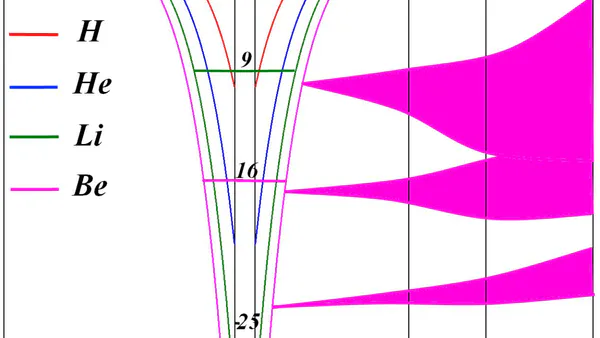
Moreover, the experimental energy characteristics which are shown in Fig. 6 "feel" well the symmetry change of the upper occupied orbitals [20, 21] —and the complete filling of s- orbitals, and the transition from the filled orbitals to the p-orbitals (jump ) and filling three electrons of the p-orbital, and even the transition from a fully p-orbital to a new p-orbital too (jump ). Then, formally, within the framework of the used model of a quantum oscillator in the Coulomb potential, the calculated dependence on the atomic number n of the position of the upper filled level (the pink dashed curve in Fig. 6) is degenerate by the symmetry of the orbitals - the energy of the calculated level is determined (supposedly) only by the main quantum number.
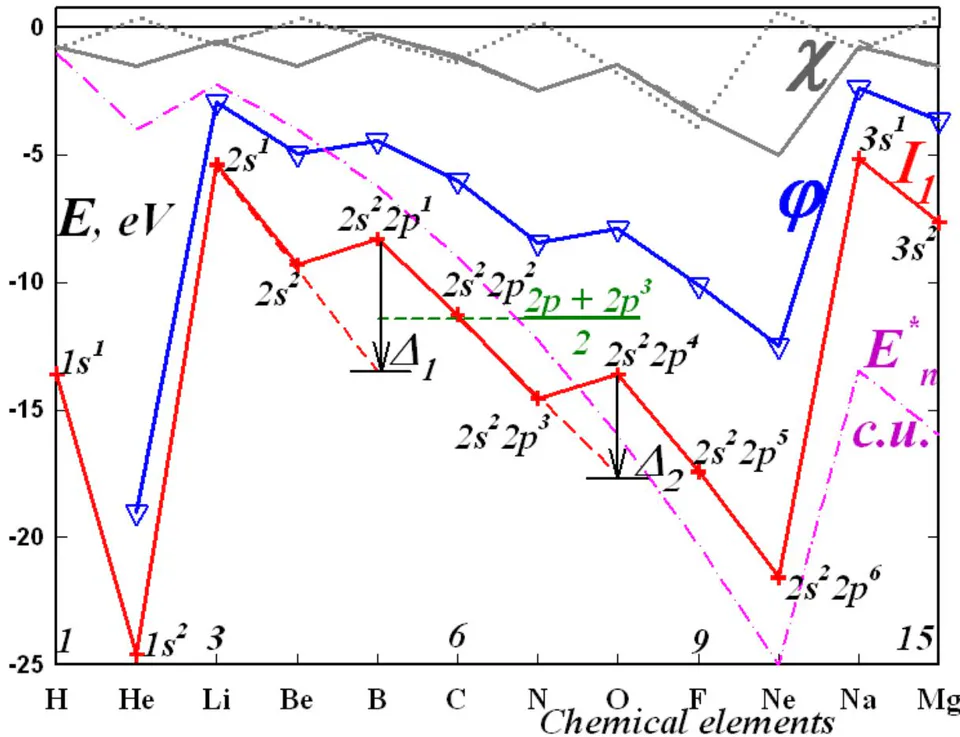
But if in the first periods the quantitative difference between the calculated energy levels with the experimentally measured energies is relatively small, then for large atomic numbers, as shown in , the discrepancy is catastrophic. Therefore, purely levels in the Coulomb potential in quantitative calculations do not use at all. Whereas a transformation similar to that shown in Fig. 4 for phonons but experimentally measured electronic levels in atoms into energy bands of allowed states in substances (Fig. 7) was experimentally repeatedly studied and described in terms of various models .
The algorithm for the natural broadening of the resonance band of coupled oscillators used in Fig. 7 to construct also followed from consideration of coupled classical oscillators and the transformation of the allowed upper occupied electron levels into bands was reliably established by experimental measurements of these levels in gases and their broadening upon transition to clusters and single crystals.
So the algorithm which is shown in Fig. 7 for broadening the allowed levels into zones of allowed states, similar to the broadening of the classical resonant level of ions in the band of allowed vibrations shown in Fig. 4, and in the parabolic Coulomb potential, can also be considered quite reasonable and used for practical calculations of allowed and forbidden energy zones. And in fact, this is done with numerous quantum-mechanical calculations, which is actually a calculation of corrections, acceptable only if the corrections are small. And if we do not eliminate the contradictions in their basis we have "a tree without roots", it is often a great arbitrariness in the choice of fitting parameters by theorists and a rather cool attitude to such calculations by practitioners - technologists and experimenters.
And to break this vicious circle, we qualitatively summarize the revealed contradictions in quantum calculations, which are directly tied to ideas about electronics, in fact, chemical orbitals.
On the other hand, the three-dimensional solutions found for electrons for hydrogen-like atoms with a centrosymmetric potential are, in principle, non-strict and incomplete, i.e., approximate. Moreover, they cannot be verified, as with dipoles in a lattice, within the framework of a clear one-dimensional model - even a qualitative consideration, as with dipoles, of a one-dimensional model, when quantized in a hydrogen-like model, is generally incorrect. And the three-dimensional wave functions obtained by the method of separation of solution variables are also not strict, qualitative, and in many respects demonstrative in nature. Nevertheless, such an approach gave a qualitative description of the entire periodic table of elements, which indicates the closeness of the obtained dependences of the wave functions on the angular coordinates to the true ones, the main error "hid" in calculating the energy from the radius! Both for electrons and, in the seemingly simplest case, for phonons.
So, let's go back to Einstein's formula: "Some equations of classical physics can be rewritten in operator form!" [25].
And we that either models (classical) that are not strictly selected for rewriting, or the algorithm for rewriting into operator form is not strict.
From the catastrophic discrepancy between the electronic levels of a hydrogen-like atom for large atoms, in principle, the conclusion made in immediately follows: a hydrogen-like atom is not ELEMENTARY for all atoms, but is a kind of simplification and, in principle, as a primitive cell is NOT TRANSLATED.
But from this alone it already follows that the Schrödinger equation has not of a general nature, but a certain approximate equation for the limiting particular case.
So, the QUESTION about the Electronic Orbitals that determine the chemical bond directly related to
Chemistry returned to the Fundamentals of Quantum Mechanics.
II. CONCLUSION
Applied research chemists usually just need to know that there is some kind of quantum mechanics that describes theoretically chemical bonds. But in practice, they simply use the purely chemically established these bonds in the atomic-molecular design of new substances and materials. And in many respects, they rely not on theory but on their instinct for the experimenter. Boris Nikolayevich Sharupin also had such a great instinct for the technologist, who for my research grows magnificent, highly ordered crystals of boron nitride and graphite, and for industry - excellent products from them. But this remarkable scientist (who was included in the co-authors of the article posthumously) was the first to invite me to the conference with a report refuting the decorative science, which was also given in his book. So apparently he understood that one instinct was not enough to get new materials. And this HIS understanding of the significance of Science has pushed me to deeply understand the contradictions that have accumulated in it over a hundred years. And our own understanding is that without a single picture in Consciousness (in theory), we will not get a reliable tool for practice, both for the Press and for technology.
But as shown earlier, the Schrödinger equation, on which almost all quantum-mechanical calculations are based, not only describes the hydrogen atom, but non-invariant and gives catastrophic discrepancies for all other atoms, which are trying to "correct" by approximation methods. A fundamental "correction" required both the elimination of Schrödinger's error in comparing the difference in size and the correction of the "kKantivanie" itself, continued contrary to Planck's ideas.
Quantization Max Planck, in principle, calculated for the electromagnetic field. And, following strictly Planck, it was necessary to initially build Quantum Electrodynamics on the basis of electrical models. Or at least Quantum NONMECHANICS or Quantum ELECTROMECHANICS. And naturally on the basis of electrical models, in particular, on the basis of a well-describing electrical impedance measurement results.
But this will be discussed in detail in the following works: "Impedance of the Skin-Plasma Effect" and "Quantum Non-Mechanics"