The subsidization of fuel means that government pays a fraction of the price residence of Nigeria would have paid when they purchase fuel in the country. Over the years, there has been vehement calls by international organizations like International Monetary Fund (IMF), World Bank (WB), different regimes in the country and even some private individuals on the need to withdraw subsidy on petroleum products in the country. The reason for this position has been anchored on corruption in the subsidy regime and the need for government to reinvest monies saved from subsidy into critical infrastructure in the country. The thrust of this paper was to examine the impact of the withdrawal of subsidy on petroleum products in the country on the wellbeing of residence in Uyo metropolis, Akwa Ibom State, Nigeria. The paper adopted a quantitative method hence information for the paper was sourced through the primary means like interview and Focused Group Discussion (FGD). For cross-validation of field information, journal articles were also reviewed for empirical evidences.
## I. BACKGROUND INTRODUCTION
Government as an institution is constituted to drive development and better living standard by providing the necessary apparatus that enhances the achievement of these goals. The attainment of development is strategically planned which explains why government adopts different models and strategies such as social welfare schemes aimed at alleviating poverty and ushering in development and societal advancement. Fuel subsidy is a government's discount on fuel which makes consumers pay less than they should have. It therefore imply that if Nigerians were to buy fuel at a cost say $\yen 800$, government can subsidize to about $\yen 650$ so that consumers can buy at a cheaper rate which brings relief to them but extra cost on the government.
It is important to note that fuel subsidy regime has had both positive and negative implications. On the negative side, it breads corruption and embezzlement of government funds that would have been used to initiate programmes that will alleviate poverty in the country. Note worthy is the fact that fuel subsidy removal places a burden on the citizens meaning that the citizens pay more for fuel which takes a chunk of their resources that would have been used for other purposes. On the positive note, it helps government to serve huge sum of money that can be reinvested in other sectors like power and other infrastructure.
Today, Nigeria is ranked as the $5^{\text{th}}$ largest producer of crude in the world with about 1,938,543 barrels of oil per day (Bisong, Ushie, Tersoo & Agbeh, 2023). With this level of oil production, one would have expected that the country would have been self-sustaining with regards to refined petroleum products, but the reverse is the case as the country exports crude but in turn imports its finished products.
The non-functioning of the refineries in the country mean that the government will have to pay for forex for the purchase of fuel for the country. However, due to Dollar/Naira differential, the cost of importation of fuel becomes higher than it would have been if it was locally refined. In order to reduce the price burden on the citizens, government subsidizes by reducing the price it would have sold fuel based on the landing cost which is aimed at lessening the financial stress on the citizens.
Historically, fuel subsidy was first introduced in Nigeria in the 1970s as a response to the oil price shock which was an implementation of oil embargo by Organization of Arab Petroleum Exporting Countries (OAPEC). This was an embargo placed on countries who had supported Israel at any point during the fourth Arab-Israel war (Onyeizugbe & Onwuka, 2012).
Since after the global oil crisis, fuel subsidy regime has been in existence in Nigeria but was only partially removed in 1986 and later reintroduced. An attempt by the Nigerian government to remove fuel subsidy in 2012 led to wild protest in the country resulting in government rescinding its earlier decision. According to Peterson & Obiora (2023), in 2022, fuel subsidy payment by the Federal Government stood at $\mathbb{N}4$ trillion (US $ 6.058 billion) which was 23 percent of the total national budget of $\mathbb{N}17.126$ trillion.
Based on the above, there has been support for and against the subsidy removal in the country. It is important to note that, successive governments in the country had made attempts to withdraw subsidy on petroleum products based on its perceived negative implications on the economy while the citizens who benefit from it have continually kicked against its removal specially where there are no programmes and policies to cushion its effect.
Supporting the end to subsidy regime in Nigeria, Omitogun, Longe, Muhammad & Adekomi (2021) observed that the removal of fuel subsidy might reduce the amount of carbon emission into the Nigeria's air. In similar vein, Adekunle & Oseni (2021) opined that fuel subsidy removal could reduce the growth in carbon emissions through low energy consumption channels even though it could lead to higher energy prices.
Conversely, there are others who are of the opinion that the removal of fuel subsidy will bring untold hardship to the citizens particularly the poor. It means therefore that, citizens will have to buy fuel at higher prices since government will no longer part-pay for the fuel they consume. Consequent upon this, the cost of transportation will jack up thereby translating into high cost of goods and services across the country.
On the government part, the major reason advanced for fuel subsidy removal is hinged on corruption and embezzlement of the funds by government officials and those managing the subsidy regime. Arguing further is the fact that government intends to use the funds saved from fuel subsidy removal for infrastructure development in the country.
Unlike previous attempts by earlier administrations both military and civilian, the current Federal Government under the leadership of President Ahmed Bola Tinubu on assumption of office on May 29<sup>th</sup> 2023 boldly announced the end to subsidy regime in the country. This proclamation was met with wide condemnation by citizens who felt that the removal of subsidy will lead to high cost of fuel and subsequent hike in the cost of goods and services across the country. The thrust of this paper is therefore to examine citizen's perception of the removal of fuel subsidy on their wellbeing in Uyo Metropolis, Nigeria.
## II. STUDY AREA
Uyo is the capital city of Akwa Ibom State which was created out of Cross River State on $23^{\text{rd}}$ September, 1987. Being the headquarters of the state, it harbours a lot of residents, the government house and major business out fits. It is the commercial nerve centre of the state. The city of Uyo lies approximately between $4^{0}521$
and $5^{0}01 \mathrm{~N}$ and longitude $7^{0}47^{1} \mathrm{E}$ and $8_{0} 03 \mathrm{E}$ of the Greenwich meriden.
The study area is very central to all other Local Government areas which make it over populated due to migration from rural areas to the capital city for better living condition. Being a capital city, most of its lands have been taken by the government for development purposes hence there are no enough land for agriculture which makes most of the residents of the city to buy most of their food items from farmers within the neighbouring local communities.
The city is bounded by Ibesikpo, Uruan, Itu, Ibiono Ibom and Abak Local Government Areas. It consists of level-to-gently undulating sandy plains with rivers, though not many but the available ones are far apart. Soil erosion is prevalent in the area especially where gullying takes place. The drainage network in the upland part of Uyo is not dense, as rivers are few and distant apart.
The decision to choose Uyo as the study area is justified by the fact that it accommodates people whose life depends on the business they do that requires them to put on generating set in the absence of light from the national grid. Apart from that, the city accommodates a wider population of persons in the state.
## III. REVIEW OF RELATED LITERATURE
Many sectors of the Nigerian economy have been highly subsidized for many years now. The subsidized sectors include amongst other fuel, education, electricity, forex etc. The regime of subsidy in Nigeria became institutionalized following the Price Control Act in 1977 which made it illegal for some products and services to be controlled by the government.
On a general note, the concept and idea of subsidy has been very beneficial to the citizens of Nigeria but its administration has been confronted with high level of mismanagement leading to corruption resulting in a call for its removal by many administrations until it was finally removed by the current administration of President Bola Ahmed Tinubu. However, there has been a lot of arguments in support and against the removal of subsidy on Premium Motor Spirit (PMS) in Nigeria.
In the work of Fathurrahman, Kat & Soytas (2017) on simulating Indonesian Fuel Subsidy Reform, the research revealed that, the reallocation of subsidy payments to low-income households could slow down economic development but improve social welfare. The argument by government is that, the introduction of subsidy may result in infrastructure deficit because the money invested into subsidy would have helped the government solve some critical infrastructure problems while on the other hand, subsidy benefits the citizens
especially the poor because it means they will buy fuel at a cheaper rate which also lead to reduction in the prices of goods and services.
In a study by Omotosho (2019) which focus was to analyze the interplay between price shocks, fuel subsidies and their effects on macro-economic stability in Nigeria. The study revealed that oil price shocks have substantial and enduring impacts on the country's economic outputs, accounting for approximately $22\%$ of its variations over a four-year period. This mean that the variation in price especially the one that is upward may result in hardship amongst the citizens.
The result of a research conducted by Onuoha (2023) on the removal of fuel subsidy and its impact on the economy revealed that there is an increase in the cost of transportation, increase in food prices and a general increase in the prices of other essential commodities. This implies that some households without substantial income will definitely suffer from stagnation.
Reporting on the removal of gas subsidy in Malaysia, Chatri (2014) assessed its economic-wide effects and discovered that the removal of subsidy led to an increase in the price of electricity followed by other economic sectors and a decrease in Gross Domestic Product. This research findings seems to fall in line with the discovery in Nigeria that the consumption of fuel reduced drastically consequent upon the subsidy removal and the immediate surge in the price of the commodity.
Commenting on the environmental impact of fossil fuel, Erickson, Down, Lazarus & Koplow, (2017) held that the removal of tax incentives and other fossil fuel supper policies could fasten the attainment of the G20 climate commitments. This research is important because it revealed that fossil fuel can be detrimental to health hence the removal of subsidy and attendant low consumption can be beneficial to the environment and human health.
Fuel subsidy removal programmes are very sensitive to economic structure and level of development in a society. It is evident that more successful countries have taken a phase or slow approach. Also important to note is the fact that many advanced countries have engaged in conscious research prior to implementation and followed by rigorous steps to the policy making and implementation. It therefore implies that any policy in this direction should be planned to avoid adverse or negative implications on the citizen's wellbeing.
## IV. RATIONALE FOR SUBSIDY REMOVAL
The eventual subsidy removal on fuel by the Federal Government of Nigeria on May $29^{\text{th}}$, 2023 by the current administration did not come as a surprise because administrations before the current one have
always expressed the desire to withdraw subsidy on fuel but they never had the will power to execute the policy. The removal of subsidy by government came with some cogent rationale such as curbing of corruption in the oil and gas sector by the administrators of the subsidy regime. It has always been the position of government that when subsidy is removed, the monies realized will be reinvested in critical government infrastructure.
According to the World Bank report (2022), Nigeria's total revenue in 2000 was USD 10.8 billion. By 2010, this amount increased to USD 67.9 billion. Yet the Nigerian government has spent over USD 30 billion on fuel subsidies over the past 18 years. (Oyedele, 2023). Based on the above report and others attributed to such challenges like corruption, there has been a sharp decline in the availability of funds for infrastructure in so many sectors of human endeavour.
Report from the Debt Management Office in Nigeria showed that the country's public debt stock has increased geometrically as government has to borrow $\mathbb{N}$ 1 trillion to finance fuel subsidy in 2022. However, to be more specific, the following could be deduced as reasons for subsidy removal in Nigeria viz:
1. Corruption: The term has been variously defined. It is involved with unwholesome practice in the society with its attendant negative effects. According to Uwak & Udofia (2016), corruption involves improper behaviour of public office holders such as enriching themselves, friends and loved ones to the detriment of the general public. Corruption as an act has dealt a big blow to the Nigeria's economy as monies meant for development are siphoned by a few individuals for personal gains. Because of the paucity and weakness in oversight of the process, fuel subsidy payment has allowed unethical and corrupt practice such as the inflation of landing costs and padding of fuel import bill. However, the solution to the corruption in the subsidy regime according to government is the removal of subsidy so that corruption activities surrounding it can end.
2. Shortage of Supply: Before the end to the subsidy regime, Nigerians used to queue up to buy fuel because of scarcity caused by non-availability of the product and non-availability of forex for the transaction. It is also good to note that, the lower than market-clearing price causes scarcity. It discourages producers and suppliers from entering the market and it involves excessive consumption. On the other hand, the fact that the neighbouring economies operate on a market-clearing prices also encourages the smuggling of the subsided products of Nigeria.
3. Spending at Expense of Infrastructure Development: Considering the volume of money invested into the fuel subsidy, it is assumed that if that amount of
money is channelled into infrastructure renaissance, the country's infrastructural facilities would have been better than what it is today. According to Oyedele (2023), over USD 30 billion was invested into subsidy. However, the argument is that, if such amount is directed towards infrastructure in the country, things would have been better. Fuel subsidy diverts part of the resources for development purposes towards consumption (Onyeizugbe & Onwuka, 2012). Asare, Reguant, Saab & Sacchetto (2020) argued that the removal of subsidy will provide additional resources to the government to shift resources for government to respond with intervention to address COVID-19 crisis.
4. Stress on Government's Finance: The high amount of funds expended on the fuel subsidy adversely affects or stresses the economy or put in another way, the financing of fuel subsidy makes government to sometimes go into borrowing. The ever-growing fuel subsidy bill continues to hit deep into government's resources. With revenue shortage, fuel subsidy payment means the government will need to borrow to invest in other sectors. This position is supported by Asare, Reguant, Saab & Sacchetto (2020) who held that resources invested into fuel subsidy has stressed the finance of the country and that the money expended would have been used for other development adventure of the country.
It is important to note that, in the course of this review, some scholars have identified the benefits of fuel subsidy to Nigerians and therefore called for a more transparent approach to its management. For instance, Omitogun, Longe, Muhammad & Adekomi (2021) explained that the removal of fuel subsidy might reduce the amount of carbon emission in the Nigerian economy.
Similarly, other studies have also identified the negative sides of fuel subsidy removal. This aligns with Umeji & Eleanya (2021) who said that Nigerian oil wealth has not translated into improved living condition of the people. In the same manner, Ovaga & Okechukwu (2022) argued that fuel subsidy breeds corruption in Nigeria because corrupt people have been working against the success of government refineries and generally sabotage the efforts of government in the oil sector for their activities to continue.
## V. RESEARCH METHOD
The study of this nature which is to examine the effect of a policy on the populace is investigative in nature hence the method suitable for adoption is the quantitative method Okpa (2022). The survey research design was adopted for the study. The term 'survey' is commonly applied in research method designed to
collect data from a specific population, or a sample from that population. It typically utilizes questionnaire as well as other survey information collection methods like Focus Group Discussion (FGD) and interview. For this study, interview and Focused Group Discussion were utilized to get needed information from the respondents. This research design also provides information concerning the degree of relationship between the variables being studied. This design was considered suitable for the study because the study examined the relationship between fuel subsidy and citizen's wellbeing in Uyo metropolis.
Also justifying the adoption of interview and Focused Group Discussion is the fact that some of the respondents may not be literate enough to answer questionnaire questions or be able to write. Therefore, the suitable information gathering method is interviews in which both English and native languages were used depending on the respondent's level of education.
Focused Group Discussion (FGD) was conducted in a group of 5 comprising 10 households in Uyo and Key Informant Interview (KII) on transporters and business owners within the capital city. The respondents were purposively selected since they possessed the characteristics needed by the researcher to gather the needed information. Therefore, there were 5-10 members in each of the FGD conducted between $20^{\text{th}}$ and $26^{\text{th}}$ November 2023 in Uyo Capital City. In the KII interview, we purposively selected Akwa Ibom State Transport Company (AKTC), God is Good Motors and Ibom Air.
Within the business sector, 5 supermarket owners, 5 eatery owners and about 10 petty traders were randomly selected and interviewed for possible responses on how the removal of subsidy has affected people's purchasing power and its effects on their turnover and profit margin.
Aside from the above instruments used basically to get primary information, the secondary sources such as official publications, internet sources, journal articles, government sources and newspapers were used to cross-match the information derived from the field survey. Therefore, these various approaches helped the researcher to gather the enormous information needed to analyze the effects of fuel subsidy removal on the wellbeing of citizens of Uyo metropolis.
The regime of fuel subsidy witnessed the government's intervention by paying part of what the citizens would have paid as they purchase Premium Motor Spirit (PMS). However, with the attendant negative and unpleasant activities resulting in the embezzlement of funds and other unwholesome practices as regards the subsidization of fuel price, the current administration in Nigeria on May $29^{\text{th}}$ 2023 on inauguration day announced the withdrawal of fuel subsidy thereby allowing the law of demand and supply to determine the price.
Notwithstanding the points and ideals behind the removal of subsidy by the government, the Nigerian citizens have been badly affected as they now buy fuel at a very exorbitant rate compared to what was before the removal. The wellbeing and survival of Nigerians especially the middle and lower classes have been affected.
The above observation is in line with the responses gathered from travellers interviewed at Akwa Ibom State Transport Company (AKTC) and God is Good Motors in Uyo metropolis. When asked if they are affected by the rise in the cost of fuel which has affected the cost of transportation, all the passengers interviewed agreed that the increase in pump price of fuel has significantly increased the cost of transportation thereby reducing their travel frequency.
One of the travellers who is a business woman bares her heart out and complained that the cost of transportation has affected her business as she no longer enjoy the patronage she used to enjoy when the cost of transportation was manageable. The comment of the passengers falls in line the research findings of (Bisong, Tersoo & Philip 2023).
It is important to note that, the impact of the removal of subsidy on fuel is not only on the travellers but also on the transport companies. The above observation was arrived at when the operational manager of God is Good Motors categorically stressed that since the removal of fuel subsidy, the number of passengers has reduced resulting in a sharp decline in the profit margin of the company. According to him, before the removal of fuel subsidy, the company's buses that travels to Abuja and Lagos was always 5 to 7 in a day but have reduced to about 2 daily and sometimes 1. This shows that fuel subsidy removal have reduced people's travelling frequency thereby leading to a decline in the transport company's profit margin.
In order to investigate further the effect of the fuel subsidy on transportation, two passengers at the Akwa Ibom State International Airport where interviewed. Their response showed that the cost of airfare has drastically increased making passengers to minimize their travel rate. One of the passengers maintained that he now pays up to \(4360,000 for a local flight to and from Lagos. This also goes to validate the opinion of one of the road users interviewed at AKTC and God is Good Motors on the 21<sup>st</sup> and 27<sup>th</sup> of April 2024 respectively.
On its effects on businesses, the removal of fuel subsidy has negatively affected business owners leading to high running cost and an increase in the amount needed to buy goods to restock. One of the supermarket owners along Ibrahim Babangida Way (IBB) in Uyo metropolis lamented about the high cost of running generator set to power his supermarket. In his words, I spend $\mathbb{N}10,000$ to $\mathbb{N}15,000$ daily on fuel since
the removal of subsidy on petrol. He pointed out that before the removal, on a daily, he buys fuel at about $45,000$ daily.
Another supermarket owner along Abak Road in Uyo capital city narrated his experience since the removal of subsidy. He said that in order not to continue to spend so much on fuel for his generator, he had to set up a solar plant to subsidize his spending on fuel.
On how fuel subsidy has affected owners of Eateries and restaurants in the city of Uyo, one of the owners of the eateries along Abak Road in Uyo lamented that the rate of turnover has reduced because many people no longer eat out because of the high cost of food at the stores. In his view, people prefer to use the little money they have to cook at home for general house consumption than spend so much eating at restaurants.
Also, in line with the observation of other business owners, the owner of one restaurant in the metropolis along Nwaniba Road in Uyo complained that she spends so much to buy fuel that will power her generator daily and it has inadvertently reduced her profit margin as part of her income goes into fuel purchase for power supply. My profit in the business was better under fuel subsidy regime than now that it has been removed according to her.
Investigation on the effect of subsidy removal on wellbeing revealed that since subsidy was removed on fuel, petty businesses have suffered marginal looses as patronage has reduced. These were the responses of some street sellers interviewed along Etuk Street and Shelter Afrique Market (Oron Road) on the $10^{\text{th}}$ of February, 2024. The sellers lamented that since the removal of subsidy, patronage have reduced leading to low profit and hence making life difficult for them as their livelihood and sustenance depends on the daily sales they make on the streets.
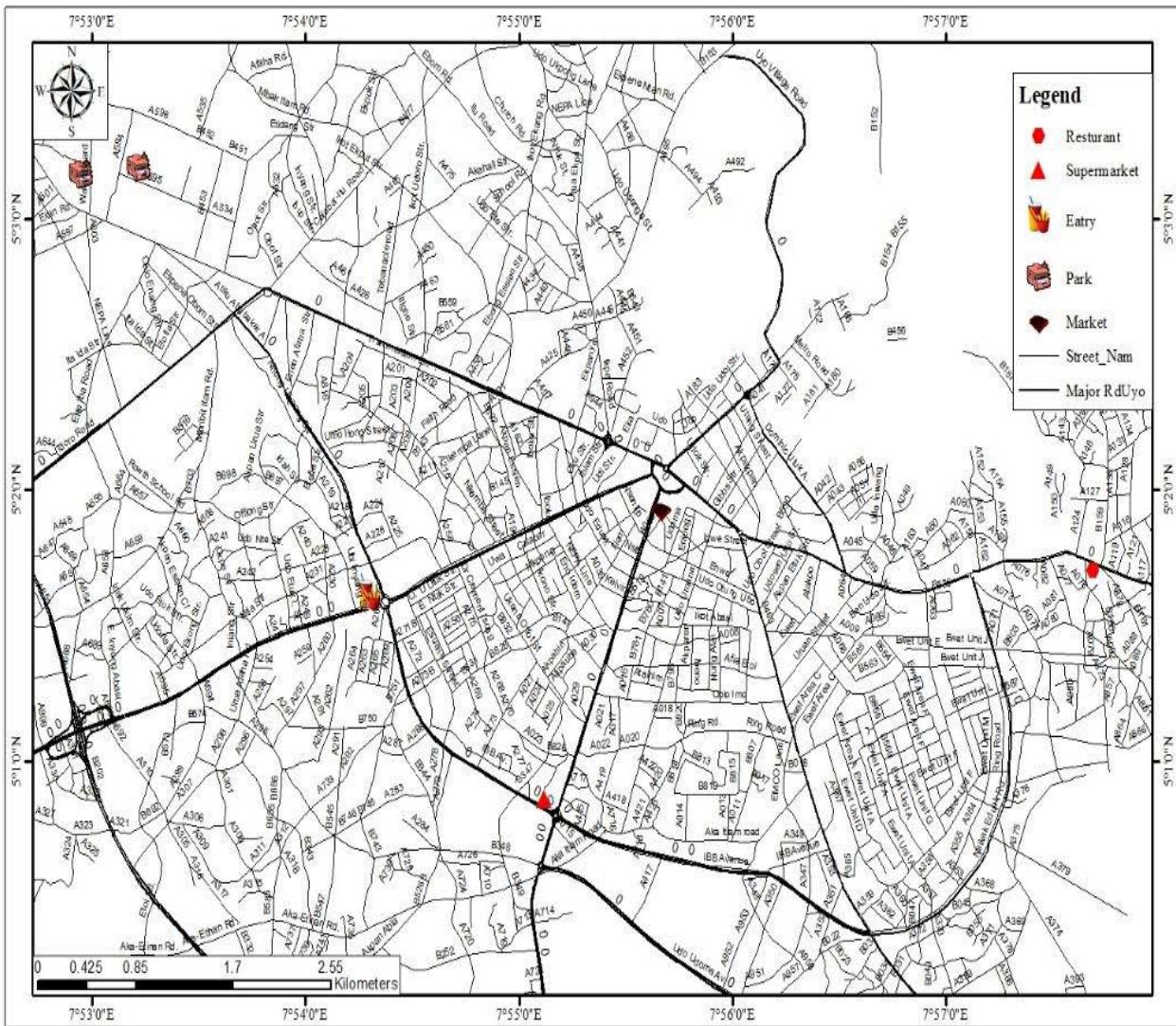
Figure 1: Map of Uyo Metropolis showing study locations
Source: Author's conception
### Focused Group Discussion
A Focused Group Discussion was initiated to further gather information on the effect of the removal of subsidy from fuel on some residence of Uyo metropolis. The discussion was divided into 5 groups of 10 families, that is 2 families in a group. The discussion went thus:
Group I: How has fuel subsidy removal affected the feeding of your family members?
Responses: A member of the group who is a civil servant with the state civil service complained that since the removal of subsidy on fuel, his savings have drastically reduced because he pays more for food, clothing, transportation and general upkeep for the house. He went further to say that, feeding three times a day has been very challenging. A second respondent who is a trader at the Uyo Main Market said that the removal of fuel subsidy has affected her family in the sense that they had to withdraw their children from a particular private school that charges about $\$ 50,000$ per term to the one they are now paying $\$ 20,000$ per term.
The two families unanimously agreed that the subsidy removal have made them spend more on feeding and that they sometimes eat 1-0-1 meal structure a day.
Group II: How has fuel subsidy removal affected your movement and that of your family members?
Responses: The first respondent who is a teacher with the State Secondary School Board said that he had to sale his only car since he does not have the needed funds to maintain and fuel it. Therefore, he uses tricycle and has also decided to withdraw his children from a school far off their residence to a one close to them. Responding, a member of a second family in the group bares her mind on the fact that she does not move around anyhow now-a-days because of the cost of transportation. According to her, the family used to go for holiday visit every August to a family in Lagos but as it is, the cost of transportation from Uyo to Lagos is now $\mathbb{N}36,000$ on road as against $\mathbb{N}15,000$ before the removal of fuel subsidy.
Group III: Is the subsidy removal to the interest of government or citizen?
Responses: Responding to the question, a lecturer with the Akwa Ibom State University averred that the removal of subsidy on fuel would have been beneficial if the government was able to reposition the country's refinery to full capacity. He went further to say that the fuel subsidy removal has saved money for the government and also reduced corruption that was in the subsidy regime. A member of the second family in the group said that the current subsidy removal regime benefits the government more because ordinary citizens are suffering as fuel is sold at a very high cost thereby making life difficult for the people.
Group IV: Would you advise government to reintroduce fuel subsidy?
Response: Respondent I said no to the question on the grounds that if government is serious in removing subsidy and making fuel available at a reduced cost, they should ensure that the refineries in the country are working. According to him, the money that would have been spent on subsidy would have gone into infrastructure development. The second respondent within the group was of the opinion that government should reintroduce fuel subsidy because the level of hardship is biting. In his words, it is only when the refineries are working that government should think of removing subsidy. In his words, government is not sincere.
Group V: Do you think it was the right time for subsidy to be removed from fuel?
Responses: In my own opinion, it was not the right time to have announced the removal of subsidy on fuel. This is because the announcement came on the day of inauguration of this current administration. The current government should have put necessary machineries in place and ensure that the refineries in the country are working so that fuel can be gotten at affordable rate before removing subsidy. The second person who responded also aligned his thoughts with that of the first person and stated that the government took that decision in haste and that with the current situation of things, it was not the right decision as there are complaints about hardship across the country occasion by the hasty removal of fuel subsidy in the country.
## VI. DISCUSSION
Analysis of the response on the effect of fuel subsidy removal on the wellbeing of residents in Uyo metropolis reveals a high rate of hardship occasioned by the removal of subsidy on fuel resulting in high cost of fuel and higher cost of living in Uyo metropolis viz-à-vis Nigeria.
Interview conducted on passengers in the state own transportation company Akwa Ibom State Transport
Company (AKTC) and a privately own company, God is Good Motors (GIS) showed that passengers turnout drastically reduced because of high cost of transportation. It was revealed that the transport companies no longer make the kind of returns they used to because of the high running cost as a result of low patronage.
On the impact of the subsidy on air travellers, investigation revealed that the high cost of airfare has significantly affected the number of passengers who travel by air in Uyo capital city. This is because the cost of airfare has skyrocketed from $\yen 75,000$ in 2023 to about $\yen 150,000$ (one way). Further investigation showed that some passengers rather than use air transport, resort to using road so as to save money for other important commitments. According to those interviewed, they decide to use air transportation only when it is very pressing and urgent to move from Uyo to other cities like Lagos or Abuja. It shows therefore that, the fuel subsidy removal affects both the rich and poor but at different dimensions. This also aligns with Peterson & Obiora (2023) research on implications of fuel subsidy removal in the Nigerian economy.
The effect of the removal of subsidy on fuel also had significant impact on businesses in the city of Uyo. This assertion was arrived at when supermarkets, eateries and petty business owners were interviewed on how the removal of subsidy has impacted on their businesses. Those interviewed revealed that since the removal of subsidy, they have spend more on fuel for their generator and this led to a reduction in their income level. One of the respondents revealed that, he had to spend $45,000,000$ to install solar power in his supermarket. Also, the petty business owners said that they were unable to buy plenty goods for sale since the patronage is very low. Therefore, if the fuel price is reduced, the profit margin of the business owners would have improved.
Analysis of the FGD on families structured into five groups revealed that the removal of subsidy on fuel have seriously affected the feeding routine of families within the city. This is because the cost of transportation has led to high cost of food items in Uyo vis-à-vis Nigeria. Therefore, the reduction in fuel prices will result in the concomitant reduction in food prices and consequent better feeding condition for people in Uyo.
On the issue of movement from one location to the other, the respondents in group II of the FGD opined that they have sold their cars and resorted to the use of commercial tricycle and even have to withdraw their wards from schools afar to the ones that are close to their area of residence. This means that, a reduction in fuel price or a return of fuel will improve the transportation condition of the residence of Uyo metropolis.
With regards to subsidy removal on whose interest, respondents in group III unanimously agreed
that if the subsidy removal was well planned, it would have yielded the much needed result. The respondents accused the current administration in the country for hastily removing subsidy on fuel without necessarily putting machineries in place to ensure that the refineries in the country work in full capacity. They also agreed that the subsidy removal is beneficial to the government because it reduces corruption in the oil sector thereby giving government more money. It means therefore that, fuel subsidy would have been beneficial to the citizens if the refineries were working and fuel sold at a cheaper price.
The fourth group of the FGD were asked if it is advisable to reintroduce subsidy, the first respondent said no only if the government can put the refineries in the country to working capacity. It implies that all things being equal, fuel subsidy removal would have yielded positive returns if the refineries were all working.
The last group of discussants were asked about the timing of the fuel subsidy removal. The responses of two persons who responded to the question posed were that the current administration should have put the necessary arrangement before removing subsidy on fuel. They recommended the fixing of the refineries as a solution to the fuel crisis issues in the country. It could be deduced therefore that, proper arrangements and planning would have made fuel subsidy removal positively impactful.
## VII. CONCLUDING REMARKS
Subsidy removal on fuel at the beginning of this administration on the $29^{\text{th}}$ of May 2023 marked the end of a long term proposed fuel subsidy removal by the Nigerian government. However, despite the justification by government and its agencies on the need to withdraw the subsidy, the general wellbeing and welfare of the people have been greatly affected as fuel now sales as high as $\mathbb{N}750$ compared to $\mathbb{N}250$ that it was sold before $29^{\text{th}}$ May 2023.
This current situation have invariably brought hardship and lack to many households resulting in the glamour in some quarters for the return to the subsidy regime or the immediate fixing of the refineries by the Nigerian government as a permanent solution. This research was therefore set out to investigate the impact of fuel subsidy removal on the wellbeing of residents of Uyo metropolis. Arising from the findings of this paper, the following recommendations are hereunder outlined.
1. Government of the country should urgently put machineries in place to fix the country's refineries. By so doing, there will be no need to import fuel because there would have been enough fuel for local and even international market.
2. The Federal government should encourage local refining of petroleum products which will result in
product availability and subsequent crashing of the fuel prices.
3. As an interim measure, before the refineries are properly fixed, government should invest heavily in public transportation through the purchase of buses, trains and the rehabilitation and construction of new roads across the country to enhance ease of movement.
4. People who were involved in fuel subsidy fraud should be identified and prosecuted to serve as deterrent to others who may want to steal or embezzle funds in the petroleum sector as well as other sectors in the country.
## APPENDIX I
### Interview Guide
### Travellers (Passenger)
1. Is there any difference between the cost of transportation before and after fuel subsidy removal? If there is, how does it affect your travel frequency?
### Transport Companies
2. What is the profit margin of your company when you compare the two periods (before and after subsidy removal)?
### Supermarket/Eatery Owners
3. How is your spending on power supply in your business since the removal of subsidy on fuel?
4. How is your profit margin before fuel subsidy and after the removal of fuel subsidy?
### Petty Businesses
5. How is your sale since the removal of fuel subsidy?
6. Are you able to buy enough goods for sales?
## Focused Group Discussion (FGD)
1. How has this fuel subsidy removal affected the feeding of your family members?
2. How has fuel subsidy removal affected your movement and that of your family members?
3. It the subsidy removal to the benefit of government or citizens?
4. Would you advise government to reintroduce fuel subsidy in the country?
5. Do you think it was the right time for subsidy to be removed from fuel in Nigeria?
Copy Right
#### Funding
Generating HTML Viewer...
Funding
No external funding was declared for this work.
Conflict of Interest
The authors declare no conflict of interest.
Ethical Approval
No ethics committee approval was required for this article type.
Data Availability
Not applicable for this article.
Dr. Anieti Nseowo Udofia. 2026. \u201cFuel Subsidy Removal and its Impacts on Citizen’s Wellbeing and Development in Uyo Metropolis, Nigeria\u201d. Global Journal of Human-Social Science - F: Political Science GJHSS-F Volume 25 (GJHSS Volume 25 Issue F3): .
The subsidization of fuel means that government pays a fraction of the price residence of Nigeria would have paid when they purchase fuel in the country. Over the years, there has been vehement calls by international organizations like International Monetary Fund (IMF), World Bank (WB), different regimes in the country and even some private individuals on the need to withdraw subsidy on petroleum products in the country. The reason for this position has been anchored on corruption in the subsidy regime and the need for government to reinvest monies saved from subsidy into critical infrastructure in the country. The thrust of this paper was to examine the impact of the withdrawal of subsidy on petroleum products in the country on the wellbeing of residence in Uyo metropolis, Akwa Ibom State, Nigeria. The paper adopted a quantitative method hence information for the paper was sourced through the primary means like interview and Focused Group Discussion (FGD). For cross-validation of field information, journal articles were also reviewed for empirical evidences.
Our website is actively being updated, and changes may occur frequently. Please clear your browser cache if needed. For feedback or error reporting, please email [email protected]
×
This Page is Under Development
We are currently updating this article page for a better experience.
Thank you for connecting with us. We will respond to you shortly.