Taibah University
To: Author
Article Fingerprint
ReserarchID
CSTK0GJF

Choose where you want to hide AI Takeaway. Your site-wide choice will be remembered in this browser.
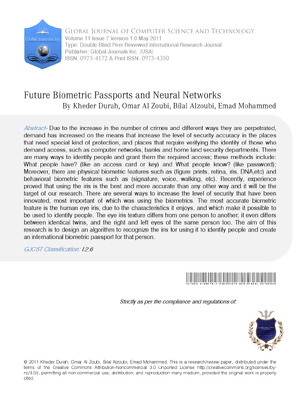
Due to the increase in the number of crimes and different ways they are perpetrated, demand has increased on the means that increase the level of security accuracy in the places that need special kind of protection, and places that require verifying the identity of those who demand access, such as computer networks, banks and home land security departments. There are many ways to identify people and grant them the required access; these methods include: What people have? (like an access card or key) and What people know? (like password); Moreover, there are physical biometric features such as (figure prints, retina, iris, DNA,etc) and behavioral biometric features such as (signature, voice, walking, etc). Recently, experience proved that using the iris is the best and more accurate than any other way and it will be the target of our research. There are several ways to increase the level of security that have been innovated, most important of which was using the biometrics. The most accurate biometric feature is the human eye iris, due to the characteristics it enjoys, and which make it possible to be used to identify people. The eye iris texture differs from one person to another; it even differs between identical twins, and the right and left eyes of the same person too. The aim of this research is to design an algorithm to recognize the iris for using it to identify people and create an international biometric passport for that person.
Omar Zoubi, Dr. Durah, Bilal Alzoubi. 1970. "Future Biometric Passports and Neural Networks". Global Journal of Computer Science and Technology GJCST Volume 11 (GJCST Volume 11 Issue 7).
Crossref Journal DOI 10.17406/gjcst
Print ISSN 0975-4350
e-ISSN 0975-4172
v1.2
Explore published articles in an immersive Augmented Reality environment. Our platform converts research papers into interactive 3D books, allowing readers to view and interact with content using AR and VR compatible devices.
Your published article is automatically converted into a realistic 3D book. Flip through pages and read research papers in a more engaging and interactive format.
Total Score: 169
Country: Saudi Arabia
Subject: Global Journal of Computer Science and Technology
Authors: Dr. Kheder Durah, Omar Al Zoubi, Bilal Alzoubi, Emad Mohammed (PhD/Dr. count: 1)
View Count (all-time): 216
Total Views (Real + Logic): 7874
Total Downloads (simulated): 653
Publish Date: 2011 03, Fri
Monthly Totals (Real + Logic):
We use cookies and similar technologies to improve site performance, understand traffic, and enhance your publishing experience. Cookie Policy
Choose which optional cookies Global Journals can use. Your preference applies across this platform and can be updated any time.
These cookies are required for core website functionality and security.

Lorem ipsum dolor sit amet, consectetur adipiscing elit. Ut elit tellus, luctus nec ullamcorper mattis, pulvinar dapibus leo.