I. INTRODUCTION
There are many theories to approximate incomplete information. Until recently, probability theory was the only existing theory to the approximate incomplete formation. Zadeh [11] proposed to deal with incomplete information. n Fuzzy set allows us to represent membership function as possibility distribution. Fuzzy theory is the most effective than the other theory because fuzzy theory depends on the degree of belief rather than likelihood (Probability). Fuzzy conditional propositions are of the type if (precedent part) then (consequent part). There are different methods of fuzzy conditional inference to approximate uncertain information [2,3,4,6,7]. The Zadeh and Mamdani inferences are needed prior information for both precedent and consequent part. There are some applications like fuzzy control systems that do not have prior information to the consequent part. The TSK fuzzy conditional inference need not know prior information to the consequent part, but it is difficult to compute.
The Sensors are able to sense and process the data. The Sensors are used to collect the data or information for many application like Wireless Sensor Networks and Contro Systems. The Wireless Sensor Network (WSN) and fuzzy control systems are given an example for proposed fuzzy conditional inference. It is necessary to give a brief description of fuzzy logic and WSN.
II. Fuzzy Logic
Zadeh [11] introduced the concept of a fuzzy set as a model of a vague fact. Fuzzy set theory for control systems is accepted because it is very convenient and believable. The fuzzy set may be defined with membership function or commonsense.
Definition: Given some universe of discourse X, a fuzzy set A of X is defined by its membership function taking values on the unit interval[0,1] i.e
Suppose X is a finite set. The fuzzy set A of X may be represented as
Where "+" is union For instance, fuzzy set may be defined with commonsense
There is an alternative way to defined fuzzy subset with function and is given by [7] For instance, fuzzy set may be defined with m**embership function
\begin{array}{c} \text {if x\in[0,25] = [1 + ((x - 25)2)] - 1} \\\text {if x\in[25,100]} \end{array}Let A and B be the fuzzy sets, and the operations on fuzzy sets are given below
Implication
The Zadeh fuzzy condition inference s given by if is and is and... and is then y is B = min
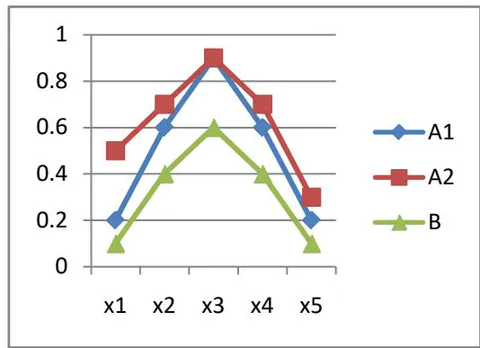
The Graphical representation of A1, A2 and b are shown in fig.1
Zadeh fuzzy inference is given as
Mamdani fuzzy inference is given as
Mamdani inference is given as if is and is and... and is then y is B = min( , B)
Reddy[7] fuzzy inference is given as if is and is and... and is then y is B
The "consequent" part is derived from "president" part of fuzzy conditions.
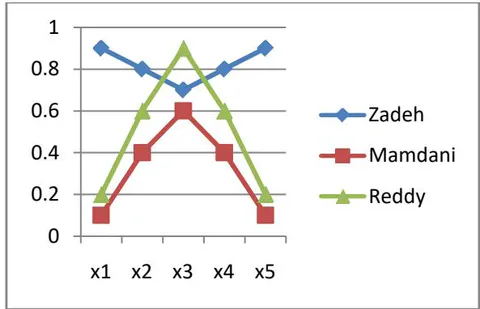
The Graphical representation of fuzzy inference is shown in Fig.2.
Composition
If some relation R between A and B is known and some value A1 then B1 is to infer from R
According to Zadeh fuzzy conditional inference
\begin{array}{c} \text {B1 = A1 o R = min\{\mu_ {A} (x), \mu_ {R} (x)\}} \\= \min \{\mu_ {A} (x), \min (1, 1 - \mu_ {A 1} (x) + \mu_ {B} (x)) \} \end{array}According to Mamdani fuzzy inference
If some relation R between A and B is not known According to The proposed fuzzy inference
III. WIRELESS SENSOR TECHNOLOGY
Natural calamities are unpredictable and happen within short periods. Therefore WSN technology used to capture signals and transmitted by monitoring. Wireless sensor technology that can send the sensed data to a data analysis center.
Fuzzy Inference System may be used an alternative procedure. The capture data may be analyzed using fuzzy parameters, and these parameters are used in fuzzy inference system. Fuzzy inference system is applied to WSN to detect Coastal erosion.
WSN technology has the capability of capturing and transmission of critical data in real-time. The most common forms are minimum spanning trees for wireless networking sensors.
Shortest paths: Minimal spanning tree is the shortest path connecting all the nodes with minimum distance. The Prim's algorithm may be used to construct minimum spanning tree. The minimum spanning tree has the base node and destination node. The data is transmitted from destination node to the base server.
The Prim's algorithm is to find a minimum spanning tree with nodes and edges. The nodes (V) are Sensors, and edges (E) are distances in WSN.
Algorithm Prim(G)
G(V,E) is a weighted connected Graph
is a set of edges of a minimum spanning tree
is the initial node with any vertex
\begin{array}{c} E _ {T} \leftarrow \theta \\\text {For i\leftarrow 1 to IVI - 1 do} \end{array}Find a minimum weight edges among all the edges (v,e)
Return
The minimum spanning tree of Fig.3 may be given as
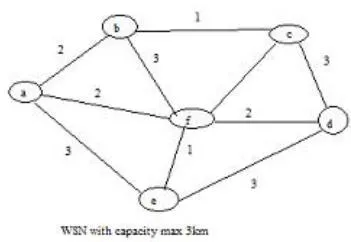
The path may be given as
The node d is the base node.
The Prim's' algorithm constructs spanning tree for collection of Data from WSN. FIS is applied on WSN to detect Costal erosions
IV. NEW METHOD OF Fuzzy Conditional INference
Zadeh[10], Mamdani[2], and TSK[3,4] proposed fuzzy conditional inference for incomplete information. Zadeh and Mamdani's inferences need prior information for the consequent part in "if... then..."
if is and is and... and is then y is B
Zadeh fuzzy inference is given by = min(1, 1-min( , ,..., ) + B)
The proposed fuzzy conditional inference for Zadeh fuzzy inference as when consequent part is not known
= min(1, 1-min( , ,..., + 1)), where B=1 because B is not known.
For instance
if x is A1 and x is A2 then x is B= B = and is not known Zadeh conditional inference is not suitable The fuzziness may be given for rule as If Depression is High and Temperature is High and Wave velocity is High Then Coastal Erosion is Savior. = min(1, (1- min{.6,0.7,0.8) +0.9) = 1 and is unknown Zadeh fuzzy conditional inference is not suitable when consequent part is unknown Mamdani inference is given by if is and is and... and is then y is B = min( , ,..., , B) The proposed fuzzy conditional inference for Mamdani fuzzy inference is given as when the consequent part is unknown = min( , ,..., , 1), where B=1 because B is not known. = min( , ,..., , 1) = min( , ,..., ) if x is A1 and x is A2 then x is B= B = 0.2/x1 + 10.6x2 + 0.9/x3 + 0.6x4 + 0.2/x5 For Example The fuzziness may be given for rule as If Depression is High and Temperature is High and Wave velocity is High Then Coastal Erosion is Savior = min(.6,0.7,0,8,0.8) =0.6
The TSK fuzzy conditional inferences are not known prior information for consequent part but it is difficult to compute applications like Control Systems and Medical diagnosis. Consider TSK fuzzy conditional inference If and ..... An) then is B A method is possible to define with memberships of when consequent part is not known
The proposed method for TSK fuzzy conditional inference may be defined as using t-norm[5] If x is and and , and or then y is If x is and or then y is Where t-norm is if x is A1 and x is A2 then x is B= The fuzziness may be given for rule as If Depression is High and Temperature is High and Wave velocity is High Then Coastal Erosion is Savior = min(.6,0.0.7, 0.8) =0.6
It may be observed that the proposed methods of Mamdani and TK conditional inferences are equal.
V. PRESENTATION OF FUZZY SET TYPE-2
The fuzzy set type-2 is a type of fuzzy set in which some additional degree of information is provided[6]
Definition: Given some universe of discourse X, a fuzzy set type-2 A of X is defined by its membership function taking values on the unit interval[0,1] i.e.
Suppose X is a finite set. The fuzzy set A of X may be represented as
John has "mild headache" with fuzziness 0.4
The fuzzy set type-2 may be defined as
Definition: The fuzzy set type-2 is characterized by membership function , x€X and y€A
Suppose X is a finite set. The fuzzy set A of X may be new represented by
Let and be the fuzzy sets.
The operations on fuzzy sets type-2 are given as Disjunction Conjunction Implication Relation
VI. Fuzzy Inference System
Fuzzy Inference System is Fuzzy Control System, which contains fuzzification ad defuzzification. The Fuzzification will be defined using the fuzzy rule. The fuzzy algorithm is a set of statements with a single fuzzy value. The fuzzy conditional statement is defined as fuzzy algorithm if is and is and... and is then is . The precedence part may contain and/or/not.
The Fuzzy Control System consists of a set of fuzzy rules
If (set of conditions are satisfied then (set of consequences inferred).
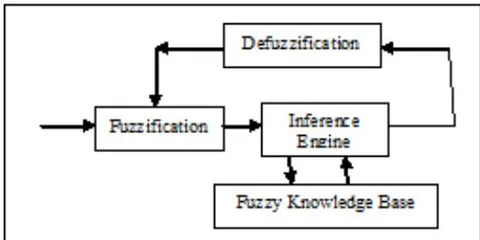
The Fuzzy control system contains fuzzy variable may be represent in a decision table
| A1 | A2 | .. | An | B | |
| A11 | A12 | .. | A1n | B1 | |
| A21 | A22 | .. | A2n | B2 | |
| Am1 | Am2 | .. | Amn | Bmn |
| Depression | Temperature | Wave Velocity | Erosion |
| High | High | High | Savior |
| Moderate | Normal | Moderate | moderate |
| Low | Low | Low | Normal |
| Moderate | Normal | Moderate | Moderate |
| High | High | Moderate | Moderate |
The relational model of fuzzy inference system for Coastal Erosion is given as If Depression is High and Temperature is High and Wave velocity is High Then Coastal Erosion is Savior For instance, consider the relational model of fuzzy control system
| Depression | Temperature | Wave Velocity | Erosion |
| 0.8 | 0.7 | 09 | |
| 0.6 | 0.5 | 0.8 | |
| 0.5 | 0.4 | 0.5 | |
| 0.6 | 0.7 | 0.6 | |
| 0.7 | 0.8 | 0.65 |
The Proposed fuzzy conditional inference are given as for Coastal Eroson
Defuzzification
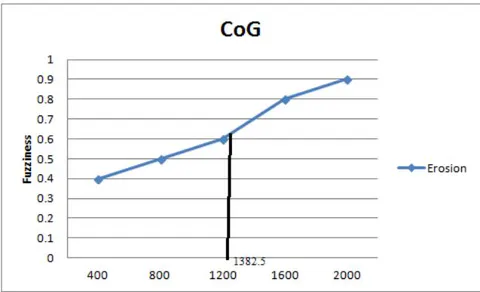
Usually Centroid technique is used for defuzzification. It finds value representing Centre of Gravity(COG) aggregated fuzzy generalized fuzzy set.
Erosion with Fuzziness and Transect Numbers are given as
VII. CONCLUSION
Some methods are studied for fuzzy conditional inference when prior information is unknown to consequent part. Zadeh and Mamdani methods are not suitable when prior information is unknown. A new method is proposed for "if... then..." when prior information is unknown to the consequent part with single fuzzy member function, and two fuzzy membership functions. Fuzzy Certainty Factor is defined with two membership functions to made a single fuzzy membership function. WSN are send data to the base station. The Fuzzy inference system (FIS) is Studied for WSN to detect Coastal erosions. The Prim's algorithm is used to construct a spanning tree for collection of Data from WSN to base station. Sensors are discussed an application for proposed fuzzy conditional inference. The Fuzzy Control System is given an example for FCF.
ACKNOWLEDGMENT
The author thanks to Prof. Yo-Ping Hiang for encouragement.