I. INTRODUCTION
The qualitative description by Quantum Mechanics of the Periodic Table of Mendeleev and the chemical bond [1] overshadowed the catastrophic discrepancies between the experimentally obtained Ionization Potentials [2, 3] and the energy position of the allowed levels obtained from the Schrödinger equation. Be that as it may, the Schrödinger equation was canonized to such an extent that even Richard Feynman, who came close to the original Planck-Einstein Quantization in his path integrals, did not dare to declare his approach to correcting the canonized equation [4, 5]. And as Bob Laughlin said in his Nobel lecture: To describe any quantum phenomenon, it is enough to take the Schrödinger equation and solve it under new boundary conditions [6]. And his solutions give no less serious discrepancies with the shape of electron orbitals [7, 8 9] and with experimentally measured phonon spectra [10]. And, as follows from the analysis of basic models [11], a huge number of earlier works, including mine, built on the canonized "Quantum Representations", are simply fitting the results of experiments to quantum mechanical calculations. Whereas ELEMENTARY ANALYSIS, as will be shown below, shows that the Schrödinger equation itself is a very rough fit to Bohr's atomic model.
The return of Mathematics to Physics by the senior telegrapher Havyside was actually a return to Newton's Physics, where they were UNITS. It helped both Maxwell in combing his Electrodynamics and Schroedinger in applying the operator method to describe the microcosm. So the very use of the operator method was undoubtedly progress, pushing both Dirac to build vector Quantum Mechanics and von Neumann to prove its Completeness. But the Completeness was obtained abstractly, for a set of operators, and was taken concretely as referring to Schrödinger solutions, which, as shown above, simply do not fit the careful characterization given by Einstein: "Some equations of Classical Physics allow rewriting in operator form". Einstein subtly sensed the dissonance of the equations with Reality, both some obtained by himself and some obtained by Schroedinger. That's what the analysis he conducted was pushing away from the verification of the Classical Equations rewritten by Schroedinger, from which Einstein himself (in the Theory of Relativity) was repelled by Bo with the phrase that he was taking on the role of God in determining the RIGHTness of the Classical Equations used. But God in Science is Logic, which must be followed, commensurate conclusions with Reality.
II. ANALYSIS OF PROPOSITIONS AND SOLUTIONS OF THE SCHRÖDINGER EQUATION
Einstein, pushed aside together with Planck, who laid the FOUNDATIONS of QUANTUM [12, 13], correctly formulated the method introduced by Schrödinger (actually for Schrödinger): "Some equations of classical physics can be rewritten in operator form." But Schrödinger, using the Hamiltonian of the One-Dimensional Equation
and with the help of the introduction of the mystical wave function, he "got" the Stationary, again one-dimensional Equation in the "operator form":
At the same time, Schrödinger acted as a professional fortune-teller, giving out the desired result and inventing all sorts of fables to "substantiate" it. He fitted, with phenomenological errors, Two-dimensional solutions - mystical wave functions of this, in principle, One-Dimensional Equation. Adjusted so that both quanta were (in the radial part of the solution) and two-dimensional orbits - orbitals (these solutions are given in all textbooks on "Quantum Mechanics"). In fact, he used
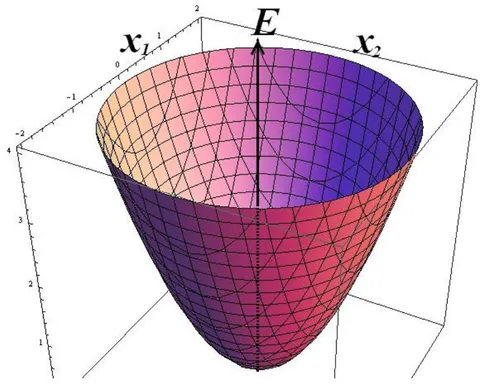
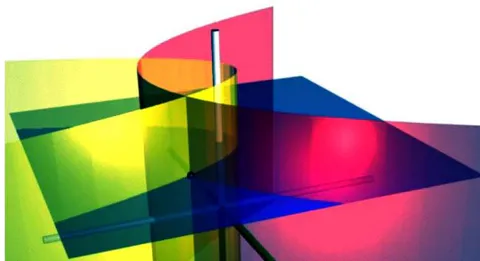
Newton's method of separation of variables to find the wave function, which gives only a particular solution [14]. But on the radial and angular parts, which corresponds not to the One-Dimensional Parabola, but, in fact, to the Paraboloid of rotation (Fig. 1).
The Schrödinger equation in its usual form (f.2) has a strict one-dimensional (radial), but not at all harmonic solution (f.3):
The complete solution is the interference of two terms, depending on the real purely real and complex, depending on the imaginary .
And it is the real term that has the property
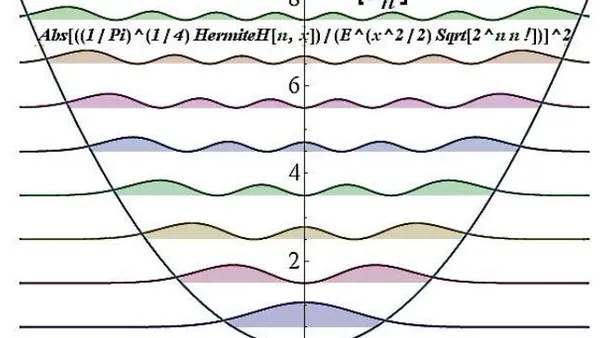
- The function is not equal to zero only in the area of origin only for integer values of (Fig. 2).
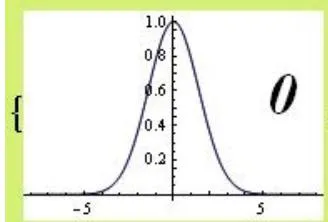
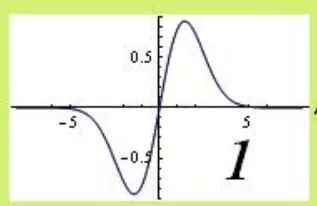
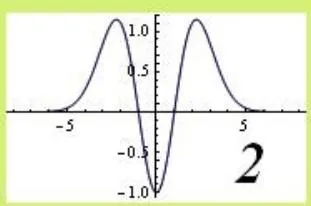
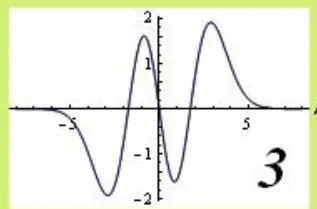
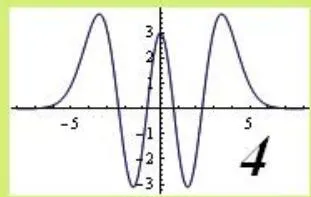
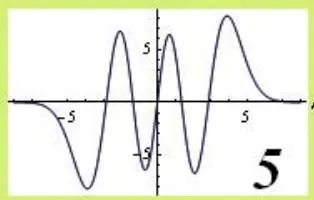
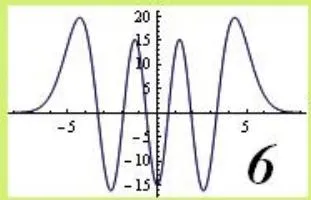
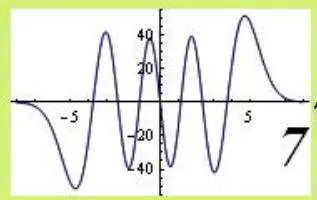
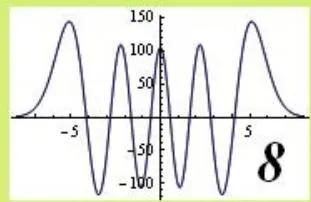
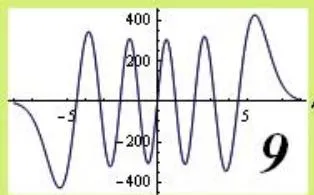
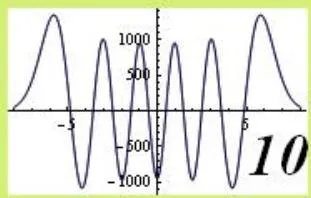
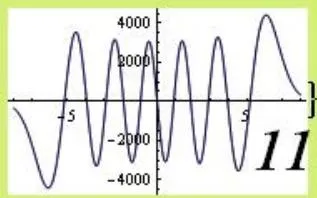
Those. for the radial part of the wave function, we have the values of "allowed" (guessed by Schrödinger) energies, with the non-physical half of the "zero oscillations"
This purely mathematical, abstract solution is not, strictly speaking, physical, since the function obtained, which describes the movement along a parabolic cylinder, when passing from one parabola of the cylinder section to another, undergoes a discontinuity of the derivative (Fig. 3).
The functions shown in Fig. 2 are not normalized, but in fact these are strictly obtained solutions for each "quantum" energy level, similar to those obtained approximately, but normalized "wave functions" of Schrödinger (Fig. 4).
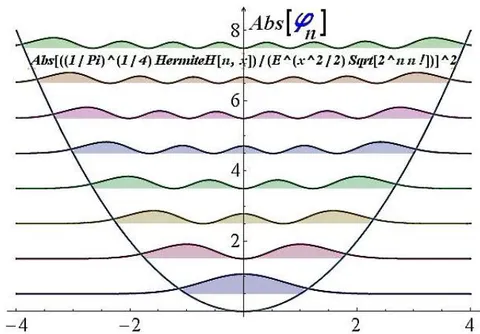
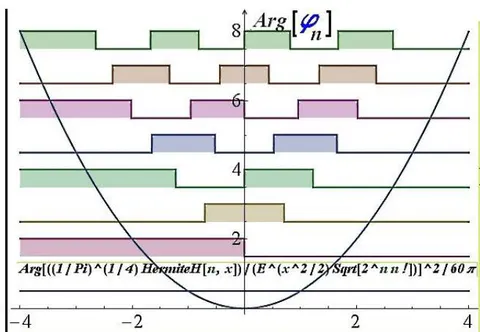
As can be seen from Fig. 4, Schrödinger's fitting of solutions, in principle, to the incorrect equation of the "Quantum Oscillator", gave only absolute values of "wave functions" similar to physical functions (Fig. 4, on the right), which were interpreted by "quantum physicists". But the phases corresponding to them are both absurd in magnitude and contain non-physical jumps - discontinuities in the derivatives.
The resulting abstract but rigorous solution is smooth (physical) dependences both on the actual values of the coordinate (shown in Fig. 2) and smooth dependences of the absolute value and phase for the term depending on the imaginary coordinate (f. 4). So, purely it is useful for initial, qualitative analysis.
First, as can be seen from Fig. 2, there are no halves of a quantum (Schrödinger). As can be seen from Fig. 4, the first level corresponds to zero energy. And the maximum of the hidden parameter of the particle is observed in the center, with its minimum bounce, which can be physically related to the fact that the minimum oscillation amplitudes near zero (Fig. 2, first inset) are smaller than the particle size. To be more precise, as follows from Pontryagin's dualism, even for an ideal Newton particle, its spatial uncertainty is less (the article "Analysis of Newton's Elementary Particle" in the book [13]). So, in relation to the electron orbitals of the atom, this term can be safely discarded.
Secondly, the first (and not one-and-a-half, as in Schrödinger) quantum level physically quite corresponds to finding a particle (somewhat blurred), but on a distinguished classical orbit, which will be analyzed in detail in the next part of the work "Correction of the Schrödinger Equation). We will not analyze the quantum levels following from formula 5, in accordance with formula 6, and so on, because taking into account its second, depending on the imaginary coordinate, term of the strict solution (f.4) gives the real and imaginary parts of the function limited in space, but not for all the numbers from formula (6), and also gives a number of additional numbers that also do not fit in any way into the canonized series of permitted levels according to Schrödinger.
III. CONCLUSION
It was from MISSION that the mysticism of two-dimensional mathematical solutions for a one-dimensional model was hidden behind the mystical parameter "wave function", to which the entire "understanding" of Quantum Theory was reduced to various interpretations. Thus, the correction of the original Classical Equation rewritten by Schrödinger in the operator form (correction of the Quantum Oscillator model) is required, and, possibly, the correction of the operators used by him. The correction of electronic atomic and molecular orbitals, which were directly associated with Schrödinger's solutions, will make it possible to solve the problems of many areas of science and technology associated with Physics. In the second, planned part of the work, within the framework of a two-dimensional model, ELEMENTARY Quantization based on harmonic de Broglie waves will be demonstrated.