Gender Analysis of Organizational Stereotypes in Bangladesh

1
Kuntala Chowdhury
Kuntala Chowdhury
1 Begum Rokeya University

Send Message

To: Author

GJHSS Volume 22 Issue C7

Article Fingerprint

ReserarchID

VRNG9

Gender Analysis of Organizational Stereotypes in Bangladesh Banner
  • English
  • Afrikaans
  • Albanian
  • Amharic
  • Arabic
  • Armenian
  • Azerbaijani
  • Basque
  • Belarusian
  • Bengali
  • Bosnian
  • Bulgarian
  • Catalan
  • Cebuano
  • Chichewa
  • Chinese (Simplified)
  • Chinese (Traditional)
  • Corsican
  • Croatian
  • Czech
  • Danish
  • Dutch
  • Esperanto
  • Estonian
  • Filipino
  • Finnish
  • French
  • Frisian
  • Galician
  • Georgian
  • German
  • Greek
  • Gujarati
  • Haitian Creole
  • Hausa
  • Hawaiian
  • Hebrew
  • Hindi
  • Hmong
  • Hungarian
  • Icelandic
  • Igbo
  • Indonesian
  • Irish
  • Italian
  • Japanese
  • Javanese
  • Kannada
  • Kazakh
  • Khmer
  • Korean
  • Kurdish (Kurmanji)
  • Kyrgyz
  • Lao
  • Latin
  • Latvian
  • Lithuanian
  • Luxembourgish
  • Macedonian
  • Malagasy
  • Malay
  • Malayalam
  • Maltese
  • Maori
  • Marathi
  • Mongolian
  • Myanmar (Burmese)
  • Nepali
  • Norwegian
  • Pashto
  • Persian
  • Polish
  • Portuguese
  • Punjabi
  • Romanian
  • Russian
  • Samoan
  • Scots Gaelic
  • Serbian
  • Sesotho
  • Shona
  • Sindhi
  • Sinhala
  • Slovak
  • Slovenian
  • Somali
  • Spanish
  • Sundanese
  • Swahili
  • Swedish
  • Tajik
  • Tamil
  • Telugu
  • Thai
  • Turkish
  • Ukrainian
  • Urdu
  • Uzbek
  • Vietnamese
  • Welsh
  • Xhosa
  • Yiddish
  • Yoruba
  • Zulu

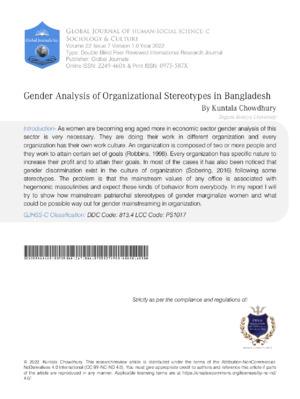
Introduction-As women are becoming eng aged more in economic sector gender analysis of this sector is very necessary. They are doing their work in different organization and every organization has their own work culture. An organization is composed of two or more people and they work to attain certain set of goals (Robbins, 1998). Every organization has specific nature to increase their profit and to attain their goals. In most of the cases it has also been noticed that gender discrimination exist in the culture of organization (Sobering, 2016) following some stereotypes. The problem is that the mainstream values of any office is associated with hegemonic masculinities and expect these kinds of behavior from everybody. In my report I will try to show how mainstream patriarchal stereotypes of gender marginalize women and what could be possible way out for gender mainstreaming in organization.

Funding

No external funding was declared for this work.

Conflict of Interest

The authors declare no conflict of interest.

Ethical Approval

No ethics committee approval was required for this article type.

Data Availability

Not applicable for this article.

Kuntala Chowdhury. 2026. \u201cGender Analysis of Organizational Stereotypes in Bangladesh\u201d. Unknown Journal GJHSS-C Volume 22 (GJHSS Volume 22 Issue C7): .

Download Citation

Gender stereotypes and organizational biases in Bangladesh.
Issue Cover
GJHSS Volume 22 Issue C7
Pg. 25- 28
Journal Specifications
Keywords
Classification
GJHSS-C Classification: DDC Code: 813.4 LCC Code: PS1017
Version of record

v1.2

Issue date

January 12, 2023

Language

English

Experiance in AR

The methods for personal identification and authentication are no exception.

Read in 3D

The methods for personal identification and authentication are no exception.

Article Matrices
Total Views: 1411
Total Downloads: 31
2026 Trends
Research Identity (RIN)
Related Research

Published Article

Introduction-As women are becoming eng aged more in economic sector gender analysis of this sector is very necessary. They are doing their work in different organization and every organization has their own work culture. An organization is composed of two or more people and they work to attain certain set of goals (Robbins, 1998). Every organization has specific nature to increase their profit and to attain their goals. In most of the cases it has also been noticed that gender discrimination exist in the culture of organization (Sobering, 2016) following some stereotypes. The problem is that the mainstream values of any office is associated with hegemonic masculinities and expect these kinds of behavior from everybody. In my report I will try to show how mainstream patriarchal stereotypes of gender marginalize women and what could be possible way out for gender mainstreaming in organization.

Our website is actively being updated, and changes may occur frequently. Please clear your browser cache if needed. For feedback or error reporting, please email [email protected]
×

This Page is Under Development

We are currently updating this article page for a better experience.

Request Access

Please fill out the form below to request access to this research paper. Your request will be reviewed by the editorial or author team.
X

Quote and Order Details

Contact Person

Invoice Address

Notes or Comments

This is the heading

Lorem ipsum dolor sit amet, consectetur adipiscing elit. Ut elit tellus, luctus nec ullamcorper mattis, pulvinar dapibus leo.

High-quality academic research articles on global topics and journals.

Gender Analysis of Organizational Stereotypes in Bangladesh

Kuntala Chowdhury
Kuntala Chowdhury Begum Rokeya University

Research Journals