





As I read this report it took me back to the early 1960s, when I was an Army medic at Fort Jackson, in Columbia, South Carolina, and wheeled a young heavily bleeding pregnant Women’s Army Corp (WAC) into the emergency room. I remember the doctors huddling in a quick conference in the hall and, then, she very quickly received a Dilation and Curettage (D&C). Essentially an abortion. As I read the Center’s report and replayed that memory in my mind, I realized that under the current administration that young woman might not have gotten the help she needed so desperately.
That experience, and the memories it provoked, led me over the next several months to deeply examine the research data on gender equality, American cultural consciousness, and the correlation with social wellbeing.
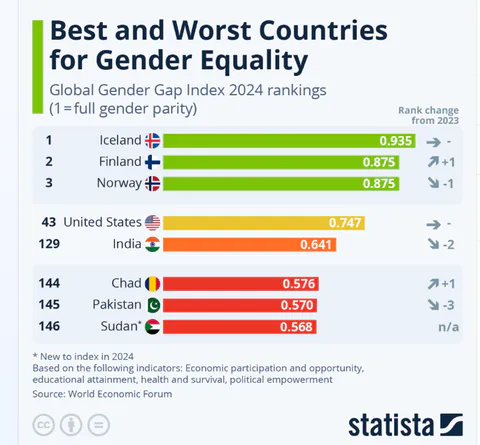
What I very quickly discovered is that as long ago as 2016, as was reported in Great Britain’s The Guardian, “The US, the world’s biggest economy, ranks below Kazakhstan and Algeria for gender equality, according to a report showing the countries that offer the most opportunities for girls.”[3]
Female subordination is usually discussed in a political, philosophical, or religious context, but I want to look at it in a different way: through the lense of objectively verifiable science research data, The issue of gender equality from that perspective rarely is discussed, except in academia, and I think it deserves much more attention, because it is clear every human society is affected by this issue, and science has made it clear that gender equality is a matter of existential importance. Let me start with this reason for justifying that statement: the correlation of gender equality and social happiness.
What stands out for you as you look at those two charts? I suggest it is the outstanding correlation between happiness and social wellbeing and gender equality. That correlation raises a question almost never discussed: If social wellbeing and happiness correlate so strongly with gender equality, why do some countries choose social misery over gender equality?
To answer that question one has to begin by recognizing that cultures are created by a defining consensus based on endlessly repeated individual mundane daily acts of consciousness. That’s why the Chinese cook eggplant differently than the French. That’s why the English drive on the left hand side of the ride and the Americans on the right side. Consensus of choices is the beginning and then, often, the consensus becomes law, fixing a culture in a specific form.
The only way this changes is when at least 10 per cent of the individuals in a culture to change their consciousness. That is why nonviolent social transformation works. That is how Gandhi got the United Kingdom to give independence to its most valuable and precious colony, India. That is how Nelson Mandela ended Apartheid in South Africa, and how Martin Luther King got President Lyndon Johnson to sign the Civil Rights Act if 1964, and the Voting Rights Act of 1965. This is why you don’t hear anyone use the word negro anymore.
To quote something from my book on social transformation, The 8 Laws of Change[4]:
“Skewing the arc of our cultural narrative toward wellness is doable. A study done by the Social Cognitive Networks Academic Research Center at Rensselaer Polytechnic Institute provides data-based guidance.
‘To change the beliefs of an entire community, only 10 percent of the population needs to become convinced of a new or different opinion. At that tipping point, the idea can spread through social networks and alter behaviors on a large scale.’ ”
In the case of gender equality the urgency for achieving this is much greater than most people realize.
Objectively verified social outcome research shows that when gender equality improves men are as deeply positively affected as women because social happiness also improves. But even as important as those improvements are, they are but a part of why gender equality needs to be achieved.
A team of researchers, led by Sarah Lawless of ARC Centre of James Cook University, studied gender equality in the context of both social and environmental wellbeing and published their conclusions in 2022: “Global visions of environmental change consider gender equality to be a foundation of sustainable social-ecological systems. Similarly, social-ecologicl systems frameworks position gender equality as both a precursor to, and a product of, system sustainability.”[5]
This was confirmed three years later by research supported by the United Nations. It found, “The climate crisis is one of the most pressing issues of our times. It threatens to reverse progress on human rights and sustainable development and worsens gender inequality – posing specific risks to the ways of life, livelihoods, health, safety and security for all women and girls around the world.”[6]
Gender equality and environmental sustainability clearly are deeply linked, because climate change disproportionately impacts women and girls, particularly in developing regions, exacerbating existing poverty, food insecurity, and health risks. While bearing the brunt of environmental disasters and resource depletion, women are crucial agents of change, because, in their livelihoods, they often adopt more sustainable practices.
China, the United States, and India, all of which rank poorly in gender equality, are the world’s top carbon dioxide polluters, producing over 50% of global emissions. This is primarily driven by coal reliance and industrial activity.
The question for these nations with such poor gender equality is can and will these very different cultures change their equality for women, since the science research shows that gender equality is such a factor in both national societal happiness, but for a reason even greater than national happiness. Gender equality is shaping the environment, and this is a matter of great urgency. How urgent?
Well, consider this research study just published in the journal Frontiers of Science. “Human activities are driving a global decline in biodiversity and are interfering with the natural processes essential for human well-being. Achieving climate and development goals is impossible without keeping nature intact. In this article, we establish the urgent need for a paradigm shift toward a “Nature Positive” (NP) future, where the health and resilience of the Earth system are recognized as the fundamental basis for human prosperity. This requires that humanity acts to halt and reverse the loss of nature by 2030.”[7]
Can the high polluter, and even the less polluting nations make the compassionate, life-affirming choices to muster the necessary 10 percent? Humanity is going to be profoundly affected by that answer.


