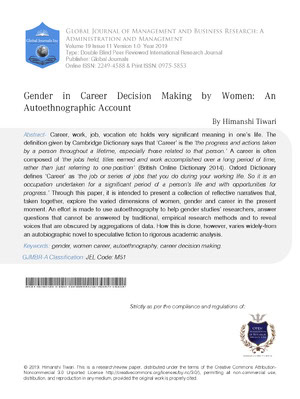
Gender in Career Decision Making by Women: An Autoethnographic Account

Send Message

To: Author

Gender in Career Decision Making by Women: An Autoethnographic Account

Article Fingerprint

ReserarchID

MBR76S11

Gender in Career Decision Making by Women: An Autoethnographic Account Banner

Key Research Insights

Synthesized scholarly intelligence & interactive research assistant
  • English
  • Afrikaans
  • Albanian
  • Amharic
  • Arabic
  • Armenian
  • Azerbaijani
  • Basque
  • Belarusian
  • Bengali
  • Bosnian
  • Bulgarian
  • Catalan
  • Cebuano
  • Chichewa
  • Chinese (Simplified)
  • Chinese (Traditional)
  • Corsican
  • Croatian
  • Czech
  • Danish
  • Dutch
  • Esperanto
  • Estonian
  • Filipino
  • Finnish
  • French
  • Frisian
  • Galician
  • Georgian
  • German
  • Greek
  • Gujarati
  • Haitian Creole
  • Hausa
  • Hawaiian
  • Hebrew
  • Hindi
  • Hmong
  • Hungarian
  • Icelandic
  • Igbo
  • Indonesian
  • Irish
  • Italian
  • Japanese
  • Javanese
  • Kannada
  • Kazakh
  • Khmer
  • Korean
  • Kurdish (Kurmanji)
  • Kyrgyz
  • Lao
  • Latin
  • Latvian
  • Lithuanian
  • Luxembourgish
  • Macedonian
  • Malagasy
  • Malay
  • Malayalam
  • Maltese
  • Maori
  • Marathi
  • Mongolian
  • Myanmar (Burmese)
  • Nepali
  • Norwegian
  • Pashto
  • Persian
  • Polish
  • Portuguese
  • Punjabi
  • Romanian
  • Russian
  • Samoan
  • Scots Gaelic
  • Serbian
  • Sesotho
  • Shona
  • Sindhi
  • Sinhala
  • Slovak
  • Slovenian
  • Somali
  • Spanish
  • Sundanese
  • Swahili
  • Swedish
  • Tajik
  • Tamil
  • Telugu
  • Thai
  • Turkish
  • Ukrainian
  • Urdu
  • Uzbek
  • Vietnamese
  • Welsh
  • Xhosa
  • Yiddish
  • Yoruba
  • Zulu
Reading Preferences
Font Size
Line Spacing
Background
This converted HTML version may contain rendering inconsistencies. Please refer to the PDF for the authoritative version, or click here to provide feedback.

Abstract

Career, work, job, vocation etc holds very significant meaning in one’s life. The definition given by Cambridge Dictionary says that ‘Career’ is the ‘the progress and actions taken by a person throughout a lifetime, especially those related to that person.’ A career is often composed of ‘the jobs held, titles earned and work accomplished over a long period of time, rather than just referring to one position’ (British Online Dictionary 2014). Oxford Dictionary defines ‘Career’ as ‘the job or series of jobs that you do during your working life. So it is an occupation undertaken for a significant period of a person’s life and with opportunities for progress.’ Through this paper, it is intended to present a collection of reflective narratives that, taken together, explore the varied dimensions of women, gender and career in the present moment. An effort is made to use autoethnography to help gender studies’ researchers, answer questions that cannot be answered by traditional, empirical research methods and to reveal voices that are obscured by aggregations of data. How this is done, however, varies widely-from an autobiographic novel to speculative fiction to rigorous academic analysis.

References

33 Cites in Article
  1. 1. Thomas Ng,Lillian Eby,Kelly Sorensen,Daniel Feldman (2005). PREDICTORS OF OBJECTIVE AND SUBJECTIVE CAREER SUCCESS: A META‐ANALYSIS. Personnel Psychology, 58(2), 367-408.
  2. 2. Andrea Abele,Daniel Spurk (2009). The longitudinal impact of self-efficacy and career goals on objective and subjective career success. Journal of Vocational Behavior, 74(1), 53-62.
  3. 3. T Ng,L Eby,K Sorensen,D Feldman (2005). Predictors of objective and subjective career success. A metaanalysis. Personnel Psychology, 58, 367-408.
  4. 4. A.-M Lämsä,M (2008). Career counselling for women managers at mid-career: Developing an autobiographical approach. Gender in Management, 23(6), 395-408.
  5. 5. V Abraham (2013). Missing labour or consistent "de-feminisation. Economic and Political Weekly, 48(31), 99-108.
  6. 6. Norman Amundson (2015). Using metaphor in career intervention. APA handbook of career intervention, Volume 2: Applications., 293-304.
  7. 7. P Applications,M Hartung,W Savickas,Walsh (2015). APA handbook of career intervention, Volume 2: Applications. APA handbook of career intervention, Volume 2: Applications.
  8. 8. Nancy Betz,Gail Hackett (2006). Career Self-Efficacy Theory: Back to the Future. Journal of Career Assessment, 14(1), 3-11.
  9. 9. D Bloch (2005). Complexity chaos and nonlinear dynamics: A new perspective on career development theory. Career Development Quarterly, 53, 194-207.
  10. 10. N Denzin,Y Lincoln (2017). Handbook of qualitative research. Handbook of qualitative research
  11. 11. M Domenico,K Jones (2006). Career Aspirations of Women in the 20th Century. Journal of Career and Technical Education, 22(2), 1-5.
  12. 12. Carolyn Ellis,Tony Adams,Arthur Bochner (2010). Autoethnography: An Overview. Forum: Qualitative Social Research
  13. 13. Ruth Ernst,Jocene Vallack (2015). Storm Surge. Qualitative Inquiry, 21(2), 153-160.
  14. 14. Itamar Gati,Mina Krausz,Samuel Osipow (1996). A taxonomy of difficulties in career decision making. Journal of Counseling Psychology, 43(4), 510-526.
  15. 15. G Hackett (1995). Self-efficacy and career choice and development. Self-efficacy in adaptation of youth to changing societies, 232-258.
  16. 16. G Hackett,N Betz (1992). Self-Efficacy Perceptions and the Career-Related Choices of College Students. Student Perceptions in the Classroom, 243-260.
  17. 17. N Hillsdale Unknown Title.
  18. 18. Gail Hackett (1985). Role of mathematics self-efficacy in the choice of math-related majors of college women and men: A path analysis. Journal of Counseling Psychology, 32(1), 47-56.
  19. 19. G Hackett,N Betz (1981). A self-efficacy approach to the career development of women. Journal of Vocational Behavior, 18, 326-339.
  20. 20. E Herr,S Cramer (1992). Career guidance and counselling through the life span: Systematic approaches. Career guidance and counselling through the life span: Systematic approaches
  21. 21. J Holland (1997). Making vocational choices: A theory of vocational personalities and work environments. Making vocational choices: A theory of vocational personalities and work environments
  22. 22. A-M Lämsä,T Savela (2014). The effect of an MBA on the development of women's management competencies: a gender viewpoint. Baltic Journal of Management, 9(2), 213-230.
  23. 23. Robert Lent,Gail Hackett,Steven Brown (2002). A Social Cognitive View of School‐to‐Work Transition. The Career Development Quarterly, 47(4), 297-311.
  24. 24. D Brown,L Brooks,Associates Career choice and development. Career choice and development
  25. 25. S Leung,P Chen (2007). Developing counselling psychology in Chienese communities in Asia: Indegenous, multicultural, and cross cultural considerations. The Counselling Psychologist, 37(7), 944-966.
  26. 26. Angela Martina,Danielle Caretta,Johanna Drozdzewski,Carolina Jokinen,Emily Falconer (2018). Who can play this game?" The lived experiences of doctoral candidates and early career women in the neoliberal university. Journal of Geography in Higher Education
  27. 27. Thomas Ng,Lillian Eby,Kelly Sorensen,Daniel Feldman (2005). PREDICTORS OF OBJECTIVE AND SUBJECTIVE CAREER SUCCESS: A META‐ANALYSIS. Personnel Psychology, 58(2), 367-408.
  28. 28. S Osipow,L Fitzgerald (1996). Theories of career development. Theories of career development
  29. 29. F Parsons (2016). Choosing a Vocation. Choosing a Vocation
  30. 30. M Patton (2002). Qualitative Research and Evaluation Methods. Qualitative Research and Evaluation Methods
  31. 31. S Phillips,A Imhoff (1997). Women and career development: A decade of research. Annual Review of Psychology, 48, 31-59.
  32. 32. A Sen (1992). Missing women. BMJ, 304(6827), 587-588.
  33. 33. D Super (1990). A life-span, life-space approach to career development. Career choice and development

Funding

No external funding was declared for this work.

Conflict of Interest

The authors declare no conflict of interest.

Ethical Approval

No ethics committee approval was required for this article type.

Data Availability

Not applicable for this article.

How to Cite This Article

Himanshi Tiwari. 2019. "Gender in Career Decision Making by Women: An Autoethnographic Account". Global Journal of Management and Business Research - A: Administration & Management GJMBR-A Volume 19 (GJMBR Volume 19 Issue A11).

Download Citation

Journal Specifications

Crossref Journal DOI 10.17406/GJMBR

Print ISSN 0975-5853

e-ISSN 2249-4588

Keywords
Classification
GJMBR-A Classification JEL Code: M51
Version of record

v1.2

Issue date
October 3, 2019

Language
English
Order Article Reprint
Experiance in AR

Explore published articles in an immersive Augmented Reality environment. Our platform converts research papers into interactive 3D books, allowing readers to view and interact with content using AR and VR compatible devices.

Read in 3D

Your published article is automatically converted into a realistic 3D book. Flip through pages and read research papers in a more engaging and interactive format.

Article Matrices
Total Views: 1.1K
Total Downloads: 85
All Trends

Request Access

Please fill out the form below to request access to this research paper. Your request will be reviewed by the editorial or author team.
X

This is the heading

Lorem ipsum dolor sit amet, consectetur adipiscing elit. Ut elit tellus, luctus nec ullamcorper mattis, pulvinar dapibus leo.


High-quality academic research articles on global topics and journals.

Gender in Career Decision Making by Women: An Autoethnographic Account

Himanshi Tiwari
Himanshi Tiwari