
Neural Networks and Rules-based Systems used to Find Rational and Scientific Correlations between being Here and Now with Afterlife Conditions
Neural Networks and Rules-based Systems used to Find Rational and

Article Fingerprint
ReserarchID
EPMT8
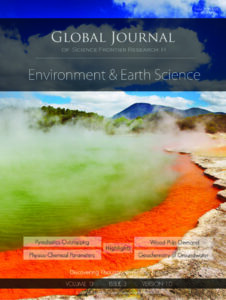
Nairobi City the Capital of Kenya lies on the eastern flank of the Kenya Rift Valley. The geological succession includes metamorphic and igneous rocks as well as interbedded lacustrine and alluvial sediments. Groundwater has been encountered in aquifers within the thirteen different geologic units in the succession. The objective of this study was to analyse the geochemistry of groundwater for major and minor elements, heavy metals as well as the presence of pollutants. The 30 samples were collected and analysed using international standards. Membrane Filter Technique, Ion chromatography, Atomic Absorption Spectrometry and Inductively Coupled Plasma were some of the methods of analysis used. The results show that the physical parameters of the groundwater across the study area range from those within the recommended World Health Organisation limits to those that raise concern such as the high turbidity, pH and electrical conductivity values in boreholes in Embakasi, Industrial area, and Karen. Since these parameters signify potential for microbial contamination, a research should be carried out to analyse their variation and the relationship with lithology and structural geology of the area. Results of this study as well as those of past chemical analyses indicate that major anions and cations concentrations are within the limits recommended by WHO. High nitrate concentrations are detected in the shallow wells. Fluoride content is above internationally recommended limits in majority of the boreholes.
Caroline Onyancha. 2013. \u201cGeochemistry of Groundwater in the Volcanic Rocks of Nairobi City\u201d. Global Journal of Science Frontier Research - H: Environment & Environmental geology GJSFR-H Volume 13 (GJSFR Volume 13 Issue H3): .
Crossref Journal DOI 10.17406/GJSFR
Print ISSN 0975-5896
e-ISSN 2249-4626
The methods for personal identification and authentication are no exception.
Total Score: 102
Country: Kenya
Subject: Global Journal of Science Frontier Research - H: Environment & Environmental geology
Authors: Caroline Onyancha, Zachary Getenga (PhD/Dr. count: 0)
View Count (all-time): 155
Total Views (Real + Logic): 5007
Total Downloads (simulated): 2479
Publish Date: 2013 09, Wed
Monthly Totals (Real + Logic):
Neural Networks and Rules-based Systems used to Find Rational and
A Comparative Study of the Effeect of Promotion on Employee
The Problem Managing Bicycling Mobility in Latin American Cities: Ciclovias
Impact of Capillarity-Induced Rising Damp on the Energy Performance of
Nairobi City the Capital of Kenya lies on the eastern flank of the Kenya Rift Valley. The geological succession includes metamorphic and igneous rocks as well as interbedded lacustrine and alluvial sediments. Groundwater has been encountered in aquifers within the thirteen different geologic units in the succession. The objective of this study was to analyse the geochemistry of groundwater for major and minor elements, heavy metals as well as the presence of pollutants. The 30 samples were collected and analysed using international standards. Membrane Filter Technique, Ion chromatography, Atomic Absorption Spectrometry and Inductively Coupled Plasma were some of the methods of analysis used. The results show that the physical parameters of the groundwater across the study area range from those within the recommended World Health Organisation limits to those that raise concern such as the high turbidity, pH and electrical conductivity values in boreholes in Embakasi, Industrial area, and Karen. Since these parameters signify potential for microbial contamination, a research should be carried out to analyse their variation and the relationship with lithology and structural geology of the area. Results of this study as well as those of past chemical analyses indicate that major anions and cations concentrations are within the limits recommended by WHO. High nitrate concentrations are detected in the shallow wells. Fluoride content is above internationally recommended limits in majority of the boreholes.
We are currently updating this article page for a better experience.

Lorem ipsum dolor sit amet, consectetur adipiscing elit. Ut elit tellus, luctus nec ullamcorper mattis, pulvinar dapibus leo.































































