This converted HTML version may contain rendering inconsistencies. Please refer to the PDF for the authoritative version, or click here to provide feedback.
Report an Issue
Abstract
Using contributions of gluon to pseudoscalar meson & vector meson , to search for masses of lightest glueball AND using Higgs Particle & gauge particle for gigantic glueball.
Contents
Introduction(P.2)
Portion I Foundations
Part A Geometrical Coordinates of particle Color(P.6)
Part B Role of Gluon in Logical Mathematical World(P.8)
Portion II Glueball
Part C Role of Gluon in Real Physical World(P.15)
Part D Masses of Lightest Glueball(P.25)
Window of Gigantic Glueball(P.27)
References
1. Introduction
Structure: This paper is divided into two portions. Portion I and Portion II below :
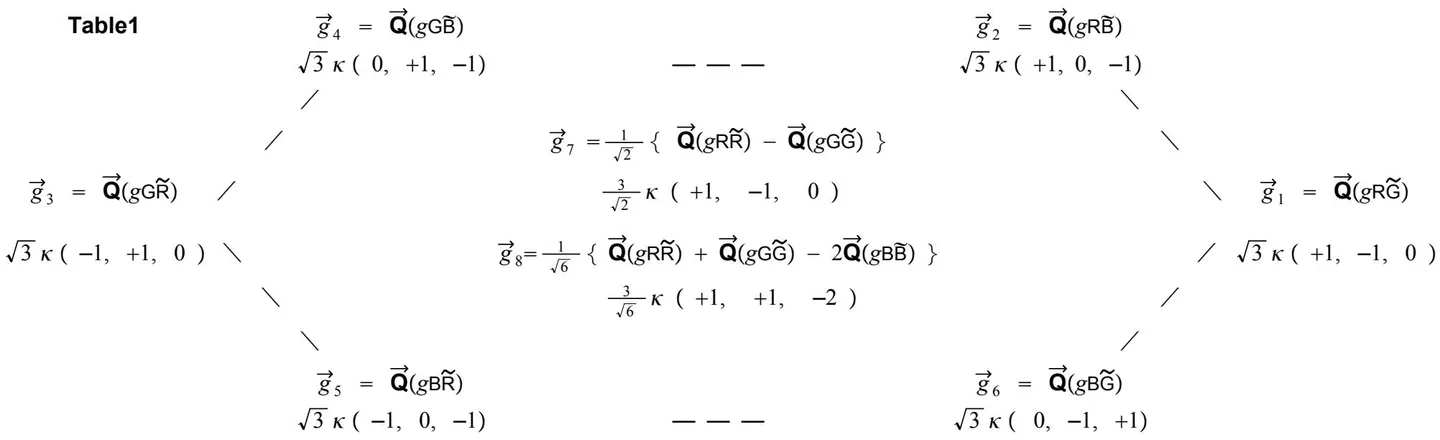
◆ Portion I is math foundament of color representation of particle , which consist of Part A and Part B. Seven color-units that construct three groups of color coordinates of particle are shown by Table 1 in Part A. Eight geometrical coordinates of gluons are given by Table 6 and Table 7 in Part B.
Portion II is about mass contribution of gluon to Particle in Part C, with which to discuss the masses of glueball in Part D.
• In Part C, the contributions of gluon to mesons are given following:
Where and are the lowest energy states of quarks and antiquarks wtth clectric charges and .
And
AND for mesons and :
• Using the above results, formulas (0.1) (0.2) turn to ✠1, ✠2.1 and ✠2.2. following
✠1 For
✠2.1 For
And
✠2.2 For
• In Part D, Using the above results, consequently we could obtain masse of Scalar Glueball and masses of Pseudoscalar Glueball.
• In Last paragraph, extending from low energy to high energy in which to discuss Gigantic Glueball.
2. Foundations
2.1. Part A Geometrical Coordinates of particle Color
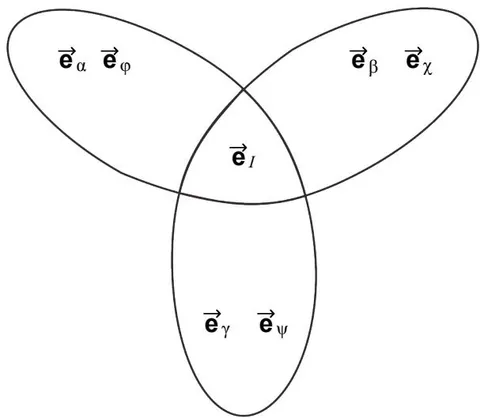
Seven color-units construct three groups of color coordinates, that are group , group and group . Each group is color orthogonal normalization. is the intersection of these three gruops.
Figure 1: Intersection of Seven Elements
Following are the color representations of Table 1, Intersection of Seven Elements
and
Orthogonal normalization
Some useful formulas below
2.2. Part B Role of Gluon g in Logical Mathematical World
Logistic Routine
Figure 2: Quark pair to pseudoscalar meson
From Flovor u, d, s to Color R,G,B
Figure 3: Color pair to boson gluon g (0 − )
AND
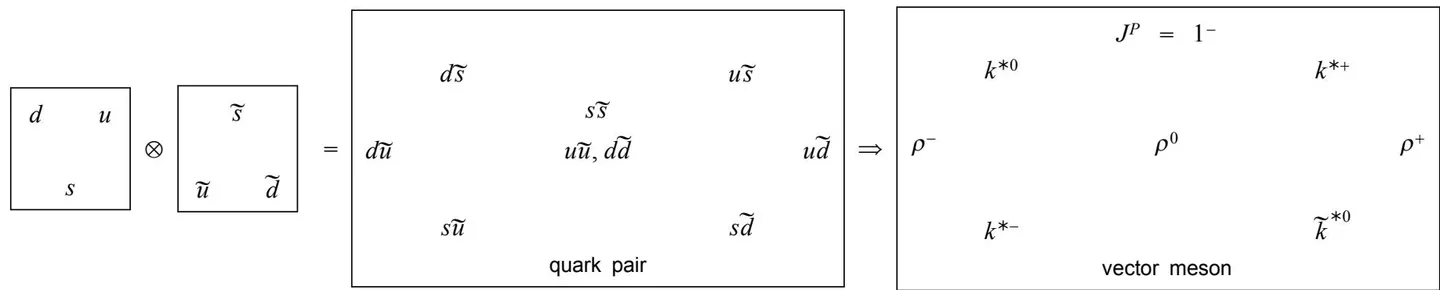
Figure 4: Quark pair to vector meson
From Flovor u, d, s to Color R,G,B
Figure 5: Color pair to boson gluon g (1 − )
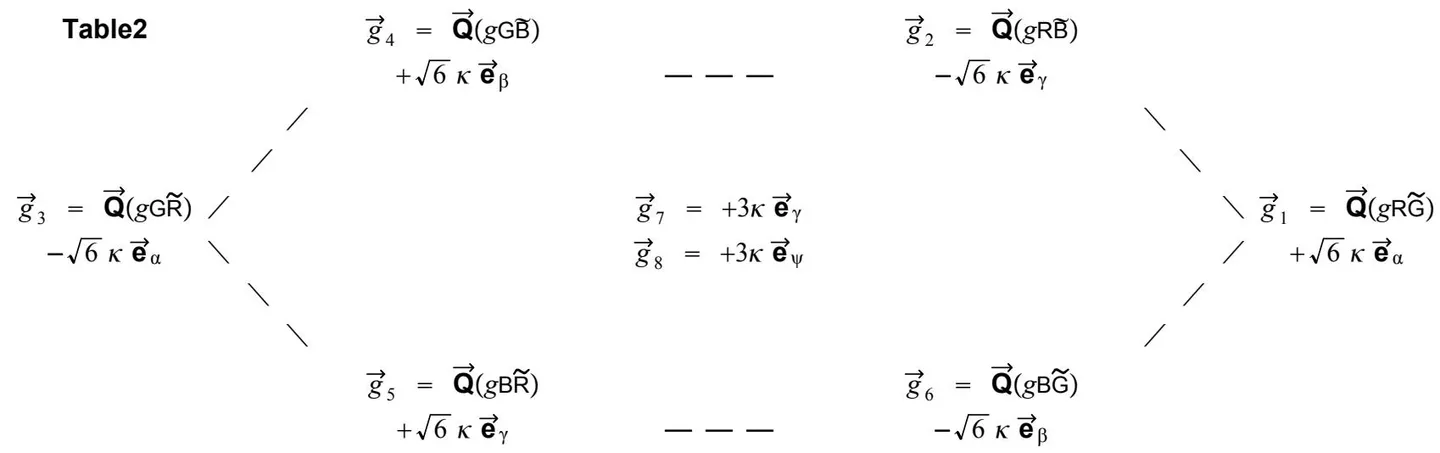
From Table 3 Table 5 above, obtain Table 6 Table 7 following
◆ Color Coordinate of Charge Function of Six Colored Gluons
◆ Color Coordinate of Charge Function of Three Neutral Gluons
Lead to
shows: no gluon-interaction between quarks, no single gluon exists.
Next calculating (11) and (12) below,
AND
OR
Figure 6: Geometrical coordinates of gluonsFigure 7: Geometrical coordinates of gluons in unit vectors
2.3. SUMMARY
◆ Color Coordinate of six colored gluons
And
◆ Color Coordinate of two neutral gluons
and Scalar Product
3. Part C Role of Gluon g in Real Physical World
The color charges R,G,B of gluons g and the coloed quarks play the essential role in Quantum Chromodynamics QCD. In this paper we use Mass Principle to discuss QCD.
To have a clearer learning the importance of gluon, an example of production of meson that arise from quark-antuquark pair and quark-antuquark pair is given following. There are two cases :
◆1 In case1 of no gluon included, the process is forbidden
◆2 In case2 of gluon included, the process is permitted
This paragraph depicts the logistic rounte of (1) to (2), borrow the color representation of Mass Principle
Using color representations of the mass experimental values of particles below,
and
Base on Mass Principle, further we could have particle masses of the previous particles
Now using (00.6) (00.7) below, (3.1) (3.2) & (4.1) (4.2) could be rewritten into more symmetrical, more concise expressions (7.1)(7.2) & (8.1)(8.2) shown following
▲1
▼1
and
▲2
▼2
OR
◆3
◆4
And
◆5
The observable charges of (7.1) (7.2) and (8.1) (8.2), could be obtained by (9.1) (9.2). An example of (7.1) to find the charge of quark following:
Substitute (9.1) (9.2) into (7.1), get (10):
From (7.1) (7.2), obtain (11):
From (8.1) (8.2), obtain (12):
• • From (11), obtain (13):
• • From (12), obtain (14):
On another side, color representation and scalar product of are given below:
Compare (13) (14) with (16), yield two inequations (17) (18) below:
After (17) being decomposed into (19). We see :
Notice (11), obtain (20):
Because of inequation (19) and inequation (20), we see the results are contradicting Equation (1).
SO the process (1) of meson that arise from quark-antiquark pair is forbidden !
In the same way, (18) excludes the process (1) of meson below:
(18) show : the amounts of bound states (13) (14) are too small to construct a neutral meson (264.187 866 9312) (16), there must something be ignored !
IF something called gluon ( percentages and everything else that are very few ) that be added to the left sides of (19) (20), consequently the two inequations could become equations (21) (23) below, Win the ticket to QCD ! We win.
Using mark
becomes
From (23), yielding
Last obtain the contribution of gluon to meson below:
◆7
We see could help complete the way (1) to (2). In a word:
Due to (19) (20)
Due to (21)
Same reason, from (26) (27)
and obtain the contribution (28) of gluon to meson below:
◆8
Analogy with neutral meson (1) (2), charged mesons (29)(30)(31)(32) and (33)(34)(35)(36) can be made below:
3.1. Summary
From Table 2 , Table 3 , the contributions (25) (28) of gluon to pseudoscalar meson are given below:
◆7
◆8
Where the terms on the rights of (25) (28) are given by following four results:
And
Finally (25) (28) turn to (37) (38) below:
And the same way, from Table 4 , Table 5 , the contributions (39) (40) of gluon to vector meson are given below:
◆11
◆12
Where the terms on the rights of (39) (40) are given by following four results:
And
Finally (39) (40) turn to (43) (44) and (45) (46) respectively following:
AND
4. Part D Masses of Lightest Glueball
■1 Making linear combination of (37) and (38) below:
Using (47) to obtain color representation of scalar glueball:
Base on mass principle, obtain mass of scalar glueball below:
■2 Making linear combination of (43) and (44) below:
Using (50) to obtain color representation of pseudovector glueball:
Base on mass principle, obtain mass of pseudovector glueball :
■3 Making linear combination of (45) and (46) below:
Using (53) to obtain color representation of pseudovector glueball:
Base on mass principle, obtain mass of pseudovector glueball :
4.1. Window of Gigantic Glueball
Using gauge boson Z & boson H Higgs particle to deal with masses of glueball following:
Where:
Next to search for masses of gigantic glueball of H Higgs particle (1) (2) and gauge boson Z (3) (4) respectively following:
From (1) (2) for H, obtain (9)(10) and (11)(12) below:
Where:
Further using the above results, yield 1 2 below:
1 Making linear combination of (9) and (11) below:
Using (16) to obtain color representation of scalar glueball:
Base on mass principle, obtain mass of gigantic glueball below:
2 Making linear combination of (10) and (12) below:
Using (19) to obtain color representation of glueball:
Base on mass principle, obtain mass of gigantic glueball below:
NOTICE:
From (3) (4) for , obtain (23) (24) and (25) (26) below:
Where:
Further using the above results, yield 3 4 below:
3 Making linear combination of (23) and (25) below:
Using (28) to obtain color representation of glueball:
Base on mass principle, obtain mass of gigantic glueball below:
4 Making linear combination of (24) and (26) below:
Using (31) to obtain color representation of glueball:
Base on mass principle, obtain mass of gigantic glueball below:
NOTICE:
Thanks to GJSFR, offering an academic platform for researchers all over the world.
References
10 Cites in Article
1.Shao-Xu Ren (2026). A Unified Mass Theory of Elementary Fermions and Elementary Bosons. Global Journal of Science Frontier Research: A Physics and Space Science, 26(1), 15-45.
2.Shao-Xu Ren (2025). The Zeroth of Generation Zh of Fermion, A Unified Mass Theory of Twelve Elementary Fermions. Global Journal of Science Frontier Research: A Physics and Space Science, 25(6), 27-61.
3.Shao-Xu Ren (2025). Production and Decay of Higgs Boson, From God Particle H to Heaven Particle II. Global Journal of Science Frontier Research: A Physics and Space Science, 25(5), 36-58.
4.Shao-Xu Ren (2025). Colorization of Gell-mann-Nishijima Relation and Mass Principle, Origins of Mass; Fermions and Charges, Bosons and Color-Pairs. Global Journal of Science Frontier Research: A Physics and Space Science, 25(3), 93-128.
Explore published articles in an immersive Augmented Reality environment. Our platform converts research papers into interactive 3D books, allowing readers to view and interact with content using AR and VR compatible devices.
Read in 3D
Your published article is automatically converted into a realistic 3D book. Flip through pages and read research papers in a more engaging and interactive format.
Article Matrices
Total Score: 174
Country: China
Subject: Global Journal of Science Frontier Research
Authors:
(PhD/Dr. count: 0)
View Count (all-time): 218
Total Views (Real + Logic): 74
Total Downloads (simulated): 2
Publish Date: 2026 09, Tue
Monthly Totals (Real + Logic):
Month 1: 64 views
Month 2: 100 views
Month 3: 36 views
Total Views: 74
Total Downloads: 2
All Trends
This is the heading
Lorem ipsum dolor sit amet, consectetur adipiscing elit. Ut elit tellus, luctus nec ullamcorper mattis, pulvinar dapibus leo.
Math Coordinates of Particle Color, Mass of Glueball