Glutathione@Fe3O4 Nanoparticles as Efficient Material for the Adsorption of Mercury(II) from Water At Low Concentrations

Wilfredo Marimón-Bolívar
Edgar E. González
Edgar E. González
Pontificia Universidad Javeriana Pontificia Universidad Javeriana

Send Message

To: Author

Glutathione@Fe3O4 Nanoparticles as Efficient Material for the Adsorption of Mercury(II) from Water At Low Concentrations

Article Fingerprint

ReserarchID

TO19W

Glutathione@Fe3O4 Nanoparticles as Efficient Material for the Adsorption of Mercury(II) from Water At Low Concentrations Banner

AI TAKEAWAY

Connecting with the Eternal Ground
  • English
  • Afrikaans
  • Albanian
  • Amharic
  • Arabic
  • Armenian
  • Azerbaijani
  • Basque
  • Belarusian
  • Bengali
  • Bosnian
  • Bulgarian
  • Catalan
  • Cebuano
  • Chichewa
  • Chinese (Simplified)
  • Chinese (Traditional)
  • Corsican
  • Croatian
  • Czech
  • Danish
  • Dutch
  • Esperanto
  • Estonian
  • Filipino
  • Finnish
  • French
  • Frisian
  • Galician
  • Georgian
  • German
  • Greek
  • Gujarati
  • Haitian Creole
  • Hausa
  • Hawaiian
  • Hebrew
  • Hindi
  • Hmong
  • Hungarian
  • Icelandic
  • Igbo
  • Indonesian
  • Irish
  • Italian
  • Japanese
  • Javanese
  • Kannada
  • Kazakh
  • Khmer
  • Korean
  • Kurdish (Kurmanji)
  • Kyrgyz
  • Lao
  • Latin
  • Latvian
  • Lithuanian
  • Luxembourgish
  • Macedonian
  • Malagasy
  • Malay
  • Malayalam
  • Maltese
  • Maori
  • Marathi
  • Mongolian
  • Myanmar (Burmese)
  • Nepali
  • Norwegian
  • Pashto
  • Persian
  • Polish
  • Portuguese
  • Punjabi
  • Romanian
  • Russian
  • Samoan
  • Scots Gaelic
  • Serbian
  • Sesotho
  • Shona
  • Sindhi
  • Sinhala
  • Slovak
  • Slovenian
  • Somali
  • Spanish
  • Sundanese
  • Swahili
  • Swedish
  • Tajik
  • Tamil
  • Telugu
  • Thai
  • Turkish
  • Ukrainian
  • Urdu
  • Uzbek
  • Vietnamese
  • Welsh
  • Xhosa
  • Yiddish
  • Yoruba
  • Zulu
Font Type
Font Size
Font Size
Bedground

Abstract

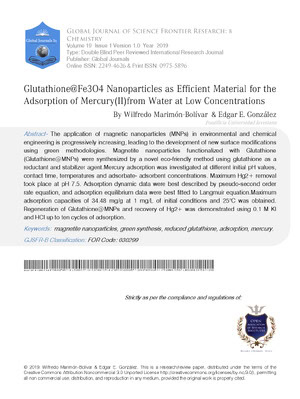
The application of magnetic nanoparticles (MNPs) in environmental and chemical engineering is progressively increasing, leading to the development of new surface modifications using green methodologies. Magnetite nanoparticles functionalized with Glutathione (Glutathione@MNPs) were synthesized by a novel eco-friendly method using glutathione as a reductant and stabilizer agent.Mercury adsorption was investigated at different initial pH values, contact time, temperatures and adsorbate-adsorbent concentrations. Maximum Hg2+ removal took place at pH 7.5. Adsorption dynamic data were best described by pseudo-second order rate equation, and adsorption equilibrium data were best fitted to Langmuir equation.Maximum adsorption capacities of 34.48 mg/g at 1 mg/L of initial conditions and 25°C was obtained. Regeneration of Glutathione@MNPs and recovery of Hg2+ was demonstrated using 0.1 M KI and HCl up to ten cycles of adsorption.

References

68 Cites in Article
  1. Qiuya Zhang,Wei Zhou,Yubo Cui,Chaojie Lyu,Tong Liu,Rongzun Zhang,Rui Zhang,Jinlong Zheng,Zhaoliang Shi,Chengxin Lu,Lin Guo (2018). Iron triad nanomaterials and their sustainable application in the environment.
  2. Luciana De Souza Neves Ellendersen,Maria Milinsk,Michael Feroldi,Izabel Volkweis Zadinelo,Lilian Dena Dos Santos,Graciela Bolzón De Muniz,Lázaro Gasparrini,Helton Alves (2018). Biopolymer foam for remediation of aquatic environments contaminated with particulates and heavy metals.
  3. Alicia Moreno-Ortega,Rafael Moreno-Rojas,Jesús Martínez-Álvarez,Montserrat González Estecha,Numa Castro González,Manuel Amaro López (2017). Probabilistic risk analysis of mercury intake via food consumption in Spain.
  4. Ya Chu,Songyu Liu,Fei Wang,Hanliang Bian,Guojun Cai (2018). Electric conductance response on engineering properties of heavy metal polluted soils.
  5. E González,J Marrugo,V Martínez (2015). El problema de contaminación por mercurio.
  6. R Li,H Wu,J Ding,W Fu,L Gan,Y Li (2017). Mercury pollution in vegetables, grains and soils from areas surrounding coal-fired power plants.
  7. L Wade (2013). Gold's dark side.
  8. Barbara Fraser (2016). Peru’s gold rush prompts public-health emergency.
  9. Wenzhong Tang,Shenghui Duan,Baoqing Shan,Hong Zhang,Wenqiang Zhang,Yu Zhao,Chao Zhang (2016). Concentrations, diffusive fluxes and toxicity of heavy metals in pore water of the Fuyang River, Haihe Basin.
  10. Fei Wang,Xingwen Lu,Xiao-Yan Li (2016). Selective removals of heavy metals (Pb2+, Cu2+, and Cd2+) from wastewater by gelation with alginate for effective metal recovery.
  11. Maths Berlin,Rudolfs Zalups,Bruce Fowler (2015). Mercury.
  12. Xiayang Yu,Pei Xin,Chunhui Lu,Clare Robinson,Ling Li,D Barry (2017). Effects of episodic rainfall on a subterranean estuary.
  13. F Mérida,A Chiu-Lam,A Bohórquez,L Maldonado-Camargo,M.-E Pérez,L Pericchi,M Torres-Lugo,C Rinaldi (2015). Optimization of synthesis and peptization steps to obtain iron oxide nanoparticles with high energy dissipation rates.
  14. Pedro Alvarez,Candace Chan,Menachem Elimelech,Naomi Halas,Dino Villagrán (2018). Emerging opportunities for nanotechnology to enhance water security.
  15. M Santos,A Seabra,M Pelegrino,P Haddad (2016). Synthesis, characterization and cytotoxicity of glutathione- and PEG-glutathione-superparamagnetic iron oxide nanoparticles for nitric oxide delivery.
  16. Piao Xu,Guang Zeng,Dan Huang,Ming Yan,Ming Chen,Cui Lai,Hui Jiang,Hai Wu,Guo Chen,Jia Wan (2017). Fabrication of reduced glutathione functionalized iron oxide nanoparticles for magnetic removal of Pb(II) from wastewater.
  17. Vivek Polshettiwar,Babita Baruwati,Rajender Varma (2009). Magnetic nanoparticle-supported glutathione: a conceptually sustainable organocatalyst.
  18. Wilfredo Marimón-Bolívar,Edgar González (2018). Green synthesis with enhanced magnetization and life cycle assessment of Fe 3 O 4 nanoparticles.
  19. Krisiam Ortiz-Martínez,Pratap Reddy,Wilman Cabrera-Lafaurie,Félix Román,Arturo Hernández-Maldonado (2016). Single and multi-component adsorptive removal of bisphenol A and 2,4-dichlorophenol from aqueous solutions with transition metal modified inorganic–organic pillared clay composites: Effect of pH and presence of humic acid.
  20. Krisiam Ortiz-Martínez,Karen Guerrero-Medina,Félix Román,Arturo Hernández-Maldonado (2015). Transition metal modified mesoporous silica adsorbents with zero microporosity for the adsorption of contaminants of emerging concern (CECs) from aqueous solutions.
  21. D Robati,B Mirza,M Rajabi,O Moradi,I Tyagi,S Agarwal,V Gupta (2016). Removal of hazardous dyes-BR 12 and methyl orange using graphene oxide as an adsorbent from aqueous phase.
  22. Jawad Ali,Huabin Wang,Jerosha Ifthikar,Aimal Khan,Ting Wang,Kun Zhan,Ajmal Shahzad,Zhulei Chen,Zhuqi Chen (2018). Efficient, stable and selective adsorption of heavy metals by thio-functionalized layered double hydroxide in diverse types of water.
  23. Changwoo Kim,Seung Lee,Brandon Lafferty,Daniel Giammar,John Fortner (2018). Engineered superparamagnetic nanomaterials for arsenic(<scp>v</scp>) and chromium(<scp>vi</scp>) sorption and separation: quantifying the role of organic surface coatings.
  24. B Tejada,T Tejada,B Marimón,O Villabona (2014). Revista Luna Azul.
  25. Yana Bagbi,Ankur Sarswat,Dinesh Mohan,Arvind Pandey,Pratima Solanki (2016). Lead (Pb2+) adsorption by monodispersed magnetite nanoparticles: Surface analysis and effects of solution chemistry.
  26. Jianhui Zhao,Jie Liu,Ning Li,Wei Wang,Jun Nan,Zhiwei Zhao,Fuyi Cui (2016). Highly efficient removal of bivalent heavy metals from aqueous systems by magnetic porous Fe3O4-MnO2: Adsorption behavior and process study.
  27. Candelaria Tejada Tovar,Edgar Quiñones Bolaños,Lesly Tejeda Benitez,Wilfredo Marimón Bolivar (2015). Absorción de Cromo Hexavalente en soluciones acuosas por cascaras de naranja (Citrus sinensis).
  28. Xiuqin Chen,Qing Ye,Dongdong Ma,Jianling Chen,Yuhua Wang,Hongqing Yang,Shusen Xie,Rongguo Yu,Yiru Peng (2018). Gold nanoparticles-pyrrolidinonyl metal phthalocyanine nanoconjugates: Synthesis and photophysical properties.
  29. Meisam Sadeghi,Fatemeh Hanifpour,Reza Taheri,Hamedreza Javadian,Maryam Ghasemi (2016). Comparison of using formaldehyde and carboxy methyl chitosan in preparation of Fe3O4 superparamagnetic nanoparticles-chitosan hydrogel network: Sorption behavior toward bovine serum albumin.
  30. Wilfredo Marimón-Bolívar,Lesly Tejeda-Benítez,Adriana Herrera (2018). Removal of mercury (II) from water using magnetic nanoparticles coated with amino organic ligands and yam peel biomass.
  31. Ling Zhang,Rong He,Hong-Chen Gu (2006). Oleic acid coating on the monodisperse magnetite nanoparticles.
  32. W Marimón-Bolívar,E González (2018). Study of agglomeration and magnetic sedimentation of Glutathione@Fe3O4 nanoparticles in water medium.
  33. Kumar Vikrant,Ki-Hyun Kim (2019). Nanomaterials for the adsorptive treatment of Hg(II) ions from water.
  34. María-José López-Muñoz,Amaya Arencibia,Luis Cerro,Raquel Pascual,Álvaro Melgar (2016). Adsorption of Hg(II) from aqueous solutions using TiO2 and titanate nanotube adsorbents.
  35. Zhuoxing Wang,Jiang Xu,Yunjun Hu,Heng Zhao,Junliang Zhou,Yu Liu,Zimo Lou,Xinhua Xu (2016). Functional nanomaterials: Study on aqueous Hg(II) adsorption by magnetic Fe3O4@SiO2-SH nanoparticles.
  36. Yang Xiong,Jian Li,Le Gong,Xue Feng,Li Meng,Le Zhang,Pan Meng,Ming Luo,Feng Luo (2017). Using MOF-74 for Hg2+ removal from ultra-low concentration aqueous solution.
  37. Yunfeng Wang,Rongjun Qu,Fangwei Pan,Xinhua Jia,Changmei Sun,Chunnuan Ji,Ying Zhang,Kai An,Yinglei Mu (2017). Preparation and characterization of thiol- and amino-functionalized polysilsesquioxane coated poly(p-phenylenetherephthal amide) fibers and their adsorption properties towards Hg(II).
  38. L Largitte,R Pasquier (2016). A review of the kinetics adsorption models and their application to the adsorption of lead by an activated carbon.
  39. Hamou Moussout,Hammou Ahlafi,Mustapha Aazza,Hamid Maghat (2018). Critical of linear and nonlinear equations of pseudo-first order and pseudo-second order kinetic models.
  40. Mousumi Basu,Arun Guha,Lalitagauri Ray (2017). Adsorption of Lead on Cucumber Peel.
  41. Amanullah Mahar,Ping Wang,Amjad Ali,Mukesh Awasthi,Altaf Lahori,Quan Wang,Ronghua Li,Zengqiang Zhang (2016). Challenges and opportunities in the phytoremediation of heavy metals contaminated soils: A review.
  42. Eunhee Ha,Niladri Basu,Stephan Bose-O’reilly,José Dórea,Emeir Mcsorley,Mineshi Sakamoto,Hing Chan (2017). Current progress on understanding the impact of mercury on human health.
  43. Chilton Ng,Jack Losso,Wayne Marshall,Ramu Rao (2002). Freundlich adsorption isotherms of agricultural by-product-based powdered activated carbons in a geosmin–water system.
  44. C Sheindorf,M Rebhun,M Sheintuch (1981). A Freundlich-type multicomponent isotherm.
  45. Ying-Xia Ma,Dan Xing,Wen-Jie Shao,Xue-Yan Du,Pei-Qing La (2017). Preparation of polyamidoamine dendrimers functionalized magnetic graphene oxide for the adsorption of Hg(II) in aqueous solution.
  46. Xiaoxia Yao,Huicai Wang,Zhenhua Ma,Mingqiang Liu,Xiuqing Zhao,Dai Jia (2016). Adsorption of Hg(II) from aqueous solution using thiourea functionalized chelating fiber.
  47. Mingyang Sun,Guanghuan Cheng,Xinlei Ge,Mindong Chen,Cheng Wang,Liping Lou,Xinhua Xu (2017). Aqueous Hg(II) immobilization by chitosan stabilized magnetic iron sulfide nanoparticles.
  48. Yang Wang,Yun Zhang,Chen Hou,Xinghua He,Mingzhu Liu (2016). Preparation of a novel TETA functionalized magnetic PGMA nano-absorbent by ATRP method and used for highly effective adsorption of Hg(II).
  49. Mora Alvarez,N Pastrana,J Lagos,Y Lozada,J (2018). Evaluation of mercury(Hg2+) adsorption capacity using exhausted coffee waste.
  50. Yingjie Li,Wenfeng Li,Qingnan Liu,Hong Meng,Yingzhou Lu,Chunxi Li (2018). Alkynyl carbon materials as novel and efficient sorbents for the adsorption of mercury(II) from wastewater.
  51. Jinrong Lu,Xiaonan Wu,Yao Li,Wenquan Cui,Yinghua Liang (2018). Modified silica gel surface with chelating ligand for effective mercury ions adsorption.
  52. Monica Bansal,Bhagat Ram,Ghanshyam Chauhan,Anupama Kaushik (2018). l-Cysteine functionalized bagasse cellulose nanofibers for mercury(II) ions adsorption.
  53. Yue Sun,Dan Lv,Jiasheng Zhou,Xiaoxin Zhou,Zimo Lou,Shams Baig,Xinhua Xu (2017). Adsorption of mercury (II) from aqueous solutions using FeS and pyrite: A comparative study.
  54. Gang Xu,Lu Wang,Yujia Xie,Minli Tao,Wenqin Zhang (2018). Highly selective and efficient adsorption of Hg2+ by a recyclable aminophosphonic acid functionalized polyacrylonitrile fiber.
  55. E Fosso-Kankeu,Hemant Mittal,F Waanders,Suprakas Ray (2017). Thermodynamic properties and adsorption behaviour of hydrogel nanocomposites for cadmium removal from mine effluents.
  56. Youssef Miyah,Anissa Lahrichi,Meryem Idrissi,Anis Khalil,Farid Zerrouq (2018). Adsorption of methylene blue dye from aqueous solutions onto walnut shells powder: Equilibrium and kinetic studies.
  57. Maisara Raja Shahrom,Cecilia Wilfred,Fai Chong (2018). Thermodynamic and kinetic studies on CO2 capture with Poly[VBTMA][Arg].
  58. Chubaakum Pongener,Parimal Bhomick,Aola Supong,Mridushmita Baruah,Upasana Sinha,Dipak Sinha (2018). Adsorption of fluoride onto activated carbon synthesized from Manihot esculenta biomass—Equilibrium, kinetic and thermodynamic studies.
  59. Mahboobeh Dirbaz,Aliakbar Roosta (2018). Adsorption, kinetic and thermodynamic studies for the biosorption of cadmium onto microalgae Parachlorella sp..
  60. Mohammad Amer,Akl Awwad (2018). Removal of As(V) from aqueous solution by adsorption onto nanocrystalline kaolinite: Equilibrium and thermodynamic aspects of adsorption.
  61. John Thomas (1961). The existence of endothermic adsorption.
  62. Norasikin Saman,Khairiraihanna Johari,Shiow-Tien Song,Helen Kong,Siew-Chin Cheu,Hanapi Mat (2017). High removal efficacy of Hg(II) and MeHg(II) ions from aqueous solution by organoalkoxysilane-grafted lignocellulosic waste biomass.
  63. L Tran,P Wu,Y Zhu,S Liu,N Zhu (2015). Comparative study of Hg(II) adsorption by thiol-and hydroxyl-containing bifunctional montmorillonite and vermiculite.
  64. L Tran,P Wu,Y Zhu,L Yang,N Zhu (2015). Highly enhanced adsorption for the removal of Hg(II) from aqueous solution by Mercaptoethylamine/ Mercaptopropyltrimethoxysilane functionalized vermiculites.
  65. Lytuong Tran,Pingxiao Wu,Yajie Zhu,Shuai Liu,Nengwu Zhu (2015). Comparative study of Hg(II) adsorption by thiol- and hydroxyl-containing bifunctional montmorillonite and vermiculite.
  66. Chao Shan,Zhiyao Ma,Meiping Tong,Jinren Ni (2015). Removal of Hg(II) by poly(1-vinylimidazole)-grafted Fe3O4@SiO2 magnetic nanoparticles.
  67. R Herrero,P Lodeiro,C Rey-Castro,T Vilariño,M Sastre De Vicente (2005). Removal of inorganic mercury from aqueous solutions by biomass of the marine macroalga Cystoseira baccata.
  68. (2015). Ministerio de ambiente y desarrollo sostenible.

Funding

No external funding was declared for this work.

Conflict of Interest

The authors declare no conflict of interest.

Ethical Approval

No ethics committee approval was required for this article type.

Data Availability

Not applicable for this article.

How to Cite This Article

Wilfredo Marimón-Bolívar. 2019. \u201cGlutathione@Fe3O4 Nanoparticles as Efficient Material for the Adsorption of Mercury(II) from Water At Low Concentrations\u201d. Global Journal of Science Frontier Research - B: Chemistry GJSFR-B Volume 19 (GJSFR Volume 19 Issue B1).
Download Citation

Journal Specifications

Crossref Journal DOI 10.17406/GJSFR

Print ISSN 0975-5896

e-ISSN 2249-4626

Keywords
Classification
GJSFR-B Classification FOR Code: 030299
Version of record

v1.2

Issue date
February 16, 2019

Language
en
Experiance in AR

Explore published articles in an immersive Augmented Reality environment. Our platform converts research papers into interactive 3D books, allowing readers to view and interact with content using AR and VR compatible devices.

Read in 3D

Your published article is automatically converted into a realistic 3D book. Flip through pages and read research papers in a more engaging and interactive format.

Article Matrices
Total Views: 2938
Total Downloads: 1438
2026 Trends
Related Research
Our website is actively being updated, and changes may occur frequently. Please clear your browser cache if needed. For feedback or error reporting, please email [email protected]

Request Access

Please fill out the form below to request access to this research paper. Your request will be reviewed by the editorial or author team.
X

Quote and Order Details

Contact Person

Invoice Address

Notes or Comments

This is the heading

Lorem ipsum dolor sit amet, consectetur adipiscing elit. Ut elit tellus, luctus nec ullamcorper mattis, pulvinar dapibus leo.


High-quality academic research articles on global topics and journals.

Glutathione@Fe3O4 Nanoparticles as Efficient Material for the Adsorption of Mercury(II) from Water At Low Concentrations

Wilfredo Marimón-Bolívar
Wilfredo Marimón-Bolívar <p>Pontificia Universidad Javeriana</p>
Edgar E. González
Edgar E. González

Research Journals