## I. INTRODUCTION
CSR, for those unaware, CSR is an abbreviation of corporate social responsibility. According to Jason[^1], "Corporate social responsibility is a self-regulating business model that helps a company be socially accountable to itself, its stakeholders and the public." Further, he mentions that by CSR activities, companies can be conscious of the kind of impact they are having on all aspects of society and environment.
In 2022 alone $^{2}$, AdEx (advertising expenditure) stood at 1,26,818 crore rupees in India, similarly, in FY (financial year) 2020-2021 total amount spent by the total sum of 18012 companies on CSR in India was 25714.75 crore rupees. This data clearly shows us the importance and value of AdEx over csr from the perspective of the corporates in terms of multidimensional growth. The purpose and aim of this paper is to open a new window of perspective, which shows how to create a golden win-win situation for majorly 3 parties- 1) businesses 2) community/society 3) end consumers or customers depending on the business model, along with spreading the awareness of csr to promote corporates for social contributions and to utilize CSR as a marketing strategy, encouraging the public to make a decision to buy the product which has a firm social background, and to analyze csr's benefits. This idea of a golden win-win situation evolves the profit for all three parties, hence the name. The profit mentioned is not only monetary to any or all the parties, but in different forms. For the community/society, this profit correlates to the welfare, upliftment and empowerment of the less privileged, needy sections not only includes financially weak sections but also for example mentally challenged or racially discriminated sections etc.
It is a general perception towards CSR activities led by corporations that the Philanthropy done by them is only increasing their revenue rather than actually doing any actual philanthropic work. The same was the idea of Friedman[^3] in a 1970 New York Times magazine article in which mentioned that the only "social responsibility of business" is to "increase its profits." He also concluded in his book that "if charitable contributions are to be made, they should be made by individual stockholders or individual employees rather than the corporation itself, the reason being is the instrument who own it and the corporation should not make it as it prevents the individual stockholder from deciding how to dispose his/her stocks by their will.
In this paper, we will be discussing Friedman's perspective regarding social responsibility of business, although rather taking it in a negative sense, we will be taking it in a positive sense and further proposing the "golden win-win situation".
Discussing further, in contrast to Friedman's perspective, there is another equally common perspective that CSR activities by businesses have no economic or monetary benefit. This perspective is heavily supported by the survey mentioned below in this paper which we shall analyze later. This perspective is also countered and showed how businesses can do good through CSR activities and still generate additional revenue, again creating a "golden win-win situation", following this will be the showcase and elaboration on the evidence which backs this idea proposed.
## II. EMPLOYEE ENGAGEMENT
Employee engagement shows us the enthusiasm and motivation of the employee in their work and workplace, higher levels of employee engagement usually means higher productivity and effectiveness of the employee towards their job and satisfaction towards the cause of their respective company. From an employer's perspective, the purpose of employee engagement is the maximum outcome, based on the resources invested in employees, which is similar to job satisfaction by employees.
Analysis of a survey by Shachi[^4] and others, shows that $58.6\%$ of employees think that CSR makes them feel better about the work they do, in addition, $70\%$ of HRs felt that the employees involved in CSR are better engaged at work. Adhering to the analysis done by both, we can see the indirect relation between CSR and productivity and how it boosts it and finally helps in the monetary growth of the company.
According to Megan[^5], perceived organizational support is the "employee perceptions regarding the extent to which their employer "values their contributions and cares about their well-being". Ante[^6] argues that CSR activities can possibly create a positive POS, after which
Ante further explains how positive POS can increase employee engagement. The given figure graphically explains his argument.
## III. BRAND EQUITY
A company's good reputation is a valuable strategic asset that helps differentiate it from its competitors[^7]. As per kevin[^8], Brand equity can be defined in terms of marketing effects uniquely attributable to a brand. Positive brand equity occurs when different outcomes are observed in the marketing of a product or service because of its brand, compared with the results if that same product or service was not identified by that brand. According to Adam[^9], the company has a better brand equity has automatically higher profit margins as it allows a company to charge more for a product than competitors, even though it was obtained at the same price.
If brand equity equates to higher profit margins, the question arises if that is the case, does CSR help brand equity to ultimately have higher profit margins? The Daisy wheel model[^10] by Richard tells us that brand equity is linked with the stakeholder's expectations, one of the most important expectations is socially responsible behavior. Given below is the above-mentioned daisy wheel model for a better explanation.
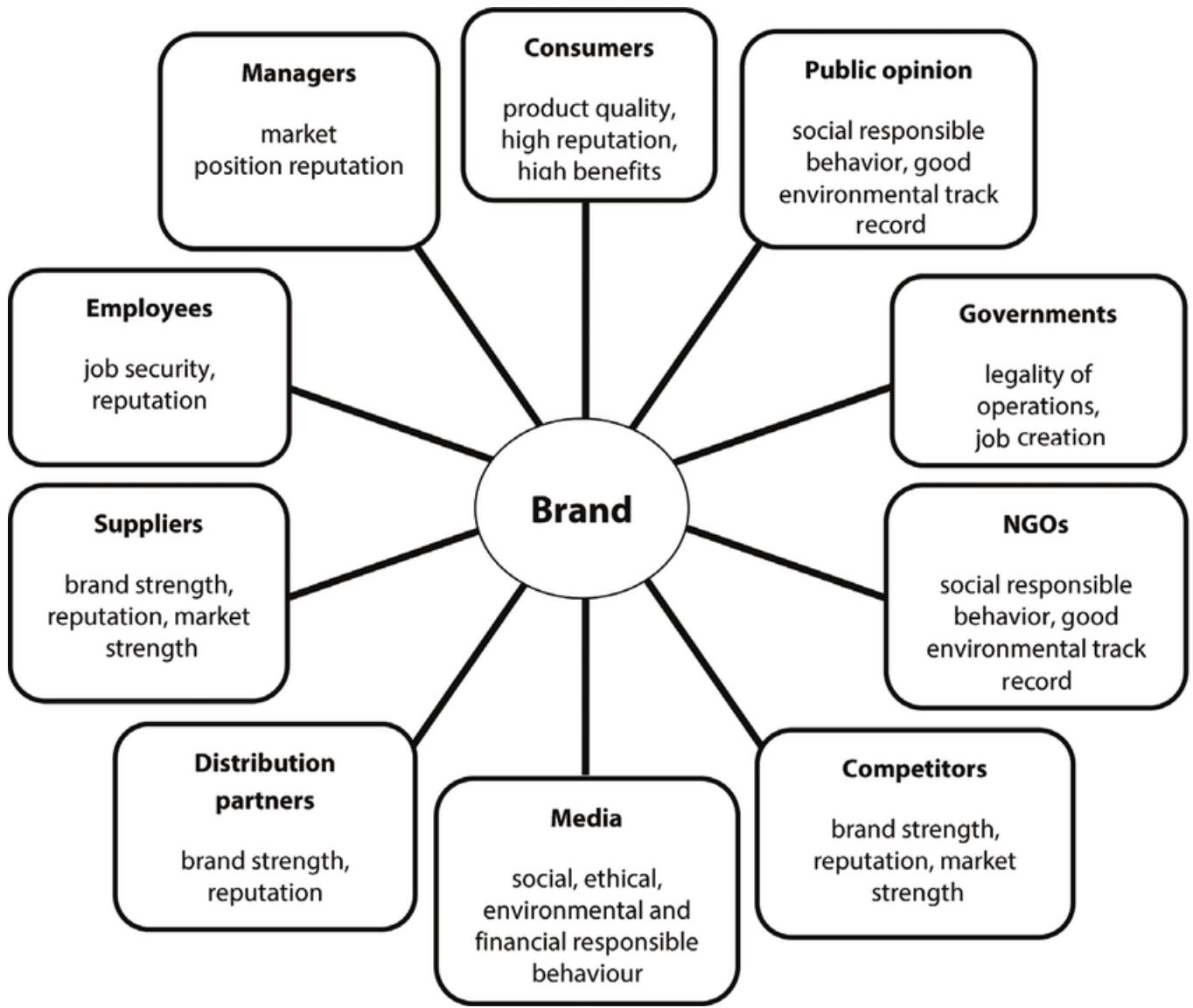 Fig. 2: Jones R. Finding Sources of Brand Value. Developing a Stakeholder m=Model of Brand Equity. Journal of Brand Management. 2005; 13 (1): 10-32
Companies use CSR to fulfill these responsibilities to stakeholders such as consumers. Through this fulfillment consumers directly help build the brand equity of a brand by word of mouth, this strategic way to build brand equity is used often these days and is known as WOM marketing. An empirical study by Asif and Jamshed[^11] shows that CSR initiatives have a positive catalytic effect between brand reputation and brand equity, outcomes of regression analysis indicated that $39\%$ of the variance in brand equity can be explained by brand reputation, and social responsibilities such as philanthropic, ethical, and economic. A study[^12] by HUR also provides evidence that CSR influences brand equity. Therefore, we can conclude that by being proactive in CSR a company can higher its profit margins.
## IV. MEDIA
According to Saurabh[^13], press releases provide several benefits to the corporates, these include:
1) Visibility- press releases can help one's company to be more aware and get identified more easily by the public as media outlets usually are seen by many.
2) Credibility- when there is a press release by a reputable media outlet it can help establish credibility for one's company and make people take one's message more seriously.
3) Press releases can help create backlinks to your company's website which can help in your search engine rankings.
4) Press releases help to generate leads for one's company. By including a call to action in your press release, one can be encouraged to visit the company's website or to visit their physical stores which can create new customers.
These benefits can be utilized by the companies which are featured in the recent press releases and potentially create more revenue for the company. If this is the case, who are being featured on press releases and by the media in recent years?
According to Susan[^14], after the 2008 recession, there has been a fall of for-profit media coverage, which has paved the way for non-profit media alongside with the increase of competition from cable and digital news outlets. This nonprofit media received can easily lead to increase in brand equity as the Daisy wheel model[^10] by Jones displays that stakeholders like media play an integral part in brand equity, which will eventually lead to more revenue.
## V. SOCIAL AWARENESS BY CAUSE MARKETING
According to Christy $^{15}$, usually a partnership between a nonprofit and for-profit for mutual benefit is cause marketing, but apart from this, when for-profit companies that engage in socially conscious behavior to bring awareness to certain issues is also considered as cause marketing. Further on, adhering to the second definition, two types of business try to utilize its benefits, which are B2C and B2B. (An example of B2B is mentioned in detail in the case study section) Today we are going to focus more on this definition rather than the initial one. This cause marketing directly influences social awareness of the company, in other words, social awareness is usually achieved by cause marketing.
While we have established that social awareness is a product of cause marketing, is brand reputation related to social awareness? The reason behind this question is to establish another relationship between brand reputation and cause marketing if the answer is positive.
As per Jake[^16], Attrition rate or churn rate is "the rate at which customers stop doing business with an entity". Similarly customer loyalty is a "measure of a customer's likelihood to do repeat business with a company or brand. It is the result of customer satisfaction[^17], positive customer experiences, and the overall value of the goods or services a customer receives from a business". Schlesinger and Heskett[^18] have developed the concept of "cycle of success" and "cycle of failure", in the "cycle of success" better customer loyalty in customer cycle results in lowered turnover and high service quality in employee cycle and finally these both result in higher profit margin which is as well in employee. This gives us an indirect relation of direct proportionality between customer loyalty and profit margins.
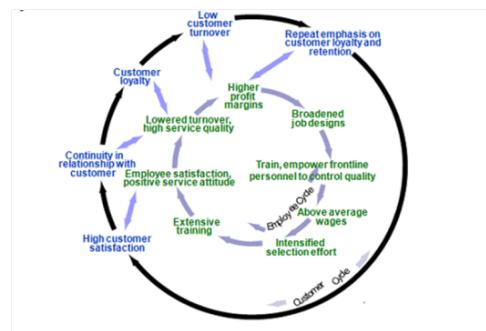 Fig. 3: Schlesinger and Heskett. Cycle of Success. 1991
According to Soumya $^{19}$ customer loyalty is a product of cause marketing as "when cause marketing campaigns are conducted, the customers are aware of the brand and feel something good about their brand". Now by this we can say that cause marketing can cause possibly higher profit margins.
So if we analyze this relationship with an example by Kayla20, she was more motivated than ever to support Starbucks due to its CSR and social awareness, hence creating a brand reputation for Starbucks. This reputation was built due to the Starbucks college achievement program, this initiative was done with arizona state university, and offers benefits-eligible Starbucks employees the opportunity to go to college, tuition-free, eligible employees can choose from 80 undergraduate programs and work out a schedule that's functional for them. This was started in 2018, to bring awareness to the inequality of college affordability, the main objective was to make college more accessible
Supporting Kayla, Paul[^21], based on the data displayed in the given below graph (figure 4) states that over 91 percentage of those who surveyed lean towards buying from a company with excellent CSR, with that, over 84 percentage of the people surveyed said that companies with top-notch CSR gets the benefit of doubt during a crisis.
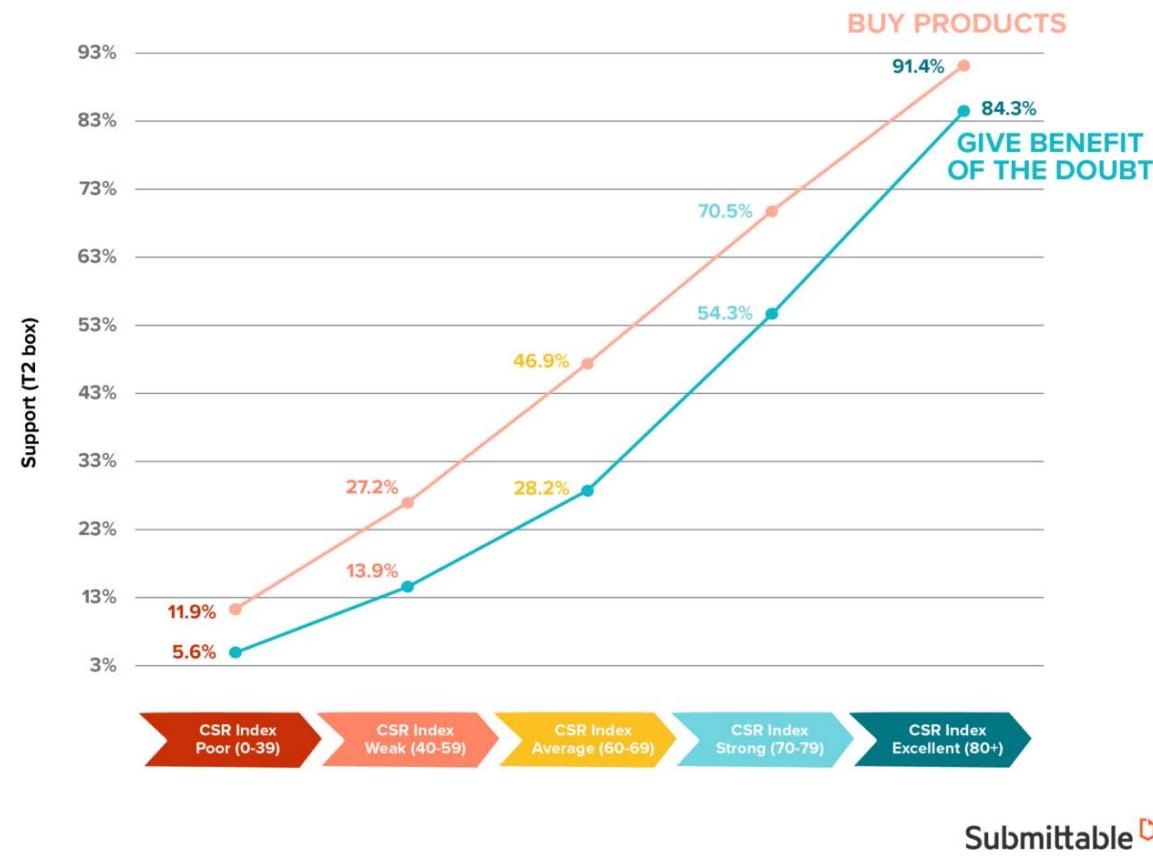
Great CSR builds significant customer support Fig. 4: Paul Perry. What's the Purpose of Corporate Social Responsibility (CSR)?. Submittable. 04/02/2020 For companies to engage in cause marketing $^{15}$, there are multiple ways that they practice.
1. Licensing- A company funds a non-profit or NGO for the added benefit of utilization of its brand on products that will be on sale.
2. Messaging- In order to promote and market messages for a cause, for-profit businesses use advertising ads and content creation channels to promote the message of a cause.
3. Point-of-sale- Cashiers or automated online forms prompt shoppers to add donations to their bills to support a charity or cause.
4. Purchase triggers- companies donate a percentage of daily sales to a cause for every purchase made within the window.
Cause Marketing is relatively a new term for the rusty business world. It isn't possible to use it to its best without actually knowing how to use it. Study by Nic S Terblanche et al22 helps in this problem, some recommendations to enhance revenue through cause marketing campaigns are as below:-
1. It shows that[23]"low-involvement products tend to have a strong relationship with purchase intention".
which indicates that consumers tend to commit quickly to lower costs and thus lower risks, according to this statement. Consumers are more likely to respond more positively to a cause-related marketing campaign through which relatively lower involvement products can yield more revenue (low-involvement $^{24}$ products are products which are brought on a frequent basis with minimum thought and effort as they do play a vital role in the customer's lifestyle).
2. It distinguishes between cognitive and affective attitude towards a cause marketing campaign offer. "Cognitive component of attitude refers to the thought, perception or ideas of the person toward the object of the attitude. Affective component is about emotional reaction or feeling of the person toward the object of the attitude such as like or dislike." It found out that a cause marketing campaign should not only aim to appeal to the voluntary behavior of the customers intended to benefit others but also a business strategy that offers measurable returns.
3. It advises firms to select the "most transparent donation expression format" whilst making cause marketing campaigns, namely the "actual amount expression format" In order to avoid confusions that could lead to an allegation toward the firm for greenwashing.
4. It advises using positive imagery in a cause marketing campaign in order to "encourage a positive attitude towards the campaign". "Brand imagery[^25] refers to every type of visual that represents your brand. It includes the aesthetic appearance of all the marketing materials that communicate a message about your brand". According to Drew[^26], in marketing and advertising it is the most essential.
5. It advises that contributions done through cause marketing campaigns and more importantly its feedback to the participants should be communicated as widely as possible as this information leads to a feeling of a "warm glow" and will contribute positively to the consumer's social identity.
## VI. GREEN WASHING
According to UN[27](united nations) environmental change is affecting the world at a "faster pace than previously thought" and suggested that governments must act now in order to reverse the damage done to the planet, this is backed by the most authoritative study that UNEP has published. As the environmental problems and subsequently the social awareness in public eyes is increasing incrementally. Due to this situation[28], the stockholders are getting more aware of environmental considerations. Subsequently[29], stakeholders like investors, consumers, governments, and corporates customers are continuously increasing pressure on the companies to disclose information related to CSR and to produce environmentally-friendly products more. According to the daisy wheel model[10] by Jones consumers, governments are some of the major stakeholders. Greenwashing[30] was coined first in 1986 by environmentalist Jay westervelt. Sebastiao et al[31] explains after reviewing multiple definitions of greenwashing by multiple authors, all of them describe the phenomenon as two main behaviors simultaneously: "retain the disclosure of negative information related to the company's environmental performance and expose positive information regarding its environmental performance." basically indicating it is a type of selective disclosure. As far as its definition goes, it is "communication that misleads people regarding environmental performance/benefits by disclosing negative information and disseminating positive information about an organization, service, or product".
Greenwashing is executed in different ways, according to delmas and $\text{burbano}^{32}$ greenwashing is done at 1) firm level, 2) product/service level, in 1st type these are the practices done by firms in order to mislead people regarding environmental practices, in 2nd type the advertised benefits are misleading regarding their social/environmental contributions. A prominent example is the 1st type, the largest consumer of wood (IKEA) which has doubled its wood consumption in the last decade. An investigation by earthsight found out that IKEA has been making beechwood chairs using illegally sourced wood from forests of Ukraine's carnation region, which is home to endangered beasts such as bears, lynxes, wolves, and bison. Another example is of H&M, whose 60 percent of claims are misleading and 96 percent of claims are not holding up. Sebastiao et al[^31] also considered two same subtypes for each given type, which are 1) claim greenwashing, 2) executive greenwashing. In the 1st, corporations "use textual arguments that explicitly or implicitly refer to the ecological benefits of a product or service to create a misleading environmental claim." In 2nd no claims are made as the first one, rather, "it suggests nature-evoking elements such as images using colors (e.g., green, blue) or sounds (e.g., sea, birds). Backgrounds representing natural landscapes (e.g., mountains, forests, oceans) or pictures of endangered animal species (e.g., pandas, dolphins) or renewable sources of energy (e.g., wind, waterfalls) are examples of executional nature-evoking elements". Further, an example for the second type is the world's largest producer of plastic (coca-cola). The changing markets foundation says that corporates using ocean-bound or recyclable plastic as path to greenwash are the most common examples of greenwashing, which includes coca cola as well, as it claims that it's bottles (product) are 25 percent marine plastic, but hides the fact that it is the world's largest plastic producer. Given below is the graph provided by sebastio et al[^31].
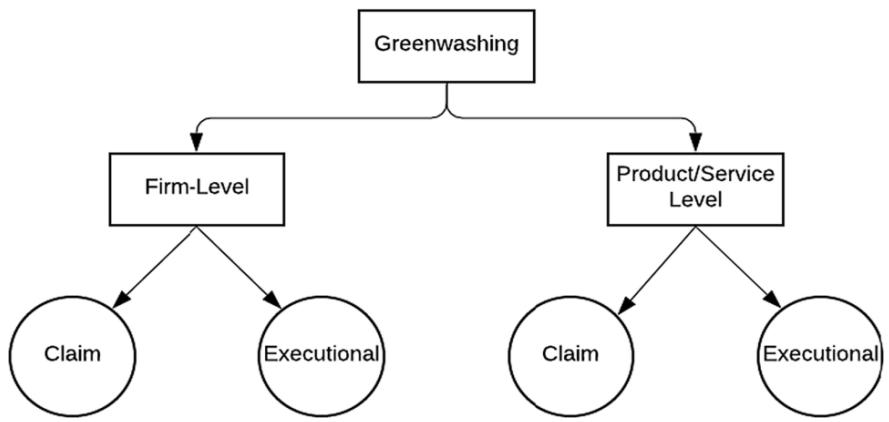 Fig. 5: De Freitas Netto, S.V., Sobral, M.F.F., Ribeiro, A.R.B. et al. Concepts and forms of greenwashing: a systematic review. Environ Sci Eur 32, 19 (2020). https://doi.org/10.1186/s12302-020-0300-3
## VII. AVOID GREENWASHING (CONSUMER)
In order to support genuine corporations who have a good initiative to support all the three parties we need to identify how actually some corporations use greenwashing for selfish purposes. Given below are types through which corporates use greenwashing[^33]
1. Unspecified- In this type, corporates do not include specific details or units of measurements, for eg-advertising made with organic cotton, which in reality it is 70 percentage of organic cotton.
2. Illegitimate Claims- these as the claims which are either old and still displayed or advertised by the corporate or false claims or certifications from fake organizations.
3. Product Alteration- this includes when corporates compare their products sustainability to competitors product sustainability, but the problem is created when the corporate compares it's products with competitors different types of product which may not have been focused on by the other corporate in terms of sustainability.
4. Misleading Visuals- often corporations color their packaging green or include images of trees and flowers to imply that their products are eco-friendly, which may not be true in every case.
## VIII. INCENTIVES BY GOVERNMENT
The companies act 2013 made history making India the first country in the world to mandate every company have a net worth of at least rupees 5 billion, sales of rupees 10 billion or profit before tax of rupees 50 million during any of the three previous financial years (financial year in India starts from 1st April to 31st march) to constitute a CSR committee of the board, develop a CSR policy and plan for CSR expenditures.
In China, 2006 company law provides that while doing business, a company shall comply with laws and administrative regulations, conform to social morality and business ethics, act in good faith, subject itself to the government and public supervision, and undertake social responsibility. In 2007, similarly Indonesia stepped out and amended its corporate statute and added that companies having its business activities in the field of and/or related to natural resources shall be obliged to implement social and environmental.
In the case of China and Indonesia, their governments have set CSR legislations more in the sense of business ethics rather than direct CSR mandate expenditure like India, but still their legislations on the topic of CSR show that more national governments are focusing on CSR in recent years.
A mandate by a government are requirements for corporations which need to be fulfilled, rather a subsidy is a sort of motivation by the government to drift in a certain path. If we get to the definition of subsidy "money[^34] given as part of the cost of something, to help or encourage it to happen". According to Duan et al[^35], there are many factors which may result in positive correlation between subsidies and firm's market power. This correlation can be shown in many ways.
1. Firstly, as per khurshid[^36], increase in subsidies for a firm leads to unfair competition in a positive sense as increase of subsidies results in reduction of the firm's costs and increase of working capital.
2. Secondly, Feldman and Kelley[^37] believe that secured loans and funding from financial institutions and banks are indirectly positively affected by subsidies.
3. Thirdly, according to aghion and Hewitt and klette[^38] and griliches, subsidies have a positive effect on a firm's innovation, and following this, Hannu and Jaana state that "innovations lead to improved profitability".
From the above we can understand how subsidies help firms in market power and profitability. But how does subsidies affect CSR activities of a firm? According to Duan et al[^35], "according to one perspective, subsidies represent a tool to control environmental externalities which pave the way for $\mathsf{csr}^{\prime \prime}$. Li et al[^39], and khurshid et al say that subsidies policies are a source of capital for private businesses and therefore help them finance their expenditures, with this source of capital, according to guo, he and xiao, this creates an opportunity for private firms to access banks and investment organizations for loans and investments. Further on, with the availability of funds through loans and investments, the efficiency in social contributions can increase along with that firms can start initializing investments in CSR with more money in hand, supporting this statement, Jia and Liu[^40] argue that firms willingly engage in CSR after receiving subsidies.
If we talk about incentives provided by the Indian government, CSR expenditure, which is of the nature described under sections 30 to 36 of the IT, was allowable as a deduction, say CSR expenditure laid out or expended on Scientific Research related to the business is allowable under section 35 (1)(i) and 35 (1)(iv), etc.
### Case study 1
#### Purpose
The purpose of this case study is to show us the practical implications of many of the research displayed in this paper above. This case study will show us how a B2B company can actually create a win-win situation for three parties, which are company, community and the customers, in other words, how company and the consuming company can both generate comparatively more revenue, simultaneously help and uplift the community.
In this case study, the company we will be taking is Kishore exports. They are a garment exporter, the customer in this situation is the retailer who buys from Kishore exports and the community in this situation is the mentally disabled community.
Kishore exports directly and indirectly to help a Institute of Mentally Challenged people known as TEARS. Kishore exports is supporting TEARS in multiple ways:-
1. Kishore exports is supporting them economically by donating or supporting them by providing things which they require (sometimes computers, tv screens, maintenance of classroom furniture or some physiotherapy equipment, etc.)
2. Contribution by their own efforts like performing small talks, consulting with the management of TEARS, liaising and enjoying some government bureaucrats to help TEARS, organizing some events.
3. As many hesitate to hire people from this institution, Kishore exports hire some pass out students from TEARS in their company.
#### Analysis
This contribution of Kishore exports is a sign of goodwill and act of kindness, but in addition to it, it is a cause marketing strategy, this is so as they get more advantages from it like:-
1. It builds and strengthens their brand equity and csr, eventually standing out and getting more potential customer companies as these companies see their own advantages and sees the potential to grow its own brand equity and csr by buying from Kishore.
2. Whatever people Kishor hires from TEARS in their factory, the PF (provident funds) and the medical coverage is supported by the government of India, as govt promotes hiring of handicapped people. Also, the efficiency of these people are somehow better than normal people in some basic jobs (also attrition rate is much lesser. So, these people remain with Kishor).
3. Then, as TEARS generally involves a lot of government bureaucrats, dignitaries and politicians in their various functions, Kishor also gets to have a good liaisoning with these bureaucrats and politicians. These liaisoning come in pretty handy while ensuring a smooth functioning of a factory in the Indian environment.
So, that is a very clear example of how Kishor draws commercial advantage by doing this social contribution. Now, the biggest question is will Kishor's Philanthropy be considered a "selfish approach" as this is facilitating them build their brand reputation along with developing brand equity by this technique. In my opinion, very well, no, because although having these advantages helped Kishore build its brand equity, and, they also have a stronger relation with the customer. But kishore does help eventually the school years and its students a lot because of not only the help and donation and contribution of Kishore directly, but also by enrolling customers with TEARS who also help TEARS subsequently. So, the system is not only profitable to Kishore, but also to TEARS and also to the customer which they are enroping. So, for sure this is like a win-win situation for all the concerned parties here. And the biggest advantage seen is that the social contribution is not momentary or short lived because it has its own economical aspects. That's why this contribution keeps on going.
Now, along with this case study of Kishor also we should study the case of Kishor's import customer. Who is being enroped with TEARS. Now for them, the contribution is that they helped either straight away by donations, or they get some products made by TEARS. A classic example of that is rugs. Which is made out of Scaps (waste of Kishor's production). Which are given to TEARS who have machines to make rugs out of them. And the customer sells this product at high margins to their end consumers, with the main Marketing tactic that not only is $0\%$ waste production, made out of scraps, but also, it's supporting TEARS.
So, is Kishor's import customer justified in this way of working?. So, I will say yes- again by doing this, the commercial advantages which they derive, give their business entity more strength economically. Also, they make a bond with their end customers who like this concept that they are helping a school like TEARS (and the customers become more loyal to them). Even though driving these selfish motives, they still help TEARS a lot by either their donations or by either buying their products.
So, we can conclude that, eventually it's a win-win situation for everyone concerned and eventually it leads to some positive impacts to society and to the environment.
#### Case study 2
#### Purpose
The purpose of this case study is very similar to the first one, which is to show us the practical implications of much of the research displayed in this paper above. But rather than taking an example of a B2B company, we will be taking an example of a B2C company and analyzing how this company creates a win-win situation for all three parties involved, which are the company itself, end consumers and the community.
The company we will be taking in this case study is gossip. Gossip is a fashion retailer, the end consumer is the customers of gossip (general public) and the community.
Gossip Practices CSR in Multiple Ways, Which are as following.
1. Gossip has set certain requirements for its suppliers. For example, only FSC certified suppliers can supply gossip. FSC certification[^41] "confirms that the forest is being managed in a way
that preserves biological diversity and benefits the lives of local people and workers, while ensuring it sustains economic viability".
2. They have been sustainable in their practices since 20 years, their practices involve "one $^{42}$ of the eco-friendly methods of solid waste management for a sustainable society" which is using recycled kashmir fabric and subsequently using upcycled sari in their apparels.
3. They have been continuously using organic cotton as a raw material in their apparels.
4. During covid, gossip adopted a new form of marketing, which was cause marketing (meaning defined above), in which gossip used instagram and Facebook as a medium to advertise themselves through cause marketing on the points mentioned above.
Analysis
Now that we have understood how Gossip executes their CSR, gossip has capitalized on a advantage that has doubled their turnover in the COVID period, which was adopting cause marketing on the basis of above mentioned points, this type of marketing was as the main form of advertising rather than conventional kind of digital marketing.
Apart from gossip, the community got a big advantage in terms of reserving and safekeeping the environment. According to Beatrice[^43], over 150 million trees are cut down for fabric production, additionally, this number is expected to double in the next decade, she states. Tackling this problem, as mentioned above, gossip requires a fsc certification from its suppliers. According to Abigail[^44], by 2030, we are expecting to discard more than 134 million tonnes of textiles a year, as mentioned above, gossip is doing its part to reduce this number by using recycled kashmir fabric and upcycled sari as their apparels. Moving on to the last advantage provided by gossip to the environment is that it makes organic cotton, this is extremely impactful to the environment, as, according to kurt, a conventional method of inorganic cotton extraction causes diseases to the cotton pickers.
## IX. SURVEY
### a) Research Design
This Research design is exploratory. We intend to examine the advantages of CSR activities from the perspective of business owners. Although literature and theories exist that would support this assumption that CSR activities help business owners, there is still a lot of research scope and exploring new dimensions remain. This study will mainly analyze qualitative data and this study is open ended, which enables new theories and parameters to emerge.
### b) Population and Samples
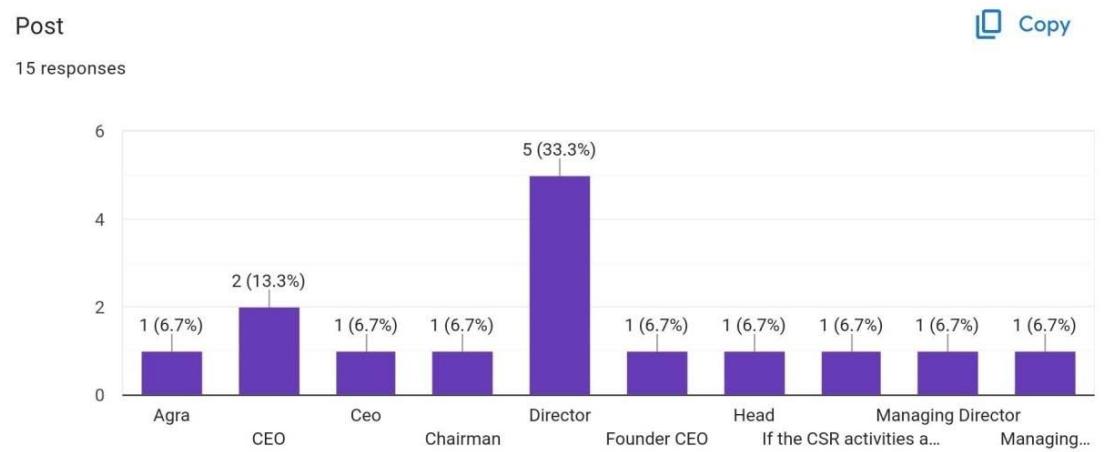
Fig. 6: The Determined Population Sample is Either Business Owners or Highly Posted Employees Like CEO's or Directors or Heads of A Department in the Domain of Organized Business. The Intention is to Learn from the Experience and Knowledge of These People
### c) Instrumentation
The instrumentation used in this study is through the use of questionnaires through a survey form. These questionnaires of the survey form will be the primary data gathering instrument for this study.
### d) Analysis
The given analysis displays results of the survey in a graphical manner for the ease of understanding.

(6) Do you believe such social contribution actually helped society/needy? 15 responses Copy
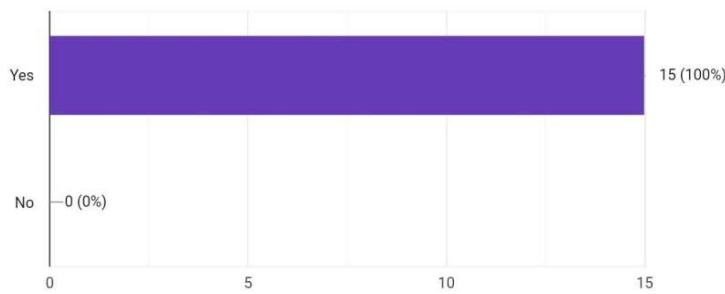
Fig. 7: Respondents Were Asked "Do You Believe Such Social Contributions Actually Helped Society/Needy?" The Graph Shows us that 100 Percent of the Respondents Believe that Their CSR Activities Actually Helped the Society/Needy

(8) Do you believe by choosing you, your customers feel more satisfied morally and you attain more customer retention (due to your social contributions)
Copy
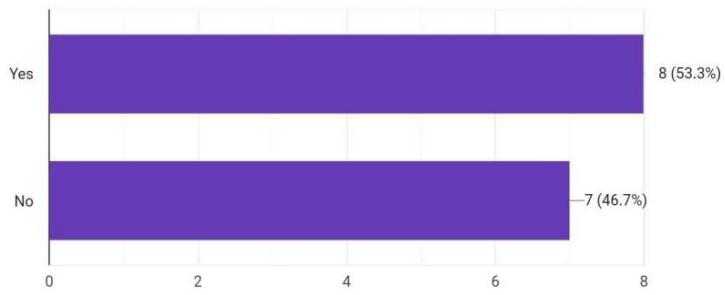
15 responses Fig. 8: The Following Graph Shows the Results of the Question, Which is "Do You Believe by Choosing you, your Customers feel More Satisfied Morally and you Attain More Customer Retention", The Results Show that 53.3 Percent Believe So, and Strengthens the Point of Kayla And Paul on Customer Retention and How CSR Increases It.
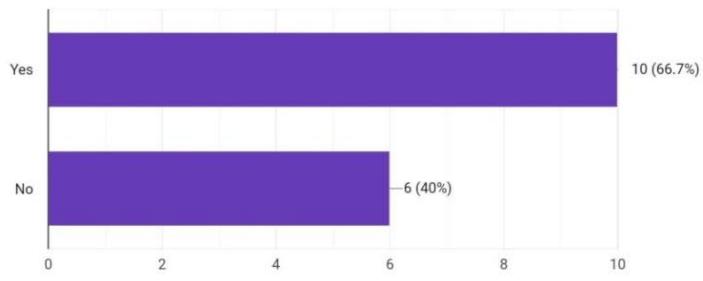
(9) Do you feel these business social contribution armed at eventual benefits to business, or, cause marketing is a "win-win" situation for corporate, customers & society? 15 responses

Fig. 10: Next Question, Related to the Previous One Questions the Respondents that "Do you Feel these Business Social Contributions are Armed at Eventual Benefits to Business, or, Cause Marketing is A "Win-Win" Situation for Corporate, Customers & Society?" The Results Show that 66.7 Percent of the Respondents Support the Idea Proposed by this Research Paper, which is that CSR Creates a Golden Win-Win Situation for All Three Parties Involved. (14) How much percentage of your revenue do you spend on cause marketing (CSR)?
Copy
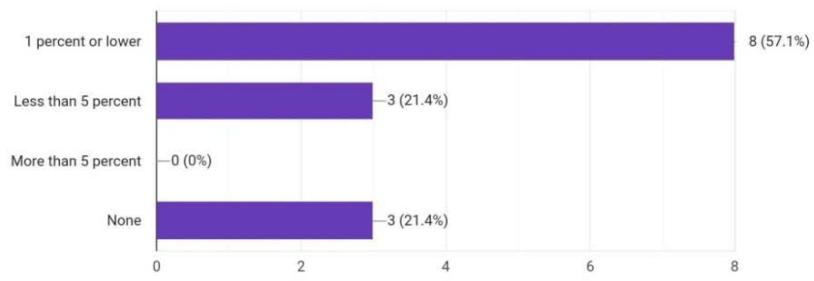
14 responses Fig. 11: As Shown, Respondents Were Asked "How Much Percent of Your Revenue Do You Spend on Cause Marketing (CSR), Which Showed that the Majority With 57.1 Percent of The Respondents Invest 1 Percent or Lower and 21.4 Percent Invest 5 Percent Or Lower, Which is Substantial Taking in Consideration of the Total Revenue. Plus That Rest of Necessary Spending is not Subtracted from This Number.
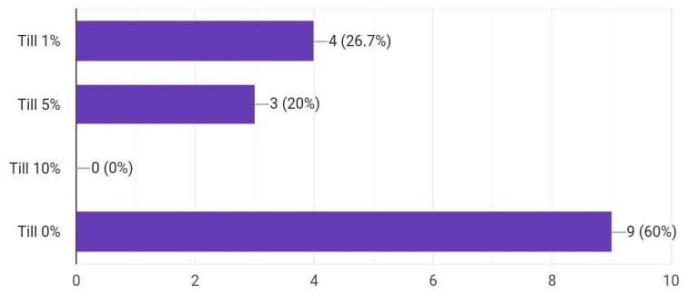
(7) Till what percentage hike of price of your product, do you think your customer will be willing to pay extra due to your investment in cause marketing or csr:-

15 responses
(11) Do you think that investing in CSR or in social communities is more beneficial for your business then investing in traditional marketing?
 Copy
14 responses
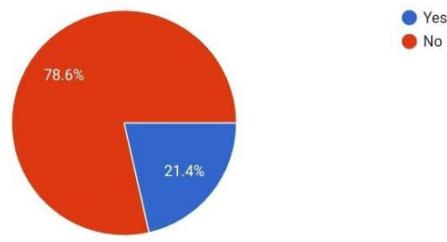
(15) Do you plan to increase the budget of your CSR expenditure which can help in promoting your business
 Copy
14 responses
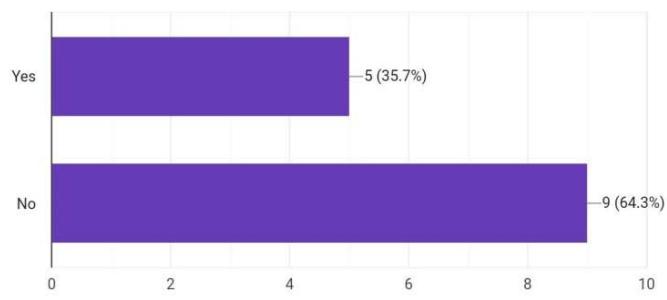
Fig. 12, 13 and 14: The Following Graphs Now Displayed Below, are the Graphical Representation of the Above (Introduction) Mentioned Assumption that "Businesses Only do CSR Activities Due to their Own Will and there is No Economical Benefit." These Graphs Further Proves that Many Business Owners are Still Unaware of the Benefits or Advantages when CSR is Practiced.
## X. LITERATURE REVIEW
There are two very contrasting perspectives of people regarding CSR activities done by businesses, first being, "The philanthropy done by them is only increasing their revenue rather than actually doing any actual philanthropic work" and the second being "the CSR activities by businesses have no economic or monetary benefit". Disproving both the perspectives, this paper describes a new perspective which shows "the golden win-win situation created by CSR", according to this perspective, CSR activities done by businesses benefit not only in monetary terms but in other aspects as well (which are discussed in the paper in detail), further it shows that this benefit is gained by all the parties involved, which are 1) businesses, 2) end consumer or the customer (depending on the situation and/or the business model) 3) community/society. This paper elaborates on benefits for the first and the second party involved as benefits for the third are well known as discussed more comparatively. This elaboration is done
by taking references and representing previous research, along with this, through interviews of two live examples of two businesses who practice this perspective are taken as case studies in order to examine how do they execute it and their benefits gained from it, in the end, results from a survey is taken to understand the perspective of business owners regarding this idea or perspective.
## XI. CONCLUSIONS
In brief, this paper has proposed an idea of "the golden win-win situation created by CSR", the practices done or the execution done through this not in no way or form new, it is an idea which is being practiced but not enough, hence the need of this paper arises to show how using a topic of social science, which is aloof from the business studies and commerce can impact the world of them in such a great and impactful way leading to a advantage of all. If we take a look for specific details this paper debunks two assumptions/myths about CSR, and further elaborates on how this idea is implemented through multiple examples, sources, two case studies of real life companies and a survey. In the end the purpose of this paper is to show how Firstly there is a way of social contributions benefiting all parties involved rather than either only the business or only the community involved, Secondly, is to show that business is not only affected by factors in the realm of business and commerce, rather business among everything is interconnected between all elements and subjects in this world.
Further, focusing on the need of this paper, according to the author, these are the following reasons why this paper is needed-
1. Adex (advertising expenditure) is valued higher than CSR and its advantages (one of which include that CSR is a better form of marketing). This statement is proven by the data that in 2022 alone2, AdEx (advertising expenditure) stood at 1,26,818 crore rupees in India, whereas, in FY (financial year) 2020-2021 total amount spent by the total sum of 18012 companies on CSR in India was 25714.75 crore rupees
2. As reported by the survey displayed in the paper, many business owners are still unaware of the advantages provided or when CSR is practiced.
3. According to the author, although there are Journal articles or research papers discussing social responsibility in general, there are a lack of them discussing the benefits or the advantages of CSR on a broader level or from a commercial/economic aspect.
### Biographical sketch
Omansh Agarwal is a motivated and enthusiastic student currently in his 11th grade education in commerce stream. He has a keen interest and passion in business studies and economics and social work. Omansh constantly tries different and usually unconventional activities and projects. Omansh strives to gain a comprehensive understanding of the commercial world and develop her skills to excel in this domain. He has consistently excelled in her academic pursuits, demonstrating a strong aptitude for commerce-related subjects. Omansh is linked and associated with multiple NGOs and has started his own social projects for the upliftment of PWDs.
Generating HTML Viewer...
References
35 Cites in Article
Jason Fernand Corporate Social Responsibility (CSR) Explained With Examples.
Thomas Brock (2023). Taylor, Thomas, (1849–23 April 1938), JP.
Milton Friedman (1970). The Social Responsibility of Business Is to Increase Its Profits.
M Paul (2016). Umbrella summary: Perceived organizational support.
J Brickley,C Smith,J Zimmerman (2002). Business ethics and organizational architecture.
K Keller (2016). Brand Equity.
Adam Hayes (2022). Brand Equity: Definition, Importance, Effect on Profit Margin, and Examples. Investopedia. David Kindness.
R Jones (2005). Finding sources of brand value. Developing a stakeholder model of brand equity.
Asif Mahmood,Jamshed Bashir (2020). How does corporate social responsibility transform brand reputation into brand equity? Economic and noneconomic perspectives of CSR.
Won-Moo Hur,Hanna Kim,Jeong Woo (2013). How CSR Leads to Corporate Brand Equity: Mediating Mechanisms of Corporate Brand Credibility and Reputation.
Saurabh Single (2023). How press releases help ecommerce businesses to grow sales.
Susan Merrill,O' Connor (2018). FIVE Reasons to Embrace Non-Profit News Media.
Christy Walters (2022). 14 Cause Marketing Examples To Inspire Your Next Campaign.
Jake Frankenfield (2022). Churn Rate.
Leonard Schlesinger,James Heskett (1991). Enfranchisement of Service Workers.
Paul Perry (2020). What's the Purpose of Corporate Social Responsibility (CSR)?.
Nic Terblanche,Christo Boshoff,Debbie Human-Van Eck (2023). The influence of cause-related marketing campaign structural elements on consumers’ cognitive and affective attitudes and purchase intention.
Nic Terblanche,Christo Boshoff,Debbie Human-Van Eck (2022). The influence of cause-related marketing campaign structural elements on consumers’ cognitive and affective attitudes and purchase intention.
Drew Hendricks (2020). Head of Marketing & Branding.
Yu‐shan Chen,Ching‐hsun Chang (2012). Enhance green purchase intentions.
E Kim,T Lyon (2015). Greenwash vs. Brownwash: exaggeration and undue modesty in corporate sustainability disclosure.
C Marquis,M Toffel,Y Zhou (2016). Scrutiny, norms, and selective disclosure: a global study of greenwashing.
K Becker-Olsen,S Potucek (2013). Green washing.
S De Freitas Netto,M Sobral,A Ribeiro (2020). Concepts and forms of greenwashing: a systematic review.
Carlyann Edwards (2023). Edwards, David, (11 April 1858–22 Feb. 1916), Editor and Managing Director, Nottingham Daily Express and Evening News since 1908; JP County Borough of Nottingham.
Duan Wenqi,Adnan Khurshid,Abdur Rauf,Adrian Calin (2022). Government subsidies’ influence on corporate social responsibility of private firms in a competitive environment.
Li Suyuan,Adnan Khurshid (2015). The effect of interest rate on investment; Empirical evidence of Jiangsu Province, China.
(2006). The ex-ante, assessment of knowledge spillovers: Government R & D policy, economic incentives and private firm behavior.
Hannu Piekkola,& Jaana,Rahko (2020). Innovative growth: the role of market power and negative selection.
X Guo,W He,X (2011). Xiao Government subsidy, extra behaviors and changes of R&D activities in strategic emerging industry Macroeconomics.
X Jia,Y Liu (2014). External environment, internal resource and corporate social responsibility.
(null). Figure 4—source data 1. FSC data in Excel format..
Beatrice Murray-Nag (2020). Is your clothing destroying the rainforest? Here's how to find out.
Abigail Beall (2020). Why the soft side of analytics is so hard to manage.
Explore published articles in an immersive Augmented Reality environment. Our platform converts research papers into interactive 3D books, allowing readers to view and interact with content using AR and VR compatible devices.
Your published article is automatically converted into a realistic 3D book. Flip through pages and read research papers in a more engaging and interactive format.
Our website is actively being updated, and changes may occur frequently. Please clear your browser cache if needed. For feedback or error reporting, please email [email protected]
Thank you for connecting with us. We will respond to you shortly.