
I. INTRODUCTION
According to [1], the 2030 Agenda for Sustainable Development is the vision of a more just and peaceful world, in which no one is left behind. One of the major challenges in implementing the 2030 Agenda is the sustainability gap between developed and developing countries, which results in part from increasing economic interdependence and the limited capacities of developing countries to develop robust management and governance of food systems. To close this gap, while making progress towards the target of rebuilding overexploited stocks set out in the 2030 Agenda, the international community must help developing countries realize their full potential in the fisheries and aquaculture sectors [2,3];[4]. It is in this vein that, as part of its development policy for the fishing sector and the fight against poverty, the Republic of the Congo has undertaken to sustainably manage its fishery resources by fishing one of its priorities [5]. This is one of the fields of activity that today forms the basis of the livelihoods of the populations living around lakes, rivers and coastal marine areas. The hydrographic network of the Republic of Congo is particularly important and presents significant fishery resources [6]. In order, to make the most of these surface water resources, which are particularly rich in fish, fishing and aquaculture can be much better managed and developed. In Congo, fishing contributes of the Gross Domestic Product (GDP) [4]. Unfortunately, it has also produced perverse effects over time. Indeed, clear signs of overexploitation are observed in many fisheries, accompanied by the depletion of certain species in certain bodies of water. It is therefore necessary to reverse these negative trends observed in the fisheries sector, in order to better contribute to the growth and poverty reduction strategy adopted by the country and to adapt the strategic orientations with those of the departmental institutions, sub-regional, regional and international [5]. The use of the value chain as a framework for analyzing artisanal fishing activities is a relatively new fact [7]. The current debate centers on the question of how best to create and distribute gains from economic activities, and how to do this in the context of developing countries [8]. The value chain analysis is an assessment of all the actors and all the factors that participate in the realization of the activities and the relationships created between the participants in order to identify the main obstacles to the improvement of performance, productivity and competitiveness and how these barriers can be overcome [9]. Today, the sustainability of artisanal fishing in the Lac Téle Community Reserve (LTCR) is threatened because it has to face the major challenges posed in particular by environmental degradation, overexploitation of target stocks, seasonality, of production in fishing and mismanagement of shared or uncharged resources [10]. Considering these lacunas related to the production and marketing of Clarias gabonensis, we aim here to investigate the following; what is the mode of governance that explains interactions between actors in the Clarias gabonensis value chain? Based on the cost and price analysis along the value chain, is the activity profitable? How is the profit made distributed among the actors in the Clarias profit made distributed among the actors in the Clarias gabonensis value chain, and is it distributed fairly? The main objective of this study which have been done between July and November 2019, was to analyze the value chain of Clarias gabonensis, an abundant species in the rivers of the LTCR, in order to determine the mechanisms of creation and distribution of added value in the light of the modes of organization and governance which govern the relations between actors of the value chain in the LTCR and in the towns of Impfondo, Pokola and Oyo. More precisely; analyze the functioning and internal governance of the Clarias gabonensis value chain; assess costs, added value and commercial profitability at all stages of the value chain; determine the actors holding a significant share of added value and profit and analyze the constraints and opportunities of the Clarias gabonensis circuit from "river to fork".
II. MANAGEMENT AND DATA COLLECTION
a) Experimental Methodology
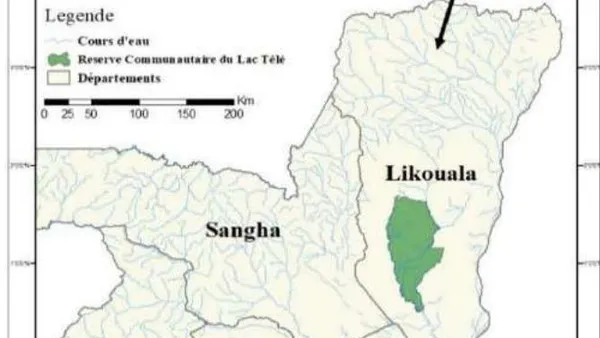
The study took place from July to November 2019 in the Lac Téle Community Reserve which is located in the Likouala Department in the far North of the Republic of Congo (Figure 1a) Video 1. The reserve has 27 villages which practice fishing. Seven (07) sample villages namely; Mokengui, Epéna, Dzeke, Moumgouma-Bailly, Botongo, Mossengue and Bouanela were randomly selected to host the surveys relating to the study. These villages are the starting point for shipments of Clarias gabonensis to supply the towns that revolve around the Reserve. These towns surrounding the LTCR are the main drop-off points for shipments of Clarias gabonensis from the LTCR during the period July to November. This is the main reason for their choice. Among them Video 1;
- Impfondo: Chief town of the Department of Likouala, 33,911 habitants
- Pokola: Cosmopolitan city of the Department of Sangha, 10,465 habitants
- Oyo: Cosmopolitan city of the Department of Cuvette 14, 950 inhabitants in reference [18].
villages of the LTCR of (09) days on average for the data collection campaign in the cities. The interview time varied between 25 to 30 minutes depending on the availability of the interviewee Video 2. During our data collection campaigns, we used several methods and techniques to collect both primary and secondary data relating to the study. Among these methods and techniques, we can cite:
- Comparative Method: This method allowed us to compare the added value and the profit along the value chain according to the different stakeholders, the comparison between the prices of the different fishing periods and the comparison of the added value of the stakeholders' value chain.
- Statistical Method: The statistical method helped us to quantify the results of the research, then allowed us to present these results in the form of graphs, tables and diagrams, using variables. This method allowed us to facilitate the processing of data collected during our research and the interpretation of this data in a clear manner.
- Synthetic Method: This method allowed us to globalize the elements of our work to a coherent whole using a map of the Clarias gabonensis value chain according to the sites of the study. The synthetic method also made it easier for us to draw the conclusion from our work.
- Descriptive or Explanatory Method: It allowed us to describe our study environment but also to know the behavior of agents in our study environment.
- Interview Technique: This technique allowed us to find clear information from the fishermen and traders sampled and some additional information to that which we obtained by questionnaire.
- Observation: It allowed us to have additional information on the functioning of the activities of the actors.
- Documentary Technique: Documentary technique has opened the sky to the systematic use of certain documents relating to our work. In this work, this technique allowed us to use the various works such as books, reports, and briefs and as well as certain websites relating to fishing activity in the various departments of the country and particularly in the LTCR.
- Questionnaire Survey Technique: The questionnaire survey technique is a mean of communicating with the respondent by asking him a series of questions concerning his fishing activity for fishermen or his Clarias gabonensis trade activity for traders (wholesalers, semi-wholesalers and retailers). This method allowed us to collect information from those who answered questions asked in an open or
closed (or mixed) manner about their respective activities in reference [12].
b) Treatment of Data Collected
The data analysis took place in several stages: mapping, analysis of governance in the value chain, analysis of costs, analysis of commercial profitability and analysis of constraints and opportunities in the value chain. [12].
i. Mapping of the Clarias gabonensis "Ngolo" value chain
Mapping the value chain was the first step in the analysis. This mapping consisted of creating a visual representation of the connections between actors in the value chain and other market actors. This provided an overview of the actors and their functions in the value chain and of the flow of products along the chain.
ii. Governance Analysis
Governance refers to the organization of the value chain and the coordination between actors. It was the second step in this analysis. This analysis was first of all qualitative, based on indicators such as regulations (product quality standards and standards), control, penalties, method of payment (by the buyer and by the seller), and price fixing, the method of financing activities, the participation of women in the value chain and the relationship of trust between the actors.
iii. Cost Analysis
Cost analysis was the third element addressed in the data analysis. This analysis was done within each value chain. It consisted in calculating the production and marketing costs for each category of actors participating in the chain. Then, the cost structure, that is to say the analysis of the share represented by each expenditure item in the total costs was made. This allowed the identification of expenditure items on which we can intervene to improve the performance of the actor concerned.
Thus, for all actors, the total costs (TC) are defined by:
With CV representing the variable costs: for the fisherman producer (fuel, battery charge, nets, etc.) and for traders (purchase cost of goods sold, other consumption by third parties, smoking costs, etc.) and CF fixed costs (depreciation, taxes and duties, interest paid, other contributions, etc.).
Socio-economic analysis by estimating a few ratios
- Gross margin (MB) Units: Cases, Basins and seals of Clarias gabonensis "Ngolo"
- Cost price (CP) Units: Cases, basins and buckets of Clarias gabonensis "Ngolo"
DC: Distribution Cost
iv. SWOT (Strengths, Weaknesses, Opportunities and Threats) Analysis
The analysis of constraints and opportunities in each value chain was done using the Strengths, Weaknesses, Opportunities, Threats (SWOT) approach. The aim is to gather, analyze and evaluate information and identify the strategic options facing the Clarias gabonensis "Ngolo" value chain in the Republic of Congo.
c) Value Chain's Description of Clarias Gabonensis in Republic of Congo
According to the documentary analysis and the accounts of the populations of the LTCR, the production period of Clarias gabonensis reaches its peak during the period of the floods in the Likouala-aux-herbes River between July and November within the LTCR. However, it should be noted that during the same period, overall in the LTCR, fishing catches are at the lowest level. This leads to a scarcity of the global fishery resource (period of low production) and a decrease in the number of players in the fishing industry during this period [5]. Conversely, the start of the year period (end of December, January to March) corresponds to the period of high production in the LTCR. During the study carried out in total, 89 actors of the Clarias gabonensis value chain of the LTCR were surveyed in the different villages and sample towns visited during the field data collection phase. Figures 1, 2 and 3 respectively illustrate the mapping of the actors and the complexity of the relationships that the actors maintain in the governance of the Clarias gabonensis value chain resulting from the LTCR fishing camps for the various towns of Impfondo, Pokola and Oyo. The total workforce and the relative proportions of each actor in the chain are presented in Table 1. Overall, it emerges that fishermen represent of this value chain's workforce, retailers and wholesalers . Tables 2 and 3 present the social profile of each actor in the different towns and villages of the LTCR. From the analysis of these tables, men are mainly represented in the fishing activity, i.e. and by women. Conversely, the marketing of Clarias gabonensis is dominated by women, ie against represented by men in the activity. The actors who practice this activity are very experienced overall both in fishing and in marketing if we consider age and seniority in the activities. Among fishermen; are over 55 years old. have no education have primary level and have secondary level. Most wholesalers and retailers have a basic educational level; of the workforce is over 50 years old and more than have more than 10 years of experience in the business. On the other hand, have a primary level of education. The fishermen surveyed do not practice agriculture during the high-water season because of the flooding of the agricultural areas in the LTCR, however during the periods of low water of the Likouala-aux-herbes, they diversify their activities in the camps between agriculture, hunting and processing of fishery products, the financing of which is exclusively from own funds. On the other hand, from Table 4, of the actors surveyed practice a part-time secondary activity, agriculture of which represents in the town of Impfondo against who do not. In the town of Pokola; the only man surveyed of the 11 registered actors, practices a secondary activity as a part-time service provider to the "Congolaise Industrielle du Bois (CIB)". The ten (10) women surveyed do not engage in any other activity other than the marketing of fish at the Pokola municipal market. In the city of Oyo; the fourteen (14) women surveyed do not practice any other secondary activity. The initial capital varies from 25,000 FCFA ( 363.63) regardless of the category of actors and the city where the activity is practiced. However, the activity is financed from own funds regardless of the category of actors whose entire funds come from the spouse's salary. Table 5 summarizes the governance in the Clarias gabonensis value chain in the different cities visited. It emerges that with regard to the suppliers of the chain, namely the fishermen; only of wholesalers and retailers in the various towns get their supplies directly from fishermen. of respondents get their supplies only from wholesalers from the villages of the LTCR. On the other hand, of those surveyed get supplies from both fishermen and wholesalers when they arrive at travel agencies (stations and ports) in the various localities. Of these actors, are supplied every day, but of the receive the products 3 times a week. Regardless of category and city, of salespeople make their payment by cash (liquidity) against by credit. The surveys carried out within the LTCR prove that it is the fishermen who set the price during exchanges with other players in the chain. Continuing on from the chain, of respondents, both wholesalers and retailers affirm that the price is set by wholesalers from the Reserve called locally "BISSOMBELA". On the other hand, of players say the price is set after a consensus between the two parties. None of the players have contracted credit with a financial institution (banks or microfinance). say they have never been informed about the availability of financing while think that accessibility through the procedures is difficult and think that the interests are too high in these financial institutions. Regarding the analysis of costs in the value chain, Table 6 shows the average cost of fixed charges recorded at retailers in each city in the study. So respectively; intermediate consumption consisting of transport as well as taxes in the various places where the Clarias gabonensis product is marketed; is 870 FCFA ( 1.67) / day in the town of Pokola and 815 FCFA ( 654.54) for a 3-day expedition in the North-East axis of the reserve entering by Epena coming from Impfondo; 416,000 FCFA ( 895.36) for a 3-day expedition in the South axis of the reserve entering through Bouanela from the city of Oyo. Table 8 presents the grid of purchase prices and cost of the different forms in which Clarias gabonensis products are marketed in the various markets visited (photo 3). Overall, the price demarcation margin for a fresh or smoked product is on average 66.6% between the town of Impfondo and Pokola and 70% between Pokola and Oyo. The table 11 presents the price of Clarias gabonensis per kg which varied around 1 and 1,2 and finally in large urban centers like; Ouesso, Dolisie, Brazzaville and Pointe-Noire, we can suppose that it varied around 5 7.27) and 9,000 FCFA ( 7.27) and 9000 FCFA ( 3.87) and 4,130 FCFA ( 7.41) and 6080 FCFA ( 16.7), 9,185 (16, 11.24). Regarding the
Strengths, Weaknesses, Threats and Opportunities (SWOT) analysis, the development opportunities of the Clarias gabonensis value chain in the area (LTCR and Impfondo, Pokola, Oyo) are enormous. The current context marked by the remarkable expansion of world demand for seafood and the stagnation of world production of catches [2],[3],[4] portends very interesting prospects for fishing activity in the villages of the LTCR but also in the various towns which hosted surveys relating to the value chain analysis of Clarias gabonensis. However, it is important to respect the principles of sustainable and responsible fishing in order to guarantee the sustainability of the resource in the LTCR, in particular the prescriptions of the existing minifishing charter that the fishermen themselves have established.
d) Impacts of Added Value in Livehoods of LTCR Communities
Regarding the social profile of the actors of the Clarias gabonensis value chain surveyed, fishing activity in the LTCR is predominantly with of men and of women regardless of the different sample villages. covered, even if in [13] mentions that the activity knows the participation of all layers of the population (men, women and children). In [10] notes that of fishermen have a secondary school level, a primary level and a university level. These results are close to those we have recorded, namely: primary and secondary. This increase in the number of secondary school education in the villages is explained by the increase in the number of schools between 2006 and 2019. It is also important to note that the activity is more practiced by the elderly. More than of the population of surveyed fishermen are over 60 years old in the villages of the LTCR. This trend is also observed in the profile of the other players in the chain, namely the wholesalers and retailers encountered in the various cities visited. The disinterestedness of young people, for lack of means and support, and the decrease in productivity seem to be the reasons for their low representativeness in the sector of activity. See [14] have observed the same configuration of values chain of Bagrus spp in two famous lakes in Democratic Republic of Congo; Edouard and Albert lakes in spite of different of species which were studied. In the towns of Impfondo, Pokola and Oyo, the "mapping" of the chain actors as well as the different relationships that govern the collaboration are practically identical. At the top of the chain; the fishermen who are often assimilated to the processors since it is the fishermen who transform their products themselves in the fishing camps, then the wholesalers locally called "BISSOMBELA" who supply the localities of the LTCR with products leaving the camps towards the towns passing through the villages. The carriers then come to facilitate the movement of products from production sites to consumption sites and finally, retailers and consumers who are at the end of the chain. This nomenclature of the Clarias gabonensis value chain is similar to that of the fish value chain architecture described by [13], however with a particular emphasis on the secondary actors who also frame the activity in like NGOs and much unstructured fishermen's associations. In [10] also mentioned this configuration of the sale of fish in the villages, specifying that the sale is above all direct at more than (72.34%) against (27.65%) through intermediaries. The work of [5] reinforces this observation on the marketing of fish but with an emphasis on the places of marketing and not on the actors, He presents the typology of the markets encountered in the villages along the Likouala-aux-herbes know; wholesale markets (which centralize production and redistribute it to remote regions); semi-wholesale markets (located in production and consumption centers) and retail markets (markets in towns and villages which may be bypassed by sales to local consumers). [5], also states that concerning the prices of fresh or smoked fish per kg or per unit of basket, they vary according to the distance of the camp from the villages or towns. This corroborates the results that we obtained during our study where for cases of 1.5 () and (3) of fresh Clarias gabonensis; the added values that were generated were respectively: 4,080 FCFA ((8) and 6,018 FCFA ()11) in the town of Pokola and 6,185 FCFA ((12) and 9,185 FCFA ()19) in the town of Oyo. Financial analysis of the overall cost of transport from the fishing camp to the city market CAF 306,000 ((557) from the Northeastern LTCR camps for the town of Impfondo; 416,500 FCFA ()758) from the North-West camps of the LTCR for the city of Pokola and 492,450 FCFA ((895) from the camps of the southern axis for the city of Oyo) also allows to justify this gross margin recorded in the selling price of the products. According to [5]: "A basin containing 60 to 120 catfish or Parachanna fish can cost 25,000 ((45.45) to 50,000 FCFA ()91). While a tank of Protopterus with 2 large fish or 5 medium-sized fish costs 30,000FCFA ((52.4). Smoked fish is sold in cases; one case can hold 8 to 12 medium-sized fish, or 5 large fish; the price varies from 12,000 ((21.81) to 50,000 FCFA ()91)". What is completely identical to the results obtained in the various markets prospects during the surveys, particularly for Clarias gabonensis. In reference [10] also mentions this observation in the marketing of fish, specifying that "The price varies with the species, the abundance fish and therefore with the season. It also varies with localities. Thus, the further south you go, the less expensive the fish, with the exception of the town of Epena". The village of Epena is subject to the law of supply and demand. Being the starting point of the products for the city of Impfondo, district manager, the strong demand both local and external imposes an increase in the costs of the products at the local market level. This would explain the high prices of products in
the locality of Epena. In short, based exclusively on commercial profitability and the added value generated by the difference in daily turnover and the gross margin resulting from intermediate consumption while combining the strong demand for fishery products in large urban centers and the quality of the offer of the latter such as Ouesso, Oyo, Brazzaville, Dolisie and Pointe-Noire, it appears that the marketing activity of Clarias gabonensis regardless of the form generates much more profit at the level of the city of Oyo, followed by the town of Pokola and finally that of Impfondo. Thus, for the town of Pokola; the and cases recorded respective returns of and with added values of 4080 FCFA and 6080 FCFA and and with added values of 9,185 FCFA ( 19.25) in the city of Oyo. In other words, the commercial profitability in the value chain of Clarias gabonensis resulting from the LTCR increases with the distance between the places of production and the large sites of consumption as well as between the different actors of the value chain of the LTCR Clarias gabonensis in particular, fishermen or boat owners, wholesalers or traders and retailers. The same have been made in different sites around the world especially in Sagaing Region, Myanmar and other African countries in reference [15], [16], [17].
III. CONCLUSION(S)
The Analysis of the Value Chain of fishery products of the LTCR and the towns of Impfondo, Pokola and Oyo, whose Clarias gabonensis had the general objective of determining the mechanisms for creating and distributing added value to the light of the modes of organization and governance which govern the relations between the actors of the said chain in the LTCR and its surrounding towns. Questions of knowledge; what would be the mode of governance that governs interactions between actors in the Clarias gabonensis value chain in the LTCR? based on cost and price analysis along the value chain, does the activity make a profit? Is the profit thus found distributed fairly? have been asked. The results obtained from this study show that, in view of the analysis of indicators relating to governance; The Clarias gabonensis value chain in the LTCR and its surroundings is governed by a mode of governance with a complex network with interrelations between dynamic actors. The analysis of costs and prices on each link in the Clarias gabonensis value chain shows that all actors make a profit because their revenues are greater than their costs if we consider that the sale of fishery products does not be done over a long period of time (plus seven (07) days). Along the Clarias gabonensis value chain, the profit thus found would be distributed unfairly because the greater part of the profit ends up with the fishmongers, given the ratio between the fishing effort provided and the price of sale of fishing products to wholesalers and so on to retailers. To conduct this analysis and verify the assumptions thus made, surveys of fishmongers, wholesalers and retailers were carried out and the data were analyzed using a descriptive approach. The analytical framework of the study was based on the value chain approach on the one hand and on the other hand on the Strengths, Weaknesses, Opportunities and Threats (SWOT) approach for the analysis of constraints and opportunities of the Clarias gabonensis value chain. At the end of this study, we can retain the following results:
Clarias gabonensis value chain is predominantly dominated by women than men as most women engage in marketing rather than production activities.
Along the Clarias gabonensis value chain, only fishermen are grouped together in professional associations, but in practice these associations do not take any action for the development of fishermen;
Generally, the purchase and sale prices are fixed after negotiation between the actors and that the quantities exchanged depend on the fishing period.
All of these features of the Clarias gabonensis value chain briefly present the extent of opportunities, but also threats to fishing activity in the LTCR wetlands. However, the majority of the wetlands of the forests encountered in the Congo Basin practically know the problem of the scarcity of resources in general and of fishery resources in particular, the contribution of which in forest life cycles is fundamental. They are unrecognized or even less valued than other resources, which are however also crucial for the survival of the Congo Basin and for the Sustainable Development of the populations who depend on them. A few scientific journals make it a major concern, such as the Scientific Journal "Sustainability", the aim of which is to highlight the results of the work and expertise of researchers and forestry professionals in all the aspects and phenomena of the Basin's forests of the Congo and the challenges of their use. It is for this reason that by way of recommendations;
To the Congolese State to strengthen decisions related to the regulation of fishing activity, management and protection of stocks, prohibit gillnet, limited and prevent fishing in the spawning grounds of the LTCR;
Set up a reliable information system on the market allowing the dissemination of information on the production and price of Clarias gabonensis and other species in the different markets surveyed in the towns of Impfondo, Pokola and Oyo;
- Promote the diversification of fishing activities and other sectors such as fish culture;
- It is up to fishermen's organizations to put in place a synergy of consultation between associations so that the interests of fishermen are at the center of any development approach and supervision of the sector;
Videos Materials
Video 1 available from:
https://www.linkedin.com/posts/eric-bertin-ndzana-biloa
-257a23a6_governance-activity-6775401703870218241
-J0lj?utm_source=share&utm_medium=memberdesk topVideo 2 available from:
https://clipchamp.com/watch/y1hllBMAFzy
IV. APPENDICES AND NOMENCLATURE
ERAIFT: Ecole Regional Post-Universitaire en
Aménagement des Forets et des Territoires Tropicaux
WCS: Wildlife Conservation Society
LTCR: Lac Téle Community Reserve
FAO: Food and Agriculture Organization
GDP: Gross Domestic Product
TC: Total Cost
CV: Cost variable
GM: Gross margin
TR: Total Receipts
TL: Total load
CP: Cost Price
BP: Buying Price
DC: Distribution
SWOT: Strengths, Weaknesses, Opportunities, Threats
CV: Chain Value
CIB: Congolaise Industrielle de Bois
FCFA: Franc des Communautés Financières Afrique
NGO: Non Govrnenmental Organization
: meter cube
: meter square
L: liter
ACKNOWLEDGMENTS
To All the staff of the prestigious international organization; Wildlife Conservation Society (WCS) in the Republic of Congo in particular to Dr. Emilie FAIRET, WCS-Congo Coordinator, for her hospitality, her remarks and especially her advice during our discussions prior to our arrival in the LTCR, as well as to Mr. Ben Evans, Senior Technical Advisor of the LTCR and End of Study Work Supervisor, for his simplicity and kindness which have always allowed us to take advantage of the base logistics during data collection campaigns and for all advice during our interviews. Thank you
To all WCS – ACFAP staff at the Base in Epena and in particular; Terrence MOUSSAVOU, Fortuné IYUNGET, Armand Samson BAKAPA, Digne ITALY, Florence LECKONGA, BOLA MADZOKE, Symphorien NGAMA, Dalvin BIKOUMOU, Fred EDIMA and the pinassier M. Fulgence DZIBO, without forgetting the eco-guards as well as the fishermen, wholesalers and retailers of Clarias gabonensis, surveyed in the LTCR, Impfondo, Pokola and Oyo. Thanks to your kindness during the data collection campaigns, we have felt supported and encouraged in doing this work. Thank You.
Conflict of Interest
The authors declare no conflict of interest.
Notes/Thanks/Other Declarations
THANKS to the Sub-Regional Post-University School of Integrated Planning and Management of Tropical Forests and Territories (ERAIFT) for our training and more particularly to its director Dr. Michel BAUDOUIN, to Mr. Frédéric Lambert BOKANDZAPACO, Director of the Congolese Agency for Fauna and Protected Areas (ACFAP) of the Ministry of Forest Economy, Sustainable Development and Environment in the Republic of Congo, for the support and authorization of access to the LTCR and at the same time, Mr. Max MVIRI, Curator of the LTCR for welcoming me and allowing me to share all these moments of joy with your families and the staff at the base in Epena.
| Variables | Towns | Impfondo | Pokola | Oyo | TOTAL | ||||||||||
| Wholesalers | Retailers | Wholesalers | Retailers | Wholesalers | Retailers | ||||||||||
| Actors Surveyed | Ni | % | N | % | Ni | % | Ni | % | Ni | % | Ni | % | Ni | % | |
| Supply Market | Fishermen | 2 | 66,6 | 0 | 0 | 2 | 100 | 0 | 0 | 1 | 20 | 0 | 0 | 5 | 12,5 |
| OtherWholesalers | 1 | 33,3 | 7 | 100 | 0 | 0 | 3 | 33,3 | 0 | 0 | 6 | 42,85 | 17 | 42,5 | |
| Retailers | 0 | 0 | 0 | 0 | 0 | 0 | 0 | 0 | 0 | 0 | 0 | 0 | 0 | 0 | |
| Fishermen Wholesalers | 0 | 0 | 0 | 0 | 0 | 0 | 6 | 66,6 | 4 | 80 | 8 | 57,14 | 18 | 45 | |
| Supplying Frequency per Week | Everyday | 1 | 33,3 | 4 | 57,1 | 0 | 0 | 2 | 22,2 | 0 | 0 | 0 | 0 | 7 | 17,5 |
| 3 times/week | 0 | 0 | 0 | 0 | 1 | 50 | 4 | 44,2 | 0 | 0 | 0 | 0 | 5 | 12,5 | |
| 2 times/week | 0 | 0 | 0 | 0 | 1 | 50 | 3 | 33,3 | 2 | 40 | 9 | 64,28 | 15 | 37,5 | |
| 1 time /week | 0 | 0 | 2 | 28,5 | 0 | 0 | 0 | 0 | 3 | 60 | 4 | 28,57 | 9 | 22,5 | |
| 3 times/month | 1 | 33,3 | 1 | 14,2 | 0 | 0 | 0 | 0 | 0 | 0 | 1 | 7,14 | 3 | 7,5 | |
| 2 times/month | 1 | 33,3 | 0 | 0 | 0 | 0 | 0 | 0 | 0 | 0 | 0 | 0 | 1 | 2,5 | |
| Payment mode | Crédit | 0 | 0 | 0 | 0 | 0 | 0 | 4 | 44,4 | 0 | 0 | 2 | 14,28 | 6 | 15 |
| Cash | 3 | 100 | 7 | 100 | 2 | 100 | 5 | 55,5 | 5 | 100 | 12 | 85,7 | 34 | 85 | |
| Establishment of price | State | 2 | 66,6 | 0 | 0 | 0 | 0 | 0 | 0 | 0 | 0 | 0 | 0 | 2 | 5 |
| Fishermen | 1 | 33,3 | 0 | 0 | 2 | 100 | 0 | 0 | 4 | 80 | 1 | 7,14 | 8 | 20 | |
| Wholesalers | 0 | 0 | 4 | 0 | 0 | 0 | 4 | 44,4 | 1 | 20 | 12 | 64,28 | 21 | 52,5 | |
| Consensus | 0 | 0 | 3 | 0 | 0 | 0 | 5 | 55,5 | 0 | 0 | 1 | 7,14 | 9 | 22,5 | |
| Access to Crédit | Yes | 0 | 0 | 0 | 0 | 0 | 0 | 0 | 0 | 0 | 0 | 0 | 0 | 0 | 0 |
| No | 3 | 100 | 7 | 100 | 2 | 100 | 9 | 100 | 5 | 100 | 14 | 100 | 40 | 100 | |
| Rasons of Inaccessibility of Crédit | Don't need | 0 | 0 | 0 | 0 | 0 | 0 | 0 | 0 | 0 | 0 | 0 | 0 | 0 | 0 |
| Difficult Access | 3 | 100 | 1 | 0 | 0 | 0 | 4 | 44,4 | 1 | 20 | 2 | 14,28 | 11 | 27,5 | |
| Interesttoo high | 0 | 0 | 4 | 0 | 0 | 0 | 1 | 11,1 | 1 | 20 | 0 | 0 | 6 | 15 | |
| No informations | 0 | 0 | 2 | 0 | 2 | 100 | 4 | 44,4 | 3 | 60 | 12 | 85,71 | 23 | 57,5 | |
Table 6: Table of Fixed Charges Borne by Retailers on the Market in the Various Cities of North East, R Congo (1
$= 550 CFA)
| Variables Actors surveyed | Towns | Impfondo | Pokola | Oyo | TOTAL | ||||||||||
| Modalities | c % | % | Modalities | Retailers | Modalities | Retailers | |||||||||
| Unit | Cost | Unit | Cost | Ni | % | Unit | Cost | Ni | % | Ni | % | ||||
| Warehouse | /day | 100 | 0 | 0 | /day | 100 | 0 | 0 | /day | 250 | 3 | 21,42 | 3 | 10 | |
| Hygien | /day | 100 | 7 | 100 | /day | 100 | 9 | 100 | - | - | - | - | 30 | 100 | |
| Fixed charges (FCFA) | security | /day | 100 | 0 | 0 | /day | 100 | 0 | 0 | /mois | 1000 | 14 | 1000 | 14 | 46,6 |
| Market place rental | /an | 2500 0 | 7 | 100 | /moi s | 3500 | 9 | 100 | /an | 1000 0 | 14 | 100 | 30 | 100 | |
| Transport to the point of sale | /day | 500 | 7 | 100 | /day | 500 | 9 | 100 | /day | 500 | 14 | 100 | 30 | 100 | |
| Average cost fixed | TOTAL (FCFA/day) | 870 | 920 | 815 | |||||||||||
| Variables | Areas LTCR | Axis Nord-Est Modalities | Axis Nord-Ouest Modalities | Axis Sud Modalities | |||||||||
| Fixed Charges | Unit | Q | U.P. | T.C | Unit | Q | U.P. | T. | Unit | Q | U.P. | T.C. | |
| Fuel | L | 250 | 1000 | 250000 | L | 300 | 1000 | 300 000 | L | 350 | 1000 | 350 | |
| Fixed transport charges in the areas to be covered | Engine oil | /L of fuel | 10 | 2500 | 25000 | /L of fuel | 12 | 2500 | 30 000 | /L of fuel | 14 | 2500 | 35 000 |
| in LTCR (FCFA) | Canoerental | unit | 1 | 1000 | 10000 | unit | 1 | 10000 | 10 000 | unit | 1 | 10 000 | 10 000 |
| Engine rental (15 CV) | unit | 1 | 2500 | 25000 | unit | 1 | 25000 | 25 000 | unit | 1 | 25 000 | 25 000 | |
| Pinassier service | men /day | 1 | 1000 | 10 000 | men /day | 1 | 10000 | 10 000 | men /day | 1 | 10 000 | 10 000 | |
| TOTAL | 3 days expedition | 300000 | 405000 | 450 | |||||||||
| 000 | |||||||||||||
| Variables | Towns | Epena-Impfondo (2h30) | Mboua-Pokola (Mi-day) | Bouanela-Oyo (3 to 4 days) | |||||||||
| Modalities | wholesalers | Modalities | Wholesalers | Modalities | Wholesalers | ||||||||
| Actors surveyed | Unit | Cost | Ni | % | Unit | Cost | Ni | % | Unit | Cost | Ni | % | |
| Transport | Aller- go-back | 500 | 3 | 100 | go-back | 10000 | 2 | 100 | go-back | 40 000 | 5 | 100 | |
| Fixed charges | 0 | ||||||||||||
| Related to travel to cities (CFA) | Handling | flat rate | 100 | 0 | 0 | flat rate | 1000 | 0 | 0 | flat rate | 2000 | 5 | 100 |
| Storage | 0 | 0 | 0 | 0 | 0 | 0 | 0 | 0 | flat rate | 450 | 5 | 100 | |
| Averagecost | TOTAL | 6000 | 11000 | 42450 | |||||||||
Table 9: Estimation of commercial profitability at wholesalers in different cities of the North East (R. Congo) for a day of sale (
= 550 CFA)
| Towns | Impfondo | Pokola | Oyo | |||||||
| Indicators | Type of products | Type of products | Type of products | |||||||
| Unit | Fresh Clarias | Unit | Smoked Clarias | smokedClarias | FreshClarias | |||||
| Quantity sold/day | Basin | Basin of 40 L | Basin of 80L | basket | basket of 1,5m3 | basket of 3,5m3 | basket of 1,5m3 | basket of 3,5m3 | 1basin of 40 L | |
| Unit purchase price | FCFA/basin | 35000 | 50000 | FCFA/Claie | 35000 | 50000 | 35000 | 50000 | 25000 | |
| Unit selling price | FCFA/basin | 45000 | 65000 | FCFA/Claie | 50000 | 70000 | 55000 | 80000 | 50000 | |
| Commercial margin | FCFA | 10000 | 15000 | FCFA | 15000 | 20000 | 20000 | 30000 | 25000 | |
| Commercial profitability (%) | 22,22 | 23,07 | 30 | 28,57 | 36,36 | 37,5 | 50 | |||
| Consumers Intermediaries | Transport | FCFA | 6000 | 6000 | FCFA | 11000 | 11000 | 42450 | 42450 | 42450 |
| TOTAL (CI) | FCFA | 6000 | 6000 | FCFA | 11000 | 11000 | 42450 | 42450 | 42450 | |
| Added value | FCFA | 4000 | 9000 | FCFA | 4000 | 9000 | -22450 | -12450 | -17450 | |
Table 10: Estimation of commercial profitability at retailers in different cities of the North East (R. Congo) for a day of sale (
= 550 CFA)
| Towns Indicators | Impfondo Type of Products | Pokola Type of Products | Oyo Type of Products | ||||||
| Unit | Fresh Clarias | Unit | Smoked Clarias | Smoked Clarias | Fresh Clarias | ||||
| Quantity sold/day | Basin | Basin of 40 L | Basin of 80 L | Basket | Basket of 1,5 m3 | basket 3,5 m3 | basket of 1,5 m3 | Basket of 3,5 m3 | Basin of 40 L |
| Unit purchase price | FCFA/cassine | 35000 | 50000 | FCFA/Claie | 35000 | 50000 | 35000 | 50000 | 25000 |
| Unit selling price | FCFA/cassine | 38000 | 55000 | FCFA/Claie | 40000 | 57000 | 45000 | 60000 | 32000 |
| Commercial margin | FCFA | 3000 | 5000 | FCFA | 5000 | 7000 | 10000 | 10000 | 7000 |
| Commercial profitability (%) | 7,89 | 9,09 | 12,25 | 12,22 | 22,22 | 37,5 | 21,87 | ||
| Consumers | Transport | FCFA | 500 | 500 | FCFA | 500 | 500 | 500 | 500 |
| Intermediaries (CI) | Taxes | FCFA | 370 | 370 | FCFA | 420 | 420 | 315 | 315 |
| TOTAL | FCFA | 870 | 870 | FCFA | 920 | 920 | 815 | 815 | |
| Added value | FCFA | 2130 | 4130 | FCFA | 4 080 | 6080 | 9185 | 6185 | |
| Strengths | Weaknesses | Opportunities | Threats |
| Existence of an increasingly demanding local, national, regional and global market | The precariousness of fishing (Fishing is still artisanal) | New political orientations for the development of the sector based on: the rational management of the fishery resource, | Lack of access to financing and credit from financial institutions (banking and microfinance) |
| The availability of labor at a lower cost. | The approximate management of the fishery resource. | Funding of several fishing and aquaculture projects in the LTCR by the World Bank | Lack of an information system, particularly in the villages of the LTCR |
| Profit realization by all actors in this value chain. | The absence of the landing infrastructure necessary to preserve quality | New perspectives offered by the country within the framework of free trade agreements in the CEMAC sub-region | The decline in the stock of biomass available following the fishing effort concentrated on Clarias gabonensis |
| Existence of a sustainable fisheries charter in the LTCR and an internal financing system | Processing techniques are still rudimentary (carbonization of specimens of Clarias gabonensis) | Strengthening of agricultural sector development policies for the diversification of the country's economy | Lack of an associative dynamic in the different villages of the LTCR |
| The actors operate in relationships of trust. | Lack of means of preservation, storage and processing | Geostrategic position of the LTCR in the sub-region (Cameroon, CAR, DRC and Gabon) | Low rate of youth participation in agro-pastoral development, particularly in fishing |
| Experience of the actors in the exercise of their activities. | Failure to comply with price regulations during periods of high and low production | Possibility of developing a label specific to Clarias gabonensis from the LTCR | Increase in poaching and commercial hunting in the LTCR |
| Technical support for fishermen in the reserve through the LTCR project | the low level of qualification of casual labor | Potential development of aquaculture to strengthen fishing activity | Temporal and discontinuous support for fishermen in the LTCR |