I. INTRODUCTION
The South American political environment of the XXI century represents a clash of belief systems, and political and economic approaches materialized in inter-presidential encounters and diplomatic tension. The region has experienced back-and-forth integration experiences since State building in the XIX century, once territories advanced in their independence struggles. Thus, empirical richness for analyzing those efforts has translated into vast academic literature regarding why (des)integration happens. Instead of wondering why it happens, I go for how it happens. How do agents acknowledge like-mindedness as a critical element that helps them to self-identity within their sub-region and push them to identify Others with whom they share standard norms, goals, or strategies? How do group agents interact and frame institutional institutions of regional and subregional nature into more specific ones?
I argue that the Pacific Alliance is the political outcome of a changing process wherein agents play a crucial role because they self-identify their like-mindedness and political and economic drivers that interlink them, thus helping them to create and shape a group image. It implies that agents insert into previous steps of mutual identification, which departure point is a set of norms and rules. For example, President Garcia (Peru) led a regional identification process followed by presidents Piñera, then Bachelet (Chile) and Uribe, then Santos (Colombia). Presidencies acknowledged their like-mindedness before the Pacific Alliance was officially announced in 2011. Since then, strategic elites of public and private nature have interacted through different means to shape the content of a collective identity yet unconsolidated.
The empirical concern mentioned above coincides with a theoretical gap concerning agent interaction and socialization. To address the first steps of group formation, I recur to Social Identity Theory (SIT) on its social psychological dimension. I adopt a qualitative methodology that includes discourse analysis and narratives (Guerra-Barón 2023). I created and analyzed an archive of more than 600 documents (speeches, letters, editorials, interviews, official records, private communications) which sources are the strategic elites (foreign policy, technocrats, business, and high-level international organizations bureaucrats) of Chile, Colombia, and Peru (Guerra-Barón 2023). The archive also includes semi-structured open-ended interviews with agents who participated directly and indirectly and whose ideas influenced the Pacific Alliance genesis and performance (Guerra-Barón 2020).
Empirically I focus on the Pacific Alliance group dynamics mechanisms to which they recur. I study a period between 2011 and 2014, particularly considering critical historical junctures before 2011 that were pyramidal to the group's creation (Guerra-Barón 2021a). Specificity on time helps to recreate strategic elites' engagement with the idea of creating an alliance (about 2007) with a vision that would help to reach a collective understanding of how to overcome frustrated efforts to reach consensus - such as ARCO (Guerra-Barón 2021a).
II. SOCIAL IDENTITY THEORY AND CLUSTERED REGIMES
Social theorists (Castells 2010; Giddens 1997) agree on the incidence of globalization on the increasing importance of Identity as a concept and its construction. Castells defines Identity as a process of constructing meaning using materials such as history, geography, (re) productive institutions, and power strategically used in political debates. Following Castells' logic, I suggest that those elements trigger a collective identity builder who negotiates its symbolic content and meaning to differentiate between insiders and outsiders. Thus, the process of interaction and systematic establishment and signification between collectivities through which collective identities result (Jenkins 2008).
Social constructivism, a broader analysis category, acknowledges that global structure changes and is a product of a complex process that includes social processes—not only material ones (Braveboy-Wagner 2009). Such multi-dimensionality expresses that norms influence leaders' objectives to engage in blocks and follow institutions set by global players. For example, emerging economies might lead and join alliances among similar partners ready to identify and create a sense of being part of a group ("we"). As Wendt (1999) states, this "social or collective identity gives actors an interest in the preservation of their culture" (1999, 337). However, Wendt's definition of collective Identity is not restricted enough as long as his interpretation does not necessarily mean that all states engaged in blocs, groups, or alliances share a culture per se. What means and matters here is that agents interact and engage in partnerships with similar partners with a similar political and economic approaches based on norms already set and, consequently, shared.
Identity is a concept ontologically erected on two perspectives: a micro sociological theory that explains an individual's role-related behaviors (identity theory: IT). On the other hand, a social psychological theory explains group processes and intergroup relations (SIT). Both perspectives "address the social nature of self as constituted by society" but differentiate mainly on the "relative emphasis placed on roles and intergroup relations" (Hogg, Terry, and White 1995, 255).
Scholars of identity theory stress that the Self refers to multiple components (role identities) wherein the notions of identity salience and commitment account for the impact of role identities on social behavior (Ibid.). Sheldon Stryker (Stryker 1987; Stryker and Serpe 1994) formulated this approach to Identity. He focused on the outside (structure) and its interplay with collectivity (Hogg, Terry, and White 1995; Stryker and Vryan 2006).
Social Identity Theory, on the other hand, was first conceptualized in 1979 by a social psychologist (Tajfel 1981) whose work and development (Crisp and Hewstone 2000) had a massive impact on other disciplines that are "intended to be a social psychological theory of intergroup relations, group processes, and the social self" (Stryker and Vryan 2006, 259). Social Identity Theory derives from the tradition of symbolic interaction1. It develops a basic idea: a social category (e.g., political and economic like-mindedness) "defines who one is in terms of the defining characteristics of that category"; in a nutshell, "a self-definition that is a part of the self-concept" (Hogg, Terry, and White 1995, 259). When such a particular social identity becomes a basis for self-regulation in a context, then what was once Self becomes an in-group. Thus, a social category describes, prescribes, and evaluates the group and its members who are encouraged to adopt strategies to achieve/maintain within a group and make in-group/out-group comparisons (Ibid.).
Social Identity Theory then allows one to understand how group members set intra-group boundaries by creating images and normative perceptions (categorization) and how members' self-strength as a group through norms following an image building (self-enhancement) and making comparisons in-group/out-group in ways that favor the in-group (Ibid.). Reasonably, interaction is indispensable for so doing. It happens between two or more agents (individuals or collectivities) "acting upon one another in the forms of either a reciprocal or a mutual influence" (McCall 2003, 3), wherein society amounts to a web of interaction (Ibidem). It is precisely on that synergy that psychological theorists focus; on the agents and how they use a social identity to self-locate within a group (Stryker and Vryan 2006). In a nutshell, understanding agent-structure interplay is critical for grasping group identity.
Unequivocally, Social Identity Theory's conceptual richness helps to understand how agents interact with the structure, how it changes, and how different stakeholders build purposive identities to set an in-group-out group image and an out-group projection. That theory also helps to understand how insiders share a social identity that transforms into action when a collective identity rises (Owens 2006).
Collective Identity then is a social category (Abdelal et al. 2009b), a "system of relations and representations" (Melucci 1996, 76), a "social object that is negotiated through interaction" (McCall 2003, 20) that has continuity over time, is differentiated and distinguished concerning other ones and can recognize itself and be recognized by others (Melucci 1996). In that sense, collective identity «is purposefully constructed and negotiated through a repeated activation of the relationships that link particular individuals to particular groups,» but that Identity is not the outcome of interaction only but constant negotiations of self-identification (Owens 2006, 227) as well as actions and its derived effects.2
Some IR scholars have adopted Social Identity Theory conceptual richness. Also, constructivists and Europeanists include collective Identity, socialization, and strategic consequences in their work (J. T. Checkel 2007; Katzenstein 1996, 2012) as well as the need to link practices (Adler 2008; Adler and Pouliot 2011) and these with linguistics (Neumann 2002). This relation between language and collective identity has also been highlighted in traditional European political theory as long as language has a fundamental and constitutive symbolic meaning of any identity and "language politics represent a crucial political and social context" wherein collective identities are negotiated (Spati 2016, 4). This kind of literature matters as long as socialization is crucial for forming any collective identity.
The classical definition of socialization roots in sociology and symbolic interactionism and consists of a "process of inducing actors into the norms and rules of a given community" (J Checkel 2007, 6). To do so, agents may learn a role (Type I internalization), or agents may accept community norms or adopt the interests of the community they belong to[^3](Type II internationalization/socialization), which implies that doing so is just right (Ibidem). Either Type I or II agents use mechanisms3 connecting institutions to socializing outcomes.
So far, IR constructivism has helped to make questions regarding the role of norms and identities (Adler 2013; J. T. Checkel 2007; Katzenstein 1996, 2012; Prieto 2016; Prieto and Aguirre 2022), while other authors explore the role of narratives in representing identities as a necessary element to explain actions in a historical sequence (Banerjee 2015). Europeanists and some IR constructivists focus on stakeholders and how state elites adopt multiple roles (Chayes and Chayes 1995; Haas 1990).
In summary, SIT and IR modern linguistic constructivists might shed light on discourse's role in setting images, categorizing, and self-enhancing a collective identity. However, public and non-public stakeholders are the ones who structure and socialize discourses. Additionally, as collective identities are narratives (Banerjee 2015; Guerra-Barón 2023) built by identity makers - such as international organizations and forums-, then its socialization and negotiation might be expressed into practices wherein agents' interaction is critical -as recently shown (Guerra-Barón 2023).
It is worth considering that collective identities have ups and downs in their building process, wherein narratives might allow one to highlight identity elements (Banerjee 2015) to update its content. E.g., the collapse of the neoliberal discourse in Latin America brought nationalism back through Hugo Chavez's engagement in socialism (Castells 2010). Thus the narratives of international cooperation structured by international institutions – such as the International Monetary Forum [IMF], the World Trade Organization [WTO], the Organization for Economic Cooperation and Development [OECD], and the Asia-Pacific Economic Cooperation [APEC] – were articulated regionally by the Interamerican Development Bank (Guerra-Barón 2023). The Peruvian president personally – and his closest advisors – shaped his interpretation of the role the country should play regarding Asia-Pacific connectivity with South America (Guerra-Barón 2021a).
Social Identity Theory traits facilitate analysis of in-group and out-group dynamics by returning to the agent's language and discourses. By discovering these intangible elements to play, it is possible to grasp a fair sense of group formation wherein States are the main actors. In brief, how agents interact with each other and what lies behind such relationships.
For so doing, regional regime complexity offers some insights into the mechanisms that state agents recur for grouping in a complex political scenario. This insight is particularly true regarding Latin America, which exemplifies "an environment where regional governance is currently in flux" (Weiffen, Wehner, and Nolte 2013, 371). Among the various institutional interconnection linkages (embedded, nested, clustered, and overlapping) of regime formation, institutional clustering traits give sense to the South American regional landscape (Young 1996).
Institutional clustering occurs when people in charge of the «formation or operation of differentiable governance systems find it attractive to combine several of these arrangements into institutional packages, even when there is no compelling functional need to nest the individual components into a common and more generic framework» (Young 1996, 5). This definition recalls key aspects to comprehend the regional scheme's formation. First, Young's description suggests that attention shall go to the cognitive element that wonders about the agents behind the inception of the governance system -or its performance. Second is the agents' strategic decision-making involved in such creation or implementation. In short, the cognitive dimension encompasses the strategic will to gather various arrangements into a new institution thus connecting them. Also, the author highlights that institutional clustering is attractive to link economies of scale; hence, its success «requires decisive action» (Young 1996, 12).
An examination of the PA confirms that international organizations' narratives and practices influenced elite PA agent states through a localization process wherein they strategically adopt narratives of global and regional organizations into their territories –through up-bottom dynamics from the presidents throughout respective offices (Guerra-Barón 2023). This paper aims to explain the significance of group interaction in making institutional clusters by focusing on group agents –notably, the president's role in it.
III. METHODOLOGY
As recently detailed (Guerra-Barón 2023), this paper's findings bases on qualitative data processing of an archive containing various discourses (audio, images, videos, speeches, and TV shows, among others).
Critical discourse analysis [CDI] aims to qualitatively and interpretatively recover the meaning of language actors used to describe and understand social phenomena (Abdelal et al. 2009a). The critical dimension lies in associating language and power, highlighting the political extent of the phenomena analyzed (Fairclough y Fairclough 2012). As these authors state, the objective of the method consists of introducing a critical perspective to language for a better understanding of the political discourse and other elements of social life –such as power. Under such reasoning, it is necessary to locate and interpret discourses within the social context wherein they emerge (Wodak 2001).
Following discourse analysis techniques on its critical dimension, I created, analyzed, and codified more than 600 documents from the Pacific Alliance decision-makers directly involved in its creation. Through constant searching and finding, I tracked key agents until I found the most relevant elite-making engaged in the design of the regional scheme. It allowed me to go back and forth between their cosmovation and representations of reality through language. The codification process followed a language-discoursive network that began by identifying specific quotes to create more complex categories represented in networks. Due to the process's complexity and detail, networks demanded establishing language relations facilitated through bottom-up analytical categories. They included quotes (identified as «...»), codes (identified as Δ), memos (identified as Δ), and, finally, networks (identified as Μ). These analytic categories gather more prominent language clusters built up from recognized quotes. Briefly, networks show more compelling findings without detailing exact phrases or particular expressions.
As this paper deals with the Pacific Alliance elite-makers, results rely heavily on interviews and confidential documents I had access to related to the South American quota of the Pacific Alliance. Considering the research focus on agencies and how the Pacific Alliance agent builders drove along the process, incorporating the political context was not only part of the critical dimension of the discourse analysis – as the literature shows (Fairclough and Fairclough 2012)– but intrinsically essential to determining the possible reasons of elite agents to engage in another regional scheme.
IV. AGENTS' INTERACTION WITHIN A POLITICAL MILIEU
To understand any attempt to form new regional groups in Latin America – or its decline—, it is indispensable to realize that the president's cosmovisions and perceptions straightforwardly affect their country's foreign policy. This phenomenon accompanies the centrality of the political context in regional politics. Each president's representation of the ideal notion of region transversally leads to existing regional integration and regionalization efforts. Therefore, this piece conceives that the regional political landscape is the social context wherein agents interact through language. The agent's storytelling of the Pacific Alliance shows empirically the importance of language structure, personally led by the presidents of the State members and extrapolated in regional schemes, including its objectives, principles, and mechanisms (Guerra-Barón 2023).
V. THE CENTRALITY OF THE POLITICAL SOUTH AMERICAN CONTEXT
In the XXI Century, the making of Latin American integration efforts characterizes by continuous attempts deeply study and explain by region experts. While some authors refer to a pos-neoliberal phase (Grugel and Riggirozzi 2009) and a post-hegemonic regionalism (Gómez-Mera 2018; Riggirozzi and Tussie 2012), others aim to define it conceptually and empirically (Molano-Cruz and Briceno-Ruiz 2021). Other works focus on agency capacities to explain the incidence of the PA on South American regionalism (De Souza Borba Gonçalves 2023). Undoubtedly, this regional understanding by academics from the South has theoretical implications. As leading authors state, regionalism refers to "The rise of post-hegemonic regionalism in Latin America" by arguing that "institutional structures and cooperation projects are (...) part of a complex set of alternative ideas and motivations" (Riggirozzi and Tussie 2012, 2); highlighting the need for understanding narratives - among other relevant aspects.
It is essential to balance the political significance of the XXI century first decade to comprehend the importance of the PA emergence (Guerra-Barón 2019, 2023). Undoubtedly, it takes us back to the Venezuelan presidency of Hugo Chavez (1998-2013) and his anti-globalization discourse, one that matched the cosmovation of Fidel Castro (1959-2008) regarding the motivations behind any effort to integrate regionally. These presidents' like-mindedness concerning the representation of the region crystalized in Castro's support to the Bolivarian Alliance of the Americas (ALBA in Spanish) –an anti-neoliberal bloc devoid of United States influence.
To some extent, Venezuela's 'anti-globalization plot echoed and aligned with Bolivian President Evo Morales (2006-2019). When he brought back the nation as the primary beneficiary of any integration effort by suggesting that ALBA required a complementary purposive element, it consequently adhered to the idea of a Treaty of Trade for the Nation [TCP, in Spanish]. Thus, the ALBA-TCP met the Castro-Chavist plot with the Bolivian storytelling regarding integration, shaping the group with the aspiration of an autonomous and solitary integration idea (Morales 2006). Besides the Bolivian president, his Ecuadorian peer (Rafael Correa: 2007-2017) aligned with Chavez's cosmovation. Morales and Correa shared his "hegemonic aspirations" (Mainwaring and Pérez-Liñán 2015, 116).
Decision-makers' identification with a resemblance to a similar representation of regional development explains much of the never-ending South American process of alienation. Achieving a South American political dialogue has been an old data aspiration in the region. Yet ideological and political divergences intertwine and erode such vision. As a result, different political schemes currently coexist. Without concrete results, the Union of South American States (UNASUR, in Spanish) –currently under a recovery process led by Brazil and followed by Argentina and Chile –and the Community of Latin American and Caribbean States (CELAC, in Spanish) exemplify that situation.
ARCO – a regional intergovernmental scheme and precedent of the PA– undoubtedly met all Latin American countries with coasts on the Pacific Ocean (Colombia, Costa Rica, Chile, Ecuador, El Salvador, Guatemala, Honduras, Mexico, Nicaragua, Panama, and Peru). ARCO's geopolitical complexity –explained by opposite ideational approaches of the governments and State capacities– endangered its existence from the beginning (Guerra-Barón 2021a). ARCO was created in a political context that questioned the US presence throughout the region and the adoption of the neoliberal economic model by the US close allies of that moment (Colombia, Chile, Peru, and Mexico) vis a vis US strong opponents (Bolivia: Evo Morales; Ecuador: Rafael Correa; Venezuela: Hugo Chavez) (Guerra-Barón 2021a). The Ecuadorian president abandoned ARCO de facto, which exemplified the incidence of motivational factors as explicative reasons for the group's disintegration. However, more demanding compromises regarding rules of origin strongly by Chile, Peru, and Mexico –to a minor extent of Colombia– over the other ARCO State members were heavier risks that these non-risk takers had to avoid (Guerra-Barón 2021a).
Political and economic disagreement within ARCO partially explains President Garcia's invitation to Colombia, Chile, Ecuador, and Panama (excluding Mexico due to difficulties in negotiating a free trade agreement [FTA] with Peru) to engage in an intergovernmental initiative aimed at creating a "deep integration area" (Guerra-Barón 2020) – as Garcia himself named it (Garcia 2013) – facilitated by the fact that those countries, except for Ecuador, already had trade accords with crucial partners (EU, US) (Guerra-Barón 2020). It partially confirms the PA State members' foreign economic policy convergence impact on its creation (Guerra-Barón 2019). However, political inconveniences – not detailed in this piece – rushed the PA project consolidation by 2011.
Instead, ARCO's short existence (2007-2010) regarding an economic understanding of trade and investment paved the way for the PA (Guerra-Barón 2021a). Despite ARCO's objective of engaging in a coordinated strategy to negotiate an FTA among its member States, some high-elite technocrats promoted that aim. Then, ARCO facilitated policy convergence on trade and pushed interaction with Asia through overlapping means (Guerra-Barón 2021a). Colombia hosted the very first experiment of policy convergence among a network of international investment agreements of regional and bilateral reach (Guerra-Barón 2019). Also, ARCO included a multidimensional network of cooperation agreements under trade ministries' leadership and private actors (Guerra-Barón 2021a).
In brief, ARCO survived along with Chavez's ideas spreading through ALBA-TPCs. However, his cosmovation irradiated the regional group ideals, thus deepening tension with Chile, Colombia, and Peru –governed then by pro-neoliberal decision-makers–and clashing with ALBA-TCP ones.
Critical discourse analysis highlighted the regional political drivers that pushed forward the idea of confronting non-democratic ALBA-TCP group practices vis a vis contrasting ones to be represented by the PA. As shown in Figure 1, the political context of South American regionalism triggered the enactment of the PA as a contrasting alternative to ALBA-TCP.
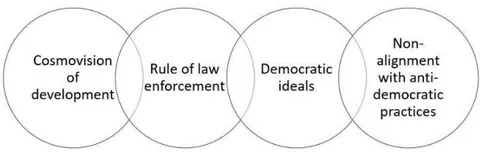
This finding confirms that understanding the PA group interaction is worth examining ARCO's political dimension, not just its geoeconomic nature – thoroughly explained already (Guerra-Barón 2021a). The discovery also ensures that looking at the role of political elements in ARCO'S formation – despite its short institutional existence – is significant. Therefore, 2010 is pyramidal for understanding the PA origin not only for the influence of international organizations' narratives in its conception (Guerra-Barón 2023) but because that year meant the end of ARCO and the birth of the PA (Guerra-Barón 2019). Peruvian President Alan Garcia (2002–2010) led the creation of the PA: a self-identified "non-ideological" group characterized by its members' acknowledgment of democratic values, respect for international law and trade, global governance, pragmatism, and openness. Alone with the quick support of the Chilean president (Michelle Bachelet left La Moneda Palace in 2010), the firm engagement of her successor (Píñera, 2010-2014), and Colombia (Álvaro Uribe: 2002-2010; Juan Manuel Santos: 2010-2014), Garcia led a sub-regional forum that clashed with the predominant anti-globalization and anti-neoliberal discourse of ALBA-TCP.
Within a complex political milieu, the Pacific Alliance emerged as a political and trade-oriented cooperative scheme that brought together like-minded South American states with a coast falling on the Pacific
Ocean –and Mexico (Guerra-Barón 2019). Once the idea of building an alliance became concrete in 2011, Chile, Colombia, and Peru aimed to act together as a unit and to engage collectively through overlapped understanding mechanisms –not just cooperation. To that end, shared norms became a departure point that allowed the Pacific Alliance States (including Mexico) to acknowledge each other as like-minded partners that share liberal values, democracy as an ideal government regime, neo-liberalism as an economic model to follow, and full compliance with the World Trade Organization's [WTO] rules and international investment standards (FTAs and bilateral trade agreements [BITs]) (Guerra-Barón 2019).
Literature shows that like-mindedness and norm-sharing by the PA States moved the agreement forward (Guerra-Barón 2018, 2019, 2021a). However, the awareness of Chavez as a negative influence in the region was not the only political motivation for enacting the PA. Also, the perception of high-elite agents (Chile, Colombia, and Peru) about the negative influence of the Venezuelan belief system as damaging to the South American region was a regional driver for the PA conception — additionally, the Venezuelan influence on the Bolivian and Ecuadorian presidents within the Andean Community [AC](Figure 2).
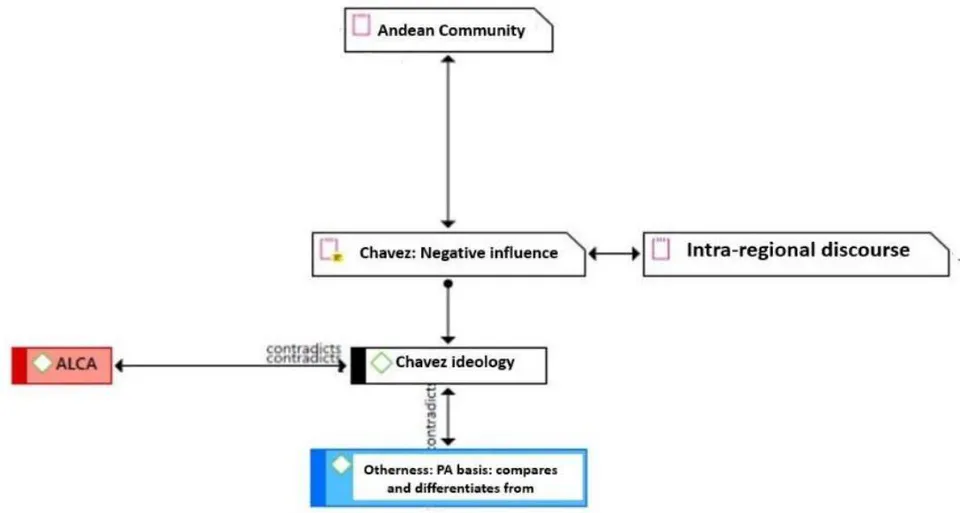
As shown above, Chavez's opposition to the US initiative of creating the Free Trade Area of the Americas is another expression of the Venezuelan leader -a position backed up by Argentina and Brazil. This collective posture straightforwardly contradicted Chile, Colombia, and Peru - plus their financial support to the Inter-American Development Bank [IDB], the Latin American Commission, and the Organization of American States [OAS]. Although FTAA did not trigger the PA, it is a discursive element that stresses the clash of interests and narrative plots (Guerra-Barón 2020).
Last but not least, evidence confirms that high-elite interviewees agreed that ALBA-TCP group practices extrapolation throughout South America gradually deteriorated the region's image externally. As evidence shows (see the blue box, Figure 2), the Chave'z belief system played a decisive role by gathering the presidents of Chile, Colombia, and Peru to straightforwardly acknowledge their commitment to defending a cohesive cosmovation of development –recognizing their particularities (Guerra-Barón 2020). Evidently, behind agents' interaction lie discourses and possible narratives not tackled here.
Before mentioned findings allow us to grasp the role that presidents García, Pinera, and Uribe/Santos played when identifying themselves in ARCO and their resilience once that intergovernmental scheme ended — also, these agents' purposive action towards converging in the PA by facilitating institutional clusters (Figure 3).
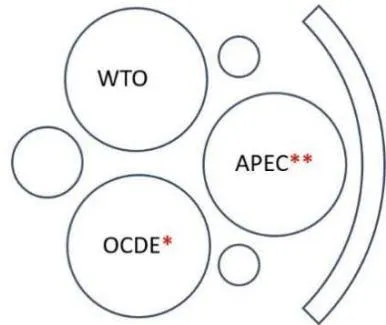
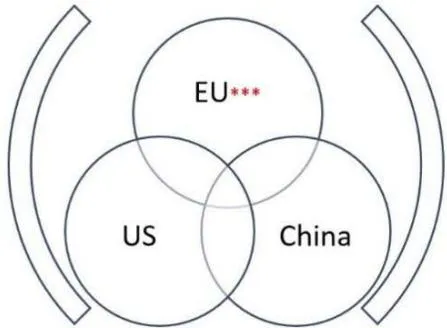
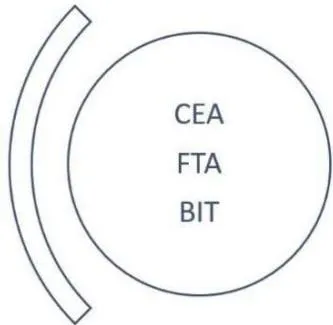
CEA: Complementary Economic Agreement. FTA: Free trade agreement. BIT: Bilateral investment treaties. WTO: World Trade Organization. *OCDE (OECD, in Spanish): Chile and Colombia are member economies; Peru accession is under discussion (2022). ** Due to the moratory declared by APEC, new State members are not allowed. *** Association Agreement (Chile); Multi-Parties Agreement (Colombia, Peru).
Common principles and regulations
Such three-fold institutional architecture covered much of the multilateral understanding of trade and investment through liberal leadership of the WTO, adopted in APEC, and further deepened in OECD. Common technical language and interpretation derived from joint agreements with key partners (EU, US) and the PA decision to engage with China –an essential trade and investment partner– were the second in-group decisive element of cohesion. Unsurprisingly, the PA members already achieved a soft level of economic integration through bilateral accords (complementary economic agreements [CEA], BIT, FTA) –except for Peru's aspiration regarding an FTA with Mexico. In a nutshell, Figure 3 shows that in-group regulatory convergence was already achieved.
As I stated somewhere (Guerra-Barón 2023), many scholars describe the South American political context as post-neoliberal, a sort of "reaction against what came to be seen as excessive marketization at the end of the XXI century and the elitist and technocratic democracies that accompanied market reforms" (Grugel and Riggirozzi 2012, 3). Some studies refer to neostructuralism in the region (Leiva 2008) or a postneoliberal stage (Burdick, Oxhorn, and Kenneth 2009;
Grugel and Riggirozzi 2009; Macdonald and Ruckert 2009; Peck, Theodore, and Brenner 2009) that questions some countries approach towards development as well as democracy itself after the Washington Consensus (Panizza 2009).
Regardless of the labels mentioned above, evidence shows that the presidents of Chile, Colombia, and Peru distanced themselves from the disseminated notion of the development model extended throughout South America through ALBA-TCP leaders and foreign policies (Guerra-Barón 2023).
VI. CONCLUSIONS
The PA confirms how politics and economics are behind clustered regimes. Evidence shows that the Alliance is a political outcome of a changing process that expresses through language, thus conforming to various story plots and, sometimes, narratives along its formation (Guerra-Barón 2021b). As some authors state, the PA aimed to differentiate from what has been called a 'leftist political activism' (Malamud 2005, 425) rapidly spread throughout the region during the first decade of the XXI century and up till now.
The role of agents has sometimes been left aside in the analysis and their interactions and non-material exchanges. CDA findings show that political and economic dimensions triggered such encounters, paving the way for some South American Pacific countries to engage in other forums mutually. Chile, Colombia, and Peru's presidents interacted through a differentiable and highly distinctive language constructed that contested ALBA-TPC. For so doing, those presidencies and close advisors acknowledged norms already shared and contributed to a new governance structure. Therefore, the PA exemplifies a clustered system that aims to be easily differentiated and whose normative foundations allow it to let WTO/OECD deepen wisely.
Checkel's thought that agents accept community norms because they impliedly acknowledge it as something right -a so-called Type II internationalization/socialization (J. T. Checkel 2007) - is recreated in the PA study. CDA shows that elite decision-makers' cosmovision regarding development was in jeopardy. Therefore, they not only agreed on the creation of a regional scheme but on the dangers that ALBA-TCP's expansion represented. It confirms that political drivers of like-minded representations of development shared by the South American PA members constituted intra-group boundaries through a normative basis already shared in multilateral fora, regional schemes - mainly ARCO -and bilateral accords. Consequently, the PA makers foresee the potential of out-group comparisons.
However, knowing how the PA building process came to life is part of the landscape. What matters the most is the regional narrative that transnational elite makers participated in. As shown in the language network, Chavist plots were pivotal. Still, critical agents and entrepreneur actors were coordinating an intra-regional discourse to contest the disseminated image of a South America led by the Venezuelan leader.
CDA on the PA elite-makers confirmed that regional geopolitical drivers triggered the clustered regime to offer an alternative image of South America, opposite to the one extrapolated by Chavez through the ALBA-TCP. These findings suggest that the presidencies of Chile, Colombia, and Peru coordinated some actions within ALBA-TCP to engage straightforwardly in another grouping.
In a nutshell, contemplating non-tangible elements—such as language, story plots, and representations—allows possible explanations regarding the importance of interaction and socialization among state agents in IR through Social Identity Theory. Furthermore, a deeper analysis might explain how in-group agents interact and socialize to shape a collective image through cluster institutions. Consequently, normative and shared perspectives of the development model may explain stronger and more demanding connections between agencies. Therefore, behind the PA governance lie geopolitical core elements coherent with geoeconomic ambitions –such as linking South America with regional and global production networks. This finding highlights the role of state elites as imagemakers of regional groups. Still, exploring how these agents interacted with private entrepreneurs to engage in coordinated discourses is necessary.
Footnotes
Thus symbolic interactionism sees society as a web of communication or interaction where persons (or collectivities) influence each other reciprocally; and interaction is symbolic as long (p.2) ↩
Scholars of IT tradition equally acknowledge negotiation as an intrinsic element of any collective identity (Dusche 2010, 84-87; Spati 2016). (p.2) ↩
Strategic calculation, role playing and normative suasion (Ibidem) (p.3) ↩