

Neural Networks and Rules-based Systems used to Find Rational and Scientific Correlations between being Here and Now with Afterlife Conditions
Neural Networks and Rules-based Systems used to Find Rational and

Article Fingerprint
ReserarchID
707EA
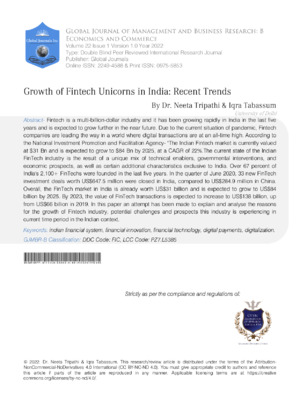
Fintech is a multi-billion-dollar industry and it has been growing rapidly in India in the last five years and is expected to grow further in the near future. Due to the current situation of pandemic, Fintech companies are leading the way in a world where digital transactions are at an all-time high. According to the National Investment Promotion and Facilitation Agency-“The Indian Fintech market is currently valued at $31 Bn and is expected to grow to $84 Bn by 2025, at a CAGR of 22%.The current state of the Indian FinTech industry is the result of a unique mix of technical enablers, governmental interventions, and economic prospects, as well as certain additional characteristics exclusive to India. Over 67 percent of India’s 2,100+ FinTechs were founded in the last five years. In the quarter of June 2020, 33 new FinTech investment deals worth US$647.5 million were closed in India, compared to US$284.9 million in China. Overall, the FinTech market in India is already worth US$31 billion and is expected to grow to US$84 billion by 2025. By 2023, the value of FinTech transactions is expected to increase to US$138 billion, up from US$66 billion in 2019. In this paper an attempt has been made to explain and analyse the reasons for the growth of Fintech industry, potential challenges and prospects this industry is experiencing in current time period in the Indian context.
Neeta Tripathi. 2026. \u201cGrowth of Fintech Unicorns in India: Recent Trends\u201d. Global Journal of Management and Business Research - B: Economic & Commerce GJMBR-B Volume 22 (GJMBR Volume 22 Issue B1): .
Crossref Journal DOI 10.17406/GJMBR
Print ISSN 0975-5853
e-ISSN 2249-4588
The methods for personal identification and authentication are no exception.
Total Score: 102
Country: India
Subject: Global Journal of Management and Business Research - B: Economic & Commerce
Authors: Neeta Tripathi, Iqra Tabassum (PhD/Dr. count: 0)
View Count (all-time): 139
Total Views (Real + Logic): 1677
Total Downloads (simulated): 30
Publish Date: 2026 01, Fri
Monthly Totals (Real + Logic):
Neural Networks and Rules-based Systems used to Find Rational and
A Comparative Study of the Effeect of Promotion on Employee
The Problem Managing Bicycling Mobility in Latin American Cities: Ciclovias
Impact of Capillarity-Induced Rising Damp on the Energy Performance of
Fintech is a multi-billion-dollar industry and it has been growing rapidly in India in the last five years and is expected to grow further in the near future. Due to the current situation of pandemic, Fintech companies are leading the way in a world where digital transactions are at an all-time high. According to the National Investment Promotion and Facilitation Agency-“The Indian Fintech market is currently valued at $31 Bn and is expected to grow to $84 Bn by 2025, at a CAGR of 22%.The current state of the Indian FinTech industry is the result of a unique mix of technical enablers, governmental interventions, and economic prospects, as well as certain additional characteristics exclusive to India. Over 67 percent of India’s 2,100+ FinTechs were founded in the last five years. In the quarter of June 2020, 33 new FinTech investment deals worth US$647.5 million were closed in India, compared to US$284.9 million in China. Overall, the FinTech market in India is already worth US$31 billion and is expected to grow to US$84 billion by 2025. By 2023, the value of FinTech transactions is expected to increase to US$138 billion, up from US$66 billion in 2019. In this paper an attempt has been made to explain and analyse the reasons for the growth of Fintech industry, potential challenges and prospects this industry is experiencing in current time period in the Indian context.
We are currently updating this article page for a better experience.

Lorem ipsum dolor sit amet, consectetur adipiscing elit. Ut elit tellus, luctus nec ullamcorper mattis, pulvinar dapibus leo.































































