I. INTRODUCTION
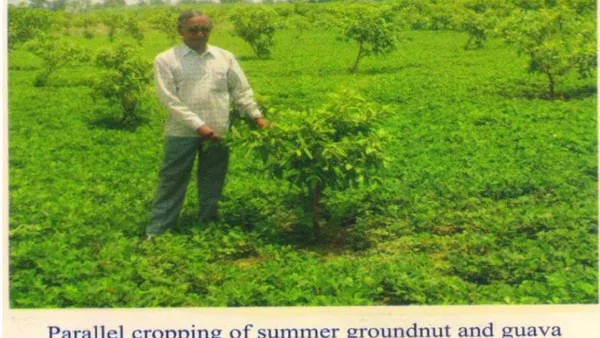
In Uttar Pradesh (India), the riverine soils of Semi-Arid-Tropics (SAT) area, having loamy sand, sandy loam and light loam texture is famous for cultivation of groundnut in rainy season. In early 1980s, groundnut was grown in U.P. on an area of 0.3 million ha with production of 0.19 million t. Since then, both area and production have slowly and steadily decreased due to various reasons especially white grubs and other soil insect and by 2010-11 the groundnut area reduced to 0.08 million ha and the production to 0.08 million tonnes with an average productivity of 988 kg/ha and the area under rainy season groundnut was gradually occupied largely by guava and other horticultural and field crops. With the introduction and spread of groundnut cultivars Dh-86 and ICGV-93468 (Avtar) for cultivation in summer. The area under summer groundnut grew in leaps and bounds from non in 2001 to 3,17,068 ha in 2011 with productivity of 25.32 q/ha. This rapid growth of area under summer groundnut promoted the need for research on cultivation of groundnut in area occupied by guava. The main objective of the experiment was to explore the feasibility of summer groundnut cultivation in the interspaces of younger plantation or already planted guava for utilizing the vacant spaces along with control of insects especially soil insects, which are damage to the pods of groundnut. The secondary objective was to increase the area under summer groundnut in catchments area of river Ganga and its tributaries, where, guava orchards have been well established. The experiment was planned on sandy loam, sandy clay loam and light loam soil of Semi-Arid Climatic Zone of Uttar Pradesh for cultivation summer groundnut during March to June by utilizing the area available between the widely spaced rows of guava. Therefore, filler cropping of summer groundnut in guava spaces is the subject matter of this manuscript.
II. MATERIALS AND METHODS
The innovative field study was undertaken during three consecutive years of 2005-06 to 2007-08 at Mainpuri, Farrukhabad and Kannuaj districts. The operational area located between the catchments area of rivers Ganga and Kali. The soils of operational area were loamy sand, sandy loam and light loam in texture. The composite sample of soil was taken and analyzed. The composite soil sample, having pH 7.9, organic carbon , total nitrogen , available 7.9 kg/ha and available 192 kg/ha. The pH was determined by Electrometric glass electrode method (Piper, 1950), while organic carbon was determined by
Colorimetric method (Datta, et al., 1962). Total nitrogen was analyzed by Kjeldahl's method as discussed by Piper (1950). The available and were determined by Olsen's method (Olsen et al., 1954) and Flam photometric method (Singh, 1971), respectively. The treatments i.e., guava + groundnut cv. Dh-86 + soil application of neem leaves powder@50 kg/ha and spraying of neem oil on guava [email protected] lit/ha, guava + groundnut cv. Dh-86 + soil application of neem leaves powder@100 kg/ha and spraying of neem oil on guava [email protected] lit/ha, guava + groundnut cv. ICGV-93468 + soil application of neem leaves powder@50 kg/ha and spraying of neem oil on guava [email protected] lit/ha and guava + groundnut cv. ICGV-93468 + soil application of neem leaves powder@100 kg/ha and spraying of neem oil on guava [email protected] lit/ha were tested. The fields of guava with two to four years old plantation were selected for sowing of groundnut as a summer filler crops. The farmers were advised for the plantation of guava at spacing of . Two cultivars of groundnut viz., Dh-86 and ICGV-93468 were selected for filler cropping. The groundnut was planted from 5-10 March during the three experimental years. The 20 rows of groundnut were planted between two rows of guava. The sowing of groundnut was done at spacing of 25 cm. The gap of 50 cm was maintained between the adjacent guava and groundnut rows from both sides to facilitate easy intercultural operations. The recommended package of practices was followed for raising of both crops. The groundnut was harvested at 90-95 days after planting in 3 to 8 June of three years. Both crops were irrigated as and when required.
III. RESULTS AND DISCUSSION
The pooled data of fruits yield of guava, pods yield of summer groundnut, system productivity and incidence of insects, pest and diseases have been presented in Table-1 and discussed here under appropriate heads.
a) Fruits yield of guava
Perusal of data make it clear that guava + groundnut cv. ICGV-93468 + soil application of neem leaves powder@100 kg/ha and spraying of neem oil on guava [email protected] lit/ha treatment gave higher fruits yield of guava by 79.00 q/ha (T4), closely followed by guava + groundnut cv. ICGV-93468 + soil application of neem leaves powder@50 kg/ha and spraying of neem oil on guava [email protected] lit/ha (77.00 q/ha) in comparison to T1 (74.00 q/ha) and T2 (76.00 q/ha). These results confirm the findings of Singh (2009) and Singh (2011).
b) Pods yield of summer groundnut
It is clear from the results that not much variation was found under different treatments, though numerically higher pods yield of cultivar ICGV-93468 was weighed under treatment of guava + groundnut cv. ICGV-93468 + soil application of neem leaves powder@100 kg/ha and spraying of neem oil on guava [email protected] lit/ha by 31.00 q/ha as compared to other tested treatments. The performance of pods yield of groundnut was (31.00 q/ha) > (30.30 q/ha) > (25.00 q/ha) and > (24.00 q/ha). These results are in agreement with those reported by Singh (2009) and Singh (2011).
c) System productivity
The system productivity was computed from the total production of fruits yield of guava and pods yield of summer groundnut. The highest total productivity was found under guava + groundnut cv. ICGV-93468 + soil application neem leaves powder@100 kg/ha and spraying of neem oil on guava [email protected] lit./ha by 110.00 q/ha, closely followed by guava + groundnut cv. Dh-86 + soil application neem leaves powder@100 kg/ha and spraying of neem oil on guava [email protected] lit./ha by 106.30 q/ha. The two treatments i.e., and displayed the system productivity as 99.00 q/ha and 101.00 q/ha, which was lowest. The higher and lowest yield of guava fruits and pods yield of summer groundnut under tested treatments were responsible for highest and lowest system productivity. Similar results have also been reported by Singh (2009) and Singh (2011).
d) Biotic Control
i. Incidence of insects, pest and diseases
For the control of white grubs, termites and pod borers, soil application of neem leaves powder was made before the sowing of groundnut. The lower and higher doses of neem leaves@50 kg/ha and 100 kg/ha, respectively, fully control the incidence of white grubs and BND disease in groundnut. The incidence of termites was counted under lower dose of 50 kg/ha neem leaves powder, while it was fully control at higher dose of 100 kg/ha neem leaves powder. The pods damage by pod borers was recorded between to under lower and higher doses of neem leaves powder. For the control of white grubs in groundnut, the prophylactic control measure was also adopted by the spraying of neem [email protected] lit/ha on guava plantation. These plant protection measures displayed the significant achievement in control of insects, pest and diseases in groundnut and guava under agro-forestry system.
ii. Abiotic control
It is well known fact that the riverine soils of Uttar Pradesh have more percentage of sand in texture with crumby structure which support to the wind soil erosion. The considerable soil moisture also loss due to high wind velocity during summer season. Being cover crop, groundnut, grown as filler crop, between rows of guava control. The wind erosion of soil and checked the moisture loss. These results are in agreement with those reported by Singh (2011).
IV. CONCLUSION AND RECOMMENDATION
In agro-forestry system of guava + groundnut cv. Dh-86 and cv. ICGV-93468 + soil application of neem leaves powder@100 kg/ha and spraying of neem oil on guava [email protected] lit/ha gave highest fruits yield of guava and pods yield of groundnut during summer season, therefore, farm families of guava and summer groundnut growing tracts may be suggested for adoption of this system and harvest the fruits of newly generated technology.