
I. INTRODUCTION
The history of African, Islamic,[^1] Western and Technocratic slavery in Africa and Nigeria in particular has rendered us numb in many ways. The chains of enslavement have been eating up our limbs. The major crime in the social, political and religious history of Nigeria is the abuse of God in the face of human injustice. People always have ways to link even bad things to God in order to control the people at the grassroots of accepting their injustices. We live not just in a modern world in which life becomes meaningful and improved but rather we have turned it into an age of terror in which the news and sight of death have become the order of the day.
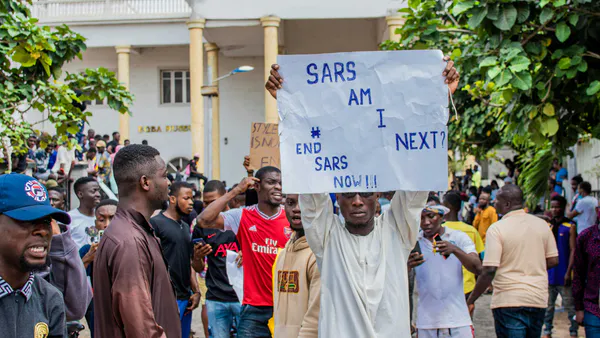
The Endsars protests around Nigerian major cities like Lagos, Port Harcourt, Jos, and even Kaduna leave us in serious tension because of the agitation of fellow citizens in their quest to fight for their rights. It has been a common sight that Nigerians are used to suffering that is why some even sing and dance in the process of protest not necessary shout and cry. The Endsars protests of 2020 have turned quite differently and frighteningly. The protesters have turned very angry and aggressive in their serious quest to restore their human rights and dignity from their political overlords. Nigerian politicians have broken the heart of the people in these recent times especially when in Lagos, Jos and Kaduna just to mention a few places where citizens broke through Corona Virus palliative stores and packed numerous goods that have even expired and were never shared to the poor citizens for whom they were initially donated and stored.
The tension in Nigeria today has in many ways stimulated our thoughts on moral theory and theodicy struggles. We would join the trend of Felix Oloyede, and Adeola Elega to briefly explore the history of hashtags (#) in recent history in order to show the significance of the social media in human mass mobilization and the social campaigns for human rights and dignity.
This short historic reflection would lead us further into a more theological reflection in connection to socio-political activism. This would give the discussion of activism a theological turn by presenting the ethics of hope from a theological perspective as the leading paradigm in doing political theology in Nigeria today. This political theology does not aim at politicizing theology but rather it hopes to theologize politics. This would hopefully present some kind of hybridization between the two human practices not in total disharmony with each other but with some measure of cohesion and tranquil hope in the midst of the chaos of life that incessantly made life difficult and our beautiful world more of a desert than home.
II. ENDSARS AND THE POLITICAL TERROR OF NIGERIA
Felix Oloyede and Adeola Elega help us to see the legitimacy and role of social media in social and political activism with special emphasis to Nigerian context.[^13]2 Historically speaking, from the inception of democratic politics in Nigeria say, from 1999, the social and political terrain of Nigeria has changed radically for better and for worse. There have been many interesting social and ethical developments around the country and the standard of human life that are quite appreciable from the democratic turns of event, yet, there is also enormous growth of social injustices of the violation of human rights and dignity across strata of life. These gross violations have rendered our country so ugly and backward in the international community and even from within us too, the distances between our religions are so enormous that we live as cats and dogs in many localities now. The horror of dehumanization has pushed many young people into aggressive resolves in order to make their voices heard on matters that concern them. These issues of sociopolitical injustices are seen in many other countries too numerous to mention here.[^10][^9][^88] The racial unrest of America, the sociopolitical tyranny in Belarus, the political revolutionary moves in Thailand and Nigeria among many others are only a few examples to show us that the time is ripe for major social reforms in our country and the world at large.
There are many other hashtags that have become the necessary expression of human awareness of their needs from those who trample upon the values of life and freedom and justice. For example, there is "#Occupy WallStreet, #BlackLivesMatters, #BringBackOursGirls, #Ferguson, #ArabSpring, #EnoughIsEnough, #Occupy Nigeria etc. All these are heart cries of many citizens in quest for freedom and justice. The citizens have explored the new avenue which can be used to easily mobilize people and their power in unison so they could speak in one authoritative voice."
- Felix Oloyede and Adeola Elega, "Exploring Hashtag Activism in Nigeria: A Case of #Endsars Campaign." Conference Proceeding: in Communication and Media Studies (CRPC 2018), Famagusta, Turkish Republic of Northern Cyrus, Eastern Mediterranean University Press, 2019; 87-92.
- [^3]Oloyede and Elega, Exploring Hashtag Activism in Nigeria: 88 cf. S. S. Ofori-Parku, and D Moscato, Hashtag Activism as a Form of Political Action: A Qualitative Analysis of #BringBackOurGirls Campaign in Nigerian, UK, and US Press.International Journal of Communication, (2018) 12,23.; C. Olson, BringBackOurGirls: Digital Communities Supporting Real-world Change and Influencing Mainstream Media Agendas. Feminist Media Studies, (2016) 16 (5), 772-787. A. S. Olutokunbo, T., Suandi, O. R. Cephas, & I. H. Abu-Samah, Bring Back Our Girls, Social Mobilization: Implications for Cross Cultural Research. Journal of Education and Practice, (2015) 6(6), 64-75.; M. Maxfield, History Retweeting Itself: Imperial Feminist Appropriation of "Bring Back Our Girls." Feminist Media Studies, (2016) 16(5), 886-900.
The protest like that of Endsars and other previous ones have been done with the actual "physical street occupation in Nigeria"4 in order to 'dramatize their grievances so as the voice of moderation could be heard and the wisdom for good action may be revitalized' (paraphrasing Hannah Arendt). This strategy has been variously interpreted and abused by different people over the social media and commentaries.5 There is no denying of the fact that some use thugs and hoodlums to take advantage of peaceful protest in order to bring on chaos and the disruption of order, sanity and even the sanctity of human life and nature in society. This is a crime and must be condemned by all and sundry.
In their article on "Exploring Hashtag activism in Nigeria" Oloyede and Elega argue that "...hashtag activism is instrumental for social transformation and as such, social media impact, dictates and influence what the traditional media think and show as important to the public." This means the hashtag revolutionary strategy opens the space for demonstrative emphasis on issues of public importance with particular weight and interest. The move is revolutionary which invites the general public into the usefulness of what should be done in mass mobilization within a short time to gain the actual interest and support of the public. The new face it gives to activism is that of digitalization. This new avenue opens space for the actual demonstration of that which is important to the well being of the general public. "The use of Twitter for social transformation over the years has given rise to hashtag activism, which is the use of hashtags for digital activism."
SARS was created out of dire necessity but it turns out ironically to be a serious concern and even a menace to the wellbeing of the general public. "The #Endsars hashtag was created to protest against the high handedness and human right abuse by men of the Special Anti-Robbery Squad (SARS), a unit of the Nigerian police force." This was meant to identify and apprehend armed robbers and not to terrorize the general public of any given community. It may be sympathetically understood that there are times when the armed robbers use the citizens of a particular community to hide themselves. This has gradually turned into community conspiracy in many instances in that the particular community in which they take refuge may not like to expose them to the law enforcement agents, this has created a lot of tension and anger on the side of the SARS agents which severally resulted into the storming of innocent communities and homes in search of suspected robbers etc. And in the process of such house by house search for hidden armed robbers, many atrocities have been committed like several dehumanization of innocent citizens by excessive beating and even killing at some point, destruction of properties, rape, etc. It is sad to note that, "Nigerian youth using the hashtag explained their ordeals with the ruthless SARS officers, some of which included humiliation, detention, extortion, unlawful arrest as well as forcefully breaking into their homes especially student dormitories."9 This made the Nigerian youth to look for an alternative way out of that life-threatening situation by calling for its end.
Hashtag activism had an interesting history in recent times which Oloyede and Elega have carefully surveyed. This shows it more as a socially and politically creative strategy and not just as spontaneous reactive move of undesirable activities around the communities. "The use of hashtags started long before the creation of Twitter although it was made popular by Twitter."10 This shows the discovery of the power of the political union of people in the century. The power of politics now has been technologized such that the people become more powerful and influential if they can muster their efforts and share their ideas on social media. The rise of hashtag as a device for social mobilization started gradually and had a serious move within a very short period of time. According to Oloyede and Elega, "...hashtags were first used to trend world issues on microblogging platforms and sometimes to have real time updates on issues that affect or can affect the public."11
Some may have different kinds of interpretation of the use of hashtag on social media. It is beyond a certain fashion for its own sake but rather it has become a mobilization network sign and identity. It is agreeable that, "...hashtag activism can be seen as an effort that concurrently induce awareness to a movement and ambiguous important phases of the movement such as historical backgrounds or socio-political context."12 This move is always done with the thoughts and quest for revolution. The idea of revolution here does not mean anarchy even though there is certainly space and effort to subvert one kind of ideological move in order to securely pursue and promote the other. Nevertheless, there should be actual expression of the heart-feelings of people in any social contexts for its improvement without actually the unleashing of terror from the people who protest and from those to whom or against whom they protest. Social and political protest is not an action of sabotage or anarchy although there are several instances in many cities of Nigeria recently where the protesters grew so angry to the extent of vandalism of many wares houses in order to pack palliatives to their homes. These violent reactions and riots cannot be justified as acceptable morally speaking yet they are rational in the sense that the subjugation of many people into the state of abject poverty and hunger that even killed many can easily stimulate such violent reaction from the oppressed. This is still another sound of the voice of the marginalized and the oppressed being raised in action against those who have trampled upon them.
Going back to the issues around the history of online activism in Nigeria it is noteworthy that, "Online activism in Nigeria can be traced back to 2009 when former Nigerian Rapper eLDee took to Twitter to express his discontent about erratic power supply in Nigeria. "This came after his friend could not have a surgery done due to power outage."13 The actual content and sociopolitical significance of hashtag campaigns have been made understandable in the following summary, "There are three distinct observations from all the hashtag campaigns; firstly it creates awareness about public issues. Secondly, it demands for a solution from the government, and lastly, it sets the agenda for the public."14
Oloyede and Elega go further to provide a useful overview of #Endsars Campaign in which they further highlighted on the fact that, "The history of police brutality in Nigeria dates back to the colonial period." In their allusion to 1861 that led to the creation of the Northern and Southern Protectorates they discovered that, "The use of violence to suppress the people by the police from the beginning has created a disconnection between the people and the force; this has defined law enforcement practices in Nigeria since that period." The colonial masters especially from the West and the Arabian countries around Africa and some within it colonized the people by the use of force as a symbol of their victory of domination and control. The police force was used to suppress demonstrations in 1920s, workers strikes in 1940s, communal violence in 1950s into the 1960s etc.
The evil of Western and Islamic colonization in Africa have left very painful memories and indelible marks on the hearts and skins of the African people, not less Nigerians. The evil of unequal governance and the subjugation of the powerless have made the powerful more powerful and brutal. The freedom of the masters was always at the expense of the freedom of the slave. The masters are the only free people not their wives, children and slaves. This kind of enslavement mentality has tragically been normalized in African social and political history. The coming of Christianity also did little on that note to change things, nevertheless, it is now that the people are realizing their intrinsic and collective power by which they would always move into a better creation of a new society.
The evil of inequality in the history of Africa has rendered many young people with great potentials into nothing but thugs and hooldlums. Many of these young people had to take to arms and rob people in different communities and contexts of life in order to "make ends meet". This polarization of the equations of freedom and justice has produced many terrorist groups in the name of fighting for freedom. The intensification of the number of armed robbery moved the government to the creation of SARS. "The Special Anti-Robbery Squad (SARS) was created in Lagos State in 1992, a time when Notorious armed robbers such as Shina Rambo were in control of the state."1 The most unfortunate thing about such organizations is that they too have at different points connived with the perpetrators of evil in order to do evil themselves. Theirs may be seen as a clean evil because of their points for its possible justification in the name of trying to create better living conditions for their wives and children. That notwithstanding, the Special Anti-Robbery Squad pushed the ball too far in many senses. There have been many reports on how they have been molested people, men, women and children in the name of sanitizing the society. The evil of SARS pushed the citizens of many local communities into serious aggression in self-defence.
The protests on social media have been done in mass in the process of setting the agenda for tradition media.2 "Agenda setting is the creation of public awareness and concern of salient issues by the news media."3 This is a new move that cannot be so politicized and covered over. Thus the media tradition has to change to become an ordered one. The terror of those that supposed to restore peace and sanity reorients that general politic into becoming more dangerous to themselves and others too. It is now a new turn of things to think and say that, "Nigerians are actively involved in politics of their country through the use of social media."4 Social media has been revitalized not just for the purpose of personal entertainment but more so for the attainment of new political ideals. This quest is that of universal equality and active social justice. These are the pillars of peace and freedom in all communities. The creation and access to social media has become a giant step forward for the African people and Nigeria in particular for the much better and informed engagements. It is interesting now to note "that social media has become an important tool for social change and transformation."22
III. LIVING IN AN AGE OF ANXIETY AND TERROR
One of the major points of concern in existential thinking is that which pertains to the aspect of life and the process of living in the world. The discourse on existential thinking gives attention to the reality of life in its actual experience and interconnectedness to the whole process of living in the world. We cannot be exhaustive in this discussion on existential questions and how they stimulate necessary responses from us for our own good and for the good of all others, thus we shall focus more on the question of anxiety and how it relates to terror as the anticipation of danger or the manifestation of evil in the world. Living in an age of anxiety and terror is the horror of life in the modern world. The dawn of Western and even cosmic enlightenment should have ushered mankind into a new dispensation of reasonableness and mutual acceptance and life together but it is so unfortunate that the age has time and again repeated the old history of evil and terror in the world. We live in an age of great technology and creative destruction of human life and nature.
The correlation between anxiety and terror is very serious and discernible. Nevertheless, the rationalization of violence cannot be an excuse for its normalization. There is no new normal in the killings of people and the destruction of their property. The professional scholars on the crisis of human tension with regards to fear and anger that leads to anxiety and violence always keep our eyes opened and our feet ready for what might come our way.5 This is human crisis beyond the quick solutions of the psychologists.
The human person is always meant to be active in search of whatever would be of help in furthering the reality of his or her life and making it comfortable. Anything that tempers with this freedom is a free stimulus for chains of reactions. Critical scholars on human psychology and theologians who have given time to the reality of human crisis and the psychoanalysis of self have concluded on the correlation of human crisis as an emotional core of human philosophy. Anxiety may be seen as the constant unrest within the self in search of comfort, peace and progress. It is a deep seated emotion that cannot easily be controlled without the actual satisfaction of the self within a given paradigm of life and action. Seeing the philosophy of life as something cogent and highly correlative with the idea of the actualization of life leaves the entire subject of being and action open.
The human quest for self actualization when hindered reacts with serious anger which eventually also triggers the emotion of fear.6 The combination of these two emotions at any given point in time leaves the human person as a free subject of any kind of action in order to either demonstrate his anger or to exhibit his fear. The demonstration of anger may be a positive sense of free communication that is meant to stimulate a sense of deep consideration for his or her sake. This is when the injustice done to them is called by its name and is dramatized in serious action. If this is neglected the fear of abandonment pushes one to the point of redundancy and even the feeling of more anger for being worthless. In order not to allow his injustice to go unnoticed the fear of such loss is manifested in the chains of reactions that may lead to serious attack in order to enact his or her own sense of justice. The negative reactions may be seen as violence from one who reads justice and decency from without but the inner self is using his or her own reason to justify such action in order to see that nothing more is done to hinder the intention of either calling attention to their pitiable situation or even taking justice into their own hands. This idea is often coming into play when those who are supposed to activate justice and order seem to neglect their duties and even seek to twist the arm of truth and justice to self-service and vested interest.
Anxiety, fear and terror are existential phenomena that are intrinsically correlative with each other. The chain moves from the point of anxiety, it moves to fear and then culminates in terror. This idea of terror may be a potential or actual depending on the situation and the feeling of the person directly involved. J. Sartre wrote on the human crisis of being and nothingness.[^25] From the narrative of human creation as seen in the Bible, every human being is the precious creation of God in God's own image. This means every human being is created to be valued and honored as a special guest on earth on behalf of God. The denigration of any human being is an act of injustice and an outright confrontation to the actual image of God. The being of the human is ultimately the being of God. This does not mean that the human person has in any way assumed the character and position of being God or even a god in context. But rather the perfection of God in the person from the point of creation in terms of human originality and the continual creation by human progressive birth on earth leaves the question of the worth of all mankind open. The sense of nothingness in man is the negation of the worth of the same person as created and given by God. Although it is not possible to take away the worth of the human being from them, nevertheless the acts of injustices by the government, church or individuals can confront us and make the person feel rejected and dishonored. This feeling of nothingness renders the person as less than human in themselves. This has the tendency of orienting the person to act less than human expectation. This is why the sane human person can be pushed to the acts of violence and terror in the world. In action, not in essence, the image of God in him or her is denied and suppressed and the image of the evil one is constructed and exalted. This move into terror is the exaltation of evil in the goodness of life not because that evil can lead to any kind of goodness but that the human sense of anxiety has moved him or her beyond the question of patience into the fast fight for the security of his or her freedom and the enactment of justice. Only the release of justice into actual human experience can assuage his or her nerves and lead them to the expression of the goodness that is intrinsically their nature as created by God.
Human emotions have been critically discussed in the discipline of human psychology and philosophy as the most interesting and endless question of existentialism.[^26] This is the kind of being human in the world as we live here and now. The consideration of existentialism as a key aspect of the general understanding of the human person leaves the question of life and death open. In the natural world these two react against each other and even negate each other. But in the new perspective of the Christian these two can be correlative to each other where death does not have to be the negation or the termination of life but even an expression of another sense of life. Death and anxiety can be correlative when the human person sees no option of survival in the hands of tyrants and the context of injustice.[^27] The rationalization of terror and violence only unlocks the human tendency on the negative in order to reach out to the last resort. Death can be that last resort. The death of the perpetrator of injustice and violence may be the release of those under his or her yoke of oppression. This can be the justification of violence not as something right but as something necessary. The necessity of violence in order to break the yoke of injustice cannot be the final solution of the difficulty that the question poses. Nevertheless, the necessity of violence can be allowed to be the only resort against the problem of injustice. There is no way we can accept violence and injustice in the name of peace and rationality but the force of violence can remain the open door through which the captives are released from bondage and through which justice can come in.
Paul Tillich wrote on the theology of being human and the actualization of life by faith and action in the context of the free life. Anxiety is seen as the main symptom of human crisis that needs urgent care and solution.[^28] The solution of anxiety is the restoration of worth and the freedom of being. There is no way the sense of being human as the release of the courage to be[^29] can be any meaningful without the attentiveness to closely understand human crisis of life and address it constructively.[^30] The courage to be may not be an adequate explanation of the meaning of faith when faith comes from within as trust and hope, but rather it is the actualization of faith in its movements outward for action. Faith cannot be moved into action or actions cannot be produced by faith without the courage of being human. This idea of the courage to be as put forward by Paul Tillich is a seminal realization of the necessity of faith in the actualization of life as truly given and as objectively created. Every human being is given the grace of life as seen in his or her actual life.
The chain of human reaction on the on acts of injustices lead to the general chaos we experience both socially and politically. This is what leads to the interpersonal chaos and even social upheavals that leave our contexts vulnerable and so much open to the tyranny of each against all. This dog-eat-dog situation is the bad omen of nihilism even in our time. The idea of solving these dangers does not only lie in the hands of the psychologists with all their therapeutic technicalities.[^31] Nevertheless, it calls for an urgent attention on the side of the government and the general public that constitute the nation state to make sure that justice is done and peace is restored.
The quest of the human person is generally confronted by the questions of life and death as the core of his or her existential enquiry. "Existential anxiety involves apprehension about the ultimate meaning of life and death."32 The question does not begin and end at whether we leave or die but rather how can we go on leaving and how can be actually avoid dying. At the core of existentialism is the human fantasy that moves his or her mind beyond the possibility of dying or rather beyond the natural welcome to the idea of death as the unnatural and the unwelcomed. This can continue to invite the human person into a sense of restlessness and anxiety. Furthermore, "Anxiety about fate and death concerns the absolute threat to one's being in death and the relative threat to the self in our personal fate."33
Another level of anxiety touches the heart at the point of guilt. This is what goes out of a person and also returns back to him or her as an open question that leaves his heart open to challenge and possible corrections. "Anxiety about guilt and condemnation involves perceived threat to one's moral and ethical identity."34 The best of this condemnation is the sense of self-condemnation. Even this can go too far if it reaches the point of self-rejection. Guilt is born within human consciousness in order to alert the mind of its corruption and the wrong that it has done. This easily leaves the person uneasy and pushes him or her to the point of repentance. The killings of human beings at rallies around different countries of the world including Nigeria are acts of heinous crimes against humanity and their rights. This can only be made right when the guilt in the minds of the perpetrators humble them enough to accept the ugliness of their wickedness and to listen to the voices that cry against them. The turning point of Nigeria in the face of all the protests we witness in recent time can be adjusted only if the ruling people seek the ways of truth, justice and righteousness among the people. For them to sit and listen to the voice of conscience from within themselves is a good step for them to hear the actual voice of God addressing them. From this personal revelation the act of revolution would lead to true revival. The destiny of Nigeria and the rest of the world does not need to end in chaos but rather to move through the darkness of life despite all looming dangers around to the point of peace and safety where the freedom and dignity of everyone is recognized and respected.
The correlation of "Fear and anxiety" are the heart of all the protest that we have witnessed at different places not least our own.[^35] The protesters have been moved by the fear of death as a result of tyranny and all kinds of injustices thus they were moved by the "courage to be," not to perish, that is why they came out in mass in search of the air of life and freedom that makes them human again. The problem of fear and anxiety paralyzes the human person and moved them away from themselves into all kinds of inhumane thoughts and actions. The only way that all this evils can be avoided is in our common self recognition as the interconnected family of God in which everyone needs to be adequately cared for and respected. In this context of mutual care and respect the material wealth of the nation can be well shared and the citizens would live with the satisfaction of being connected and together protected.
The reaction of many has led not just to periodic demonstrations but rather even to full scale "terrorism" this is the evil of the human person against another human being. Terrorism cannot be explained or excused in the name of political injustices or marginalization. Nevertheless, all this may have their own contributions to it. According to the historical development and actions of terrorist groups they do not operate from the vantage point of humanity in need, they do not live in fear and anxiety that raise existential questions. But rather they operate from the vantage point of religious exclusivism and imperial hunger and arrogance. No terrorist groups seek freedom and justice, all they need is the space to capture, dominate and oppress. They are all oppressive religious groups who want to exclude all others to their own glory and honor. They have turned themselves to the god of themselves. They live in the name of "the power of the will" as Nietzsche would say, and proclaim the gospel of death in the name of might as their only right. These are groups around the world who daily push all others to the margin and seek to the take hold of the center in the name of trying to sanitize the world in the name of God. The hashtag protests that led to the beginning of the new turn of political activism is also influential in the rethink of Christian theology especially with regards to political theology and social sciences to ask questions that lead to the adjustments of social and political policies in order that this broken world can share the thoughts of humanity that cry so severely against all dangers that loom around it. The basic question that remains for us to reflect upon at the end of this essay is the question of hope and ethics. How can we think and speak of hope as an ethical paradigm in this time of crime and danger?
IV. CONCLUSION: TOWARD THE ETHICS OF HOPE
Jürgen Moltmann has made a name since 1964 with his epoch making publication titled The Theology of Hope.36 In this book and in many other subsequent books, Moltmann has redefined hope as the Christian hope of life against death. From a realistic point of view, this is hope that is born in the midst of strife and threats of death. Nevertheless, human evil towards nihilism and the end of history do not have the last word. The Christian theological vision of life is found on the new horizon opened by the person and work of Jesus Christ in whose light and life we stand and live and for whom we wait in hope in this terrible world of darkness. The comforting words of Jesus Christ of victory against the world (John 16:33) surely keeps the Christian open to the hope of life in its fullness in the person of Jesus Christ. The time in which we live may be the time of anxiety, terror and death as a result of human sinfulness, crimes and injustices, yet, it is also the time of hope and the time of grace. "All of time is grace."37 And the God we know in Jesus Christ is the God of grace and the God of justice and healing of life.
Moltmann discussed the ugliness of our history in the emergence of what he titled "[a] culture of life, terror of death" which has heavily characterized our civilization and age in general. The idea of capturing human beings and even killing them has almost been normalized as the order of the day. The protests we see here and there are general condemnations of the evil of human beings against one another and the continual call for the space and breath of life against the looming danger of death and the reign of evil. It is no news that "Today human life itself is in acute danger."38 The killings and threats may continue as we see them only because of the hardness of the human heart for the cry of the other. The call of the neighbor has been made a strange story from a distant land. It is so pathetic that in our time we hardly see each other as friends and neighbors but more as strangers and foreigners. The time we live in today is surely the days of evil and the life we live is only a borrowed time. "Life was for us a matter of indifference, because it had been made meaningless."39 The meaning of life can only emerge from the heart of love. Where the human heart has grown callous nothing remains than the reign of evil in the distance of self. The darkness of human neighborliness is seen in the words of a Taliban Leader in 2004, Mullar Omar who said to a reporter, 'Your young people love life, our young people love death'.40 The character of life is seen in the love of life and the character of death is seen in the love of death. The evil of life cannot continue to reign among us as the final order of the day. No matter how dark and ugly the situation gets we can move beyond it in the name of Christ who alone is our life and nothing else, for there is nothing else (Col. 3:1-4).
Our ethics of hope is rooted in the person of God as revealed to us in Jesus Christ. The evil of our time has turned many human beings to love their religions more than the love of God. To love religion more than God is the love of darkness more than light. This is the darkness from within and not only from without the self. To love God more than religion is to recognize the Lordship of God above all things and everyone at all time. This is the glory of God and the sure promise of life in the midst of death. The recent Endsars protests in Nigeria point us not only the new turn of political action in Nigeria and the revelation of the evil of human personal interest and social injustices, but it also opens us further to the general hunger of people to the reign of God's righteousness which is the only true history of justice and freedom. The age we live today as an age of anxiety, and all kinds of evil is a constant threat to our human sense of life and flourishing, nevertheless, it is also the time in which we live under the shadow of God and experience the time of grace.
SELECTED BIBLIOGRAPHY
Egbunike, N. Framing the #Occupy Nigeria Protests in Newspapers and Social Media. Open Access Library Journal, (2015) 1-13.
Kierkegaard, S. The Sickness Unto Death (Princeton University Press, Princeton, NJ [1849] 1954b.
Kierkegaard, S. Fear and Trembling. Princeton University Press, Princeton, NJ. (1843/1954a.
Maxfield, M. History Retweeting Itself: Imperial Feminist Appropriation of "Bring Back Our Girls." Feminist Media Studies, (2016) 16(5), 886-900.
Moltmann, J. Ethics of Hope. Minneapolis: Fortress Press, 2012.
Moltmann, Jürgen. Theology of Hope: On the Ground and the Implications of a Christian Eschatology. Translated by J. W. Leitch. London: SCM Press, 1967.
Odewale, O. Project Light Up Nigeria: Power in Our Hands. In E. Zukerman & L. LeJeune, Global Dimension of Digital Activism. Cambridge: MIT Center for Civic Media 2014.
Ofori-Parku, S. S. and D Moscato, Hashtag Activism as a Form of Political Action: A Qualitative Analysis of #BringBackOurGirls Campaign in Nigerian, UK, and US Press. International Journal of Communication, (2018) 12,23.
Oloyede, Felix and Adeola Elega, "Exploring Hashtag Activism in Nigeria: A Case of #Endsars Campaign." Conference Proceeding: in Communication and Media Studies (CRPC 2018), Famagusta, Turkish Republic of Northern Cyrus, Eastern Mediterranean University Press, 2019; 87-92.
Olson, C. Bring Back Our Girls: Digital Communities Supporting Real-world Change and
- Influencing Mainstream Media Agendas. Feminist Media Studies, (2016) 16 (5), 772-787.
Olutokunbo, A. S., T., Suandi, O. R. Cephas, & I. H. Abu-Samah, Bring Back Our Girls, Social Mobilization: Implications for Cross Cultural Research. Journal of Education and Practice, (2015) 6(6), 64-75.
Rasmussen, C. A. and Brems, C (1996). The Relationship of Death Anxiety with Age and Psychosocial Maturity. The Journal of Psychology, 130, 141-145.
Sartre, J. Being and Nothingness. New York: Philosophical Library.
Sartre, J. Existentialism and Human Emotions. New York: Philosophical Library, 1957.
Solomon, S., J. Greenberg, and T. Pyszczynski, A Terror Management Theory of Social-behaviour-The Psychological Function of Self-Esteem and Cultural Worldview. Advances in Experimental Social Psychology, 24, (1991): 93-159.
Tillich, Paul Existentialism and Psychotherapy. Review of Existential Psychology and Psychiatry, 1, (1961) 8-16.
Tillich, Paul. Anxiety, Religion and Medicine. Pastoral Psychology, 3, (1952b):11-17.
Tillich, Paul. The Courage to Be. New Haven: Yale University Press, 1952a.
Ward, Graham. Cities of God. London & New York: Routledge, 2000.
Weems, Carl F., Natalie M. Costa, Christopher Dohen, and Steven L. Berman, Paul Tillich's Theory of Existential Anxiety: A Preliminary Conceptual and Empirical Examination. Anxiety, Stress and Coping (December, 2004) vol. 17, No. 4, pp. 383-399.
Yalom, I. D. The Theory and Practice of Group Psychotherapy. New York: Basic Books, 1975.
Footnotes
Oloyede and Elega, Exploring Hashtag Activism in Nigeria: 90. (p.4) ↩
Oloyede and Elega, Exploring Hashtag Activism in Nigeria: 90. (p.4) ↩
Oloyede and Elega, Exploring Hashtag Activism in Nigeria: 90. (p.4) ↩
Oloyede and Elega, Exploring Hashtag Activism in Nigeria: 90. (p.4) ↩
Carl F. Weems, Natalie M. Costa, Christopher Dohen, and Steven L. Berman, Paul Tillich's Theory of Existential Anxiety: A Preliminary Conceptual and Empirical Examination. Anxiety, Stress and Coping (December, 2004) vol. 17, No. 4, pp. 383-399; S. Kierkegaard, The Sickness Unto Death (Princeton University Press, Princeton, NJ [1849] 1954b). (p.4) ↩
S. Kierkegaard, Fear and Trembling. Princeton University Press, Princeton, NJ. (1843/1954a) (p.5) ↩