
Introduction
Diabetic Foot Ulcers (DFUs) represent a major cause of morbidity, health care utilization, and lower-extremity amputation among patients with diabetes1–3. DFUs are associated with prolonged healing, frequent clinical encounters, and increased risk of infection and hospitalization, contributing substantially to overall health care costs2–4. When standard wound care fails to achieve timely healing, advanced skin substitutes are frequently used to promote tissue regeneration and wound closure4–6.
In recent years, the economic evaluation of advanced skin substitutes has become increasingly complex due to significant changes in Medicare payment policy. Under 2026 Medicare Physician Fee Schedule (PFS) and Outpatient Prospective Payment System (OPPS) rules, skin substitutes are reimbursed as incident-to supplies using standardized per-square-centimeter payment methodologies rather than product-specific pricing. These changes have shifted attention away from unit price and toward utilization patterns, surface area applied, and clinical outcomes.
Emerging clinical evidence suggests that high-purity type I collagen-based skin substitute like Helicoll, may achieve early wound area reduction and clinically meaningful healing in patients with DFUs. However, their economic value relative to established advanced skin substitutes has not been well characterized, underscoring the need for comparative effectiveness and cost-effectiveness evaluation1,2.
The objective of this analysis is to descriptively compare published healing outcomes and estimated cost per healed DFU across selected advanced skin substitutes, interpreted within CMS payment environment.
Methods
Study Design
This study is an exploratory cost-per-responder analysis using secondary published data7. It is not a systematic review, meta-analysis, or formal cost-utility model.
No AI-generated cost estimation algorithms were used in the final model. All economic inputs are explicitly defined below to ensure reproducibility. No formal PRISMA review or risk-of-bias scoring was conducted. Clinical trial number is not applicable. Therefore, cross-trial comparability is limited. Healing probabilities were extracted exactly as reported in published studies.
Because the included studies differed in study design, ulcer severity, wound size, Wagner grade, infection status, offloading methods, and standard wound-care practices, the reported healing rates could not be considered directly comparable measures of relative treatment effectiveness. Therefore, a descriptive semi-quantitative evidence weighting approach was used, taking into account factors such as study design, sample size, baseline patient comparability, endpoint definition, and follow-up duration. Accordingly, the resulting rankings should be interpreted as exploratory economic illustrations rather than definitive comparative effectiveness conclusions.
Perspective and Time Horizon
The analysis was conducted from a payer perspective intended to reflect a typical DFU treatment episode. No lifetime horizon or QALY (Quality-Adjusted Life Year) modeling was conducted.
Interventions Included
Helicoll, Grafix, Apligraf, Dermagraft, and EpiFix.
Clinical Outcome Inputs
The primary clinical outcome was complete DFU healing at approximately 12 weeks. In contrast, the early healing kinetics observed with Helicoll Skin Substitute support accelerated wound closure, achieving comparable outcomes within 5 weeks versus 12 weeks reported for other products. This efficacy was clinically demonstrated in a multicentric study8, which reported a wound closure probability of 0.83 at 5 weeks (4-week treatment period with 1-week follow-up).
Cost Inputs
Estimated treatment-related costs were derived from payer reimbursement information that was publicly available7.
Since CMS payment is applied per treated square cm, episode cost is highly sensitive to utilization assumptions, particularly number of applications and average treated wound area. A one-way sensitivity analysis is therefore necessary in future by varying the number of applications per episode across plausible real-world ranges as given in Table 1. This analysis is essential for products requiring more frequent applications or larger treated surface areas as it may generate substantially higher episode costs even when the per-cm² reimbursement amount is standardized. Thus, future analyses should validate these inputs using independent hospital acquisition data, payer claims, chargemaster information, or registry-derived utilization costs.
| Variable | Base Case | Low Scenario | High Scenario |
|---|---|---|---|
| Applications per episode | Product-specific average | 1–2 | 5–8 |
| Treated area | Product-specific average | −50% | +50% |
| Healing probability | Published/adjusted value | −25% | +25% |
| Treatment cost | Base estimate | −50% | +50% |
Sensitivity Analysis
Economic Outcome
Primary economic outcome was calculated using:
No ICERs were calculated because:
Cross-trial comparison violates incremental modeling assumptions
No common comparator arm exists
No probabilistic uncertainty modeling was performed
Dominance terminology has been removed to avoid overstating comparative claims.
Ethical Considerations
This study used aggregated, de-identified secondary data and did not involve direct patient contact. As such, institutional review board approval and patient consent were not required. The analysis adhered to ethical standards for health economic research and transparent reporting.1
Results
Drivers of Cost per Healed DFU
Although estimated treatment-related costs varied across products, differences in calculated cost per healed DFU were driven primarily by variation in reported healing probabilities rather than absolute cost alone. Products with similar estimated treatment-related costs demonstrated markedly different cost per healed DFU values due to differences in reported healing outcomes, as specified in Table 2. Notably, higher treatment-related cost did not consistently correspond to higher healing probability, underscoring the importance of considering both outcomes and resource use when interpreting descriptive economic metrics.
Reported 12-week healing probabilities varied across products, ranging from approximately 0.30 to 0.837,8. Estimated treatment-related costs ranged from approximately $20,000 to over $33,000 per treatment episode. Helicoll demonstrated the lowest calculated cost per healed DFU among evaluated products.
| Product | Estimated Treatment-Related Cost (USD) | Healing Probability | Approx. Cost per Healed DFU (USD) |
|---|---|---|---|
| Helicoll | $20,000 | 0.83 at 5 weeks | $24,000 |
| Grafix | $28,449 | 0.62 at 12 weeks | $45,900 |
| Apligraf | $25,370 | 0.48 at 12 weeks | $52,850 |
| Dermagraft | $24,552 | 0.38 at 12 weeks | $64,600 |
| EpiFix | $33,288 | 0.30 at 12 weeks | $110,960 |
Reported Healing Outcomes and Calculated Cost per Healed DFU
Table Notes: (1) Reported values represent approximate 12-week healing rates as described in the cited literature7 and are not derived from head-to-head comparisons. Cost per healed DFU as illustrated in Figure 1 was calculated descriptively as estimated treatment-related cost divided by reported healing probability. The annual cost per patient versus 12-week healing probability is given in Figure 2. (2) The estimated treatment related cost of Helicoll was based on the respective average invoice cost. (3) The previously completed cost-analysis study used a total study duration of 12 weeks. However, owing to the accelerated healing kinetics of Helicoll, the product demonstrated substantial wound healing within 4 weeks, allowing its clinical evaluation8 to be completed over a shorter 4-week treatment period with 1-week follow-up (4+1 weeks). (4) The healing probabilities included in Table 2 provided healing rates that could be used for descriptive cost-per-healed-ulcer calculations and were not selectively chosen to favor any specific product. However, the available clinical trials may have differed in patient enrollment criteria, wound severity, comparator groups, and treatment protocols. (5) When multiple publications were available for a product, the study most consistent with the 12-week DFU endpoint and suitable for the cost-analysis model was selected.
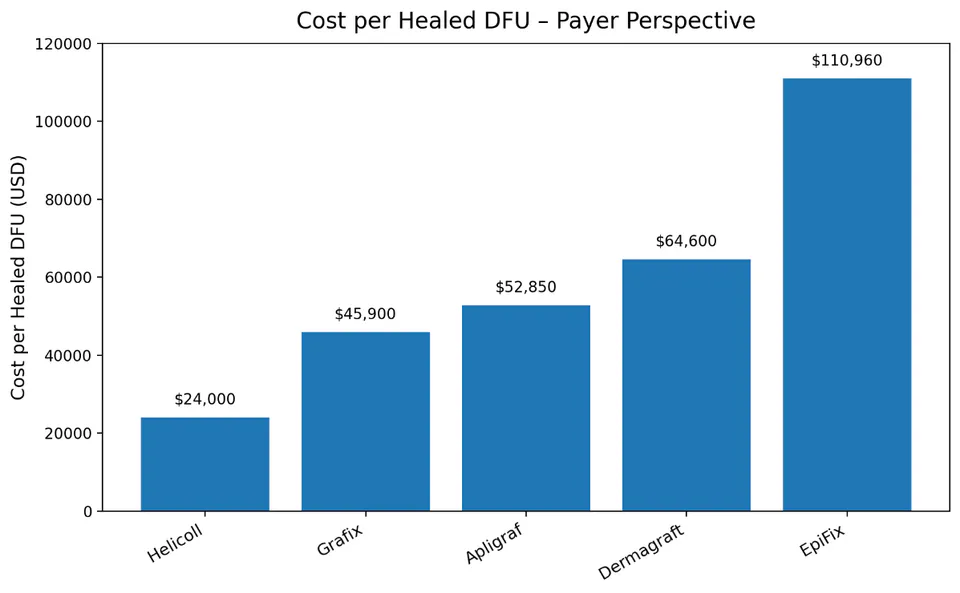
Cost per Healed DFU (Payer Perspective). Bar chart showing the cost per healed DFU for each skin substitute. Helicoll has the lowest cost compared with other products.
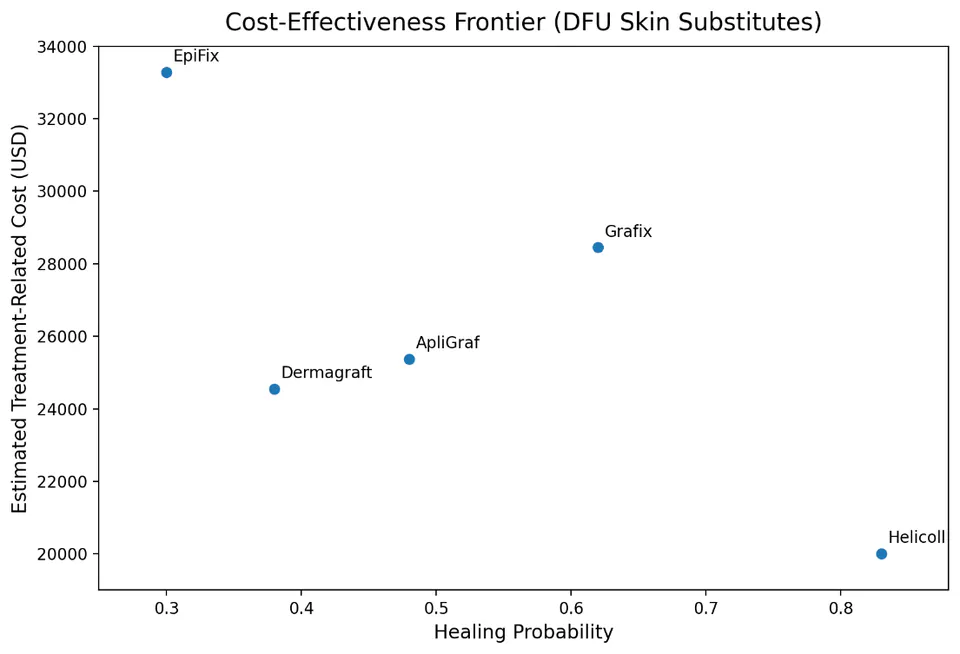
Cost-Effectiveness Frontier for DFU Skin Substitutes. Scatter plot of annual cost per patient versus healing probability at 12 weeks for all products except Helicoll at 5 weeks. Treatments in the lower-right quadrant are more cost-effective. Helicoll shows a favorable balance, with high healing probability and the lowest annual cost.
Discussion
Clinical Interpretation of Descriptive Economic Metrics
From a payer perspective, lower cost per healed ulcer translates into reduced total cost of care and improved allocation of healthcare resources. From a clinical standpoint, achieving timely wound closure is associated with reduced risk of infection, fewer clinic visits, and lower likelihood of amputation.
The favorable cost-effectiveness profile observed for Helicoll may be explained by its demonstrated ability to promote early wound area reduction and granulation, as reported in randomized and real-world clinical studies8-16 of high-purity type I collagen–based skin substitutes.
This study does not establish comparative clinical superiority or formal cost-effectiveness dominance. Instead, it demonstrates how cost-per-responder metrics are mathematically sensitive to healing probability inputs under CMS reimbursement standardization.
Key Interpretations:
Cross-trial comparisons are inherently confounded by differences in patient severity, ulcer size, study design, and background standard of care.
Without head-to-head trials or network meta-analysis, relative effectiveness cannot be conclusively determined.
Economic rankings derived from unadjusted healing rates should not be interpreted as definitive payer guidance.
Limitations
This study is limited by reliance on secondary data and modeled assumptions rather than direct head-to-head randomized controlled trials. Real-world outcomes may vary based on patient characteristics, wound severity, and adherence to standard of care. Future prospective studies and registry-based analyses are warranted.
This analysis has several important limitations:
It is not a systematic review.
No PRISMA-compliant selection framework was implemented and no formal risk-of-bias assessment, probabilistic uncertainty analysis, and quality-adjusted life-year (QALY) modeling was conducted.
No adjustment for baseline ulcer size, Wagner grade, or infection status was performed.
Healing probabilities were drawn from separate trials with heterogeneous populations, study designs, wound characteristics, and standard-of-care procedures.
Manufacturer affiliation presents a potential conflict of interest and possible risk of selection bias in literature inclusion, cost assumptions, and interpretation of descriptive rankings.
The treatment-related cost inputs were obtained from public data and were not independently audited.
The analysis does not constitute a network meta-analysis or formal comparative effectiveness evaluation, and no common comparator arm existed across the included studies.
The findings should be interpreted as exploratory and hypothesis-generating economic illustrations rather than definitive comparative cost-effectiveness conclusions. Further validation through independent systematic reviews, registry-based real-world evidence analyses, third-party health economic modeling, and prospective head-to-head clinical trials is warranted.
Conclusion
This study presents a transparent cost-per-healed-ulcer framework using published 12-week healing data and standardized CMS reimbursement assumptions. In this preliminary comparative effectiveness and cost-effectiveness study, Helicoll demonstrated clinically meaningful healing outcomes at substantially lower cost compared with other advanced skin substitutes used in DFU management. It does not constitute a formal cost-effectiveness model or systematic comparative effectiveness evaluation.
Future research warrants for:
PRISMA-compliant systematic review
Network meta-analysis or head-to-head RCTs
Probabilistic cost-utility modeling
Longitudinal recurrence and amputation modeling
Independent cost validation
The authors acknowledge Encoll Corp. for providing product-related cost inputs used in this analysis.
Footnotes
Helicoll® is a registered trademark of Encoll Corporation (Fremont, CA, USA). Grafix® is a registered trademark of Smith & Nephew, Inc. (Andover, MA, USA). Apligraf® and Dermagraft® are registered trademarks of Organogenesis Inc. (Canton, MA, USA). EpiFix® is a registered trademark of MiMedx Group, Inc. (Marietta, GA, USA). All other trademarks are the property of their respective owners. ↩