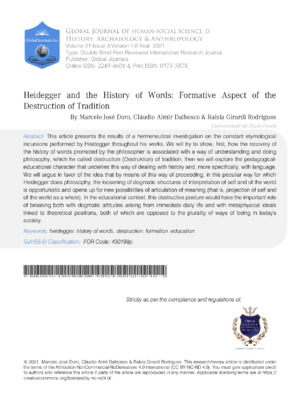
Heidegger and the History of Words: Formative Aspect of the Destruction of Tradition

Article ID

RM110

A detailed study on the evolution and significance of language, exploring how words shape culture and society.

Heidegger and the History of Words: Formative Aspect of the Destruction of Tradition

Marcelo José Doro
Marcelo José Doro
Cláudio Almir Dalbosco
Raísla Girardi Rodrigues
DOI

Abstract

This article presents the results of a hermeneutical investigation on the constant etymological incursions performed by Heidegger throughout his works. We will try to show, first, how the recovery of the history of words promoted by the philosopher is associated with a way of understanding and doing philosophy, which he called destruction (Destruktion) of tradition; then we will explore the pedagogical-educational character that underlies this way of dealing with history and, more specifically, with language. We will argue in favor of the idea that by means of this way of proceeding, in this peculiar way for which Heidegger does philosophy, the loosening of dogmatic structures of interpretation of self and of the world is opportunistic and opens up for new possibilities of articulation of meaning (that is, projection of self and of the world as a whole). In the educational context, this destructive posture would have the important role of breaking both with dogmatic attitudes arising from immediate daily life and with metaphysical ideals linked to theoretical positions, both of which are opposed to the plurality of ways of being in today’s society.

Heidegger and the History of Words: Formative Aspect of the Destruction of Tradition

This article presents the results of a hermeneutical investigation on the constant etymological incursions performed by Heidegger throughout his works. We will try to show, first, how the recovery of the history of words promoted by the philosopher is associated with a way of understanding and doing philosophy, which he called destruction (Destruktion) of tradition; then we will explore the pedagogical-educational character that underlies this way of dealing with history and, more specifically, with language. We will argue in favor of the idea that by means of this way of proceeding, in this peculiar way for which Heidegger does philosophy, the loosening of dogmatic structures of interpretation of self and of the world is opportunistic and opens up for new possibilities of articulation of meaning (that is, projection of self and of the world as a whole). In the educational context, this destructive posture would have the important role of breaking both with dogmatic attitudes arising from immediate daily life and with metaphysical ideals linked to theoretical positions, both of which are opposed to the plurality of ways of being in today’s society.

Marcelo José Doro
Marcelo José Doro
Cláudio Almir Dalbosco
Raísla Girardi Rodrigues

No Figures found in article.

Marcelo José Doro. 2021. “. Global Journal of Human-Social Science – D: History, Archaeology & Anthropology GJHSS-D Volume 21 (GJHSS Volume 21 Issue D3): .

Download Citation

Journal Specifications

Crossref Journal DOI 10.17406/GJHSS

Print ISSN 0975-587X

e-ISSN 2249-460X

Classification
GJHSS-D Classification: FOR Code: 430199p
Keywords
Article Matrices
Total Views: 1841
Total Downloads: 823
2026 Trends
Research Identity (RIN)
Related Research
Our website is actively being updated, and changes may occur frequently. Please clear your browser cache if needed. For feedback or error reporting, please email [email protected]

Request Access

Please fill out the form below to request access to this research paper. Your request will be reviewed by the editorial or author team.
X

Quote and Order Details

Contact Person

Invoice Address

Notes or Comments

This is the heading

Lorem ipsum dolor sit amet, consectetur adipiscing elit. Ut elit tellus, luctus nec ullamcorper mattis, pulvinar dapibus leo.

High-quality academic research articles on global topics and journals.

Heidegger and the History of Words: Formative Aspect of the Destruction of Tradition

Marcelo José Doro
Marcelo José Doro
Cláudio Almir Dalbosco
Raísla Girardi Rodrigues

Research Journals