Higher Education Policies in Brazil: From a Foreign Policy Strategy to the Dismantling

α
Roberta Rodrigues Marques da Silva
σ
Marcela Vitarelli Batista
ρ
Thais Ferreira Rodrigues
α Universidade Federal Fluminense Universidade Federal Fluminense

Send Message

To: Author

Higher Education Policies in Brazil: From a Foreign Policy Strategy to the Dismantling

Article Fingerprint

ReserarchID

1T7HQ

Higher Education Policies in Brazil: From a Foreign Policy Strategy to the Dismantling Banner

AI TAKEAWAY

Connecting with the Eternal Ground
  • English
  • Afrikaans
  • Albanian
  • Amharic
  • Arabic
  • Armenian
  • Azerbaijani
  • Basque
  • Belarusian
  • Bengali
  • Bosnian
  • Bulgarian
  • Catalan
  • Cebuano
  • Chichewa
  • Chinese (Simplified)
  • Chinese (Traditional)
  • Corsican
  • Croatian
  • Czech
  • Danish
  • Dutch
  • Esperanto
  • Estonian
  • Filipino
  • Finnish
  • French
  • Frisian
  • Galician
  • Georgian
  • German
  • Greek
  • Gujarati
  • Haitian Creole
  • Hausa
  • Hawaiian
  • Hebrew
  • Hindi
  • Hmong
  • Hungarian
  • Icelandic
  • Igbo
  • Indonesian
  • Irish
  • Italian
  • Japanese
  • Javanese
  • Kannada
  • Kazakh
  • Khmer
  • Korean
  • Kurdish (Kurmanji)
  • Kyrgyz
  • Lao
  • Latin
  • Latvian
  • Lithuanian
  • Luxembourgish
  • Macedonian
  • Malagasy
  • Malay
  • Malayalam
  • Maltese
  • Maori
  • Marathi
  • Mongolian
  • Myanmar (Burmese)
  • Nepali
  • Norwegian
  • Pashto
  • Persian
  • Polish
  • Portuguese
  • Punjabi
  • Romanian
  • Russian
  • Samoan
  • Scots Gaelic
  • Serbian
  • Sesotho
  • Shona
  • Sindhi
  • Sinhala
  • Slovak
  • Slovenian
  • Somali
  • Spanish
  • Sundanese
  • Swahili
  • Swedish
  • Tajik
  • Tamil
  • Telugu
  • Thai
  • Turkish
  • Ukrainian
  • Urdu
  • Uzbek
  • Vietnamese
  • Welsh
  • Xhosa
  • Yiddish
  • Yoruba
  • Zulu

Abstract

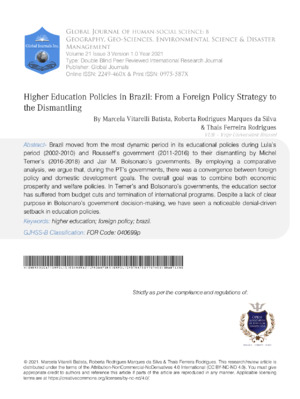
Brazil moved from the most dynamic period in its educational policies during Lula’s period (2002-2010) and Rousseff’s government (2011-2016) to their dismantling by Michel Temer’s (2016-2018) and Jair M. Bolsonaro’s governments. By employing a comparative analysis, we argue that, during the PT’s governments, there was a convergence between foreign policy and domestic development goals. The overall goal was to combine both economic prosperity and welfare policies. In Temer’s and Bolsonaro’s governments, the education sector has suffered from budget cuts and termination of international programs. Despite a lack of clear purpose in Bolsonaro’s government decision-making, we have seen a noticeable denial-driven setback in education policies.

References

28 Cites in Article
  1. L Almeida (2015). O Mercosur Educacional e a criação da UNILA no início do século: por uma integração regional via educação.
  2. C Almeida De Carvalho (2014). Política para a educação superior no governo Lula: expansão e financiamento.
  3. Thais Aveiro (2014). O programa Ciência sem Fronteiras como ferramenta de acesso à mobilidade internacional.
  4. Pedro Bastos,; Paulo,Célio Hiratuka (2020). The Foreign Economic Policy of Dilma Rousseff's Government and the Limits of Dependency.
  5. D Benincá,T Pereira (2016). Universidade popular e a construção do inédito viável -o caso da UFFS.
  6. Jeffrey Cason,Timothy Power (2009). Presidentialization, Pluralization, and the Rollback of Itamaraty: Explaining Change in Brazilian Foreign Policy Making in the Cardoso-Lula Era.
  7. João Cornetet,Marcelo Conte (2014). Foreign policy of the Dilma Rousseff administration: restraint and continuity.
  8. Costa Silva,Álvaro Vicente (2019). A política externa do governo Michel Temer (2016-2018): mudanças para a legitimidade? Um teste da teoria de Charles Hermann.
  9. I Fuser (2019). Diplomacia da subserviência.
  10. Folha De,São Paulo (2003). Discurso de Lula no Congresso Nacional.
  11. Roberto Leher (2019). Autoritarismo contra a universidade: o desafio de popularizar a defesa da educação pública.
  12. Lilian Barros,Eliene Assis,Hayder Gomes,Hayder Gomes,Paulo Souza,Martinho Horta (2016). Paracoccidioidomicose na mucosa oral: Relato de caso.
  13. Maria Alice De Marques,Freitas (2018). Políticas Educacionais Nos Governos Lula e Dilma: Impactos na Expansão do Ensino Superior e Profissional.
  14. C Martinez (2018). Geografias da mobilidade acadêmica.
  15. Azevedo Muhr (2019). Relações Sul-Sul em Educação: o programa ¡Yo, Sí Puedo! E a cooperação em educação do BRICS em foco.
  16. Andréa Gill,Isabela Silva,Marta Fernández,Tatiana Moura (2013). Reimaginando os contornos de gênero: intervenções artísticas no campo das masculinidades.
  17. Prouni (2020). Ministério da Educação MEC.
  18. Djamila Ribeiro (2019). Pequeno manual antirracista.
  19. M Rodrigues,Gilberto (2019). Trump dos trópicos? Política externa de ulltradireita no Brasil.
  20. Jose Sanahuja,Antonio (2012). Post-Liberal regionalism in South America: the case of UNASUR.
  21. Paulo Sehnem,Roberto (2019). Os programas erasmus e ciencia sem fronteiras como materializacao da internacionalizacao universitaria / The erasmus and science programs without borders as materialization of university internationalization.
  22. S Schwartzman (2015). Higher Education in the BRICS Countries.
  23. Renata Silva (2017). The Restructuring of Higher Education in Brazil and the European Union.
  24. L Carneiro,J Paula,J Aguiar,P Ludvig (2011). CONCRETO AUTOCICATRIZANTE PELA INTRODUÇÃO DE BACTÉRIAS – UMA REVISÃO.
  25. Maria Soares De Lima,Mônica Hirst (2010). Brazil as an intermediate state and regional power: action, choice and responsibilities.
  26. M Spektor (2019). Diplomacia da Ruptura.
  27. Oliver Stuenkel (2017). BRICS e o futuro da ordem global. 1ª ed. Rio de Janeiro.
  28. M Trombini (2020). Evaluation of the REUNI program at federal universities in brazil.

Funding

No external funding was declared for this work.

Conflict of Interest

The authors declare no conflict of interest.

Ethical Approval

No ethics committee approval was required for this article type.

Data Availability

Not applicable for this article.

How to Cite This Article

Roberta Rodrigues Marques da Silva. 2021. \u201cHigher Education Policies in Brazil: From a Foreign Policy Strategy to the Dismantling\u201d. Global Journal of Human-Social Science - B: Geography, Environmental Science & Disaster Management GJHSS-B Volume 21 (GJHSS Volume 21 Issue B3): .

Download Citation

Exploring Brazil's higher education policies and strategies for disarmament in education.
Issue Cover
GJHSS Volume 21 Issue B3
Pg. 37- 50
Journal Specifications

Crossref Journal DOI 10.17406/GJHSS

Print ISSN 0975-587X

e-ISSN 2249-460X

Keywords
Classification
GJHSS-B Classification: FOR Code: 040699p
Version of record

v1.2

Issue date

October 8, 2021

Language
en
Experiance in AR

Explore published articles in an immersive Augmented Reality environment. Our platform converts research papers into interactive 3D books, allowing readers to view and interact with content using AR and VR compatible devices.

Read in 3D

Your published article is automatically converted into a realistic 3D book. Flip through pages and read research papers in a more engaging and interactive format.

Article Matrices
Total Views: 1958
Total Downloads: 881
2026 Trends
Related Research

Published Article

Brazil moved from the most dynamic period in its educational policies during Lula’s period (2002-2010) and Rousseff’s government (2011-2016) to their dismantling by Michel Temer’s (2016-2018) and Jair M. Bolsonaro’s governments. By employing a comparative analysis, we argue that, during the PT’s governments, there was a convergence between foreign policy and domestic development goals. The overall goal was to combine both economic prosperity and welfare policies. In Temer’s and Bolsonaro’s governments, the education sector has suffered from budget cuts and termination of international programs. Despite a lack of clear purpose in Bolsonaro’s government decision-making, we have seen a noticeable denial-driven setback in education policies.

Our website is actively being updated, and changes may occur frequently. Please clear your browser cache if needed. For feedback or error reporting, please email [email protected]

Request Access

Please fill out the form below to request access to this research paper. Your request will be reviewed by the editorial or author team.
X

Quote and Order Details

Contact Person

Invoice Address

Notes or Comments

This is the heading

Lorem ipsum dolor sit amet, consectetur adipiscing elit. Ut elit tellus, luctus nec ullamcorper mattis, pulvinar dapibus leo.

High-quality academic research articles on global topics and journals.

Higher Education Policies in Brazil: From a Foreign Policy Strategy to the Dismantling

Roberta Rodrigues Marques da Silva
Roberta Rodrigues Marques da Silva Universidade Federal Fluminense
Marcela Vitarelli Batista
Thais Ferreira Rodrigues

Research Journals