I. INTRODUCTION
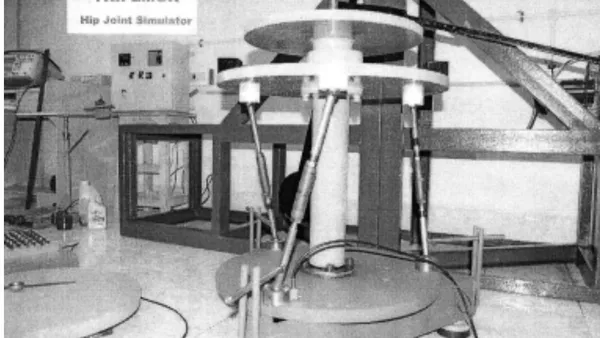
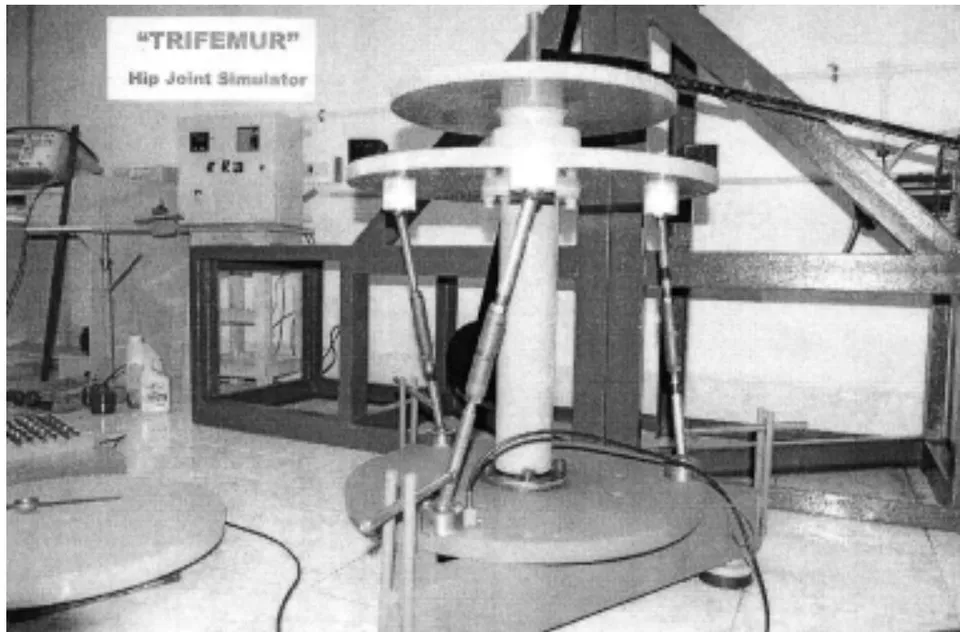
Trifemur, a patented invention and the simplified three-station wear tester after its realization, successfully tested metallic spherical shells articulating against steel balls of dia in dry ambient condition as shown in Fig. 1 and Fig. 2[1]. The results of run-in, steady state wear-rate and its dependence on the load as a new finding, are all reported in the author's Doctoral Thesis [1]. The shells are of: Copper, Cast Iron and Bronze. Next the wear-tests of specimen shells under proper lubrication and reaching to the maximum 6 to linear wear depth had to be ensured. Accordingly, a lubricant container was made with sheet metal, around the shell-holder as shown in Fig. 3. Also, ball-on-triflat wear testing is required for evaluating surface fatigue, special coatings and lubricants. Hence a special octant shaped specimen holder located in a tetrahedral lub-basin was made. Specimen-flat of round discs get laid up as a trifolium on the octant's face snugly, without extra fixtures of any kind as shown in Fig. 3 and Fig.
- The lubricant of choice can be filled during the experiments.
Publishing this decade old research due to its growing relevance globally and terming it as "Rubric Report 2023" is explained separately.
a) Pilot Experiments
i. Ball-on-socket Test: With the steel balls of dia articulating against hemi spherical shells of ABS plastic of thickness, in distilled water lubricant pool, was conducted for 10 hours duration. Linear wear depth of was reached and more depth range of ball impinging is just feasible as can be seen in Fig 4a & 4b. This is the nominal depth range of service life mostly, for the hip joint implants which the Trifemur ensured.
ii. Ball-on-triplate Test: With steel balls of dia, articulating against trifolium of teflon discs of thick and dia, in the distilled water lubricant pool, was conducted for 10 hours duration. The linear wear depth of for each disc was noted. The circular wear-scar is sufficient for wear characterization as can be seen in Fig. 5a & 5b. With thicker flat specimens, the impinging ball can reach the trifoliate's vertex. Then the three wear fronts coalaces into a clover shape and keep changing as that of quasi balloon-socket configuration henceforth.
The wear of steel balls as a counter face is outside the scope of the present experiment. However, the transferred Teflon film onto each ball, as three elliptical patches is noticed. Soft materials of ABS plastic for shells and commercial grade Teflon flat of thick for discs were deliberately chosen as the tribo pair to reduce the pilot experimental duration for just only 10 hours. Fig 6a & 6b show the worn out discs and transferred film.
b) Characteristic Wear Curves & Life Cycles
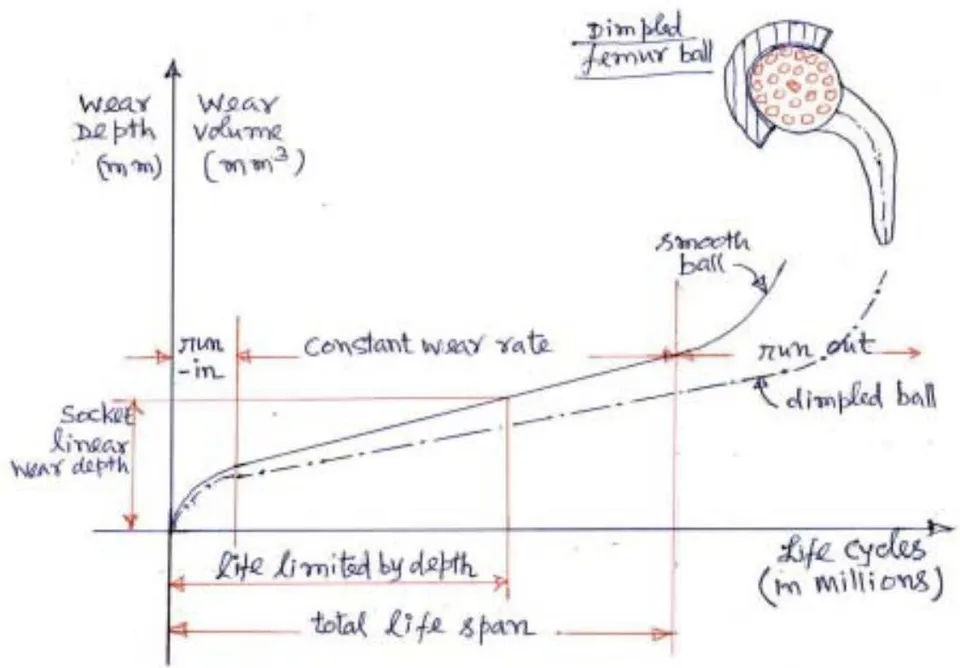
Dry Test: The experience gained earlier, while wear testing the metallic dry shells as reported in the Doctoral Thesis [1] of the author is as follows. The typical wear curve is shown in Fig. 7 coasting through the run-in and proceeding considerably into the steady-state wear regime requires about 15 data points. It is about cycles at ; which is 9000 minutes, as in the case of ball on socket shell configuration. It is a continual test, unaccelerated one, intermittently stopped for data collection: emanated wear debris quality/quantity.
Lubricated Test: Now, once the data of steady state wear-rate in lubricated condition is obtained and its stability is experimentally confirmed, then the implant specimen wear-life can be estimated by computation and it is a prediction guided by constant wear-rate and limited by the maximum linear wear depth or cumulative wear volume which ever is desired and happen earlier for the tribo pair!.
As for the ball-on-triplate wear test, run-in and steady-state are not distinct at all. The entire wear regime is a non steady state transient regime, and data generation has to be continued till the required wear depth is reached.
Implant Test: Clinical ready hip-joint implants could be put to marathon wear tests, say cycles and beyond, to find out their run-in wear, steady state wear-rate and the resulting wear debris types, continually at 1 Hz level, of unaccelerated operation. Experiments can proceed through the multimillion cycles of the life span, accurate to the last cycle, reaching either the permitted maximum linear wear depth or cumulative wear volume whichever is happening first. Thus, the wear-life determined is the practical gauging approach using Trifemur.
c) Intended Experiments & Protocol
i. Lubricant top-up, change over, recirculation and wear debris collection etc shall be as per the prevailing norms. ii. Retrofitting of the clinical ready implants needs rectification of the kink of the femur shaft to suit the Trifemur simulator. Special components are needed for the fitment. iii. Wear test results of each of the three stations can be retained as individual data generated by the experimentation. iv. Motorised pendulum at 1 Hz level as the actuator and minimalist mechanism of mimicking human walking, using Trifemur, is the twin strengths of this unaccelerated wear test, by a harmonically driven, linearly damped, oscillator. v. The total number of cycles from the start to reach the tertiary wear regime is termed "Characteristic wear curve", life is limited by wear depth or wear volume. vi. Dimpling of the ball for better lubrication was suggested by the author first in [2] and then referred in [1] which has been proved effective by Arkansas university, U.S.A [4].
Description of Figures:
Fig. 1. Trifumur a patented invention: Wear tester in the front & pendulum actuator in the behind [3].
![Fig. 2. Set of femur balls & copper metallic shells: 25mm dia and 6mm thick. [These above two photos are taken from the Doctoral Thesis of the author]. [1]](https://doc.globaljournals.org/xawk57_55640/ocr/images/derivatives/1c/1c1b79b29a6ff1946a1338683ceb851ce4c5e414832338e3bf3385ea3476468f.webp)
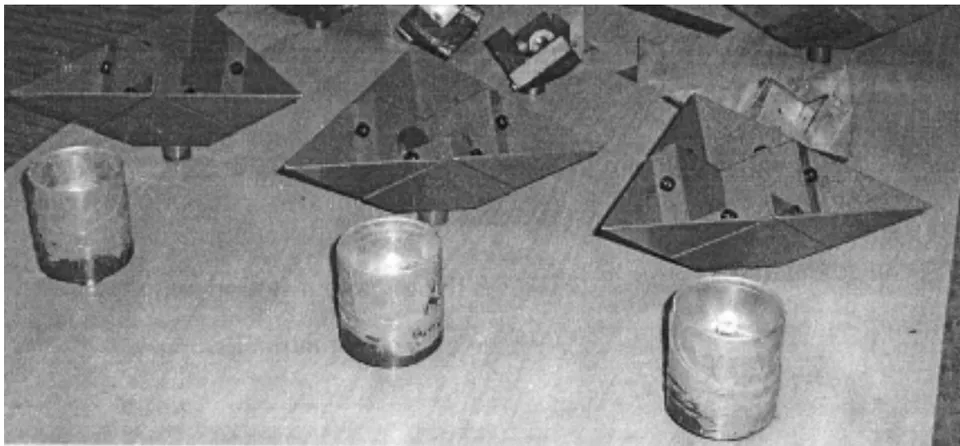
Fig. 4a. Close-up at a wear station: Ball-on-socket; ABS plastic shell in distilled water pool lubricant against steel ball.
Fig. 4b. Set of three shells simultaneously tested; worn out shells after washing.
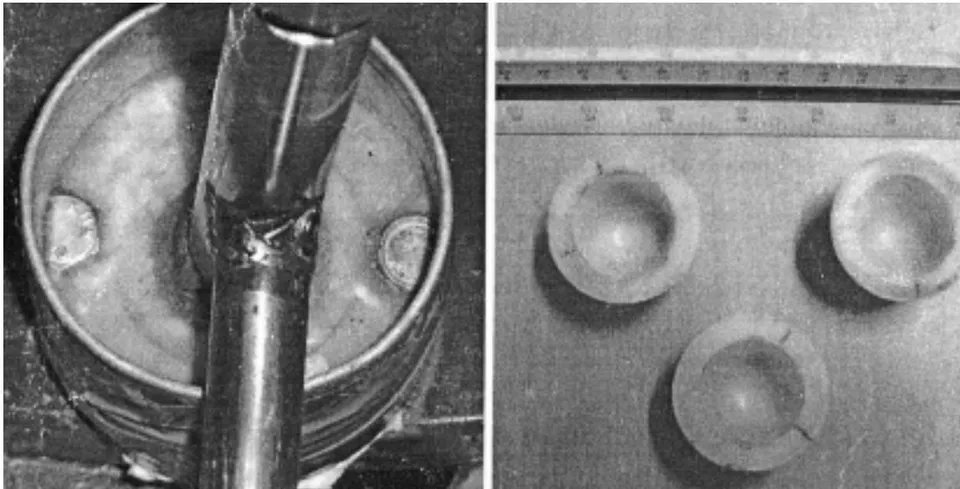
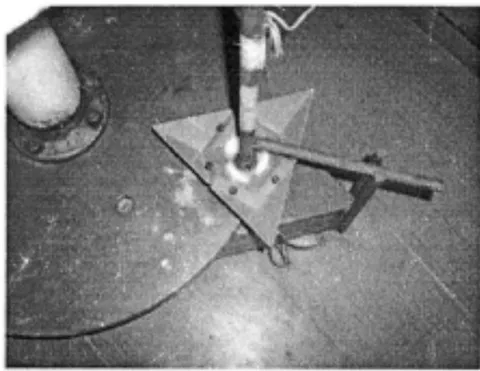
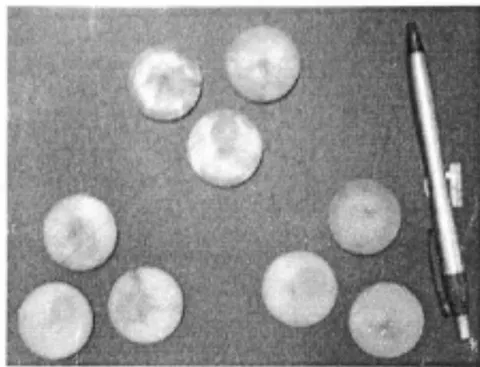
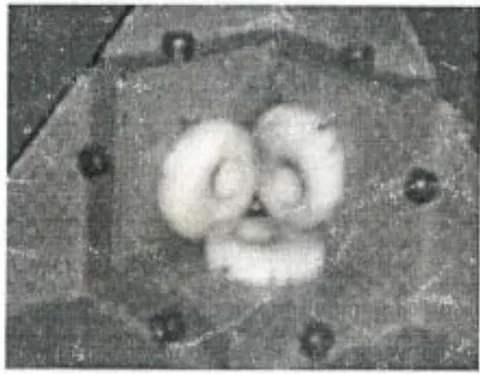
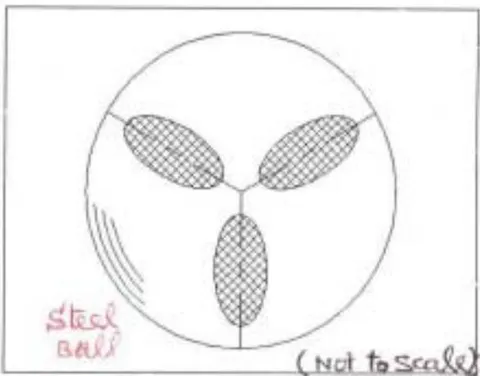
Fig. 7 Characteristic wear curve/Dimpled femur ball.
II. CONCLUSION
Comparative grading of prosthetic implants on the basis of constant wear-rate and resulting wear debris types, for over decades equivalent of gait cycles, (touching up to the tertiary wear region) forms an impressive catalogue, like the Periodic Table for the physical elements. A Standard Comparator and unaccelerated testing makes the wear assessment more realistic, and hence the grading process of implants/biomaterials/and coating becomes a practically useful catalogue, with details of wear life span.
The dimpled ball type bettering in lubrication might be the prosthetic best design with functional ease due to least friction & wear; which is already confirmed by the recent study [4]. Unaccelerated testing will further perfect the art and science of wear testing of hip joint prosthetic implants.
Like Charpy and Izod tests for fracture mechanics, Trifemur uses the pendulum actuator for wear testing, essentially a harmonically driven, linearly damped, mechanical oscillator. Biased merits of products, obtained on varied tests, mostly in the accelerated conditions, can be remedied only by a common comparator, unaccelerated test standardized for that purpose only. Pursuit of such a goal is in the domain of Accademia and other professional Testing Authorities.
Note on Author's Name
Githaguru and Geethaguru both refer to the same author; phonetic identity triggers the variant spelling.