
Histological Origin and Anaplastic Behavior of Neoplasms Diagnosed in Canines in Guatemala (2015-2019)

1
Andrea Daniela Lemus-Centes
2
Jazzel Silvia Zea-Muñoz
3
Mariano Jarquín-Delgado
1 University of San Carlos of Guatemala

Send Message

To: Author

GJMR Volume 22 Issue G1

Article Fingerprint

ReserarchID

CUX3J

Histological Origin and Anaplastic Behavior of Neoplasms Diagnosed in Canines in Guatemala (2015-2019) Banner
  • English
  • Afrikaans
  • Albanian
  • Amharic
  • Arabic
  • Armenian
  • Azerbaijani
  • Basque
  • Belarusian
  • Bengali
  • Bosnian
  • Bulgarian
  • Catalan
  • Cebuano
  • Chichewa
  • Chinese (Simplified)
  • Chinese (Traditional)
  • Corsican
  • Croatian
  • Czech
  • Danish
  • Dutch
  • Esperanto
  • Estonian
  • Filipino
  • Finnish
  • French
  • Frisian
  • Galician
  • Georgian
  • German
  • Greek
  • Gujarati
  • Haitian Creole
  • Hausa
  • Hawaiian
  • Hebrew
  • Hindi
  • Hmong
  • Hungarian
  • Icelandic
  • Igbo
  • Indonesian
  • Irish
  • Italian
  • Japanese
  • Javanese
  • Kannada
  • Kazakh
  • Khmer
  • Korean
  • Kurdish (Kurmanji)
  • Kyrgyz
  • Lao
  • Latin
  • Latvian
  • Lithuanian
  • Luxembourgish
  • Macedonian
  • Malagasy
  • Malay
  • Malayalam
  • Maltese
  • Maori
  • Marathi
  • Mongolian
  • Myanmar (Burmese)
  • Nepali
  • Norwegian
  • Pashto
  • Persian
  • Polish
  • Portuguese
  • Punjabi
  • Romanian
  • Russian
  • Samoan
  • Scots Gaelic
  • Serbian
  • Sesotho
  • Shona
  • Sindhi
  • Sinhala
  • Slovak
  • Slovenian
  • Somali
  • Spanish
  • Sundanese
  • Swahili
  • Swedish
  • Tajik
  • Tamil
  • Telugu
  • Thai
  • Turkish
  • Ukrainian
  • Urdu
  • Uzbek
  • Vietnamese
  • Welsh
  • Xhosa
  • Yiddish
  • Yoruba
  • Zulu

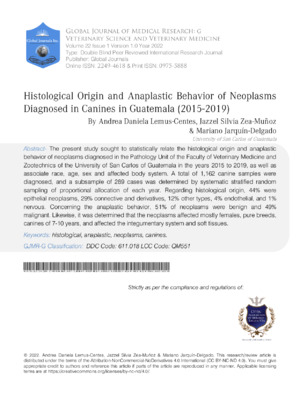
The present study sought to statistically relate the histological origin and anaplastic behavior of neoplasms diagnosed in the Pathology Unit of the Faculty of Veterinary Medicine and Zootechnics of the University of San Carlos of Guatemala in the years 2015 to 2019, as well as associate race, age, sex and affected body system. A total of 1,162 canine samples were diagnosed, and a subsample of 289 cases was determined by systematic stratified random sampling of proportional allocation of each year. Regarding histological origin, 44% were epithelial neoplasms, 29% connective and derivatives, 12% other types, 4% endothelial, and 1% nervous. Concerning the anaplastic behavior, 51% of neoplasms were benign and 49% malignant. Likewise, it was determined that the neoplasms affected mostly females, pure breeds, canines of 7-10 years, and affected the integumentary system and soft tissues.

Funding

No external funding was declared for this work.

Conflict of Interest

The authors declare no conflict of interest.

Ethical Approval

No ethics committee approval was required for this article type.

Data Availability

Not applicable for this article.

Andrea Daniela Lemus-Centes. 2026. \u201cHistological Origin and Anaplastic Behavior of Neoplasms Diagnosed in Canines in Guatemala (2015-2019)\u201d. Global Journal of Medical Research - G: Veterinary Science & Medicine GJMR-G Volume 22 (GJMR Volume 22 Issue G1): .

Download Citation

High-quality research on neoplasm diagnosis in Guinea from 2015-2019. Insights into histological and clinical analysis.
Journal Specifications

Crossref Journal DOI 10.17406/gjmra

Print ISSN 0975-5888

e-ISSN 2249-4618

Keywords
Classification
GJMR-G Classification: DDC Code: 611.018 LCC Code: QM551
Version of record

v1.2

Issue date

May 31, 2022

Language

English

Experiance in AR

The methods for personal identification and authentication are no exception.

Read in 3D

The methods for personal identification and authentication are no exception.

Article Matrices
Total Views: 1636
Total Downloads: 26
2026 Trends
Research Identity (RIN)
Related Research

Published Article

The present study sought to statistically relate the histological origin and anaplastic behavior of neoplasms diagnosed in the Pathology Unit of the Faculty of Veterinary Medicine and Zootechnics of the University of San Carlos of Guatemala in the years 2015 to 2019, as well as associate race, age, sex and affected body system. A total of 1,162 canine samples were diagnosed, and a subsample of 289 cases was determined by systematic stratified random sampling of proportional allocation of each year. Regarding histological origin, 44% were epithelial neoplasms, 29% connective and derivatives, 12% other types, 4% endothelial, and 1% nervous. Concerning the anaplastic behavior, 51% of neoplasms were benign and 49% malignant. Likewise, it was determined that the neoplasms affected mostly females, pure breeds, canines of 7-10 years, and affected the integumentary system and soft tissues.

Our website is actively being updated, and changes may occur frequently. Please clear your browser cache if needed. For feedback or error reporting, please email [email protected]
×

This Page is Under Development

We are currently updating this article page for a better experience.

Request Access

Please fill out the form below to request access to this research paper. Your request will be reviewed by the editorial or author team.
X

Quote and Order Details

Contact Person

Invoice Address

Notes or Comments

This is the heading

Lorem ipsum dolor sit amet, consectetur adipiscing elit. Ut elit tellus, luctus nec ullamcorper mattis, pulvinar dapibus leo.


High-quality academic research articles on global topics and journals.

Histological Origin and Anaplastic Behavior of Neoplasms Diagnosed in Canines in Guatemala (2015-2019)

Andrea Daniela Lemus-Centes
Andrea Daniela Lemus-Centes University of San Carlos of Guatemala
Jazzel Silvia Zea-Muñoz
Mariano Jarquín-Delgado

Research Journals





























































