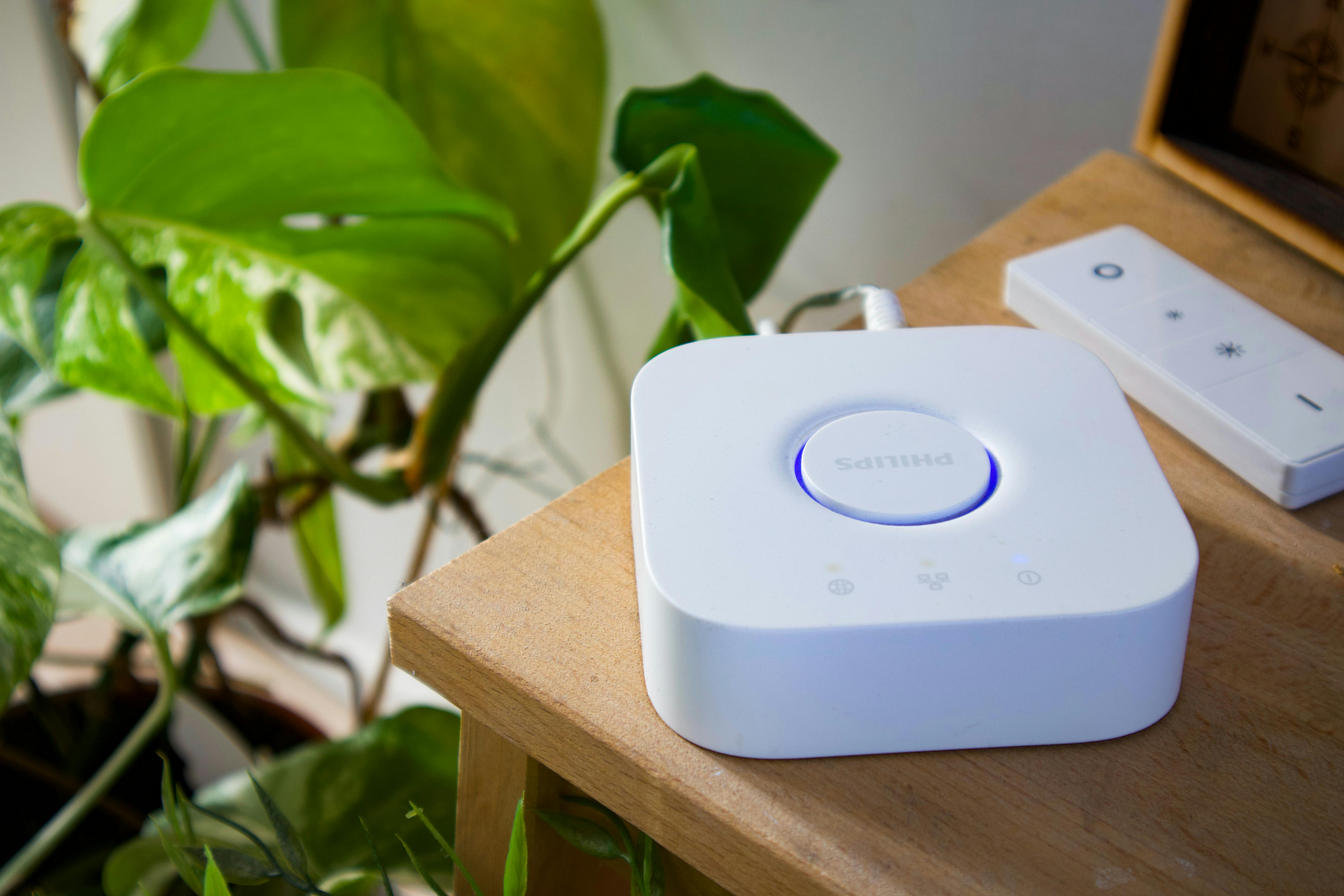
The home automation system based on the Raspberry Pi and Node MCU leverages house hold appliances and allows users to control them vi the internet from anywhere in the globe. It enables control and operation of appliances and gadgets in a house through communication between hardware and software. Home automation might lead to more effective and intelligent energy saving strategies. The main goal of this project is to build a home automation system using a Raspberry Pi and a Node MCU board, with the internet controlled by the Telegram application. With the Io idea, all household appliances and electrical equipment may be regulated automatically as well as manually via relay circuits.
## I. INTRODUCTION
The internet-based functioning of physical devices (also known as "connected devices" and "smart gadgets"), buildings, and other items integrated with electronics, software, sensors, actuators, and network connectivity, allowing these objects to gather and share data, is referred to as the Internet of Things (IoT). Home automation is defined as the interconnection of physical things via sensors and software. Network connections are used to acquire and share data. Home automation refers to the automated and electronic control of household features, activities, and appliances. Home automation systems are becoming more popular as a way to control objects around the house. All forms of home equipment, including doors, lights, fans, electric heaters, surveillance systems, and consumer electronics, are included in the household automation system.
The goal of the home automation system is to automate the control of equipment and systems in the house by utilising existing technologies. This project shows a prototype of an intelligent home automation system that uses the Telegram application to operate household appliances, electrical equipment, and other devices from smart phones, computers, tablets, and other devices with an active internet connection. It will use relay circuits, Raspberry Pi, and Node MCU with the concept of IoT to turn on or off and operate household appliances and electrical equipment remotely as well as manually. Home automation offers a lot of promise for exchanging data among family members or trusted persons for personal security, and it might lead to energy-saving measures in the future. When one of these automated systems is used in a residential installation, it is referred to as a home automation system. All electrical and electronic equipment and devices are monitored and controlled via the Telegram application. The rest of the paper is laid out as follows: Section II examines some key aspects of related works, section IV elucidates the proposed methodology, section V presents experimental results, and section VI concludes with a discussion of future work.
## II. LITERATURE SURVEY
In [1] The project development includes an Internet of Things-based secure home access solution. Using the Raspberry Pi controller, camera, and numerous other connected sensors, this presents a smart, creative, and secure access. The system is a synthesis of all previous work, for which an IR sensor is used to identify objects, which then triggers a camera for facial recognition. The technology is intended for secure remote access and control of household equipment.
In [2] A Smart Home Application with Wi-Fi module prototype and implementation are shown. As a Wi-Fi module, the ESP8266 is utilised. A hardware interface and a software interface make up the system. The integration of ESP8266 Wi-Fi technology for managing home appliances and sensors is represented in the hardware interface, and a software interface is given for controlling numerous users of the house. The output of this system is reached by utilising the blynk app for smart home automation. The temperature and humidity is depicted, along with a Wi-Fi connection. GSM and GPS modules are used to send messages on a mobile phone.
In [4] The goal of the study is to create an IoT-based system that allows users to operate electrical appliances remotely using an Android mobile application. The mobile application was put to the test, and the reaction in terms of turning on/off appliances and locking/unlocking doors was noticed. Thing Speak cloud provides a web access for monitoring data logs and signal transmission. The technology performed as intended in terms of lowering energy use.
In [5] The appliances are managed by the Raspberry pi server, which runs according to the user command received from the phone through an android app. Smart home automation is suggested for the elderly, based on python, OpenCV, raspberry pi, and android applications. Face identification and recognition from a camera positioned outside the main door, which can be accessed from the phone, is used to create a unique door monitoring system. The hardware for regulating the intensity of light using the Raspberry Pi's PWM output is presented. For home security, an automatic door monitoring system based on an Android mobile is presented.
In [6] Smart home automation particularly for old age people is proposed based on python, OpenCV, raspberry pi and android application, the appliances are controlled by the Raspberry pi server, which operates according to the user command received from the mobile phone. A unique door monitoring system is designed based on face detection and recognition from a camera installed outside the main door, which can be accessed from the phone using android application. The hardware implantation for controlling intensity of light using PWM output from Raspberry Pi is depicted. An automatic door monitoring system using USB camera, python, OpenCV, raspberry pi, and android device is proposed for monitoring and security purpose. IoT provides more flexible and low-cost solutions for daily life problems which ultimately improve the user's life. Although many previous researchers proposed many home automation systems by using different concepts, there are some reasons for the motivation to design an efficient home automation system. Previously proposed home automation systems are expensive and complex, Bluetooth based home automation systems required intrusive installation [6] and some of the senior citizens does not use G-mail, Twitter or web server as it requires the account creation as well as additional wi-fi module [2,3,5] and find it difficult to operate as it requires additional learning [4].
## III. PROBLEM STATEMENT
The high cost of ownership, inadequate administration, and difficulty in attaining security are the four primary issues that home automation systems confront. The main goal is to create and construct a low-cost, open-source home automation system that can manage and automate most household appliances using a simple interface. Our suggested system has a lot of versatility since it connects its modules to the Telegram Application utilizing wi-fi technology. Secure wireless communication protocols between user and telegram server, will be used in the system.
## IV. METHODOLOGY
The System Architecture includes a set of hardware components such as the Raspberry Pi, Node MCU esp8266, MLX Sensor, and relays. As well as a set of software components like Raspbian operating system, Arduino IDE and Telegram application as shown in the figure. The system receives the commands from the user via the Telegram application. The command from the user can be received from anywhere through the internet.
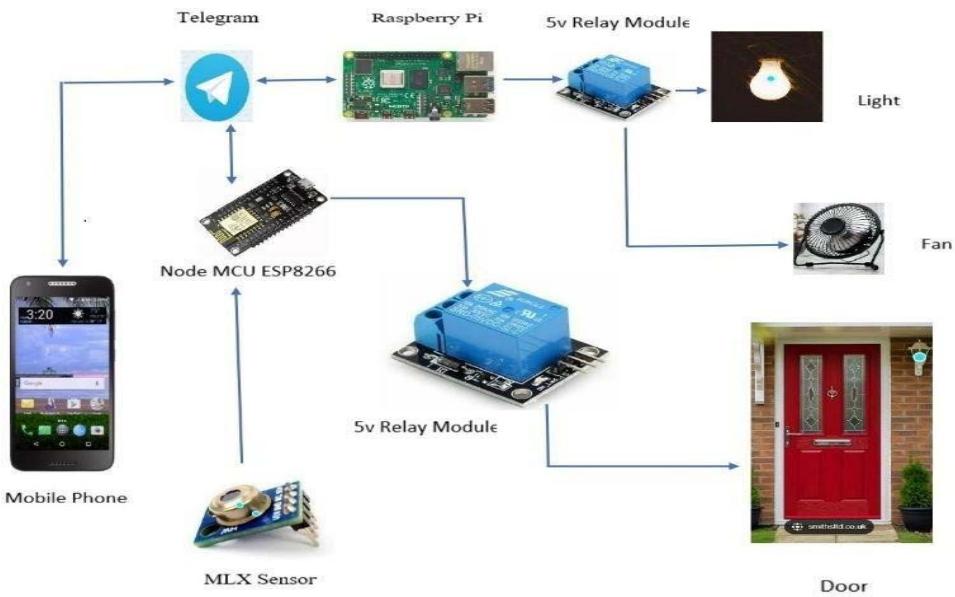 Figure 1: System Architecture
The Raspberry Pi and Node MCU process the instructions received and operates the loads (light and fan) to switch them ON/OFF and, the door lock to lock/unlock according to desired user commands respectively. Thus, we automate light, fan and door over the internet using Raspberry Pi and Node MCU. Raspberry Pi, Node MCU esp8266 hardware, MLX90614 sensor, and Telegram application are at the core of smart home automation. The system is divided into two halves based on Raspberry Pi and Node MCU. For the initial half, Because of its user-friendly features and cost-effectiveness, the Raspberry Pi was chosen as the system's processing unit. A python-coded programming has also been put into the Raspberry Pi, which is connected to the internet through a wireless wi-fi interface and can access and send data to the Telegram application. The Household Electrical Devices to be monitored were interfaced with the Raspberry Pi using a relay driver circuit due to the different power ratings of the devices and the Raspberry Pi. The latter half contains the microcontroller, Node MCU esp8266 that connects the user to the door lock system through the Internet. This allows the user to lock or unlock the door lock from anywhere in the world using the Telegram application. The MLX sensor detects the person's body temperature and sends the information to the Telegram application through the Node MCU microcontroller embedded telegram server.
### a) Raspberry Pi
The Raspberry Pi is a credit card-sized computer that plugs into a computer monitor or TV and comes with a standard keyboard and mouse as shown in Fig. 2. The Raspberry Pi is an open-source ecosystem for controlling electrical components in physical computing and exploring the Internet of Things. It's Linux-based and features GPIO (general-purpose input/output) pins (IoT). It provides individuals with low-cost, high-performance computers with which to research and resolve issues.
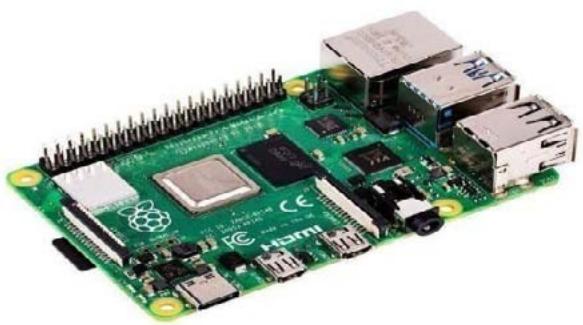 Figure 2: Raspberry Pi
### b) Node MCU
Node MCU is an open-source platform based on the ESP8266 that enables the connection of devices and the transmission of data through the Wi-Fi protocol.
Furthermore, by offering some of the most important microcontroller functions such as GPIO, PWM, ADC, and so on, it may be able to manage many of the project's demands on its own. The system's Node MCU esp8266 is shown in Fig. 3.
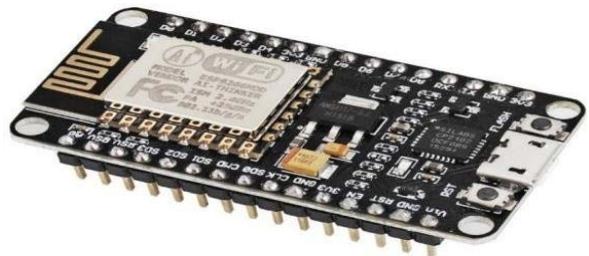 Figure 3: Node MCU ESP8266
### c) Relay Module
The relay in Fig. 4, is essentially a control switch that employs electromagnetic to swap the switch, allowing it to be readily activated by a low voltage signal. It's utilised to keep the load from being supplied when it's needed.
 Figure 4: Relay Module
### d) Electric Door Lock
The motor is controlled by an electrical impulse, which may be activated in a number of ways, including an electronic card reader, a keypad, or a wireless remote control sensor, as shown in Fig.5. The electronic door lock is configured to engage the motor-driven actuator only after receiving the right electrical input in either instance.
 Figure 5: DC 12V Solenoid Electric Door Lock
### e) MLX Sensor
It is a contactless infrared temperature sensor with exceptional precision. Due to its great accuracy and precision, it may be utilised in a number of business, health-care, and home applications, such as room temperature monitoring and body temperature measuring. The MLX90614 sensor, which is used to monitor body temperature, is shown in Fig. 6.
 Figure 6: MLX90614 Sensor
### f) Telegram Bot
A Telegram Bot is a software that works in the same way as a conventional chat partner but adds extra functionality. It does predetermined tasks on its own, without the user's involvement. Bots are Telegram accounts that are controlled by software rather than humans, and they commonly incorporate artificial intelligence elements. It could also use the Internet of Things to teach, play, search, broadcast, remember, connect, interact with other services, and even transmit instructions.
## V. RESULTS
The Fig 7 and Fig 8 shows the photograph of the experimental setup while performing the actual experiment. The system uses Telegram mobile application to control the light, fan and door lock. Experimental results of Home Automation System corresponding to the commands received from the user and response from telegram bot is shown in Fig 9 and Fig 10. It shows that the light, fan and door lock functioned accurately with the proposed idea.
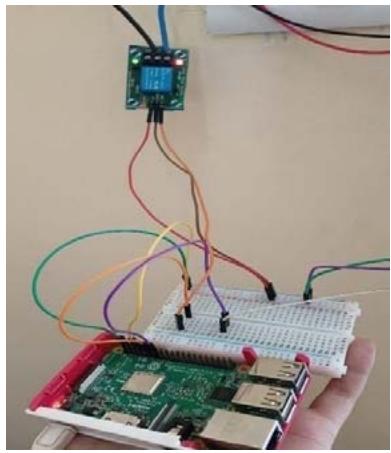
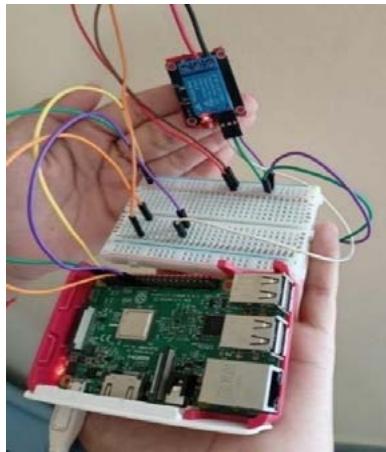 Figure 7: Smart Light and Fan
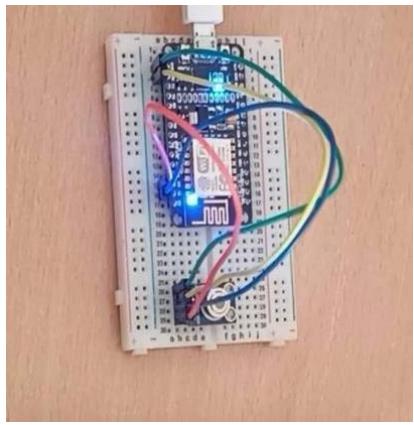
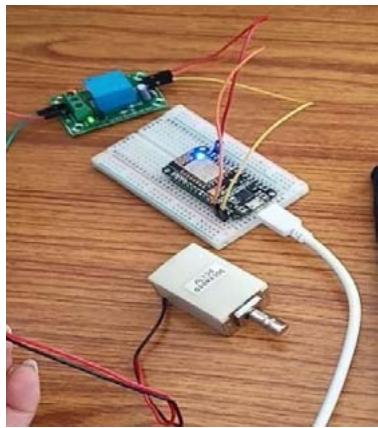 Figure 8: Smart Door and MLX sensor
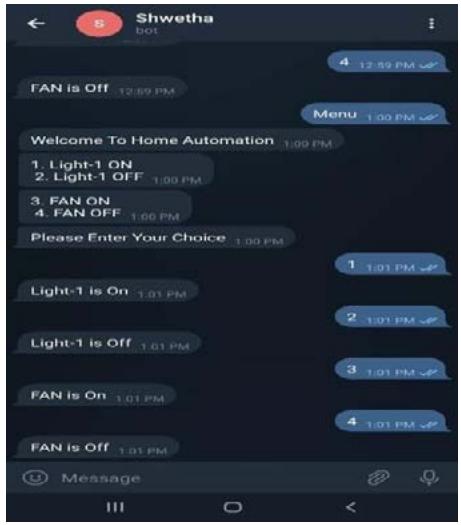
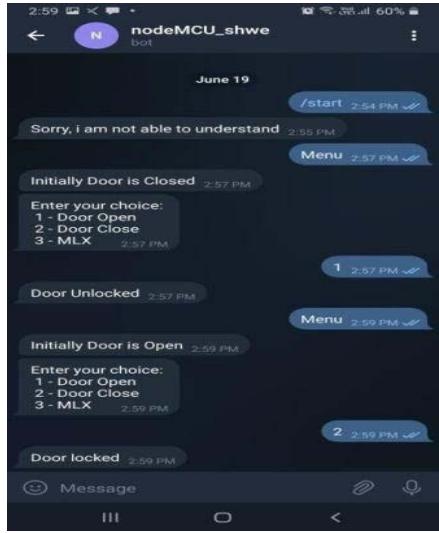
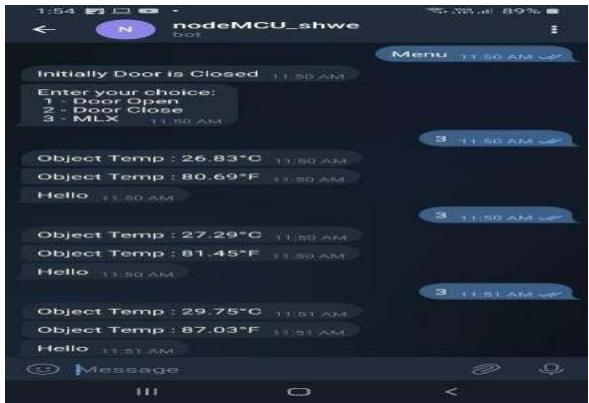 Figure 9: Commands given by the user via Telegram Figure 10: Commands given by the user via Telegram
## VI. CONCLUSION AND FUTURE WORK
Generating HTML Viewer...
References
19 Cites in Article
N Hema,Juli Yadav (2020). Secure Home Entry Using Raspberry Pi with Notification via Telegram.
U Singh,M Ansari (2019). Smart Home Automation System Using Internet of Things.
Diponkar Kundu,Md. Khallil,Tushar Das,Abdullah Mamun,Ahmmad Musha (2020). Smart Home Automation System Using on IoT.
Adeem Akhtar,Taha Ahmad,Nosheen Sabahat,Sidra Minhas (2019). IoT Based Home Automation System Using ThingSpeak.
Smart home automation with a unique door monitoring system for old age people using Python, OpenCV, Android and Raspberry pi.
Bhaumik Vaidya,Ankit Patel,Anand Panchal,Rangat Mehta,Krish Mehta,Parth Vaghasiya (2017). Smart home automation with a unique door monitoring system for old age people using Python, OpenCV, Android and Raspberry pi.
A Alheraish (2004). Design and implementation of home automation system.
A Al-Ali,M Al-Rousan (2004). Java-based home automation system.
Jasmin Guth,Uwe Breitenbücher,Michael Falkenthal,Paul Fremantle,Oliver Kopp,Frank Leymann,Lukas Reinfurt (2018). A Detailed Analysis of IoT Platform Architectures: Concepts, Similarities, and Differences.
Al Majid,Abdulrahman Kuwari,Ramadan (2018). Smart-Home Automation using IOT-based Sensing and Monitoring Platform.
P T Kishore,K Veeramanikandasamy,S Sabbath,Veerakumar (2017). Internet of Things based Low-Cost Real-Time Home Automation and Smart Security System.
C,C-H,G C-C,C,J-J (2011). Intelligent home energy conservation system based on WSN.
Miguel Zamora-Izquierdo,José Santa,Juan Martínez,Vicente Martínez,Antonio Skarmeta (2018). Smart farming IoT platform based on edge and cloud computing.
A Pawar,V Umale (2018). Internet of Things Based Home Security Using Raspberry Pi.
V Nakrani,M Panchal,D Thakkar,S Pednekar,Y Mane (2017). A Review:Internet of Things(IoT) Based Smart Home Automation.
S Kumar (2014). Ubiquitous smart home system using android application.
Mari Domingo (2012). An overview of the Internet of Things for people with disabilities.
R Vinay Chand1,M Veda Chary2 (2013). Wireless Home Automation System with Acoustic Controlling.
B Yukesekkaya,A Kayalar,M Tosun,M Ozcan,A Alkar (2006). A GSM, Internet and Speech Controlled Wireless Interactive Home Automation System.
No ethics committee approval was required for this article type.
Data Availability
Not applicable for this article.
How to Cite This Article
Syeda Jamala Fatima. 2026. \u201cHome Automation using Raspberry PI\u201d. Global Journal of Research in Engineering - A : Mechanical & Mechanics GJRE-A Volume 23 (GJRE Volume 23 Issue A1): .
Explore published articles in an immersive Augmented Reality environment. Our platform converts research papers into interactive 3D books, allowing readers to view and interact with content using AR and VR compatible devices.
Your published article is automatically converted into a realistic 3D book. Flip through pages and read research papers in a more engaging and interactive format.
The home automation system based on the Raspberry Pi and Node MCU leverages house hold appliances and allows users to control them vi the internet from anywhere in the globe. It enables control and operation of appliances and gadgets in a house through communication between hardware and software. Home automation might lead to more effective and intelligent energy saving strategies. The main goal of this project is to build a home automation system using a Raspberry Pi and a Node MCU board, with the internet controlled by the Telegram application. With the Io idea, all household appliances and electrical equipment may be regulated automatically as well as manually via relay circuits.
Our website is actively being updated, and changes may occur frequently. Please clear your browser cache if needed. For feedback or error reporting, please email [email protected]
Thank you for connecting with us. We will respond to you shortly.