Introduction
Ecology, the study of the relations between organisms and their environments or of the organism-environment nexus, has been used as an interactive and also integrative interrelationship in the study of human society, popularly known as human ecology. The dimensions of human ecology are more dynamic as it is not guided by rigid laws of ecology. Extended from biotic ecology, human ecology is investigated in the diverse and complicated directions as it opts to intensify not only the relationship between man and its physical environment but also the socio-economic environment (Baker et al., 2016). It is used in the social interaction as social ecology, political dimension as political ecology. In the forgoing analysis it considers the interactive interaction in the context of school education.
Looking at this interactive interdisciplinary nature, sociologists, anthropologist and geographers of India are widely investigating ecology of school education for its diverse social, economic, educational and infrastructural problems which are posing the barriers for the access and the success to school education of under privileged society. In the realm of social and cultural geography, it basically portrays a diverse array of outlook and planning in regard to geographic (Hartshorne 2016; Berry 2005), economic and social (Zhan, 2005; World Bank Group District Level Survey, 2012) consideration analysing different attributes in spatio-temporal context (Sheppard, 2002; Dearing et al., 2006). A handful of studies of the ecology of school education
deals with infrastructure, school climate, curriculum, and teacher-student interaction (Sudla et al. 2020; Berkowitz et al. 2017; Wang and Degol 2016; Hung et al. 2015; Ramelow et al. 2015; Motiram 2011; Huisman et al. 2010; Bacolod and Tobias 2006; Welsh 2000; Adeujimi, 2002; Wang & Degol, 2016), while, the importance of home environment or home ecological set up in terms of desire, awareness, encouragement of parents and family members, economic support of the family etc. are not so much interactively interpreted. Therefore, home ecological set up is another intriguing factor for the access and success of school education of the backward areas. For the students of the under privileged society, home ecological set up seems to be the most important factor which sets barriers for each and every step for the success in school education. The grimness of the situation is more acute for the first-generation learners – the core area of this investigation.
First-generation learners are those who among the family members come for education for the first time in school, and their parents have no formal education at all. They lack any guidance from anyone neither at home nor there any stimulation for them to learn. These learners have a number of handicaps while entering the school. Unlike the second or third generation learners, they do not get the necessary motivation to pursue academic studies (Geeta 2001). They lack basic knowledge of time management, school finances, and bureaucratic operations of higher education (Richardson and Skinner 2000). They have been less likely to encounter a welcoming environment on campus (Terenzini et al. 1996; Welsh, 2000). Most of them get discouraging and dis-facilitating educational environment at home. This may result in poor academic achievement and less healthy attitudes towards life and society (Ghosh and Susmita, 2014).
Theoretical Framework
The home environment is ‘the most powerful informal learning’ (Doley 2017) space in which the family, especially parents, act as ‘an educator’. The term home environment refers to all objects, forces, and conditions prevailing at home which influence the child physically, intellectually and emotionally (Muola 2010; Nyarko, 2010; Oyserman et al., 2007; Ramelow et al., 2015; Reddy, 2004). An encouraging learning atmosphere at home and parents’ involvement carry huge importance in child’s educational performance in school (Hill & Tyson, 2009; Jeynes, 2005; Kim and Sheridan, 2015). The social environment of the family can be portrayed as the “interpersonal relationships among the family members, the directions of the personal growth and the family’s basic organizational structure” (Spokane et al., 2000) which are emphasized in the system. This environment positively influences mental development as healthy family relationships increase the level and the quality of the stimulations provided for the child (Motiram, 2011). The home and school are probably the two most influential contexts within which child develops. Besides, when parents and teachers both are focused on the child’s schooling simultaneously, this ‘mutual involvement’ will enhance child’s success in school (Sudla et al., 2020). Parent involvement in a child’s education, especially in earlier phase is consistently shown to be positively associated with the child’s academic performance (Hill and Craft 2003).
Considering this ideological perspective, school education in rural remote areas of India faces a dynamic reality where the hurdles are more, and opportunities are less. Physical barriers in terms of remote location, connectivity, accessibility is there. Social inertia of schooling is rampant. Participating in schools regularly and survive up to the last grade of the cycle with no one at home to support is an uphill task for first- generation learners. The backstopping support from home/parents and the sheer economics of school participation tend to push learners out of school.
Apart from this, each and every family possesses its distinct socio-economic individuality as well as parents’ participation in child’s access and success in schooling. Children whose parents are more concerned in child’s education achieve better performance in school than the children of parents involved in a lesser degree. It goes without saying that hild’s education with lack of encouragement, limited or no involvement with least motivation from parents’ part reduce home effectiveness as a learning environment (Doley, 2017). Parents having low Socio-Economic Status (SES) with little or no formal education may devoid of the sense of efficacy in assisting their child succeed in school. These group of
parents feel less potent to help their children in school related activities as compared to the educated parents, and also become less comfortable to interact with teachers whenever necessary (Zhan 2005).
Against this backdrop, some pertinent questions arise: To what extent does home ecology act as barriers for academic maladjustment in school for first-generation learners? Are their parents really interested about school education? Why do the first-generation students hardly achieve desired school success? The study opts to analyse the role of a learning home environment to child’s access and success in school education in rural context. It also seeks to measure the parental expectation as well as involvement in child’s education with little or no educational background.
In this study, Bronfenbrenner's social ecological model and resilience theory have been applied as a framework to investigate the broader contextual ecological factors as well as academic resilience among the disadvantaged children, especially first-generation learners of rural and hilly background. In particular, this paper examines the role of home-ecology as barrier on school-level academic adjustment of these hard-to-reach learners of disadvantaged background.
Importance of Home Ecological Set Up Needed for First Generation Learners
“All the years that children attend school; they attend home” (Islam et. al., 2021; Kumar et al., 2023; Flora et al., 2004; Froiland et a., 2013; Geeta, 2001). The impression of home and family factors on child’s education has been extensively acknowledged (Grolnick et al., 2008; Gwirayi and Shumba, 2007; Hill and Taylor, 2004; Hartshore, 2016; Hill and Craft, 2003; Hong and Ho, 2005). Family structure and demography, socioeconomic status (SES) and parental education, on the one hand, and parental involvement (Gialllo et al., 2010; Stone et al., 2010; Agabrian, 2007; Lichter et al., 2003; Crosnoe and Benner, 2015) in terms of parental processes and parenting style, on the other, are considered mainly the home-ecological factors related to the child’s access and success in schooling. In addition, parents’ perception (Gi et al., 2018; Dusi, 2023; Lawson, 2003; Lisa et al., 2006) on child’s schooling, parental attitudes on teachers and schools exert great influence on child’s schooling (Lavenda, 2011; Huisman et al., 2010; Hung et al., 2015).
The socio-economic status (SES) of a family and the academic performance of children is well-established in the arena of sociological research (Järvinen et al., 2023; Paulus et al., 2025; Mullis et al., 2003; Muola, 2010). It may be defined as ‘a person’s overall social position…to which attainments in both the social and economic domain contribute’’ (Considine and Zappalà, 2002; Jensen and Seltzer, 2000; Altschul, 2012). Socio-Economic status is determined by an individual’s condition in education, occupational status and income. In developing country’s context, specifically in India, research have already explored that children from low SES families do not perform good in school as per their potential compared to the children from high SES families (Dubey et al., 2024; Assan et al., 2021; Barro, 2013; Basant and Chandra, 2021; Green-Demers and Pelletier, 2003). Because “school success depends strongly on the socio-economic status of one’s parents” (Wise, 2003; Vaz et al., 2014). Lower SES parents usually feel less welcome at school as compared to higher SES parents and this perception in turn flows with low teacher perceptions about their child’s actual academic potentials and skills (Dumais 2006). A reverse psychology always acts in their mind and they pre-assume that the teacher will not favour their children due to parents’ illiteracy. A few social linkages and their less expectation will enhance worry and anxiety among the parents thinking that they will not be able to provide support their children in future due to the paucity of intellectual, material or cultural resources. With low expectation these parents tend to be less engaged in child’s school-related activities, including encouraging them in co- curricular activities or monitoring their academic progress (Sy et al. 2005). Teachers also pay attention to those children whose parents regularly participate in child’s education believing that their classroom effort are being reinforced at home (Pastorelli et al., 2001; Shams et al., 2011; Barley and Beesley, 2007; Berkowitz et al., 2017; Berry, 2005).
Parental education, specifically mother’s educational attainment in the family is a strong predictor of child’s good academic outcomes (Ekstrom et al. 1986; Renzuli and Park, 2004; Elffers and Oort, 2013; Van der Veen and Peetsma, 2006; Ghosh and Sengupta, 2014). The bio-ecological model of human development proposed by Bronfrenbrenner (2006; 1986) adds flavour of the relationship between family and school as important for child’s development contexts. Family with educated parents possesses enough expectations as well as quality involvement for child’s positive school outcomes than do those whose parents have relatively low expectations. High parental expectation motivates a child to achieve in school, scholastic and social resilience, and aspirations to attend higher educational institutions (Richardson and Skinner, 2000; Robinson et al., 2001). On the contrary, parents with very little or no education and limited economic resources become less effective helping their children with school work and also feel become uncomfortable interacting with teachers being influenced by the reverse psychology that the school teacher will not communicate with illiterate parents. These parents may develop low academic expectations for their children. Several researches uncover the racial/ethnic differences in parent expectation saying that “certain social class gives rise to a specific level of parent expectations which in turn affect students’ educational and occupational attainment” (Sengupta and Ghosh, 2011).
The concerned literatures of parents’ involvement in child’s schooling have made two separated but interrelated stream of concepts, firstly, those related to parent-school involvement, such as parents’ participation in school activities, parent-teacher communication (Hill and Taylor 2004; Dearing et al. 2006; Doley, 2018; Dumais, 2006) whereas the second stream explores parenting processes and parenting style at home which are related to child’s school performance. Scott-Jones (1995) suggested four levels of parent-child interactions: ‘valuing’, ‘monitoring’, ‘helping’ and ‘doing’. Valuing means self-awareness, self-respect, expectations and accomplishments. Generally, it is believed that monitoring develops ‘self-management
strategies’ that facilitate achievement in school. Helping is the ‘assistance of skill development of child through a tutorial relationship’, directing the behaviour and helping in finding resources. Checking homework, keeping eyes on child’s home and school activities, even limiting the leisure include the monitoring and lastly doing is excess involvement of parents in child’s schooling.
However, parents with academic expectation for child generally participate in educational activities both at home and in school. A growing body of research has highlighted that child performs better in school if their parents are more involved with their schooling (Froiland et al. 2013; Shaff et al., 2008). A study of Parcel and Dufur showed positive link of parental involvement with mathematics achievement of students. Parental involvement may cover a wide range of activities, from reading at home to attending school functions and participating in school governance. Another set of research has also shown that parental involvement varies widely by caste, social class, and even family structure and thus may help explain differential achievement levels among such families (Monserud and Elder, 2011). In addition, Parenting styles are instrumental to their children’s learning achievement. Students develop more psychological maturity and do better in school when they come from families in which parents monitor and regulate their children’s activities at the same time they provide emotional support and encourage independent decision making (Froiland and Oros, 2013; Stein et al., 2014; Baker, 2017). Again, these parenting styles have been proved to vary by family caste structure, socio-economic status resulting differential educational achievement (Fedak et al., 2015; Cooper and Stewart, 2020).
Methodological Framework
Methodological analytics
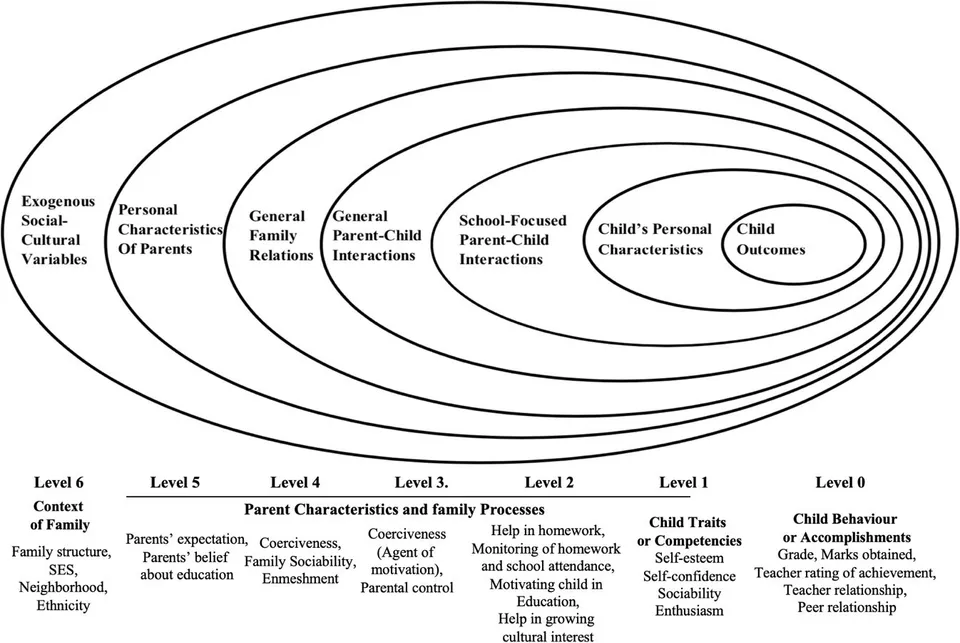
Bronfenbrenner (1986) and Ryan and Adams (1995) postulated a set of interrelated but distinct model that endeavored to provide “an organization for studying family processes, individual characteristics of child and children’s school achievement and adjustment”. The model considers child’s personal behaviours in school as “most proximal”, therefore, mediating family process and parenting style that work within the family. Moreover, the tone of family climate will determine what kind of parent-child interactions are likely to occur. These constitute the “distal” social contexts that probably influence the proximal effects of the child’s characteristics on school success. Congruent with the Ecological theories (such as Bronfenbrenner 2013; Scaglioni et al., 2018), a hierarchy of several contexts or layers of within-family characteristics and processes influence child’s educational outcome to a great extent.
The figure 1 displays the Ecological model of Family-School Relationships that encompasses all of the related family characteristics that may be interweaved in child’s school adjustment as well as educational outcomes. The model is oriented along a proximal- distal dimension, where the child’s schooling outcome is labelled as ‘Level 0’, the next adjacent place occupied by child’s personal characteristics labelled by ‘Level 1’. The successive levels are dragged out to exogenous socio-cultural and biological variables up to ‘level 6’. Obviously, the intensity of interaction is generally highest between the adjoining levels.
Employing the concept into parents’ involvement practices, the ecological model addresses four issues: 1. Parents’ home-centric involvement; 2. Relevant educational atmosphere at home; 3. Family structure and SES and lastly 4. Physical aspects of the home learning environment. At the initial phase of child’s schooling, parents do function like a school by extending their help with cognitive tasks to smooth child’s schooling, motivate for better learning and guide school-related behaviour. Ryan and Adams (1995) outlined educational atmosphere at home as consisting of a few strata, viz. school-focused parent-child interaction, general parent-child interaction, family relations and parents’ personal characteristics pertaining to exogenous socio-cultural (socio-economic status) and biological (gender of parent and child) variables. Family structure and its size play significant roles in shaping child’s education al outcome in school. Several recent researches (Mullis et al. 2003) have revealed positive impact of physical aspects of learning home environment (study hours, availability of learning materials, and place of study at home) on child’s outcome. The present study has limited its focus on within the family processes and not wished to judge the role of all other socialization agents on child’s academic outcome.
Study area
The rain-fed Purulia district is part of Chota Nagpur plateau representing an area of particularly low agricultural productivity and a high incidence of poverty among the rain-fed areas in Asia. High seasonality of rainfall confines the cropping period to only part of the year (mono-cropping). The district of Purulia is one of the most “resource-poor” districts dominated mainly by people of scheduled social affiliation. The population living below the poverty line is very high (35 percent). The district is positioned within the top three in respect of poverty (World Bank Group District Level Survey 2012). Unproductive land, extreme rurality, lack of proper industrialization, limited in-situ employment opportunities, the concentration of tribal population, and social customs and traditions have resulted in a totally stagnated region socially and economically. Being “resource-poor,” the district has been ranked in the lower rung of the human development ladder (16th out of 17 districts, Human Development Report, West Bengal, 2004).
Livelihood exerts a typified impact on the educational scenario of any area. Besides socio-economic marginalization, also the educational scenario of the district is featured by distinct rurality. The Census reports in different decades reveal that the district's rural literacy rate has not changed significantly throughout the last 50 years. Various push-pull factors like poor accessibility, poverty and economic uncertainties, and socio-cultural discontinuities contribute a great deal to the educational marginalization of the rural pockets of Purulia district. Economic uncertainty and backstopping support from family pushes these students to dropout prematurely from school.
Data Collection and Sampling Techniques
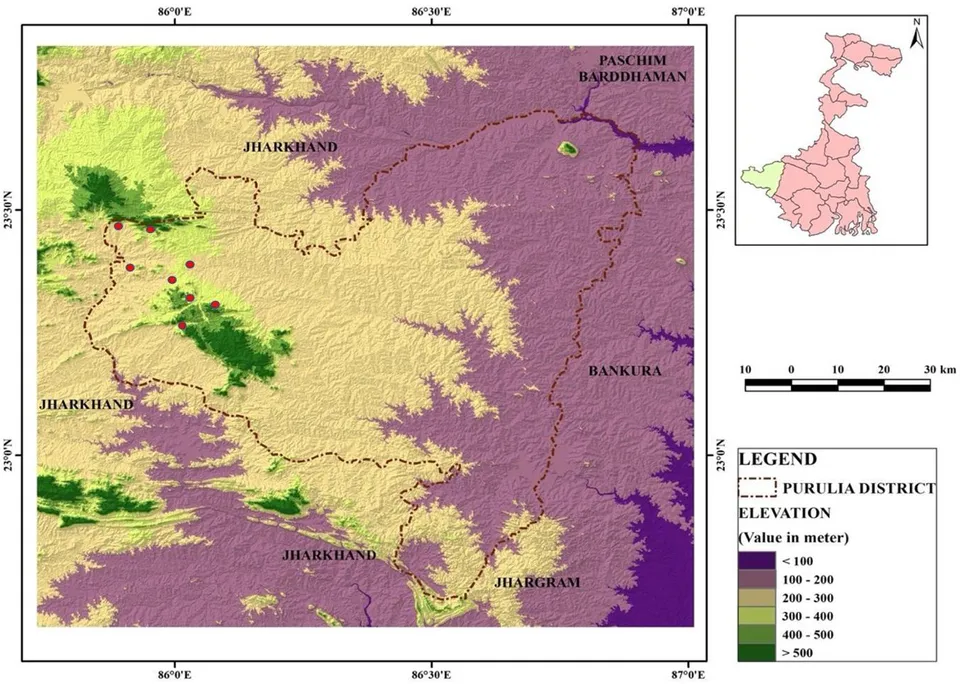
The necessary data for the present study have been collected through the household survey in two distinct phases. Firstly, a close-ended structured questionnaire was administered to each and every learner regarding learning atmosphere prevailing at their home. The questionnaire captured learners’ socio-demographic status, economic condition of the households, parents’ level of educational attainment; and the existing learning atmosphere at home and parenting processes. To have a quantitative flavour, most of the questions were in close-ended fashion, designed by Likert scale. In the next phase, to explain the quantitative findings collection. of qualitative data were collected in semi-structured and open-ended fashion regarding parents’ perception and attitudes on child’s education. Key informant interviews and focus group discussions were arranged with learners, parents, teachers, and head of the institutions to supplement the quantitative findings. Multistage sampling techniques was selected the candidate households for the present enquiry. After choosing the Chota Nagpur plateau fringe (Figure 2) as a broad study area, the district of Purulia was selected as micro-level study based on the criteria of marginality in the field of socio-economy and education. In the next stage, the westernmost part of the districts was chosen due to its topographic uniqueness, prevalence of physical barrier in terms of poor accessibility and connectivity, and also stagnancy in socio-economic scenario. In recent past, the administrative area was declared the ‘poorest in education’ (18.4 percent literacy, Census 2001) within Asia continent. Still, ample illiteracy (39.53 percent), huge gender gap in education (36.24 percent, 2011) and quite high non-working population (59.61 percent, 2011) speak in favour of the backwardness of the area. The terms like ‘remoteness’, ‘forest dependence’, ‘illiteracy’, ‘poverty’, ‘first-generation learner’ are the keywords to diagnose the target group of the study. Keeping these key terms in mind, specific villages were identified lying in the physically and socio-economically isolated pockets of western part of Purulia district for micro-level study. Eight villages of the district possessing relatively high relief have been purposively chosen to capture the essence of the study. The set of participants are exclusively first-generation learners (N=211), either ‘school-going’ or ‘dropped out’ status during the time of field investigation whose parents have no experience of formal school education at all. The ‘Siksha Bandhu’, the key participant of the study, helped a lot to capture the home learning atmosphere as barriers and resultant academic challenges leading to dropout of these ‘uncertain climbers’ from the school prematurely.
The first type includes variables of home ecology that consists of continuous variables of SES of the family and parental involvement. SES echoes with the parental educational attainment in years and monthly income of the family. The next category variables relating to family learning structure capture the background conducive to learning at home (Altschul 2012), i.e. (a) the amount of money the family spent on children’s education, (b) the presence of reading materials, (c) private tuition fee of children provided by the family, (d) time of home assignment and (e) the time of engagement in domestic chore (inverse). The Likert scale fitted for the items include: (a) money spent on child’s education No money spent (1), less than Rs. 50/ (2), Rs. 50/ to Rs. 100/ (3), Rs. 100/ to Rs. 200/ (4) and more than Rs. 200/ (5); (b) reading materials available at home No materials (1), less than 5 (2), 5 to 10 study materials (3), 11-15 study materials (4) and above 15 (5); (c) availing private tuition Never (1), seldom (2), often (3), almost always (4) and always (5); (d) child spending for learning at home? No time spent (1), Less than one hour (2), one to two hours (3), two to three hours (4), above three hours (5); and (e) child’s engagement in domestic chores No hour spent (5), less than 2 hours (4), 2-4 hours (3), 4-6 hours (2) and above 6 hours (1).
Parental involvement generally refers to the extent and quality of helping child in doing homework, contacting with teachers and attending school meetings regularly, participating in school-related activities and facilitating cognitively stimulating activities (Sy & Schulenberg, 2005). The typology of parental involvement is categorized broadly into two by various contexts in which it occurs, i.e., at home or school (Giallo et al. 2010; Godenberg et al., 2001). Parameters like (a) attending school meeting, (b) visiting school teacher (Nyarko 2010) whenever needed and (c) attending school function cater parents’ school-based participation (Oyserman et al. 2007), whereas (a) helping child in doing homework, (b) checking homework (Nyarko 2010) and (c) talking with them about school represent parents’ home-based participation (Sy et al., 2005) in child’s schooling. The parents’ responses range from 1 (never done) to 5 (always done) in Likert scale. The last but the most important parameters of parenting style include (a) encouraging the learners for education, (b) giving emotional support, (c) decision- making independence and (d) motivating them in continuing education. All responses have been scaled after Likert ranging from 1 (never) to 5 (always). Both the dimensions of parental involvement have maintained homogeneity10 (Cronbach’s Alpha). The marks in the final examination in the last academic session have been taken as academic performance in the form of continuous variable. It is the only outcome variable in the study.
Data Analysis and Results
The study opts to address how the learning environment at home shapes a child’s desired success in school under varying socio-economic contexts. Therefore, the study considers some specific hypotheses regarding socio-demographic features (gender, social group affiliation, generation status, family size and location) and SES (family income and parent education) determining child’s achievement in school; The study hypothesizes that learning environment at home, especially parents’ involvement in child’s education bears positive relation with child’s academic outcome. First-generation learners in rural areas may face more challenges in achieving school success. Poor socio-economic status, limited educational attainment levels of parents and low income may be responsible for this uncertainty.
Sample Characteristics
The research participants comprise of 211 first-generation learners systematically and purposively selected from the candidate villages, out of which 118 are from school going students studying at Upper Primary and Secondary Grade (including Higher Secondary also). The little learners of S.S.K. have been carefully excluded from the survey due to their below the age and immature response. To capture the essence of socio-economic barriers, the study has included another 93 participants who dropped out of school at different grades. To sort out this group, the office of School Inspector (S.I.) helped to identify the houses of dropped out students which are marked as “D” by the Siksha Bandhu of S.I. Office. In addition, Village Information Center and Village Education Communities of Jhalda Blocks helped a lot recognize these groups and carry on survey of the parents as well.
First-Generation Learners – Descriptive Statistics
To analyze the sample features of first-generation learners, descriptive statistics have been summarized in table 1. Out of 211 learners, 120 (56.87 percent) were boys and 91 were girls (43.12 percent). Majority (55.92 percent) are currently enrolled in school (55.92 percent), others (44.08 percent) have dropped out in the mid-way. The enrolled learners’ average age is 14.76 years with SD of 1.449. These special types of learners mainly consist of first-generation type as stated earlier, out of which 72.99 percent participants belong to the scheduled group category with a tiny SD of 0.45. The literacy status of parents shown in the descriptive statistics reveals very gloomy picture; fathers on an average enjoyed 0.9 years of school education, whereas it is only 0.18 years for mothers, though in case of fathers the standard deviation is higher (1.238 years) than mothers (0.39 years). The Skewness of fathers’ (1.699) and mothers’ (2.312) education indicate shallow educational attainment levels of both holding the maximum frequency. It is also noteworthy that parental education exerts a strong influence (father’s education: r2=0.447; mother’s education: r2=0.556) on children’s education. Keeping in mind the economic condition, it has been found that more than the half of the learners’ family (63.51 percent) belong to the daily-wage labour group in various farm and off-farm sectors whereas 36.49 percent family are self-employed with very low SD of 0.67 and skewness (0.78).
Table 1. Descriptive Statistics: First-Generation Learners
| Variable | Frequency | Mean (SD) | Skewness | Kurtosis | Description |
|---|---|---|---|---|---|
| N | 211 | ||||
| Gender | 0.58 ± 0.50 | -0.33 | -1.91 | Boy (0) and Girl (1) | |
| Boy | 120 (56.87) | ||||
| Girl | 91 (43.12) | ||||
| Age (Enrolled learners) | 14.76 ± 1.449 | 0.106 | 0.589 | Age (in years) | |
| Social affiliation | 0.72 ± 0.45 | -0.96 | -1.09 | Social Affiliation status: Scheduled (1) and Non-Scheduled (0) | |
| Scheduled group | 154 (72.99) | ||||
| Non-Scheduled group | 57 (27.01) | ||||
| Educational status | 0.86 ± 0.14 | 0.15 | -0.79 | Currently enrolled (1) and dropped out (0) | |
| Enrolled | 118 (55.92) | ||||
| Dropped out | 93 (44.08) | ||||
| Father's education | 0.9 ± 1.238 | 1.699 | 2.893 | Father's year of schooling | |
| Mother's education | 0.18 ± 0.39 | 2.312 | 5.106 | Mother's year of schooling | |
| Family Occupation | 1.56 ± 0.666 | 0.779 | -0.48 | ||
| Daily wage labour | 134 (63.51) | ||||
| Self-employed | 77 (36.49) |
*Values in parentheses indicate percentage
Dominant Components of Learning Environment at Home
To investigate ‘which one dominates the learning atmosphere of a child at home?’ the study has performed Exploratory Factor Analysis (EFA) applying maximum-likelihood extraction and varimax-rotation method with Kaiser-Normalization and have identified three dominant components carrying significant weights (Table 2). The scree-plot reveals three components with Eigen values greater than one, which together explains 72.99 percent of the learning environment variance and parental involvement. The Kaiser-Meyer-Olkin (KMO) value of 0.960 tells in favour of sample adequacy.
Table 2. Dimensions of Learning Environment at Home
| Item Details | SES and Family Background | Parents' Participation | Parenting Style |
|---|---|---|---|
| Generation | -0.817 | ||
| Mother’s education | 0.798 | ||
| Father’s education | 0.790 | ||
| Caste | -0.788 | ||
| Private tuition | 0.716 | ||
| Monthly income | 0.708 | ||
| Reading materials at home | 0.697 | ||
| Engagement in homework | 0.694 | ||
| Money spent in education | 0.683 | ||
| Engagement in domestic chore | -0.590 | ||
| Attend school meeting | 0.795 | ||
| Visit school teacher | 0.794 | ||
| Help child in doing homework | 0.732 | ||
| Checking homework | 0.691 | ||
| Attend school function | 0.649 | ||
| Talking with child about school | 0.547 | ||
| Motivation | 0.841 | ||
| Emotional support | 0.677 | ||
| Encouragement | 0.571 | ||
| Decision making independence | 0.549 | ||
| Eigen Value | 8.072 | 4.803 | 3.913 |
| Explained Variance (percent) | 35.094 | 20.883 | 17.014 |
| Accumulated (Rotated) Explained Variance (percent) | 35.094 | 55.977 | 72.992 |
Approx. Chi. Sq. 7.255, degree of freedom: 253, Sig. 0.000, Kaiser-Meyer-Olkin: 0.960
The analysis reveals that demographic status along with SES and learning environment at home form the most dominant component explaining 35.094 percent (Eigen value: 8.072) followed by parent participation in child’s school activities explaining 20.883 percent (Eigen value: 4.803) of the variance and parenting style being the third and last component explaining only 17.014 percent of total Variance (Eigen value: 3.913) of the analysis. The magnitude of the factor loadings was acceptable, ranging from 0.55 to 0.84. The findings echo with the literature that the first- generation with scheduled groups does not get a healthy learning environment at home for smooth access to schooling (Bandyopadhyay and Subrahmanian 2008; Reddy 2004). A considerable family income with parental education, especially mothers’ education, is a strong predictor of the learning environment at home. The higher loading of parents' education than income signifies the former variable's importance for creating a healthy atmosphere at home that helps a child achieve school success (Baker et al., 2001; Rumberger and Rotermund, 2012). Likewise, availability of learning structure at home, i.e., private tuition, sufficient reading materials, money spent for child’s education and time of engagement at homework generate an effective learning home environment. In contrast, engagement in domestic chores speaks opposite and carry a negative sense. After SES, parental physical involvement, both at home, and in school, takes a major role in providing a good academic atmosphere at home, while internalized behaviour from parents is also in queue to support children in his/her education.
After exploring the dominant components creating a favourable learning environment at home, it is now pertinent to know ‘to what extent do these components predict learners’ success?’ To capture the varying determinants, a stepwise multiple regression analysis has been adopted. Keeping in mind the EFA results, the socio-demographic factors followed by SES, learning structure, and parental involvement have been stepped into the regression analysis successively. The regression analysis starts (Table 3) with covariates of socio-demography that explain 65 percent of predicting school success. In the first step of the Regression analysis, out of six covariates, except gender and location, four are significantly related to school performance. A first-generation learner of scheduled group of Jhalda does not get desirable marks in school, large family size and increasing age hinder desired success in school.
In the second step, the analysis considers three more covariates of SES, family income and parents’ educational attainment explaining another 15 percent of school success. Family income predicts better success than education level of parents in the initial model. All three are significantly correlated with school success. It is interesting to note that mothers’ education ascertains a child’s school performance better than the father’s education level. The findings look similar to the work of Sengupta and Ghosh (2011), Cooper and Stewart (2020), Costello et al., 2003, Lai et al., (2020) and Beeber et al., (2008). In step three, availing learning structure explains only seven percent of students’ success, in which recurring expenses for the smooth running of education and availability of reading materials are positively associated with child’s school performance. The child engaged more in homework is more likely to succeed in school, in contrast, the child, who is busy in domestic chores perform poorer in the school examination than others.
The fourth step predicts children’s better performance in school due to parents’ more participation in school-centric activities, maintaining parent-teacher relationship, helping children at home in doing homework to lift ward’s success. Parents’ internalized behaviour explaining only two percent of child’s success presents a gloomy picture of school education scenario, all covariates, though significant; carry very little weightages predicting good performance in examination. It is noteworthy that while considering all predictors, boys significantly perform better in school examination than girls; family size no longer remains a significant predictor of school success. Interestingly, parental education, especially mother’s education determines child’s school performance better than family income.
Table 3. Determinants of Learning Environment at Home by Stepwise Multiple Regression Analysis
| Variable | Model 1: Socio-Demographic | Model 2: SES | Model 3: Learning Structure | Model 4: Parents' Participation | Model 5: Parenting Style |
|---|---|---|---|---|---|
| R² Adjusted (Sig.) | 0.641 (0.000) | 0.789 (0.000) | 0.864 (0.000) | 0.926 (0.000) | 0.946 (0.000) |
| Δ R² | 0.648 | 0.148 | 0.074 | 0.061 | 0.019 |
| Δ F (Sig.) | 91.724 (0.000) | 71.215 (0.000) | 33.267 (0.000) | 62.97 (0.000) | 26.225 (0.000) |
| Predictors | b | b | b | b | b |
| Intercept | 11.373* | 11.944 | 15.121* | 15.828* | 15.992* |
| Socio-Demographic | |||||
| Gender | 0.015 | 0.046 | 0.096* | 0.053* | 0.033* |
| Social Group Affiliation | -0.039* | 0.012* | 0.052* | 0.023 | 0.013 |
| Age | -0.093* | -0.094 | 0.046* | -0.05* | -0.046* |
| Generation Status | -0.092* | 0.092* | 0.002 | 0.001 | 0.006 |
| Location | -0.109 | 0.179* | 0.179* | 0.156* | 0.171* |
| Family Size | -0.711* | -0.275* | -0.088* | 0.028 | 0.008 |
| SES | |||||
| Monthly Income | 0.746* | 0.333* | 0.176* | 0.122* | |
| Fathers' Educational Attainment | 0.141* | 0.244* | 0.054 | 0.253* | |
| Mothers' Educational Attainment | 0.168* | 0.188* | 0.033 | 0.288* | |
| Learning Structure | |||||
| Money Spent in Education | 0.381* | -0.092* | 0.48* | ||
| Reading Materials at Home | -0.13* | 0.223* | 0.238 | ||
| Availing Private Tuition | -0.01 | -0.2* | -0.13* | ||
| Time of Doing Homework | 0.157* | 0.03 | 0.008 | ||
| Engagement in Domestic Chores | -0.176* | -0.227* | -0.27* | ||
| Parents' Participation | |||||
| Attending School Meeting | 0.199* | 0.141* | |||
| Visiting School Teacher | 0.114* | 0.084* | |||
| Attending School Function | 0.074* | 0.16* | |||
| Helping child in Homework | 0.105* | -0.037 | |||
| Checking Homework | 0.056* | 0.045 | |||
| Taking with child about School | 0.067* | 0.234* | |||
| Parenting Style | |||||
| Encouragement | 0.131* | ||||
| Emotional Support | 0.13* | ||||
| Decision Making Independence | 0.015 | ||||
| Motivation | 0.08 |
*P<0.05. Note: Δ denotes change; N = 211.
Parental Attitudes and Learning Outcomes
The parental expectation is a causal determinant of a child’s academic success. Sociologists rely on the theory of membership of a certain ‘social class’ giving rise to a particular level of parental expectation that affects learners’ academic outcome. Poor SES may generate low expectation, minimum awareness, and little knowledge regarding a child’s education, thus, leading to an unhealthy and discouraging the learning environment at home. Siksha Bandhu opined that this depressive scenario aggravates native parents to hold a pessimistic perception towards the child’s education a lot.
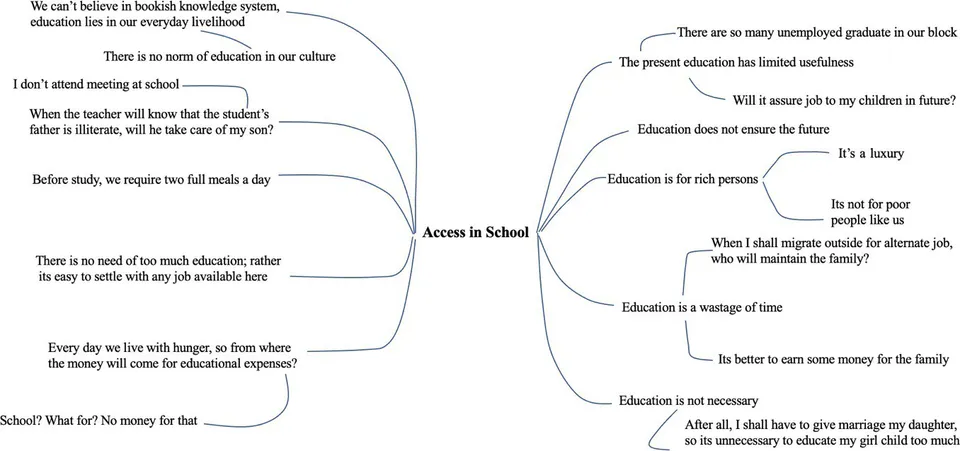
The mental map (Figure 3) shows that the parents hardly perceive any positive attitude regarding school education, and in all the cases, parents’ perception work negatively. Nearly 88 percent parents (N=80) feel very pessimistic that education bears minimum significance, useless and nothing but a luxury. The sufficient number of responses, i.e., ‘Education is not necessary’ or ‘a wastage’ is also disappointing. Still, it is a hard reality to them. This kind of indifferent attitudes invite less expectation (Hong and Ho, 2005) and dissatisfaction (Ahmetoglu and Acar, 2017; Bacolod and Tobias, 2006; Bandyopadhyay and Subrahmanian, 2008) among the parents. This is quoted by the following interview narrative given by a father and confirmed by Siksha Bandhu:
“What is the benefit to become a graduate? In our village, a graduate student remains still unemployed. He goes to Jhalda for the daily casual job like us, what is the difference between this graduate and us- the illiterate people? He also teaches as a private tutor, but no one sends children to avail the tuition. Within the village, a so- called ‘failure’ graduate without salaried job lessens our expectation to the existing education system.”
“Those who perform well in school migrate to town with the whole family and get admitted to the renowned school for better education. The educated parents also don’t want to keep the children in that ‘poor’ environment. The low SES villagers cannot see anybody to
become successful in staying in that remote village. This depressive scenario aggravates native parents to hold a pessimistic perception towards the child’s education a lot.”
Parental Attitude as Mediator of Poverty on Child’s Learning Outcome
Following the relevant literature of parental negative attitudes in the context of India’s rural and hilly pockets of India, several dimensions of low expectation, minimum awareness and little knowledge about child’s schooling have been considered for the analysis. To acquire an idea of parental expectation, the parents were asked of how far educational achievement they think that their children will achieve in terms of formal schooling (Belardo and Candelaria, 2023; Sandra, 2021; Goldenberg et al. 2001); to realize parental awareness, they were asked to what extent they think education is necessary, and whether they have any knowledge of the present school education system. A mediation regression analysis is fruitful in establishing the mediator role of parents’ negative attitudes towards education under specific SES. The study mainly concentrates on first generation learners’ home environment featured by high poverty and low educational attainment. To measure the depth of the poverty, the study has taken the per capita MCE of each family and its gap from the calculated ‘cut off’ value, i.e., Rs. 594.49/. The relevant research question of the analysis includes: Does the negative attitude of parents mediate the influence of poverty on child’s school outcome?
The hypotheses are as follows:
Hypothesis 1: Poverty significantly affects school outcome;
Hypothesis 2: Parents’ negative attitude has a significant unique effect on school outcome;
Hypothesis 3: Parents’ negative attitudes significantly affect parents’ expectation;
Hypothesis 4: The effect of poverty on school outcome shrinks upon the addition of the parents’ negative attitude (Mediator) to the model;
The equations are as follows:
School Outcome = +** Poverty Depth (Significant)….1
Negative Attitude = + Poverty Depth (Significant)….2
School Outcome = + Negative Attitude (Significant)….3
School Outcome = +* (Poverty Depth) Insignificant +Negative Attitude\Significant …4
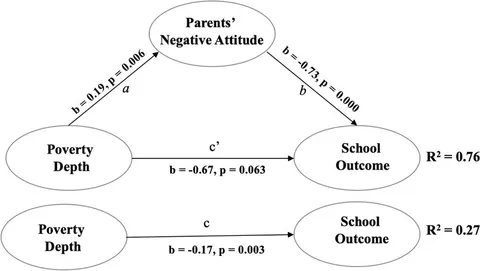
Primarily, the three models interacting separately with each other are associated in significant ways, i.e., poverty adversely affects school performance (F1,118) =27.04, R2=0.27, p=0.003, parents’ negative attitude also has ill-effect on the school performance (F1,118) =83.69, R2=0.75, p=0.000 and poverty affects parents’ negative attitude towards child’s education (F1,118) =8.80, R2=0.24, p=0.006. Three regression analyses show that unit increase in poverty increases 0.19 negative attitude among the parents (a path). One unit more depth in poverty decreases 0.17 unit of child’s school performance (c path) determining 27 percent of it. But coupled with parents’ negative attitude, poverty hinders 0.67 unit of child’s school outcome determining 76 percent of child’s school performance that is far greater than the influence of poverty alone. It is to note that a full mediation occurs in the above analysis as the addition of parents’ negative attitude totally makes the influence of poverty (c’ path) insignificant on child’s academic performance (Figure 4). Therefore, it is the parents’ detrimental attitude, not poverty that comes first to determine child’s achievement in school.
This negative attitude of parents to child’s access and success in school education flows into next-generation plaguing today’s teenage youth of a lack of motivation towards academic activities (Lisa et al., 2006). A huge number of learners, especially of first generation, locate themselves in a condition in which they do not desire to continue the school activities required for them (Green-Demers and Pelletier, 2003). This lack of motivation can give birth to the feelings of loneliness and frustration, thus hampering well- being. This kind of home ecological issues is not alike to the home atmosphere of subsequent generation learners, a comparative view is pertinent to analyse to address the question: “To what extent does the home ecology differ by generations?”
Discussion
In the context of developing countries, particularly in India, children in rural India from poor economic and social backgrounds are disadvantaged concerning their development and learning potential (Kamper, 2008; Ademujimi, 2002; Oyeka, 2002). Research on rurality demand sensitivity to the uniqueness and individuality (Barley and Beesley, 2007). Practically, in rural areas hurdles are more and opportunities are less. Rural schools serve large number of scheduled social groups, families in socio-economic distress, and parents with little or no educational attainment (Flora et al., 2003; Pitan, 2012; Schneider, 2002). Students from rural base are at risk of low motivation and devoid of school success (Lichter et al., 2003). Parents of these children with no education and skill spend little or no quality time with them, mainly due to keep engaged in different income generating activities as survival strategy (Robinson et al. 2001). This lack of time deepened by the inability of poor parents to extend support due to their own levels of educational attainment hinders nourishing from within the families. Secondly, poverty decreases child’s motivation for learning (Gwirayi and Shumba, 2007). Poverty aggravates discrepancy in academic aspiration with great number of children believing that they hardly possess any ability to achieve. Teachers also believe that these children, especially first-generation learners, are incapable of reaching their learning potential.
Children living with poverty are less likely to attend school regularly and pursue higher education, as it is an arduous task for them to break out of the poverty cycle. The association between poverty and academic achievement is complicated by social identity factor, as a large number of scheduled social groups with a long history of legal and social discrimination have hardly got any chances of academic and material success (Rienks et al., 2017; Kamper, 2008). Children of low SES parent usually lag behind academically in their school years and are more prone to dropout before the completion of school education cycle.
Conclusion
Agriculture is the backbone of economy of India even at the end of first quarter of the 21st century and agro-economy is too much regressive in the plateau fringe area and poverty is the integral part of household economy of this region. Under such consideration, most of the parents of school goers struggle for their livelihood where desire or success of school education of their wards is nothing but a luxury. Success completion of school education up to the last grade of the cycle with no one at home to support is an uphill task for first generation learners. Not only researchers, but policy makers also have felt the importance of learning environment and parental involvement on child’s academic performance and have stated assimilated effort aimed at including parental involvement into broader educational policy initiatives. EFA clearly proves that learning environment at home comes first succeeded by parental participation in child’s school activities. Poverty and livelihood struggle of parents seems to be the most crucial barriers in this context. Poverty not only affects their livelihood and household economy; it has some negative impact on parental attitudes to send their wards to attend school and also the learning outcome of the school goers. Parents are more interested to engage their wards in farming, day labouring and household chore especially for the girl child. To sustain their family, most of the parents are engaged in day labouring frequently. Girl child have to take the responsibility to take care of the household duty of the mother in terms caring kids and other household chores. The scenario has slightly changed with the introduction of Universal Literacy programme. With such programme initiated from 2007, school goers up to 8th standard get mid-day meal, book grant, school dresses and even different scholarships under central and provincial government, but the desire of the parents about successful school education of their wards is drain out due to lack of gainful employability of the first-generation learner and even non- first-generation learners even after success completion of their higher education as stated by the respondents. The opportunity cost for school education of their wards is lessened now, but the non-encouraging home environment and psychological barriers of first-generation learners still prevails which is at the root for drop out. Psychological barriers are more pervasive for dropout. During their home study, they rarely get any help in understanding the lessons. As a result, they are afraid of attending school. Continuation of this process leads to drop out. Therefore, school curriculum and syllabus up to 8th standard should not be a burden to them. The moto of school education up to 8th standard is to be developed to gain knowledge and general understanding about the nature and society through which they will be in a joyful learning with subsequent development of sociability. Opportunity cost can be reduced through government planning which is gradually being established through Universal literacy programme, but psychological barriers can only be removed by joyful learning.
Acknowledgement
The authors are grateful to the respondents for their kind cooperation in completing the study.