
How Are Ideas About Evolution Evolving?

Article ID

2IH77

In-depth exploration of how ideas evolve over time within the context of human development and scientific progress.

How Are Ideas About Evolution Evolving?

Patrick Manning
Patrick Manning University of Pittsburgh
DOI

Abstract

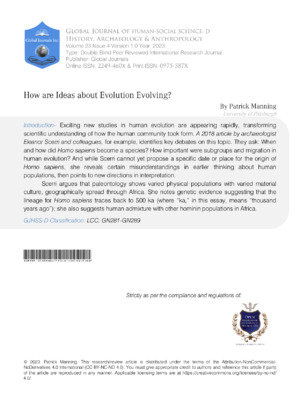
Exciting new studies in human evolution are appearing rapidly, transforming scientific understanding of how the human community took form. A 2018 article by archaeologist Eleanor Scerri and colleagues, for example, identifies key debates on this topic. They ask: When and how did Homo sapiens become a species? How important were subgroups and migration in human evolution? And while Scerri cannot yet propose a specific date or place for the origin of Homo sapiens, she reveals certain misunderstandings in earlier thinking about human populations, then points to new directions in interpretation. Scerri argues that paleontology shows varied physical populations with varied material culture, geographically spread through Africa. She notes genetic evidence suggesting that the lineage for Homo sapiens traces back to 500 ka (where “ka,” in this essay, means “thousand years ago”); she also suggests human admixture with other hominin populations in Africa.

Exciting new studies in human evolution are appearing rapidly, transforming scientific understanding of how the human community took form. A 2018 article by archaeologist Eleanor Scerri and colleagues, for example, identifies key debates on this topic. They ask: When and how did Homo sapiens become a species? How important were subgroups and migration in human evolution? And while Scerri cannot yet propose a specific date or place for the origin of Homo sapiens, she reveals certain misunderstandings in earlier thinking about human populations, then points to new directions in interpretation. Scerri argues that paleontology shows varied physical populations with varied material culture, geographically spread through Africa. She notes genetic evidence suggesting that the lineage for Homo sapiens traces back to 500 ka (where “ka,” in this essay, means “thousand years ago”); she also suggests human admixture with other hominin populations in Africa.

Patrick Manning
Patrick Manning University of Pittsburgh

No Figures found in article.

Patrick Manning. 2026. “. Global Journal of Human-Social Science – D: History, Archaeology & Anthropology GJHSS-D Volume 23 (GJHSS Volume 23 Issue D4): .

Download Citation

Journal Specifications

Crossref Journal DOI 10.17406/GJHSS

Print ISSN 0975-587X

e-ISSN 2249-460X

Classification
GJHSS-D Classification: (LCC): GN281-GN289
Keywords
Article Matrices
Total Views: 1121
Total Downloads: 25
2026 Trends
Research Identity (RIN)
Related Research
Our website is actively being updated, and changes may occur frequently. Please clear your browser cache if needed. For feedback or error reporting, please email [email protected]

Request Access

Please fill out the form below to request access to this research paper. Your request will be reviewed by the editorial or author team.
X

Quote and Order Details

Contact Person

Invoice Address

Notes or Comments

This is the heading

Lorem ipsum dolor sit amet, consectetur adipiscing elit. Ut elit tellus, luctus nec ullamcorper mattis, pulvinar dapibus leo.


High-quality academic research articles on global topics and journals.

How Are Ideas About Evolution Evolving?

Patrick Manning
Patrick Manning University of Pittsburgh

Research Journals






























































