
F. F. Mende
I. INTRODUCTION
ightning discharges are formed during the development of the so-called thunderstorm cell, the process of formation of which is described in sufficient detail in the monograph [1]. First of all, it should be said that thunderclouds consist of several thunderstorm cells closely adjacent to each other, the development of processes in which is identical, but shifted in time. A cell means a region that has a certain horizontal extent in which all the basic physical processes take place.
In Fig. 1 in an idealized form presents a thunderstorm cell at an early stage of development.
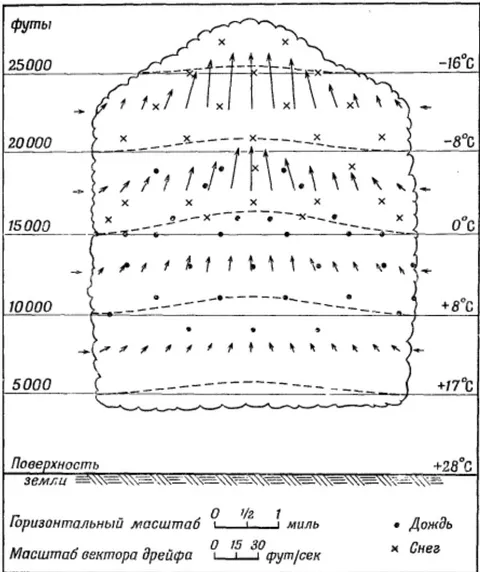
Streams of warm air rush up and cool down as they rise. If at the bottom of the cell, located at an altitude of 5,000 feet, the temperature is about +17 degrees Celsius, then already at an altitude of 25,000 feet it is -16 degrees, and in this area water vapor begins to turn into snow. Further development of the thunderstorm cell is shown in Fig. 2.
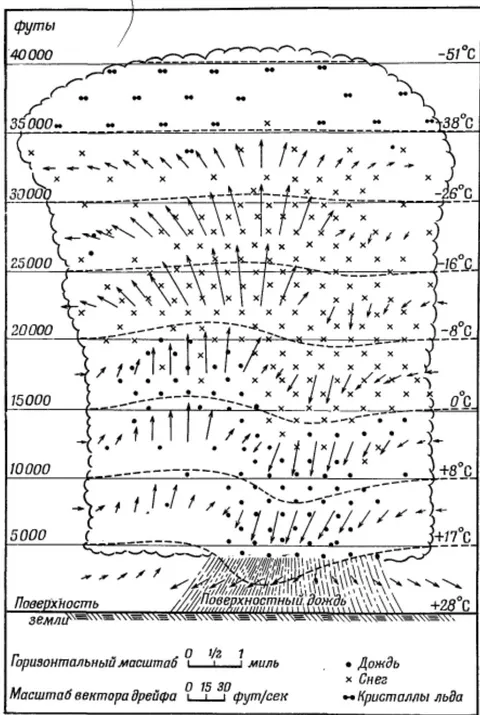
In this state, the cell is considered ripe and it begins to rain from its lower part, while ice crystals form in its upper part. Ice crystals formed in the upper part of the cell and snow formed in its middle part, falling down, begin to melt in warm air, turning into raindrops. It is at this stage that lightnings are formed, indicating that this process is accompanied by charge transfer from the upper part of the cell to its lower part. But the mechanism for such a transfer is not yet clear.
II. ELECTRIFICATION BY FRICTION
It is known that the friction of amber on wool leads to its electrification. This is due to the fact that the dielectric constant of amber (the relative dielectric constant of amber is 2.6 - 2.8) is greater than that of wool, and electrons transfer from a dielectric with a lower dielectric constant to a dielectric with a higher dielectric constant. A similar phenomenon is easily observed during friction of dielectric films (for example, from fluoroplastic), with dielectrics whose dielectric constant is less. For some types of fluoroplastic, the relative permittivity reaches 10. Such films are so electrified that they literally adhere to neutral conductors, or to other dielectrics with a lower dielectric constant.
In water and ice, the relative permittivity is also high and for static fields reaches 3.25 and 80 for ice and water, respectively. Therefore, if water droplets, or ice crystals, fall into an environment where there are free electrons, such electrons will adhere to them.
III. THE PROCESS OF LIGHTNING
In a mature thunderstorm cell, ice crystals form at heights of the order of 40,000 feet (about 12 km). This, of course, is not yet the ionosphere, which begins with altitudes of about 60 km, but there is already some kind of air ionization at this altitude. And to the crystals of ice formed at this height, the electrons in the air stick. Falling down together with electrons, these crystals carry their charges down. During the fall, falling into the warm air, ice crystals melt, turning into raindrops, but since the dielectric constant of water is much higher than that of ice, the electrons remain on these drops. A raindrop collects electrons on itself for the reason that the electric field of a thundercloud is polarized, as shown in Fig. 1.

The lower part of the polarized droplet is positively charged and when falling down, this part also captures the electrons encountered in its path. This process leads to the fact that when raindrops fall on the ground, the thunderstorm cell acquires an additional charge and a potential difference is formed between the cell and the earth's surface. This leads to lightning.
IV. CONCLUSION
The article describes the physical processes leading to the formation of lightning. Previously, this point of view on the formation of lightning was not presented in the scientific literature. Lightning discharges are formed during the development of a thunderstorm cell. First of all, it should be said that thunderclouds consist of several thunderstorm cells closely adjacent to each other, the development of processes in which is identical, but shifted in time. By cell we mean a region with a certain extent in the horizontal direction in which all the basic processes take place. It is the physical processes that occur in such cells that lead to lightning.
- Р. Фейнман, Р. Лейтон, М. Сэндс. Фейнмановские лекции по физике Т. - 5. М,: Мир, 1976.