How does ALS Ice Bucket Challenge Achieve its Viral Outcome through Marketing via Social Media?

§ HELP College of Arts and Technology

Send Message

To: Author

How does ALS Ice Bucket Challenge Achieve its Viral Outcome through Marketing via Social Media?

Article Fingerprint

ReserarchID

MBRI503V

How does ALS Ice Bucket Challenge Achieve its Viral Outcome through Marketing via Social Media? Banner

Key Research Insights

Synthesized scholarly intelligence & interactive research assistant
  • English
  • Afrikaans
  • Albanian
  • Amharic
  • Arabic
  • Armenian
  • Azerbaijani
  • Basque
  • Belarusian
  • Bengali
  • Bosnian
  • Bulgarian
  • Catalan
  • Cebuano
  • Chichewa
  • Chinese (Simplified)
  • Chinese (Traditional)
  • Corsican
  • Croatian
  • Czech
  • Danish
  • Dutch
  • Esperanto
  • Estonian
  • Filipino
  • Finnish
  • French
  • Frisian
  • Galician
  • Georgian
  • German
  • Greek
  • Gujarati
  • Haitian Creole
  • Hausa
  • Hawaiian
  • Hebrew
  • Hindi
  • Hmong
  • Hungarian
  • Icelandic
  • Igbo
  • Indonesian
  • Irish
  • Italian
  • Japanese
  • Javanese
  • Kannada
  • Kazakh
  • Khmer
  • Korean
  • Kurdish (Kurmanji)
  • Kyrgyz
  • Lao
  • Latin
  • Latvian
  • Lithuanian
  • Luxembourgish
  • Macedonian
  • Malagasy
  • Malay
  • Malayalam
  • Maltese
  • Maori
  • Marathi
  • Mongolian
  • Myanmar (Burmese)
  • Nepali
  • Norwegian
  • Pashto
  • Persian
  • Polish
  • Portuguese
  • Punjabi
  • Romanian
  • Russian
  • Samoan
  • Scots Gaelic
  • Serbian
  • Sesotho
  • Shona
  • Sindhi
  • Sinhala
  • Slovak
  • Slovenian
  • Somali
  • Spanish
  • Sundanese
  • Swahili
  • Swedish
  • Tajik
  • Tamil
  • Telugu
  • Thai
  • Turkish
  • Ukrainian
  • Urdu
  • Uzbek
  • Vietnamese
  • Welsh
  • Xhosa
  • Yiddish
  • Yoruba
  • Zulu
Reading Preferences
Font Size
Line Spacing
Background
This converted HTML version may contain rendering inconsistencies. Please refer to the PDF for the authoritative version, or click here to provide feedback.

Abstract

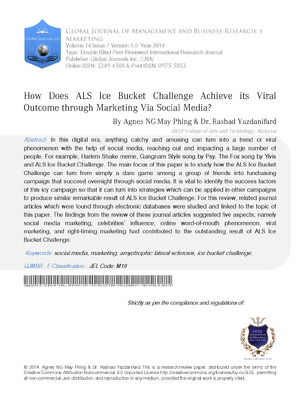
In this digital era, anything catchy and amusing can turn into a trend or viral phenomenon with the help of social media, reaching out and impacting a large number of people. For example, Harlem Shake meme, Gangnam Style song by Psy, The Fox song by Ylvis and ALS Ice Bucket Challenge. The main focus of this paper is to study how the ALS Ice Bucket Challenge can turn from simply a dare game among a group of friends into fundraising campaign that succeed overnight through social media. It is vital to identify the success factors of this icy campaign so that it can turn into strategies which can be applied in other campaigns to produce similar remarkable result of ALS Ice Bucket Challenge. For this review, related journal articles which were found through electronic databases were studied and linked to the topic of this paper. The findings from the review of these journal articles suggested five aspects; namely social media marketing, celebrities’ influence, online word-of-mouth phenomenon, viral marketing, and right-timing marketing had contributed to the outstanding result of ALS Ice Bucket Challenge.

References

33 Cites in Article
  1. 1. P Abdussalam (2014). Celebrity advertisement: Key to marketing success. Indian Journal of Commerce and Management Studies, 5(1), 78-82.
  2. 2. S Aslam,E Jadoon,K Zaman,S Gondal (2011). Effect of word of mouth on consumer buying behavior. Mediterranean Journal of Social Sciences, 2(3), 497-507.
  3. 3. Mauro Bampo,Michael Ewing,Dineli Mather,David Stewart,Mark Wallace (2008). The Effects of the Social Structure of Digital Networks on Viral Marketing Performance. Information Systems Research, 19(3), 273-290.
  4. 4. A Barreto (2014). The word-of-mouth phenomenon in the social media era. International Journal of Market Research, 56(5), 631-654.
  5. 5. Jonah Berger,Katherine Milkman (2012). What Makes Online Content Viral?. Journal of Marketing Research, 49(2), 192-205.
  6. 6. I Cora,V Tomita,D Stuparu,M Stanciu (2010). The mechanisms of the influence of viral marketing in social media. Economics, Management and Financial Markets, 5(3), 278-282.
  7. 7. S Diorio (2004). Revitalizing Lead Creation (Part 2): Better Placement, Better Timing and Better Coverage. MarketingProfs
  8. 8. W Duan,B Gu,B Andrew (2008). The dynamics of online word-of-mouth and product sales -an empirical investigation of the movie industry. Journal of Retailing, 84(2), 233-242.
  9. 9. Nozha Erragcha,Rabiaa Romdhane (2014). New Faces of Marketing In The Era of The Web: From Marketing 1.0 To Marketing 3.0. Journal of Research in Marketing, 2(2), 137.
  10. 10. S Gîrboveanu,S Puiu (2008). Viral marketing. Annals of the University Of Petrosani Economics, 8(1), 223-230.
  11. 11. Dan Goldstein,Yuchun Lee (2005). The rise of right-time marketing. Journal of Database Marketing & Customer Strategy Management, 12(3), 212-225.
  12. 12. S Hyun (2013). Social media and youtube as an attractive marketing tool. Journal of American Business Review, Cambridge, 1(2), 249-255.
  13. 13. Kineta Hung (2014). Why Celebrity Sells: A Dual Entertainment Path Model of Brand Endorsement. Journal of Advertising, 43(2), 155-166.
  14. 14. Seung-A Annie Jin,Joe Phua (2014). Following Celebrities’ Tweets About Brands: The Impact of Twitter-Based Electronic Word-of-Mouth on Consumers’ Source Credibility Perception, Buying Intention, and Social Identification With Celebrities. Journal of Advertising, 43(2), 181-195.
  15. 15. N Kalpaklioglu,N Toros (2011). Viral marketing tecniques within online social network. Journal of Yasar University, 6(24), 4112-4129.
  16. 16. Astrid Keel,Rajan Nataraajan (2012). Celebrity Endorsements and Beyond: New Avenues for Celebrity Branding. Psychology & Marketing, 29(9), 690-703.
  17. 17. Eran Ketter,Eli Avraham (2012). The social revolution of place marketing: The growing power of users in social media campaigns. Place Branding and Public Diplomacy, 8(4), 285-294.
  18. 18. Matthew Kiernan,Steve Vucic,Benjamin Cheah,Martin Turner,Andrew Eisen,Orla Hardiman,James Burrell,Margaret Zoing (2011). Amyotrophic lateral sclerosis. The Lancet, 377(9769), 942-955.
  19. 19. P Kuhikar (2013). Social media as a future marketing tool in India: An overview. PRIMA, 3(2), 15-21.
  20. 20. V Kumar,R Mirchandani (2012). Increasing the ROI of social media marketing. MIT Sloan Management Review, 54(1), 55-61.
  21. 21. Siegwart Lindenberg,Janneke Joly,Diederik Stapel (2011). The Norm-Activating Power of Celebrity. Social Psychology Quarterly, 74(1), 98-120.
  22. 22. Lili Luo,Yuan Wang,Lifeng Han (2013). Marketing via social media: a case study. Library Hi Tech, 31(3), 455-466.
  23. 23. M Mcneal (2012). The secret to viral success. Marketing Research, 24(4), 10-15.
  24. 24. Ioanna Papasolomou,Yioula Melanthiou (2012). Social Media: Marketing Public Relations’ New Best Friend. Journal of Promotion Management, 18(3), 319-328.
  25. 25. Anthony Patino,Dennis Pitta,Ralph Quinones (2012). Social media's emerging importance in market research. Journal of Consumer Marketing, 29(3), 233-237.
  26. 26. D Smedescu (2013). Social media marketing tools. Romanian Journal of Marketing, 23-29.
  27. 27. Peipei Song (2014). The Ice Bucket Challenge: The public sector should get ready to promptly promote the sustained development of a system of medical care for and research into rare diseases. Intractable & Rare Diseases Research, 3(3), 94-96.
  28. 28. C Stella,L Yip (2009). Media, celebrities, and fans: An examination of adolescents' media usage and involvement with entertainment celebrities. Journalism and Mass Communication Quarterly, 86(1), 23-44.
  29. 29. Shanton Chang (2014). The Ice Bucket Challenge and social media virality. Facebook Newsroom
  30. 30. D Tomše,B Snoj (2014). Marketing communication on social networks -solution in the times of crisis. Marketing, 0354(3471), 131-138.
  31. 31. (2014). What Is ALS?. What is ALS, 1-10.
  32. 32. Lokesh Wijesekera,P Nigel Leigh (2009). Amyotrophic lateral sclerosis. Orphanet Journal of Rare Diseases, 4(1), 1-22.
  33. 33. L Yuping (2012). Seeding viral content: The role of message and network factors. Journal of Advertising Research, 52(4), 465-478.

Funding

No external funding was declared for this work.

Conflict of Interest

The authors declare no conflict of interest.

Ethical Approval

No ethics committee approval was required for this article type.

Data Availability

Not applicable for this article.

How to Cite This Article

Agnes Ng May Phing, Dr. Rashad Yazdanifard. 2014. "How does ALS Ice Bucket Challenge Achieve its Viral Outcome through Marketing via Social Media?". Global Journal of Management and Business Research - E: Marketing GJMBR-E Volume 14 (GJMBR Volume 14 Issue E7).
Download Citation

Journal Specifications

Crossref Journal DOI 10.17406/GJMBR

Print ISSN 0975-5853

e-ISSN 2249-4588

Keywords
Classification
GJMBR-E Classification JEL Code: M19
Version of record

v1.2

Issue date
December 17, 2014

Language
English
Order Article Reprint
Experiance in AR

Explore published articles in an immersive Augmented Reality environment. Our platform converts research papers into interactive 3D books, allowing readers to view and interact with content using AR and VR compatible devices.

Read in 3D

Your published article is automatically converted into a realistic 3D book. Flip through pages and read research papers in a more engaging and interactive format.

Article Matrices
Total Views: 1.1K
Total Downloads: 58
All Trends

Request Access

Please fill out the form below to request access to this research paper. Your request will be reviewed by the editorial or author team.
X

This is the heading

Lorem ipsum dolor sit amet, consectetur adipiscing elit. Ut elit tellus, luctus nec ullamcorper mattis, pulvinar dapibus leo.


High-quality academic research articles on global topics and journals.

How does ALS Ice Bucket Challenge Achieve its Viral Outcome through Marketing via Social Media?

Agnes Phing
Agnes Phing HELP College of Arts and Technology
Dr. Yazdanifard
Dr. Yazdanifard