This converted HTML version may contain rendering inconsistencies. Please refer to the PDF for the authoritative version, or click here to provide feedback.
Report an Issue
Abstract
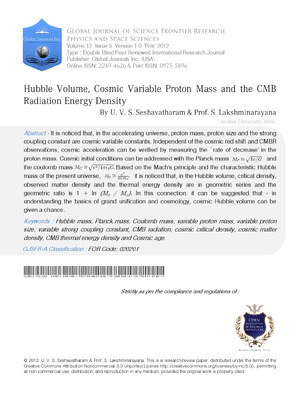
It is noticed that, in the accelerating universe, proton mass, proton size and the strong coupling constant are cosmic variable constants. Independent of the cosmic red shift and CMBR observations, cosmic acceleration can be verified by measuring the `rate of decrease’ in the proton mass. Cosmic initial conditions can be addressed with the Planck mass and the coulomb mass Based on the Mach’s principle and the characteristic Hubble mass of the present universe, it is noticed that, in the Hubble volume, critical density, observed matter density and the thermal energy density are in geometric series and the geometric ratio is 1 + ln (M 0 / M C ). In this connection, it can be suggested that -in understanding the basics of grand unification and cosmology, cosmic Hubble volume can be given a chance.
References
15 Cites in Article
1.U Seshavatharam,S Lakshminarayana (2026). The 2.07 Billion kg Quantum Gravitational Mass and Its Applications in Astrophysics and Cosmic Evolution. Global Journal of Science Frontier Research, XII
2.E Recami Elementary Particles as Micro-Universes, and \Strong Black-holes": A Bi-Scale Approach to Gravitational and Strong Interactions. Elementary Particles as Micro-Universes, and \Strong Black-holes": A Bi-Scale Approach to Gravitational and Strong Interactions
3.P Dirac (1937). The Cosmological Constants. Nature, 139(3512), 323-323.
4.J Huchara (2009). Estimates of the Hubble Constant. Estimates of the Hubble Constant
5.W Freedman Final Results from the Hubble Space Telescope Key Project to Measure the Hubble Constant. The Astrophysical Journal, 553(1), 47-72.
6.U Seshavatharam,S Lakshminarayana Accelerating universe and the expanding atom. Accelerating universe and the expanding atom
7.E Hubble (1947). The 200-inch telescope and some problems it may solve. PASP, 59, 153-167.
8.D Sciama (1971). Modern Cosmology. Modern Cosmology
9.George Hawking,Rayner Francis,Ellis (1973). The Large Scale Structure of Space-Time. The Large Scale Structure of Space-Time
10.D Raine (1975). Mach's Principle in general relativity. Royal Astronomical Society, 171, 507.
11.Bondi (1997). The Lense-Thirring Effect and Mach's Principle. Physics Letters A, 228(3), 121-126.
12.R Vishwakarma (2002). A Machian model of dark energy. Classical and Quantum Gravity, 19(18), 4747-4752.
13.Peter Mohr,Barry Taylor,David Newell (2006). CODATA recommended values of the fundamental physical constants: 2006. Reviews of Modern Physics, 80(2), 633-730.
14.J Narlikar (2002). An Introduction to Cosmology. An Introduction to Cosmology
15.Ebenezer Burgess (1858). Translation of the Surya-Siddhanta, A Text-Book of Hindu Astronomy; With Notes, and an Appendix. Journal of the American Oriental Society, 6, 141.
No ethics committee approval was required for this article type.
Data Availability
Not applicable for this article.
How to Cite This Article
Mr. U.V.S.Seshavatharam. 2012. "Hubble Volume, Cosmic Variable Proton Mass and the CMB Radiation Energy Density". Global Journal of Science Frontier Research - A: Physics & Space Science GJSFR-A Volume 12 (GJSFR Volume 12 Issue A5).
Explore published articles in an immersive Augmented Reality environment. Our platform converts research papers into interactive 3D books, allowing readers to view and interact with content using AR and VR compatible devices.
Your published article is automatically converted into a realistic 3D book. Flip through pages and read research papers in a more engaging and interactive format.