Aleksei V. Babkin
I. INTRODUCTION
The analysis of climatic time series reveals their hidden periodicities. But, if these harmonics are reliable, they, as their environmental causes, should impact to other Earth systems including human society and should be traced in history. Some hypothesis of appearance of environmental cycles in history were formulated, including the conceptions of A.L. Chizhevsky [4] concluded that 11 year cycle of solar activity impacts to the mankind development, M.A. Bogolepov [3] explained some historical events by the reaction of communities of people for the unfavorable for them changes of environment related with combinations of harmonics revealed in the hydrometeorological time series, and many other researchers.
This research is aimed not only to formulate, present and discuss the problems of analysis, modeling and prediction of hydrometeorological and climatic time series and relate their hidden periodicities with any human activity or social process, but also to show the way of development of the combination of revealed periods into the chronological system embracing and structuring all human past. This chronological system is alike on some extent to the time scale of Joseph Justus Scaliger [11]. But this chronology is aimed to be a tool for revealing, description and analysis of some regularities of development of mankind rather than for systematization of dates of events in the past of different human communities for composing of their succession.
The chronological system should be as some analog of the Geologic time scale. As the Geologic time scale is an effective tool to describe the evolution of the life and to explain its aim – formation of humans, the presented chronological system could be applied as the instrument to describe the development of human society and to make more clear the aim and sense of history.
The chronological system could be interpreted from the points of view of different conceptions. It was combined with the doctrine of Karl Marx , explained the sense of history as the successive alteration of social formations from primitive communism to future communism and with conception of N.F. Fedorov – founder of philosophical direction of Russian Cosmism. According to N.F. Fedorov which made the same conclusion that H.G. Wells from the analysis of the world social tendencies, the sense of history is the uniting of all nations, tribes and people into the whole and universal community (modern science of western countries interprets it as globalization).
This chronological system structures the past from the moment of Creation of the World (expelling the Adam and Eve from Paradise) by the Hebrew Calendar and subdivide it for two basic eras: Era of Separated World and Era of United Humanity. The Era of Separated World consists from the seven ages which boundaries are the greatest historical and religious events caused the origination of more complicated and developed human communities that is was earlier.
The boundary of the eras, calculated by the combination of environmental cycles of 28 and 29 years, is 1924, when Vladimir Ilich Lenin and Thomas Woodrow Wilson died with two weeks distance. V.I. Lenin – the leader of the Great October Socialist Revolution and the founder of the USSR (World Republic of Labor People) and Woodrow Wilson – the founder of the League of Nations (the first political organ of United Humanity) united the mankind on the basis of communism and capitalism respectively. The human chronology is divided for the time before V.I. Lenin or Woodrow Wilson and after them, and these persons could be considered as the men initiating the beginning of the new era.
Person, initiating the new era, should be estimated as the greatest from the humanity from all its generations. V.I. Lenin and Woodrow Wilson were the opponents during their lifetime and posthumous ideological rivals architected the different ways for mankind development, which still is the basis of modern confrontation of the Russia and United States. They are also the rivals in my chronological system. The discussion concerning their contribution to the development of humanity should be especially actual taking into the consideration the Century Anniversary of the Great October Socialist Revolution and Historical Fourteen Points of Wilson (8 of January, 1918), the base of League of Nations creation.
II. THE AVAILABILITY OF THE SAME PERIODS IN HYDROMETEOROLOGICAL TIME SERIES AND HUMAN PAST
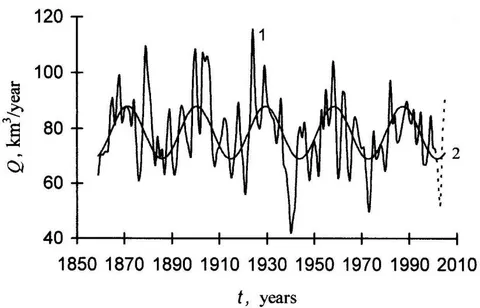
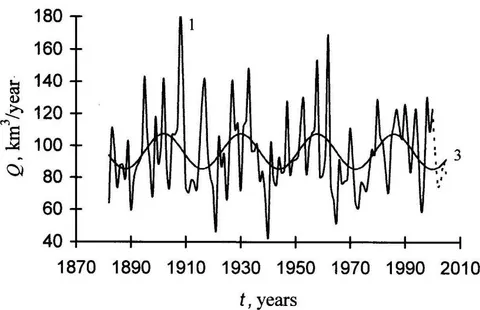
Figure 1 illustrates the time series of water runoff of the Neva (a) and Dnieper (b) Rivers. These time series were analyzed by the method of "Periodicities" [1, 2] from their beginning to 2000. The last five years of 2001 – 2005 were applied for the computation of the training forecasts of river runoff and estimation its results by the new independent data.
The time series are added by the revealed sinusoids with the periods of 29 and 28 years respectively. There is the high correlation of the time series and the sinusoids ( ). The results of training forecasts by these sinusoids are better than the predictions by the mean values of time series. These periods were revealed also in large number of different hydrometeorological time series.
The period of 29 years may be in presence in the history of the Soviet Russia and World Communist Movement. It is the cycle of the death of the most powerful and ideologically motivated communists. Friedrich Engels – co-author of conception of Marxism died at August 5, 1895. V.I. Lenin dyed at January 21, 1924, 29 years after F. Engels. I.V. Stalin – secretary-general of the communist party and prime minister of Soviet Union died at March 5, 1953. Head of the USSR L.I. Brezhnev died at November 10, 1982.
The Soviet Union collapsed at 1991. But in 2011 there were the deaths of the Heads of the States originated by the former Soviet Union copying its social organization and political system. Muammar Khadafy of
Libya died at October 20, 2011 and Kim Jong II of North Korea – at December 17, 2011.
The period of 28 years is the calendar cycle. It is the time interval for what the calendar dates stand for the same days of the week. This period was interpreted by the Velimir Khlebnikov, Russian writer of the beginning of XX century, as the cycle of alternation of generations [6]. He concluded that the leaders resolving the opposed political or ideological and world-outlook tasks are born very often through 28 years as the Peter the Great – the Emperor of Russia and the Ivan Mazepa – Hetman of Zaporizhian Host. The new generation of people confront with the older generation born 28 years before.
This period is also could be revealed in the past of Russia and former Soviet Union. The 28 year is the time interval between the Great Russian Revolution of 1917 and the victory of USSR in the Second World War. The Serfs Emancipation in Russia of 1861 and the Great Revolution are separated by two cycles of 28 years.
If the periods with the length of 28 and 29 years are available in the variations of environmental processes and human past, their combination should cause the cycle of their multiplication with the length of 812 years. This complex long cycle, if it is reliable, can be applied as the chronological unit for the systematization of the human past – its subdivision for approximately equal time intervals with the own socio-historical sense and meaning of each of them. Such systematization could be valuable because the environmental cycle of 812 years is external for society.
As on the boundaries of subdivisions of the Geologic time scale there were the outstanding environmental processes related with the mass extinctions of different groups of organisms and rapid formation and evolution of other organisms in the empty ecological niches as the important social processes should be developed near the subdivisions of chronological system of human past and great events should be occurred which cause the changes of the structure of society.
Association of the historical events into the group according to their location in the chronological system should permit to describe some of their general peculiarities, develop analogies between them and analyze and discuss the significance of their leaders in history. As these events are combined by the regularities of variations of environmental processes it should be interesting to analyze their relations, not only causality, which should be useful for formulation of general regularities of the development of the nature and society.
III. CHRONOLOGICAL SYSTEM OF HUMAN PAST AND SENSE OF HISTORY
The period of 812 years should be calculated from the important point in human past. Such important point is the Creation of the World (expelling of the Adam and Eve from Paradise) as its beginning. There are different dates of Creation of the World of the Christian theologians and Bible researchers. Let us consider the date of October 6/7, 3761 BC, which is the beginning of the Hebrew Calendar – official calendar of the State of Israel.
Because the Creation of the World was completed near the end of 3761 BC of Gregorian calendar, let us to calculate the time from the next year – 3760 BC, which embraces the most part of the first year of human past. The chronological system, including the years of boundaries of 812 year cycles, is presented in the table 1. The years Before Christ are characterized by the minus.
The years of completing of the cycles are the 2948 BC, 2136 BC, 1324 BC, 512 BC, 300 AD, 1112 AD and 1924 AD. The closest for us year of this dependence is 1924. From the Creation up to our time the 7 full cycles are revealed. The number 7 characterizes certain fullness and completeness, and, as a rule, namely it is used for the description and classification of various processes and states. In particular, 7 colors of visible radiation, 7 basic units of physical quantities of International System of Units (SI) are allocated.
The music scale is formed by the 7 basic notes. According to the Book of the Revelation to John of the New Testament the 7 seals are opened from the Book and 7 angels with 7 trumpets sound. The organisms of the biosphere are classified by their uniting into 7 basic taxonomical groups: species, genus, family, order, class, phylum and kingdom. There are 7 Wonders of the World – great architecture monuments of antiquity: the Great Pyramid of Khufu, the Colossus of Rhodes, the Lighthouse of Alexandria, the Mausoleum at Halicarnassus, the Temple of Artemis, the Statue of Zeus and the Hanging Gardens.
According to Russian philosopher N.F. Fedorov and British H.G. Wells the sense of the history of humans is the formation of their universal community. The most whole and universal community of people is the United Humanity. Let us to subdivide the historical time for the two eras, which boundary is the 1924. We will call time before 1924 by the Era of Separated World, and after – the Era of United Humanity. The concept of the "Era of Separated World" was applied by Russian science fiction author I.A. Yefremov [10].
Most simple human community is the family. Between family and United Humanity we could introduce five more forms of communities or levels of the organization of people – the clan, the tribe, the polis (the city-state or the principality), the nation and the union of nations. The specified forms of community are presented in table 1 in the 7th column to each of which the cycle of the chronological table corresponds at the end of which the historical events, caused its origination, occurred. Events are specified in the 4th column, their leaders – in the 5th column. In the 3th column the level of a community of people and a cycle at the end of which it was initiated, is characterized by the index.
There could be true the analogy between the events which caused origination of new forms of communities of people of higher level and Wonders of the World. Such events should to be the giant scale, involve the huge masses of people, to be characterized by uniqueness and to be on the edge or even beyond of the social and technological capabilities of people and societies of that time.
The analogy between the succession of communities of people of the presented chronology and the systematic of organisms of biosphere also could be developed. The succession of human communities may be interpreted as the social systematic of humanity. So each person can be characterized by his belonging (or not belonging) to united humanity, large number of people – to their associations with any unions of nations, with any nation and polis.
| Era | Cycle (age) | Age index | Great Revolutions (events and processes of formation of human communities of next level) | Great personalities | Name of the age | Forming human community | Opening direction for social development |
| 1 | 2 | 3 | 4 | 5 | 6 | 7 | 8 |
| Era of United Humanity | |||||||
| Era of Separated World | 1924 – 1112 | 7 | Great October Socialist Revolution and formation of USSR, foundation of the League of Nations | Vladimir Ilich Lenin Thomas Woodrow Wilson | Age of unions of nations | United Humanity | Communistic |
| 1112 – 300 | 6 | First Crusade and formation of Christian States in the Western Asia and Palestine | Godfrey of Bouillon Bohemond I Tancred of Galilee | Age of nations | Union of nations | Capitalistic | |
| 300 – (–512) | 5 | Completing the epoch of Three Kingdoms and formation of China, War of the Eight Princes | Wu of Jin Jia Nanfeng | Age of poleis | Nation | Feudal | |
| –512 – (–1324) | 4 | Expelling the Tarquin the Proud from Rome, overthrow the monarchy and formation of the Roman republic | Lucius Junius Brutus Spurius Lucretius Tricipitinus | Age of tribes | Polis | Slaveholding | |
| –1324 – (–2136) | 3 | Development of Monotheism | Akhenaten Tutankhamun Moses | Age of clans | Tribe | Subslaveholding | |
| –2136 – (–2948) | 2 | Creation of Ark | Noah Shem Japheth | Age of families | Clan | Primitive communistic | |
| –2948 – (–3760) | 1 | Archaic age | Family | ||||
| 0 | Expelling of Adam and Eve from Paradise | God | Archaic | ||||
In many places of the world remote from the centers of capitalistic development, people can be characterized by their belonging to a tribe and a clan, and each human person belongs to any family. In this research the history of origination of forms of communities of people according to change of their level is analyzed.
Let us the intervals of 812 years long, according to chronological terminology of I.A. Yefremov and H.G. Wells [9], to call by the ages. Era of Separated World could be subdivided for sequence of the ages named by the communities of people of that time of the highest level (table 1, a column 6).
This sequence consists from an archaic age at the time moment of Adam and Eve's expelling from Paradise (age of lack of any community among the people), age of families, age of clans, age of tribes, age of policies, age of nations, age of unions of nations which comes to the end with the Era of United Humanity.
In every age the community of people with the highest index is subject of historical process.
Such community interacts with other communities as it as lower levels, building the relations of war and peace, domination and submission, market exchange and competition and the other. So, in the age of tribes, one tribe can subdue another tribe, the relations of Spartans and Helots are an example of that, but, the tribes related by the domination and submission during its age don't become the polis.
Often poleis conquered other poleis, or entered with them into alliances or other relations. Sometimes, formations of the poleis combined with each other by various relations reached the large sizes and involved in themselves the huge mass of the population, an example of that is Rome. But the poleis related with each other in its age didn't become the nation.
The nations obeyed each other, but related with each other, in its age they didn't become the union of nations. The unions of nations were at war and traded with each other, but victories of some unions and defeats of others, as well as their peace relations, didn't lead to their association into the United Humanity.
According to Karl Marx doctrine sense of history is the consecutive alternation of socioeconomic formations which are the primitive communism, slaveholding, feudal, capitalistic and communistic. Let us apply these concepts to specify the ages on all its extent as the new direction of humanity development rather than the steady society. So, merger of unions of nations into the United Humanity opens for it the possibilities of communistic development.
Association of nations into the unions of nations opens the possibilities of development of capitalism in them. Combination of poleis into the nations gives for them the possibility of development of feudalism, and association of tribes into the poleis – developments of the slaveholding relations, table 1, column 8. Association of families into the clans creates the prerequisites to the primitive communistic development of society. Also let us consider the subslave holding direction of development opening for the association of clans into the tribes, which was not specified by Marx.
Let us consider the processes and events of the ends of ages which caused formation of new communities of people of higher organization.
IV. PROCESSES AND EVENTS OF COMPLICATION OF COMMUNITIES OF PEOPLE
a) Origination of United Humanity and appearance of the communistic direction of its development
In 1924, at the moment of the end of the age of the unions of nations and the Era of Separated World V.I. Ulyanov (Lenin) and Woodrow Wilson (on February 3) died, and also the First Constitution of the USSR including the Declaration of the Creation of the USSR and the Treaty on the Creation of USSR was adopted by the Second Congress of Soviets of the Soviet Union on January 31.
V.
I. Lenin – the leader of the Great October Socialist Revolution which exposed some indications of origin of United Humanity – principally new community of people. This revolution step out the solution of the political and social problems of countries and nations, and their unions, having set the aim of formation of society of a brotherhood of labor people of the whole world and their association after victory of socialist revolutions in other countries.
Almost simultaneously with origination of the united humanity on the basis of communism, the most developed capitalist countries under the leadership of the U.S. President Woodrow Wilson made an attempt of association of the world in the form of League of Nations – the first political body of United Humanity. Slightly earlier, in 1913 at Wilson's presidency the Federal Reserve System of the USA – a financial basis of association of the world was created.
The League of Nations was based on the declaration of Fourteen Points of Wilson presented to the Congress of the USA on January 8, 1918. This declaration was devoted to the principles of the world arrangement after the victory of the USA and its allies in World War I. Creation of the League of Nations was undertaken for the protection of the interests of the winners in this war – leading capitalistic powers. Nevertheless, Fourteen Points of Wilson partly repeated some of provisions of the Decree on Peace and other ideas of V.I. Lenin and slogans of the Great October Socialist Revolution, as they were the reaction to them of the capitalist world. Wilson's points formulated the need of cancellation of secret diplomacy, guarantees of the peace to the great and small nations, the rights of the nations of the former empires of Europe and Russia for creation of their own states, and for Russia – to find its own way of development.
The human history subdivided for the two eras: the time before Lenin (or Wilson) and the time after V.I. Lenin. We can conclude that the new era after the death of V.I. Lenin begins, because the state of human society changed qualitatively. Before Lenin in all ages the mankind was divided, though the extent of this division successively reduced, the labor was an object for exploitation though its form and degree changed. After V.I. Lenin the tendency of uniting of humanity originated and the new direction of its development – communistic, liberating the labor from the exploitation, opened.
Huge significance of the Great October Socialist Revolution was realized already by its contemporaries, and, not only supporters of building of the communism. Today, when there is no more Soviet power, events of Great October and the subsequent history of the USSR seems as the real Wonder of the World doesn't have the analogs in the past.
b) Origination of the union of nations and appearance of the capitalistic direction of development of humanity
In December 12, 1112, after end of the age of nations, Tancred of Galilee died. He was one of heads of the First Crusade, the participant of a siege and charge of Jerusalem, the founder and the Prince of the Principality of Galilee, obeyed to the Kingdom of Jerusalem as vassal, populated by the people of the same faith as the Jesus Christ and consanguineous to him. Slightly earlier, in 1111, before the beginning of the age of the unions of nations two other heads of this campaign died: Bohemond I (on March 17) and Robert II, Count of Flanders (on October 5).
The occasion for the First Crusade was the inquiry of the Byzantine emperor Alexios I Komnenos to the Pope Urban II for assistantship in the struggle against invasion of the Turks to the Anatolian region. In November 1095 the Pope called the Council of Clermont, where he asked Western Christians for the military campaign against Muslims not only to help to the Byzantine but also to capture the Jerusalem.
The appealing of the Pope was actively supported by many European communities, people of different social groups and estates. Peter the Hermit, a priest of Amiens and the French knight Walter Sans Avoir had composed, organized and headed the poorly armed and weakly trained troops of commoners of some tens of thousands of people. In the April of 1096 this army moved to the Anatolia beginning the People's Crusade. In October it was defeated by Turks, Walter Sans Avoir and many of his soldiers were lost, Peter the Hermit retreat to the Constantinople and joined himself to the nobility and knights preparing for the First Crusade.
After the army of commoners the main troops of crusaders were formed. The prominent European feudal nobility with their detachments and vassals had arrived to the capital of the Byzantine including the Duke of Lower Lorraine Godfrey of Bouillon with brothers and nephew, Count of Flanders Robert II and the Prince of Taranto Bohemond with his nephew Tancred. Bohemond was a son of Robert Guiscard, Norman conquer of southern Italy. During the feudal wars between the heirs of his father he formed the Principality of Taranto.
The crusaders begin the military invasion into the Turkish Anatolia at the spring of 1097. The success of this campaign was caused partly by its support by the local Christians and Armenian nobility. The brother of the Godfrey of Bouillon the Baldwin of Boulogne promised the support and protection for the Armenian Prince Thoros governing by the city of Edessa, but dethroned and executed him. So, the first Crusader state – the County of Edessa was formed.
In June of 1098 the crusaders captured the submitted to Turkish Muslims the city of Antioch and formed the Principality of Antioch. The Bohemond of Taranto became Bohemond I, Prince of Antioch. In the July of the next year the troops of crusaders captured the Jerusalem which was under the authority of Fatimid Caliphate. The Kingdom of Jerusalem was established and Godfrey of Bouillon was elected to be its secular authority. Godfrey refused to be crowned and instead of accepting of the royal title he was proclaimed as the Defender of the Holy Sepulcher. After the death of Godfrey at 1100 the next ruler of the kingdom became the Baldwin of Boulogne – the king Baldwin I of Jerusalem. The Baldwin of Bourcq, nephew of Godfrey of Bouillon, changed the Baldwin of Boulogne as the Count of Edessa.
In 1099 the Godfrey of Bouillon gave to Tancred the cities of Tiberias, Haifa, and Bethsan to establish the Principality of Galilee. After the Bohemond I was captured by the Malik Ghazi Gumushtekin at 1100 Tancred replaced his uncle as Regent of Antioch. After liberation for the ransom Bohemond returned to Europe, formed the army to struggle against the Byzantine and invaded to the Balkans. But this campaign was not successful and the Peace Treaty of Devol was concluded in 1108 positioning Bohemond I as the vassal of the Byzantine. Made the peace Bohemond returned the Principality of Taranto where died.
Robert II, Count of Flanders participated in the battles for Antioch and Jerusalem. He not pursued the fiefs in the Western Asia for himself and returned to Europe. Robert II was killed in the skirmish during the war with English king Henry I. Tancred not approved the Treaty of Devol and heading the Principality of Antioch and Principality of Galilee sharply confronted with the neighbor states. He died for typhoid epidemic.
The First Crusade was as an organized campaign of the nobility as the mass movement of commoners which embraced various countries and regions of Europe. Its various nations, organizing this campaign and participating in it, for the first time felt oneself as the community based on a common goal and the general values. Thus, for the first time in the history, it was created the community of people of higher level that it was before – the union of nations, and there came the new age in the history of mankind – the age of unions of nations.
The European community known today as the European Union became the first union of nations in the history. Namely in its capital, the city of Brussels, the monument to Godfrey of Bouillon – to the Defender of the Holy Sepulcher, the founder and the first head of Kingdom of Jerusalem was built.
Also, it is possible to conclude that exactly the First Crusade opened for humans the capitalist direction of development of their society. During this campaign the methods and approaches of war by the groups of detachments on the territories very remote from their countries and formation of the authority of conquerors over the population of other belief and other culture and capturing of its lands and property which were widely used later, during an Age of Discovery and during the development of colonialism were applied for the first time. Not incidentally, in 1982, mobilizing the supporters for confrontation with the USSR and the countries of the Warsaw Pact, the fortieth U.S. President Ronald Reagan called for a crusade against communism, appealing to the origin of the capitalistic way of life.
The Great October Socialist Revolution is dated by the establishment of the Soviet power in Russia by the Second All-Russian Congress of Councils, November 7, 1917. Analogically the establishment of authority of the crusaders in Mediterranean region of Western Asia is possible to specify as the Great Capitalist Revolution, dating it on July 15, 1099 – the day of capture of Jerusalem, or by the date of election of the first head of Kingdom of Jerusalem. Bohemond I, Tancred of Galilee and Robert II, Count of Flanders, who died at the boundary of 6 and 7 ages of the presented chronology, were the leaders of Great Capitalist Revolution among others.
Establishment of the power of crusaders in East Mediterranean involved the huge mass of the population, was on the edge of capabilities of people and the European societies of that time. As well as the Great October Socialist Revolution, the event of the First Crusade should be considered as the social Wonder of the World.
c) Origination of nation and appearance of the feudal direction of development of humanity
In 300 the Jia Nangfeng – the superior authority of China, spouse of the emperor of Zhengdu (Sima
Zhong, Hui of Jin) – the son of the Emperor Wu of Jin, which was the first Emperor of Jin dynasty, died. She actively struggled for the power during collision of clans of the nobility which developed into the civil war known as the War of Eight Princes.
Wu of Jin (personal name Sima Yan) established his dynasty in the kingdom of Gao Wei, in 280 conquered the neighboring state – the Eastern Wu, united the China and completed the Three Kingdoms period of Chinese history. During the formation of the new state the nobility and emperor relatives structured into the clans which leaders received the possibility to have their own military detachments supported from the provinces which their governing. The base of the agriculture became the job of peasants, controlled by local authorities, on their lots of land.
The Emperor Wu of Jin died at 290. He was succeeded by his son Hui of Jin which was weak ruler or disabled person. After the death of Wu of Jin the state was governed by the regents and leaders of the nobility and their clans were in confrontation with each other for the position of the regent. The war of nobility for the regency is famous as the War of Eight Princes. During the progressing crisis Jia Nanfeng – the wife of emperor increased her authority over the court and China.
In 291 she with the emperor brother Sima Wei and several military leaders moved away from regency the Yang Jun, the father of Dowager Yang – second wife and widow of Wu of Jin and executed him with the majority of their clan. The regency was received by another clan of nobility headed by the Sima Liang, uncle of Wu of Jin, and Wei Guan. Several months later, by the edict of Hui of Jin and support of the army of Sima Wei, Jia Nanfeng moved Sima Liang and Wei Guan from the regency and killed them with their relatives. After that Sima Wei was arrested and killed accused in the unauthorized executions.
After the deaths of Sima Liang, Wei Guan and Sima Wei Jia Nanfeng have concentrated actual authority over China. But her hostility with Sima Yu, the heir of the throne was increased gradually. Prince Sima Yu was a son of Hui of Jin from the concubine Xie Jiu, while Jia Nanfeng gave a birth for four daughters. Sima Yu became the Crown Prince till by the will of Wu of Jin. Jia Nanfeng killed Sima Yu sending the assassins for him. After the death of Sima Yu, Sima Lun, another uncle of Wu of Jin, dethroned Jia Nanfeng which poisoned herself, executed members of her clan and appointed himself by the regent. At the spring of 301 he proclaimed himself by the emperor.
Jia Nanfeng in fight against clans of the nobility provided the unity of the Chinese state and formation of the Chinese nation. The large scale civil war began after her death. The coalition of the nobility defeated the army of Sima Liang which returned Hui of Jin to the throne and committed to suicide. But civil war grew gradually. It completed only after the January of 307, when Hui of Jin died and Huai of Jin, his younger brother, succeeded him.
War of Eight Princes was the first in the history of China and the world the civil war of clans of an emperor dynasty when the leaders of confronting parties took the resources from the dependent from them regions of the state and use their own armed groups. Earlier the civil wars in China and in other countries developed as a struggle of generals supported by the government troops subordinated to them. This first war of feudal type is the evidence that the new direction of development of humanity – feudal opened in China.
Earlier the imperceptible in history and the obedient to authorities the relatives of the head of the state and other representatives of the nobility and officials realized their interests and initiated the armed struggle for them. New nature of civil war, its support by the population of the country split and stirred up against at each other by the clans of the nobility controlled different areas testifies that as a result of politics of the empress Jia Nangfeng and military and administrative efforts of the emperor Wu of Jin there were organized community of people of new, more high form – the nation. The events in China at the end of the III century could be specified as the Great Feudal Revolution and the social Wonder of the World, and its leaders are the Wu of Jin and Jia Nangfeng.
So, the first nation of humanity is the Chinese people.
d) Origination of polis and appearance of the slaveholding direction of development of humanity
In the 509 BC, the year close to the 512 BC, the monarchy in Rome was overthrown and the republican political system began its development. Lucius Junius Brutus – the leader of the struggle of the Rome people against the king Lucius Tarquinius Superbus, Spurius Lucretius Tricipitinus – the prefect of the Rome in the time of the Lucius Tarquinius dethrone and other politicians died.
From the Rome foundation in 753 BC the city was headed successively by the seven kings: Romulus, Numa Pompilius, Tullus Hostilius, Ancus Marcius, Tarquinius Priscus, Servius Tullius and Tarquinius Superbus. Initiating the Rome Romulus united three tribes: the Latins, Sabines and Etruscans were jointed. Each tribe subdivided for ten curiae (clans). Servius Tullius formalizing the duties of Rome people before the authority instead tribal subdivision of population classified them according the territories of their living.
Reforms of Servius Tullius cause his confrontation with the Senate, led by the Lucius Tarquinius Superbus – the son of the Tarquinius Priscus. Servius Tullius was dethroned and killed in 535 BC, and Lucius Tarquinius became the seventh king of the Rome.
In spite the successful conquer policy and building of the Rome (the Temple of Jupiter Capitolinus and city sewerage, which begin to be build under his father, were completed for the time of authority of Lucius Tarquinius) the tyranny and abuses of royal family caused hostility to Lucius Tarquinius Superbus from various groups of the Roman population. The immediate occasion for the rebelling of Rome people against authority was the rape of the Lucretia, the daughter of the Spurius Lucretius Tricipitinus and the wife of the Lucius Tarquinius Collatinus – the grandson of the brother of Tarquinius Priscus, by the Sextus Tarquinius – the youngest son of the Tarquinius Superbus. Lucretius told about the incident to father and husband, and committed suicide.
Lucius Tarquinius headed the army besieging the city of Ardea. Having learned about disorders in Rome, Tarquinius moved to the capital, having appointed the Marcus Horatius Pulvillus and Titus Herminius to command the army. The insurgent people of Rome leading by the prefect of the city Spurius Lucretius Tricipitinus didn't permit him to come into the city. Then Tarquinius went back to the military camp. But Marcus Horatius and Titus Herminius received the information from the Lucius Junius Brutus – the son of sister of Lucius Tarquinius about the Tarquinius dethroning. They expelled the Tarquinius by the common resolution of the army. Marcus Horatius and Titus Herminius made the armistice with the Ardea and returned to Rome with troops.
The Rome established the authority of the two consuls elected for one year. The first consuls were the Lucius Junius Brutus and the Lucius Tarquinius Collatinus. Lucius Tarquinius Collatinus as the member of the royal family soon resigned from the consulate and this position was taken by Publius Valerius Publicola.
Lucius Tarquinius Superbus formed an army from his supporters and allies from the Etruscan cities of Veii and Tarquinii. Rome puts forward the army with infantry leaded by Valerius Publicola and cavalry – by Junius Brutus. At the beginning of their decisive battle – the Battle of Silva Arsia, Brutus and the Aruns – the son of the Lucius Tarquinius speared each other to the death. They were the friends before and traveled together to Greece to the Delphic Oracle for receiving a prediction who should be the king of the Rome.
No one party achieved the decisive success. But after the battle Etruscans refused to struggle for Lucius Tarquinius. Publius Valerius Publicola returned to Rome with the triumph. The Spurius Lucretius Tricipitinus became the consul after the Junius Brutus, but he died soon and the Marcus Horatius Pulvillus changed him. Marcus Horatius consecrated the Temple of Jupiter Capitolinus which construction was finished by the Lucius Tarquinius.
After the failure at the Battle of Silva Arsia, Tarquinius Superbus wandered the cities of Italy, agitating their authorities for war with the Rome. He finds the allies among authorities of some Latin cities. But this coalition was finally defeated in the Battle of Lake Regillus in 496 BC. Titus Tarquinius – the last son of the Lucius Tarquinius was killed in this battle. After this defeat Lucius Tarquinius retreated to the city of Cumae, where he died in the next year.
Thus, at a boundary of 4 and 5 cycles as a result of uniting of the residents of the city combined by the tribal relations in territorial structures and formation of the republican political system more high-organized community of people – the polis was created. Rome is the first polis in history. Some later the Athens became the second polis, where in 508 BC in the course of popular uprising against tyranny and oligarchy the authority was gained by the Cleisthenes – supporter of the democratic political system. He, as Servius Tullius, replaced the tribal subdivision of population of the city to the territorial.
Overthrowing the monarchy, establishing the republic and formation of the polis – the new community of people of higher than before level opened for humanity the new direction of its development – slaveholding. Therefore, it is possible to conclude that events in Rome in 509 BC were the Great Slaveholding Revolution, which on its scale, character and consequences also has to be considered as the social Wonder of the World.
e) Origination of tribe and appearance of the subslaveholding direction of development of humanity
In 1323 BC, in the next year after the end of the 3 cycle, the Pharaoh Tutankhamun, the son of the Pharaoh Akhenaton or of the Pharaoh Smenkhkare died. There are various chronologies of dates of death of Pharaohs of the Amarna Period. According to one of them (W. Helc), namely Akhenaton died in a year of the end of 3 cycle [11].
The Pharaoh of the XVIII dynasty Akhenaton, Amenhotep IV, the son of the Amenhotep III, reigned by the Egypt in 1353 – 1334 BC. He developed the religious reform, trying instead of worship of population of Egypt to various gods to force to believe all of them for the monotheistic god Aton, the God of Sun.
Pharaoh founded the new capital – the city of Akhetaton on coast of Nile in 300 km to the North from Thebes. Instead of the name Amenhotep, meaning Amun is happy, he took himself the new name – Akhenaton, which could be translated as Pleasing to Aton, and gave new names to members of his family and court. From the new capital Akhenaton commanded to build the Temples of Aton and close the temples of the other gods all over the Egypt.
The modern settlement of Amarna is located near the ruins of the city of Akhetaton. The time interval of the Egyptian history, when the social processes related with the Akhenaton reforms developed, is specified as the Amarna Period. This period, in particular, is characterized by the development of Amarna art-style with realistic pictures and sculptures of plants, animals and members of royal family, including scenes from their private life, which differ from the standard monumental arts of the Egypt of that time.
The development of the cult of Aton and struggle of the Pharaoh against other cults were followed by the economic decline, deterioration of the relations with the adjacent kingdoms, disorders in Asian possession of Egypt and loss of part of them. The reforms of Akhenaton were not supported as by nobility which income was reduced as by commoners, which life became more difficult.
After the Akhenaton death the revival of former cults began. The former cults renewed gradually for the time of supreme authority of the Smenkhkare, Tutankhamun and Ay Pharaohs, reigning 2, 9 and 4 years respectively. After the death of Ay the military leader Horemheb becomes the Pharaoh of Egypt which was the head of the state at 1319 – 1292 BC. Horemkheb prohibited the cult of Aton, having restored the former religions as they were before the reforms of Akhenaton. The city of Akhetaton was destroyed.
There could be suggested different causes of the Akhenaton reforms. The development of the cult of the Aton and persecution of the other cults could be the intension of the Pharaoh to reduce and restrict the influence of the priesthood, which was significantly enriched and increased in number as result of gifts to gods, for the state and government. It also could be the development of the tendency of the pharaoh self-idolization which already appeared during the reign of previous pharaohs. The hypothesis that Akhenaton tried to unite the population of Egypt, worshipped to different gods, by the same religious is interesting.
From the point of view of the presented conception the Akhenaton reforms are an attempt of uniting of peoples of the clans or nomes into the community of people of higher level – the tribe. There was no success to unite the Egypt population by the same religious. Nevertheless, perhaps, as a result of Akhenaton reforms the tribe of believers in the Monotheistic God was originated in the Egypt. The first tribe in the history is the Hebrew Community.
So, if the Moses, the leader of Hebrews, died before the entrance into the Promised Land at 1272 BC, and leaded his followers through the desert 40 years before that, the Exodus could be dated about 1312 BC – the time of the first half of Horemkheb reign. This is the time of persecutions of believers for the Monotheistic God and to keep their belief and conscience, supporters of monotheism left the Egypt.
Events of reforms of Akhenaton and the Amarna Period of history of Egypt can be characterized as the Great Subslaveholding Revolution and the social Wonder of the World as a result of which the tribal social relations originated.
f) Origination of clan and appearance of the primitive communistic direction of development of humanity
The boundary of the second and third ages is coincides with the First Intermediate Period of Egypt – period between its the Old Kingdom and the Middle Kingdom, when important events occurred, but there is no sufficient information to classify them as the Great Revolution. The chronology of Bible events by the Hebrew Calendar points out that near the boundary of these ages the event of the Great Flood occurred in 1656 from the Creation of the World or in 2104 BC.
During the Great Flood all humans and all land animals died excepting those who were taken by the Noah into his Ark. Noah took into the Ark the pair from each species of animals and seven pairs of animals needed to be taken for purposes of sacrifice. The Noah, his wife and three his sons: Shem, Ham and Japheth with their wives went into the Ark.
These humans could be specified as the first clan of mankind. This clan – the group of humans originated from the same ancestor and united by common economy apparently originated as community for their joint labor activity – building the Ark some time before the Great Flood. Therefore the appearance of the Noah clan corresponds to the moment of the Great Revolution by the time scale of the presented chronology.
Thus, the building of the Ark and salvation of humanity and terrestrial fauna during Great Flood could be considered as the Great Primitive Communistic Revolution, the social and technological Wonder of the World which initiated the clan social relations.
g) General peculiarities of formation of human communities of the higher level
Years of the death of the leaders of the World communist movement – Friedrich Engels, V.I. Lenin, I.V. Stalin and in some less degree – L.I. Brezhnev and Kim Jong II correspond to the 29 year periodic regularity, calculated directly from the time moment of the Creation of the World. The time of the death of V.I. Lenin also accords to the 28 year periodicity which is calculated from the Creation of the World. It is the evidence that V.I. Lenin is the greatest politic comparing with the other communistic leaders.
From the moment of the Creation of the World (October 6/7, 3671 BC) the full seven 812 year cycles or ages of the Era of Separated World passed. Each age was completed by the origination of the community of people of higher level than it was before and by the opening of the new direction of the social development of humanity. With the end of the seventh age edged by the death of Vladimir Ilich Lenin and Thomas Woodrow Wilson the Era of Separated World completed and the mankind entered into the new era – the Era of United Humanity.
For the completion of the ages or on their boundaries there were events initiated the origination of the human community of higher level than before. Such events could be interpreted as the Great Revolutions. The six Great Revolutions are identified from the closest to us the completing of seven ages.
The cycle of historical development of 812 years is with the same period as the period of variations of the environmental processes and could be caused by it. This environmental and social cycle could be the combination of variations with the periods of 28 and 29 years revealed in time series of the runoff of the Dnieper and Neva Rivers respectively. It could be suggested that the Great Revolutions, the formations of the human communities of the higher level and the opening of the new directions of humanity development occurs under the favorable conditions of the cyclically varied environmental parameters.
During the Great Revolutions the new forms of communities gained the outstanding results in different areas of human activity. It could be explained that uniting into the community of the new form people for the first time entered into the new social relations. These social relations were more progressive comparing with the relations between the people of the dominating forms of lower level. New social relations provided the advantages as for communities of people of the new form as for their individuals.
The peculiarity of the each age, initiated by the Great Revolution, was the obvious social regress, beginning some time after it.
The Soviet authority, aimed for the communistic development of the Russia and the World, existed 76 years and after that the bourgeois values dominate in Russia. The Principality of Galilee obeyed for the crusaders were captured and exterminated by the Muslims under the leadership of the An-Nasir Salah ad-Din in 1187. The Jerusalem was captured also. The other controlled by the crusaders territories were captured some later.
The new Crusades to the Western Asia were originated in Europe, but all of them were less successful than the First Crusade. The European people lost the understanding of their community and Europe downfall into the abyss of feudal wars.
On the last stage of the War of Eight Princes the uprising of the Five Barbarians occurred. The uprising was successful and sixteen kingdoms formed in northern China. One of these states – Northern Han (The Han Zhao) defeated the Jin army in 311 and occupied its capital – the city of Luoyang. The emperor Huai of Jin (Huái Di), one of the youngest sons of Emperor Wu of Jin, was captured. For the first time in history the China emperor was executed in captivity at 313. In 316 the Northern Han seized the city of Chang'an – next capital of Jin.
The state of Jin which became called the Eastern Jin partly kept itself in the south-eastern part of China. Its capital became the city of Jiankang. The formed China nation became separated again.
In the Rome, sometime after the dethroning of the Lucius Tarquinius Superbus the tribal aristocracy – patricians obeyed to themselves the authority of the republican form. Patricians occupied the Senate and other governmental offices. Authority of patricians supported the tribal social relations and restricted the slaveholding development of the polis.
The reforms of the Akhenaten were almost completely annulated by the Horemheb, who restored the former religious system and social relations. The monotheistic Hebrews worshiped for the Golden calf. Ham offended his farther and founder of his clan saw his nakedness.
Sometime after the Great Revolutions the new social relations between people became weaken and changed by the old relations. Great Revolutions causing the origination of the human communities of the new type are developed under the increased strain and activity of the people which could not continue infinitely.
Comprehending the history as oscillatory process we could explain that the peak of the people social activity should be alternates by its recession favorable for the reverse movement of the society from higher community to lower. Partly, the enforcement of the former social relations was encouraged by the leaders of the past-revolutionary communities due to the necessity to have the mechanisms for administrating of the society including the old, historically proved methods. The decreasing of the people activity and returning of the former social relations could be associated with the environmental changes which pass into their phase not favorable for the social relations of the new type.
But, after the completion of the Great Revolution and apparent reverse of the society to its former state, the some new algorithms of interaction of people, initiated in the course of its development, retain. These algorithms and other social peculiarities of the community of higher level are accumulated gradually in the subsoil of the past-revolutionary society. Accumulation of these peculiarities is the development of society in the new direction.
So, after the Great October Socialist Revolution, in the USSR and the leading capitalistic states the systems of pension, social health care and social education were formed. These systems work and are developed in the subsoil of the bourgeois society after the dissolution of the Soviet Union and cancellation of socialism. These systems of societal consumption of the material, cultural and spiritual values are an indication of the social development in the communistic direction.
Beginning from the epoch of the Crusades or even some earlier, in the subsoil of the feudal society of the advanced European countries the social relations of renting of land by the small farmers and wage labor in the craft and agriculture – indications of the development of the society in the capitalistic direction developed and accumulated. Such relations of some economical freedom of small producers of the goods could be initiated for the first time or became much stronger due to the departure of the nobility with their vassals and servants from their fiefs to the military campaign to the far countries for the long years.
In the mature slaveholding society, which formation should be close in time to the War of Eight Princes, the evidences of its development in the feudal direction are appeared. The slaves, as former belonged to the slaveholders, became to have their own families, huts and labor tools. The former free peasants became dependent from the large landowners.
The origination, accumulation and the development of the new algorithms of the interaction of people make the profit for the society in general and for the overwhelming majority of its members, including the authority. Therefore the society for a long time develops in the new direction without the counteraction from the ruling class.
Already after the long time, developed in the subsoil of society, the algorithms of interaction of the people, appeared in the course of the Great Revolutions, begin the sharp political conflict with the ruling class, which aimed to keep his dominating position on the base of the former, historically rooted, principles of societal regulation. The examples of such political conflict are the bourgeois revolutions of the modern history, such as the English Revolution of 1642 or the French Revolution of 1789.
In distinction from the Great October Socialist Revolution and the other Great Revolutions from the table 1, the bourgeois revolutions of the modern time resolved only restricted tasks of the development of the political system of the society according to the needs of the algorithms of interaction of people. These revolutions not created the new communities of people of higher level and not opened the new directions for the development of humanity.
The important peculiarity of the historical process is that after the phase of the regress the communities of people formed the first due to the respective Great Revolutions develop more actively in the new opened by them directions. Very often such communities exported their algorisms of interaction of the people to other territories, becoming be the centers of development of humanity or its parts.
Bourgeois social relations most actively and successively were developed in the European community, which appeared itself for the first time for the First Crusade and the European region together with the United States of America achieved the greatest successes in the capitalistic direction of development, especially in the sphere of the economy. European countries became the centers of huge colonial empires and exported their social relations on the controlled territories.
China nation was formed the first during the Great Feudal Revolution. Today namely this nation is the most numerous in the world. Ancient Rome stood on the slaveholding direction of development the first and namely this polis became the hugest and the only one of its kind slaveholding empire of the antiquity. As the first tribe in the human history namely the Hebrew community built the monotheistic temple and this religion became the base of the belief and moral values of the numerous Christian and Muslim communities.
The first human community, formed in the course of the Great Revolution, retains its individuality in follow history, not combining in the next ages with other communities into the social structures of higher level. So the European Union, belonging to the privileged part of humanity – the gold billion, not united and not objectively interested in the possessing integration into the United Humanity with poor nations and their unions.
China not forms any economic or military unions as it people is the first nation formed by the Great Revolution. Modern Rome is the capital of Italy. But, namely in the boundaries of the Rome the polis – independent State of Vatican City is located which is the successor of the former Rome. As the religious and spiritual center the State of Vatican City, as the Ancient Rome, retains the domination to the large number of poleis all over the world.
After completion of the building of the Holy Temple the Hebrew community split for two kingdoms – Kingdom of Israel (Samaria) and Kingdom of Judah. Kingdom of Israel was captured by the Assyrians and some later Kingdom of Judah was captured by the Babylonians. The population of the kingdoms was exiled by invaders and Holy Temple was destroyed. So the exiled and dispersed Hebrew tribe had no opportunity to associate themselves with other close to them tribes and to form their polis, and the Hebrew community is the tribe now, though increased in number according to the regularities of the demography.
V. REGULARITIES OF CHRONOLOGICAL SYSTEM OF HUMAN PAST IN THE HISTORY OF ST. PETERSBURG
The number of full ages and their length of the time of humans from Creation of the World up to now coincide with the international telephone code of St. Petersburg: 7-812. Such identity of the time and the code permits to specify the time as informational category rather than physical.
Usually the understanding of the time is related with the astronomical processes – the revolving the
Earth around its axis and around the sun. The identity of the time and the telephone code gives possibility to interpret the time as the access into the informational and communicational system, as capability to receive, to process, to analyze, to accumulate and to transfer the information.
The identity of the time of humans and the telephone code of St. Petersburg points out for the special significance namely of this city in the future. In some moment the crucially important for humanity will be the communication with its inhabitants. So, St. Petersburg should become the capital of the United Humanity. The argument that St. Petersburg should become the center of mankind is that namely in the runoff of Neva River, which flows through it, the harmonic with the period of 29 years, which is the integer of his telephone code and chronological scale of the time of humans, was revealed.
To understand the significance of the city in history it is compared with other settlements by the peculiarities of the development of its social and religious processes and by the relation of its authority to its people and people of other communities. The Philotheus of Pskov, the hegumen of the Yelizarov Monastery in the first half of the XVI century evaluating the significance of Moscow as a center of the Great State, protector of Christianity and successor of Byzantium, formulated the conception that Moscow is the Third and the Last Rome.
Comparing St. Petersburg with settlements where the great events of formation of human communities of higher level than it was before occurred, it could be concluded that his history besides the Great October Socialist Revolution which was here directly on some extent repeated these events. So St. Petersburg located in the lower river bed and mouth of Neva River is vulnerable for flooding. During the floods St. Petersburg becomes as the Ark of Noah arising over the water abyss. One of the strongest floods of the Neva River for the St. Petersburg history was at the 23 of September, 1924 – in the year of the boundary of eras. Considering the Moscow as historical continuation of Constantinople, the St. Petersburg could be identified as the Noah Ark of the contemporaneity. As an Ark, St. Petersburg should salve the humanity from some global disaster in future.
As the city of Akhetaten of Amenhotep IV the St. Petersburg was not appeared spontaneously as the center of trading and crafting, but was built by the will of the Great Sovereign for the declaration of the Great Truth and the beginning the Great Changes. St. Petersburg is the Akhetaten of contemporaneity, the city – reformer and initiator of the changes in the Russia and in the World, built as the counterpoise to the conservative and inertial Moscow. The sphinxes at the Universitetskaya Embankment of the Neva River, the monuments for Amenhotep III, the father of Akhenaten, underline the continuity of St. Petersburg to the Egypt of pharaohs of the XVIII dynasty.
Alike as in the Rome the monarch Tarquinius Superbus was overthrown, the tsar Nicholas II was dethroned namely in St. Petersburg. The technical details of pushing aside of these monarchs have large resemblance. Both the Rome and the St. Petersburg after abolition of monarchy became the centers of originations of the political systems and social formations of new type. Therefore St. Petersburg could be identified as the Rome of contemporaneity, Rome not third as Moscow, but the first, true republican Rome of Brutus and Tricipitinus.
Wu of Jin, the monarch at the Wei Kingdom, united the Chinese states, completed the Three Kingdom Epoch and formed the empire. Tsar Peter I was proclaimed as the emperor in 1721 after the victory in the Great Northern War. Due to the proclamation of empire the title of the Russian holder of supreme authority was changed. Earlier it was interpreted as "Great Sovereign and Grand Prince, the Great, Small and White Russia Autocrat". In the empire the highest title in Russia became "Emperor and Autocrat of All the Russias". So, Peter I as Wu of Jin completed the Epoch of the Three Kingdoms and formed the empire. St. Petersburg – the city of the Peter the Great is the Luoyang of contemporaneity, the cradle of the empire power.
The political leaders of modern Russia were born or rising to their offices from St. Petersburg mainly. They actively struggle against the exterminating Christians the terroristic organization "Islamic State (IS)" propagandized itself as the Caliphate. This struggle is especially intense in Syria – in the region of the Crusades and battles of Crusaders with the Byzantines, Turkish, Muslim people of the Caliphate and with each other. Therefore St. Petersburg could be identified as the Jerusalem of contemporaneity, the Christian Jerusalem of Godfrey of Bouillon and Tancred of Galilee, the city the protector of Christians of Syria and Near East.
Thus, have repeated and assimilated the greatest events of the past of humanity which caused the development of society at the boundaries of ages and being the center of the latest Great Revolution laid the beginning of the new era, namely St. Petersburg among the other cities of the world is most prepared to become the capital of the United Humanity.
VI. CONCLUSION (POSSIBLE FUTURE OF HUMANITY)
The Era of Separated World which is subdivided into the seven ages came to the end in the 1924. The Era of United Humanity began. The humanity tried to be united during the Great October Socialist Revolution and in the form of the League of Nations on the basis of the Federal Reserve System of the USA. The Era of United Humanity opened for people the new direction of the social development – communistic.
As after all Great Revolutions from the table 1, the social regress began after the rising of the Great October Socialist Revolution. The regress is manifested by the dissolution of the Soviet Union, cancelling of the socialist social, economic and political system and dissemination of bourgeois relations in Russia and other countries.
However, some of the communistic social relations retain, and they should gradually be developed and accumulated in the subsoil of the bourgeois society, even if they are subordinated to the profit of its ruling class. After some interval of the regress the new splash of the social relations appeared during Great Revolution occurred for each age.
After the First Crusade, the new appearance of the capitalist relations falls on the Age of Discovery, 300 years later. Since the Age of Discovery the period of modern history – time of formation and development of the bourgeois relations in the society of the western countries starts.
But, it could be more correct to count the time of formation of the bourgeois relations since the First Crusade when they for the first time appeared as the factor of development of the historical process.
China, broken for the uprising of the barbarian tribes, united again into the feudal state under the authority of Sui Dynasty at the end of the VI century, practically 300 years after the War of Eight Princes. The struggle of the plebeians for their rights with the patricians – tribal aristocracy was the core of the first 300 years of the history of Rome Republic. Only after the gaining of the rights by the plebeians the rapid development of Rome as the slaveholding polis began.
Therefore the new slash of the communistic social relations even centuries after the Great October could be predicted. Because after the phase of the historical regress the new social relations developed in the communities of people formed the first in the course of the respective Great Revolutions more actively, it is possible to conclude that the communistic relations should be developed in Russia – the motherland of the Great October Socialist Revolution more successively than in any place in the world.
The development of the communistic relations in the subsoil of the bourgeois society will make an imitation of the convergence of different economic and social systems. During this convergence process the Russia will become stronger, more developed and more attractive country as social model for humanity. After the time the communistic social relations will become dominate in Russia and cause the respective changes of its political system.
Russia will become the Soviet Republic again. At the beginning Russia will restore the federative relations with its adjacent countries – the republics of the former USSR and after all other countries joint to this federative agreement. The humanity will be united into the World Socialist Soviet Republic proclaimed by the Declaration of the Creation of the USSR at the moment of the boundaries of the eras.
Because all human communities formed the first by the Great Revolutions retain in history, the united the humanity the World Socialist Soviet Republic will be until the humans will exist. The capital of the United Humanity will be the center of the Great October Socialist Revolution – the city of St. Petersburg-Petrograd-Leningrad, modern capital of the CIS, what could be predicted, in particular, apart from by other speculations, by the coincidence of the number of ages of this "Human chronology in the periods of variations of environmental processes" and their length with the international telephone code of St. Petersburg.
WWW.GLOBALJOURNALS.ORG
FELLOW OF ASSOCIATION OF RESEARCH SOCIETY IN SCIENCE (FARSS)

The "FARSS" is a dignified title which is accorded to a person's name viz. Dr. John E. Hall, Ph.D., FARSS or William Walldroff, M.S., FARSS.
FARSS accrediting is an honor. It authenticates your research activities. After recognition as FARSB, you can add 'FARSS' title with your name as you use this recognition as additional suffix to your status. This will definitely enhance and add more value and repute to your name. You may use it on your professional Counseling Materials such as CV, Resume, and Visiting Card etc.
The following benefits can be availed by you only for next three years from the date of certification:

The FARSS can go through standards of OARS. You can also play vital role if you have any suggestions so that proper amendment can take place to improve the same for the benefit of entire research community.
The FARSS will be eligible for a free application of standardization of their researches. Standardization of research will be subject to acceptability within stipulated norms as the next step after publishing in a journal. We shall depute a team of specialized research professionals who will render their services for elevating your researches to next higher level, which is worldwide open standardization.
The FARSS member can apply for grading and certification of standards of their educational and Institutional Degrees to Open Association of Research, Society U.S.A. Once you are designated as FARSS, you may send us a scanned copy of all of your credentials. OARS will verify, grade and certify them. This will be based on your academic records, quality of research papers published by you, and some more criteria. After certification of all your credentials by OARS, they will be published on your Fellow Profile link on website https://associationofresearch.org which will be helpful to upgrade the dignity.
The FARSS members can avail the benefits of free research podcasting in Global Research Radio with their research documents. After publishing the work, (including published elsewhere worldwide with proper authorization) you can upload your research paper with your recorded voice or you can utilize
chargeable services of our professional RJs to record your paper in their voice on request.

The FARSS member also entitled to get the benefits of free research podcasting of their research documents through video clips. We can also streamline your conference videos and display your slides/ online slides and online research video clips at reasonable charges, on request.

The FARSS is eligible to earn from sales proceeds of his/her researches/reference/review Books or literature, while publishing with Global Journals. The FARSS can decide whether he/she would like to publish his/her research in a closed manner. In this case, whenever readers purchase that individual research paper for reading, maximum 60% of its profit earned as royalty by Global Journals, will be credited to his/her bank account. The entire entitled amount will be credited to his/her bank account exceeding limit of minimum fixed balance. There is no minimum time limit for collection. The FARSS member can decide its price and we can help in making the right decision.
The FARSS member is eligible to join as a paid peer reviewer at Global Journals Incorporation (USA) and can get remuneration of 15% of author fees, taken from the author of a respective paper. After reviewing 5 or more papers you can request to transfer the amount to your bank account.

MEMBER OF ASSOCIATION OF RESEARCH SOCIETY IN SCIENCE (MARSS)
The ' MARSS ' title is accorded to a selected professional after the approval of the Editor-in-Chief/Editorial Board Members/Dean.
The "MARSS" is a dignified ornament which is accorded to a person's name viz. Dr. John E. Hall, Ph.D., MARSS or William Walldroff, M.S., MARSS.

MARSS accrediting is an honor. It authenticates your research activities. After becoming MARSS, you can add 'MARSS' title with your name as you use this recognition as additional suffix to your status. This will definitely enhance and add more value and repute to your name. You may use it on your professional Counseling Materials such as CV, Resume, Visiting Card and Name Plate etc.
The following benefitscan be availed by you only for next three years from the date of certification.

MARSS designated members are entitled to avail a 25% discount while publishing their research papers (of a single author) in Global Journals Inc., if the same is accepted by our Editorial Board and Peer Reviewers. If you are a main author or co-author of a group of authors, you will get discount of 10%.


We shall provide you intimation regarding launching of e-version of journal of your stream time to time. This may be utilized in your library for the enrichment of knowledge of your students as well as it can also be helpful for the concerned faculty members.
The MARSS member can apply for approval, grading and certification of standards of their educational and Institutional Degrees to Open Association of Research, Society U.S.A.

Once you are designated as MARSS, you may send us a scanned copy of all of your credentials. OARS will verify, grade and certify them. This will be based on your academic records, quality of research papers published by you, and some more criteria.
It is mandatory to read all terms and conditions carefully.
Institutional Fellow of Global Journals Incorporation (USA)-OARS (USA)
The "FARSC" is a dignified title which is accorded to a person's name viz. Dr. John E. Hall, Ph.D., FARSC or William Walldroff, M.S., FARSC.

The IFOARS institution is entitled to form a Board comprised of one Chairperson and three to five board members preferably from different streams. The Board will be recognized as "Institutional Board of Open Association of Research Society"-(IBOARS).
The Institute will be entitled to following benefits:

The IBOARS can initially review research papers of their institute and recommend them to publish with respective journal of Global Journals. It can also review the papers of other institutions after obtaining our consent. The second review will be done by peer reviewer of Global Journals Incorporation (USA) The Board is at liberty to appoint a peer reviewer with the approval of chairperson after consulting us.
The author fees of such paper may be waived off up to 40%.
The Global Journals Incorporation (USA) at its discretion can also refer double blind peer reviewed paper at their end to the board for the verification and to get recommendation for final stage of acceptance of publication.

The IBOARS can organize symposium/seminar/conference in their country on behalf of Global Journals Incorporation (USA)-OARS (USA). The terms and conditions can be discussed separately.
The Board can also play vital role by exploring and giving valuable suggestions regarding the Standards of "Open Association of Research Society, U.S.A (OARS)" so that proper amendment can take place for the benefit of entire research community. We shall provide details of particular standard only on receipt of request from the Board.

The board members can also join us as Individual Fellow with 40% discount on total fees applicable to Individual Fellow. They will be entitled to avail all the benefits as declared. Please visit Individual Fellow-sub menu of GlobalJournals.org to have more relevant details.
We shall provide you intimation regarding launching of e-version of journal of your stream time to time. This may be utilized in your library for the enrichment of knowledge of your students as well as it can also be helpful for the concerned faculty members.
After nomination of your institution as "Institutional Fellow" and constantly functioning successfully for one year, we can consider giving recognition to your institute to function as Regional/Zonal office on our behalf.
The board can also take up the additional allied activities for betterment after our consultation.
The following entitlements are applicable to individual Fellows:
Open Association of Research Society, U.S.A (OARS) By-laws states that an individual Fellow may use the designations as applicable, or the corresponding initials. The Credentials of individual Fellow and Associate designations signify that the individual has gained knowledge of the fundamental concepts. One is magnanimous and proficient in an expertise course covering the professional code of conduct, and follows recognized standards of practice.



We shall provide print version of 12 issues of any three journals [as per your requirement] out of our 38 journals worth $ 2376 USD.
Other:
The individual Fellow and Associate designations accredited by Open Association of Research Society (US) credentials signify guarantees following achievements:
The professional accredited with Fellow honor, is entitled to various benefits viz. name, fame, honor, regular flow of income, secured bright future, social status etc.
In addition to above, if one is single author, then entitled to 40% discount on publishing research paper and can get 10% discount if one is co-author or main author among group of authors.
The Fellow can become member of Editorial Board Member after completing 3yrs.
The Fellow can earn 60% of sales proceeds from the sale of reference/review books/literature/publishing of research paper.
- This individual has learned the basic methods of applying those concepts and techniques to common challenging situations. This individual has further demonstrated an in-depth understanding of the application of suitable techniques to a particular area of research practice.
Note:
In future, if the board feels the necessity to change any board member, the same can be done with the consent of the chairperson along with anyone board member without our approval.
In case, the chairperson needs to be replaced then consent of 2/3rd board members are required and they are also required to jointly pass the resolution copy of which should be sent to us. In such case, it will be compulsory to obtain our approval before replacement.
In case of “Difference of Opinion [if any]” among the Board members, our decision will be final and binding to everyone.
We accept the manuscript submissions in any standard (generic) format.
We typeset manuscripts using advanced typesetting tools like Adobe In Design, CorelDraw, TeXnicCenter, and TeXStudio. We usually recommend authors submit their research using any standard format they are comfortable with, and let Global Journals do the rest.
Alternatively, you can download our basic template from https://globaljournals.org/Template.zip
BEFORE AND DURING SUBMISSION
Authors must ensure the information provided during the submission of a paper is authentic. Please go through the following checklist before submitting:
Authors must go through the complete author guideline and understand and agree to Global Journals' ethics and code of conduct, along with author responsibilities.
Authors must accept the privacy policy, terms, and conditions of Global Journals.
Authors should submit paper in a ZIP archive if any supplementary files are required along with the paper.
Proper permissions must be acquired for the use of any copyrighted material.
Manuscript submitted must not have been submitted or published elsewhere and all authors must be aware of the submission.
Declaration of Conflicts of Interest
It is required for authors to declare all financial, institutional, and personal relationships with other individuals and organizations that could influence (bias) their research.
POLICY ON PLAGIARISM
Plagiarism is not acceptable in Global Journals submissions at all.
Plagiarized content will not be considered for publication. We reserve the right to inform authors' institutions about plagiarism detected either before or after publication. If plagiarism is identified, we will follow COPE guidelines:
Authors are solely responsible for all the plagiarism that is found. The author must not fabricate, falsify or plagiarize existing research data. The following, if copied, will be considered plagiarism:
Words (language)
Ideas
Findings
Writings
Diagrams
Graphs
Illustrations
Lectures
Printed material
Graphic representations
Computer programs
Electronic material
Any other original work
AUTHORSHIP POLICIES
Substantial contributions to the conception and acquisition of data, analysis, and interpretation of findings.
Drafting the paper and revising it critically regarding important academic content.
Final approval of the version of the paper to be published.
Changes in Authorship
Copyright
Appealing Decisions
Unless specified in the notification, the Editorial Board's decision on publication of the paper is final and cannot be appealed before making the major change in the manuscript.
Acknowledgments
Contributors to the research other than authors credited should be mentioned in Acknowledgments. The source of funding for the research can be included. Suppliers of resources may be mentioned along with their addresses.
Declaration of funding sources
Global Journals is in partnership with various universities, laboratories, and other institutions worldwide in the research domain. Authors are requested to disclose their source of funding during every stage of their research, such as making analysis, performing laboratory operations, computing data, and using institutional resources, from writing an article to its submission. This will also help authors to get reimbursements by requesting an open access publication letter from Global Journals and submitting to the respective funding source.
PREPARING YOUR MANUSCRIPT
Authors can submit papers and articles in an acceptable file format: MS Word (doc, docx), LaTeX (.tex,.zip or.rar including all of your files), Adobe PDF (.pdf), rich text format (.rtf), simple text document (.txt), Open Document Text (.odt), and Apple Pages (.pages). Our professional layout editors will format the entire paper according to our official guidelines. This is one of the highlights of publishing with Global Journals—authors should not be concerned about the formatting of their paper. Global Journals accepts articles and manuscripts in every major language, be it Spanish, Chinese, Japanese, Portuguese, Russian, French, German, Dutch, Italian, Greek, or any other national language, but the title, subtitle, and abstract should be in English. This will facilitate indexing and the pre-peer review process.
The following is the official style and template developed for publication of a research paper. Authors are not required to follow this style during the submission of the paper. It is just for reference purposes.
Manuscript Style Instruction (Optional)
Microsoft Word Document Setting Instructions.
Font type of all text should be Swis721 Lt BT.
Page size: 8.27" x 11", left margin: 0.65, right margin: 0.65, bottom margin: 0.75.
Paper title should be in one column of font size 24.
Author name in font size of 11 in one column.
Abstract: font size 9 with the word "Abstract" in bold italics.
Main text: font size 10 with two justified columns.
Two columns with equal column width of 3.38 and spacing of 0.2.
First character must be three lines drop-capped.
The paragraph before spacing of 1 pt and after of 0 pt.
Line spacing of 1 pt.
Large images must be in one column.
The names of first main headings (Heading 1) must be in Roman font, capital letters, and font size of 10.
The names of second main headings (Heading 2) must not include numbers and must be in italics with a font size of 10.
Structure and Format of Manuscript
The recommended size of an original research paper is under 15,000 words and review papers under 7,000 words. Research articles should be less than 10,000 words. Research papers are usually longer than review papers. Review papers are reports of significant research (typically less than 7,000 words, including tables, figures, and references)
A research paper must include:
a) A title which should be relevant to the theme of the paper.
b) A summary, known as an abstract (less than 150 words), containing the major results and conclusions.
c) Up to 10 keywords that precisely identify the paper's subject, purpose, and focus.
d) An introduction, giving fundamental background objectives.
e) Resources and techniques with sufficient complete experimental details (wherever possible by reference) to permit repetition, sources of information must be given, and numerical methods must be specified by reference.
f) Results which should be presented concisely by well-designed tables and figures.
g) Suitable statistical data should also be given.
h) All data must have been gathered with attention to numerical detail in the planning stage.
Design has been recognized to be essential to experiments for a considerable time, and the editor has decided that any paper that appears not to have adequate numerical treatments of the data will be returned unrefereed.
i) Discussion should cover implications and consequences and not just recapitulate the results; conclusions should also be summarized.
j) There should be brief acknowledgments.
k) There ought to be references in the conventional format. Global Journals recommends APA format.
Authors should carefully consider the preparation of papers to ensure that they communicate effectively. Papers are much more likely to be accepted if they are carefully designed and laid out, contain few or no errors, are summarizing, and follow instructions. They will also be published with much fewer delays than those that require much technical and editorial correction.
The Editorial Board reserves the right to make literary corrections and suggestions to improve brevity.
FORMAT STRUCTURE
It is necessary that authors take care in submitting a manuscript that is written in simple language and adheres to published guidelines.
All manuscripts submitted to Global Journals should include:
Title
The title page must carry an informative title that reflects the content, a running title (less than 45 characters together with spaces), names of the authors and co-authors, and the place(s) where the work was carried out.
Author details
The full postal address of any related author(s) must be specified.
Abstract
The abstract is the foundation of the research paper. It should be clear and concise and must contain the objective of the paper and inferences drawn. It is advised to not include big mathematical equations or complicated jargon.
Many researchers searching for information online will use search engines such as Google, Yahoo or others. By optimizing your paper for search engines, you will amplify the chance of someone finding it. In turn, this will make it more likely to be viewed and cited in further works. Global Journals has compiled these guidelines to facilitate you to maximize the web-friendliness of the most public part of your paper.
A major lynchpin of research work for the writing of research papers is the keyword search, which one will employ to find both library and internet resources. Up to eleven keywords or very brief phrases have to be given to help data retrieval, mining, and indexing.
One must be persistent and creative in using keywords. An effective keyword search requires a strategy: planning of a list of possible keywords and phrases to try.
Choice of the main keywords is the first tool of writing a research paper. Research paper writing is an art. Keyword search should be as strategic as possible.
One should start brainstorming lists of potential keywords before even beginning searching. Think about the most important concepts related to research work. Ask, “What words would a source have to include to be truly valuable in a research paper?” Then consider synonyms for the important words.
It may take the discovery of only one important paper to steer in the right keyword direction because, in most databases, the keywords under which a research paper is abstracted are listed with the paper.
Numerical Methods
Numerical methods used should be transparent and, where appropriate, supported by references.
Figures
Figures are supposed to be submitted as separate files. Always include a citation in the text for each figure using Arabic numbers, e.g., Fig. 4. Artwork must be submitted online in vector electronic form or by emailing it.
Revise what you wrote: When you write anything, always read it, summarize it, and then finalize it.
Make every effort: Make every effort to mention what you are going to write in your paper. That means always have a good start. Try to mention everything in the introduction—what is the need for a particular research paper. Polish your work with good writing skills and always give an evaluator what he wants. Make backups: When you are going to do any important thing like making a research paper, you should always have backup copies of it either on your computer or on paper. This protects you from losing any portion of your important data.
Produce good diagrams of your own: Always try to include good charts or diagrams in your paper to improve quality. Using several unnecessary diagrams will degrade the quality of your paper by creating a hodgepodge. So always try to include diagrams which were made by you to improve the readability of your paper. Use of direct quotes: When you do research relevant to literature, history, or current affairs, then use of quotes becomes essential, but if the study is relevant to science, use of quotes is not preferable.
Use proper verb tense: Use proper verb tenses in your paper. Use past tense to present those events that have happened. Use present tense to indicate events that are going on. Use future tense to indicate events that will happen in the future. Use of wrong tenses will confuse the evaluator. Avoid sentences that are incomplete.
Pick a good study spot: Always try to pick a spot for your research which is quiet. Not every spot is good for studying.
Know what you know: Always try to know what you know by making objectives, otherwise you will be confused and unable to achieve your target.
Use good grammar: Always use good grammar and words that will have a positive impact on the evaluator; use of good vocabulary does not mean using tough words which the evaluator has to find in a dictionary. Do not fragment sentences. Eliminate one-word sentences. Do not ever use a big word when a smaller one would suffice.
Verbs have to be in agreement with their subjects. In a research paper, do not start sentences with conjunctions or finish them with prepositions. When writing formally, it is advisable to never split an infinitive because someone will (wrongly) complain. Avoid clichés like a disease. Always shun irritating alliteration. Use language which is simple and straightforward. Put together a neat summary.
Arrangement of information: Each section of the main body should start with an opening sentence, and there should be a changeover at the end of the section. Give only valid and powerful arguments for your topic. You may also maintain your arguments with records.
Never start at the last minute: Always allow enough time for research work. Leaving everything to the last minute will degrade your paper and spoil your work.
Multitasking in research is not good: Doing several things at the same time is a bad habit in the case of research activity. Research is an area where everything has a particular time slot. Divide your research work into parts, and do a particular part in a particular time slot.
Never copy others' work: Never copy others' work and give it your name because if the evaluator has seen it anywhere, you will be in trouble. Take proper rest and food: No matter how many hours you spend on your research activity, if you are not taking care of your health, then all your efforts will have been in vain. For quality research, take proper rest and food.
Go to seminars: Attend seminars if the topic is relevant to your research area. Utilize all your resources.
Refresh your mind after intervals: Try to give your mind a rest by listening to soft music or sleeping in intervals. This will also improve your memory. Acquire colleagues: Always try to acquire colleagues. No matter how sharp you are, if you acquire colleagues, they can give you ideas which will be helpful to your research.
Think technically: Always think technically. If anything happens, search for its reasons, benefits, and demerits. Think and then print: When you go to print your paper, check that tables are not split, headings are not detached from their descriptions, and page sequence is maintained.
Adding unnecessary information: Do not add unnecessary information like "I have used MS Excel to draw graphs." Irrelevant and inappropriate material is superfluous. Foreign terminology and phrases are not apropos. One should never take a broad view. Analogy is like feathers on a snake. Use words properly, regardless of how others use them. Remove quotations. Puns are for kids, not grunt readers. Never oversimplify: When adding material to your research paper, never go for oversimplification; this will definitely irritate the evaluator. Be specific. Never use rhythmic redundancies. Contractions shouldn't be used in a research paper. Comparisons are as terrible as clichés. Give up ampersands, abbreviations, and so on. Remove commas that are not necessary. Parenthetical words should be between brackets or commas. Understatement is always the best way to put forward earth-shaking thoughts. Give a detailed literary review.
Report concluded results: Use concluded results. From raw data, filter the results, and then conclude your studies based on measurements and observations taken. An appropriate number of decimal places should be used. Parenthetical remarks are prohibited here. Proofread carefully at the final stage. At the end, give an outline to your arguments. Spot perspectives of further study of the subject. Justify your conclusion at the bottom sufficiently, which will probably include examples.
Upon conclusion: Once you have concluded your research, the next most important step is to present your findings. Presentation is extremely important as it is the definite medium though which your research is going to be in print for the rest of the crowd. Care should be taken to categorize your thoughts well and present them in a logical and neat manner. A good quality research paper format is essential because it serves to highlight your research paper and bring to light all necessary aspects of your research.
INFORMAL GUIDELINES OF RESEARCH PAPER WRITING
Key points to remember:
Submit all work in its final form.
Write your paper in the form which is presented in the guidelines using the template.
Please note the criteria peer reviewers will use for grading the final paper.
Final points:
One purpose of organizing a research paper is to let people interpret your efforts selectively. The journal requires the following sections, submitted in the order listed, with each section starting on a new page:
The introduction: This will be compiled from reference matter and reflect the design processes or outline of basis that directed you to make a study. As you carry out the process of study, the method and process section will be constructed like that. The results segment will show related statistics in nearly sequential order and direct reviewers to similar intellectual paths throughout the data that you gathered to carry out your study.
The discussion section:
This will provide understanding of the data and projections as to the implications of the results. The use of good quality references throughout the paper will give the effort trustworthiness by representing an alertness to prior workings.
Writing a research paper is not an easy job, no matter how trouble-free the actual research or concept. Practice, excellent preparation, and controlled record-keeping are the only means to make straightforward progression.
General style:
Specific editorial column necessities for compliance of a manuscript will always take over from directions in these general guidelines.
To make a paper clear: Adhere to recommended page limits.
Mistakes to avoid:
Insertion of a title at the foot of a page with subsequent text on the next page.
Separating a table, chart, or figure—confine each to a single page.
Submitting a manuscript with pages out of sequence.
Keep paying attention to the topic of the paper.
Use paragraphs to split each significant point (excluding the abstract).
Align the primary line of each section.
Present your points in sound order.
Use present tense to report well-accepted matters.
Use past tense to describe specific results.
Do not use familiar wording; don't address the reviewer directly. Don't use slang or superlatives.
Avoid use of extra pictures—include only those figures essential to presenting results.
Title page:
Choose a revealing title. It should be short and include the name(s) and address(es) of all authors. It should not have acronyms or abbreviations or exceed two printed lines.
An abstract is a brief, distinct paragraph summary of finished work or work in development. In a minute or less, a reviewer can be taught the foundation behind the study, common approaches to the problem, relevant results, and significant conclusions or new questions.
Write your summary when your paper is completed because how can you write the summary of anything which is not yet written? Wealth of terminology is very essential in abstract. Use comprehensive sentences, and do not sacrifice readability for brevity; you can maintain it succinctly by phrasing sentences so that they provide more than a lone rationale. The author can at this moment go straight to shortening the outcome. Sum up the study with the subsequent elements in any summary. Try to limit the initial two items to no more than one line each.
Reason for writing the article—theory, overall issue, purpose.
Fundamental goal.
To-the-point depiction of the research.
Consequences, including definite statistics—if the consequences are quantitative in nature, account for this; results of any numerical analysis should be reported. Significant conclusions or questions that emerge from the research.
Approach:
Single section and succinct.
An outline of the job done is always written in past tense.
Concentrate on shortening results—limit background information to a verdict or two.
Exact spelling, clarity of sentences and phrases, and appropriate reporting of quantities (proper units, important statistics) are just as significant in an abstract as they are anywhere else.
Introduction:
The introduction should "introduce" the manuscript. The reviewer should be presented with sufficient background information to be capable of comprehending and calculating the purpose of your study without having to refer to other works. The basis for the study should be offered. Give the most important references, but avoid making a comprehensive appraisal of the topic. Describe the problem visibly. If the problem is not acknowledged in a logical, reasonable way, the reviewer will give no attention to your results. Speak in common terms about techniques used to explain the problem, if needed, but do not present any particulars about the protocols here.
The following approach can create a valuable beginning:
Explain the value (significance) of the study.
Defend the model—why did you employ this particular system or method? What is its compensation? Remark upon its appropriateness from an abstract point of view as well as pointing out sensible reasons for using it.
Present a justification. State your particular theory(-ies) or aim(s), and describe the logic that led you to choose them.
Briefly explain the study's tentative purpose and how it meets the declared objectives.
Approach:
Use past tense except for when referring to recognized facts. After all, the manuscript will be submitted after the entire job is done. Sort out your thoughts; manufacture one key point for every section. If you make the four points listed above, you will need at least four paragraphs. Present surrounding information only when it is necessary to support a situation. The reviewer does not desire to read everything you know about a topic. Shape the theory specifically—do not take a broad view.
As always, give awareness to spelling, simplicity, and correctness of sentences and phrases.
Procedures (methods and materials):
This part is supposed to be the easiest to carve if you have good skills. A soundly written procedures segment allows a capable scientist to replicate your results. Present precise information about your supplies. The suppliers and clarity of reagents can be helpful bits of information. Present methods in sequential order, but linked methodologies can be grouped as a segment. Be concise when relating the protocols. Attempt to give the least amount of information that would permit another capable scientist to replicate your outcome, but be cautious that vital information is integrated. The use of subheadings is suggested and ought to be synchronized with the results section.
When a technique is used that has been well-described in another section, mention the specific item describing the way, but draw the basic principle while stating the situation. The purpose is to show all particular resources and broad procedures so that another person may use some or all of the methods in one more study or referee the scientific value of your work. It is not to be a step-by-step report of the whole thing you did, nor is a methods section a set of orders.
Materials:
Materials may be reported in part of a section or else they may be recognized along with your measures.
Methods:
Report the method and not the particulars of each process that engaged the same methodology.
Describe the method entirely.
To be succinct, present methods under headings dedicated to specific dealings or groups of measures.
Simplify—detail how procedures were completed, not how they were performed on a particular day.
If well-known procedures were used, account for the procedure by name, possibly with a reference, and that's all.
Approach:
It is embarrassing to use vigorous voice when documenting methods without using first person, which would focus the reviewer's interest on the researcher rather than the job. As a result, when writing up the methods, most authors use third person passive voice.
Use standard style in this and every other part of the paper—avoid familiar lists, and use full sentences.
What to keep away from:
Resources and methods are not a set of information.
Skip all descriptive information and surroundings—save it for the argument.
Leave out information that is immaterial to a third party.
Results:
The principle of a results segment is to present and demonstrate your conclusion. Create this part as entirely objective details of the outcome, and save all understanding for the discussion.
The page length of this segment is set by the sum and types of data to be reported. Use statistics and tables, if suitable, to present consequences most efficiently.
You must clearly differentiate material which would usually be incorporated in a study editorial from any unprocessed data or additional appendix matter that would not be available. In fact, such matters should not be submitted at all except if requested by the instructor.
Content:
Sum up your conclusions in text and demonstrate them, if suitable, with figures and tables.
Present a background, such as by describing the question that was addressed by creation of an exacting study.
Explain results of control experiments and give remarks that are not accessible in a prescribed figure or table, if appropriate.
☐ Examine your data, then prepare the analyzed (transformed) data in the form of a figure (graph), table, or manuscript.
What to stay away from:
Do not discuss or infer your outcome, report surrounding information, or try to explain anything.
Do not include raw data or intermediate calculations in a research manuscript.
Do not present similar data more than once.
A manuscript should complement any figures or tables, not duplicate information.
Never confuse figures with tables—there is a difference.
Approach:
As always, use past tense when you submit your results, and put the whole thing in a reasonable order.
Put figures and tables, appropriately numbered, in order at the end of the report.
If you desire, you may place your figures and tables properly within the text of your results section.
Figures and tables:
If you put figures and tables at the end of some details, make certain that they are visibly distinguished from any attached appendix materials, such as raw facts. Whatever the position, each table must be titled, numbered one after the other, and include a heading. All figures and tables must be divided from the text.
Discussion:
The discussion is expected to be the trickiest segment to write. A lot of papers submitted to the journal are discarded based on problems with the discussion. There is no rule for how long an argument should be.
Position your understanding of the outcome visibly to lead the reviewer through your conclusions, and then finish the paper with a summing up of the implications of the study. The purpose here is to offer an understanding of your results and support all of your conclusions, using facts from your research and generally accepted information, if suitable. The implication of results should be fully described.
Infer your data in the conversation in suitable depth. This means that when you clarify an observable fact, you must explain mechanisms that may account for the observation. If your results vary from your prospect, make clear why that may have happened. If your results agree, then explain the theory that the proof supported. It is never suitable to just state that the data approved the prospect, and let it drop at that. Make a decision as to whether each premise is supported or discarded or if you cannot make a conclusion with assurance. Do not just dismiss a study or part of a study as "uncertain."
Research papers are not acknowledged if the work is imperfect. Draw what conclusions you can based upon the results that you have, and take care of the study as a finished work.
You may propose future guidelines, such as how an experiment might be personalized to accomplish a new idea.
Give details of all of your remarks as much as possible, focusing on mechanisms.
Make a decision as to whether the tentative design sufficiently addressed the theory and whether or not it was correctly restricted. Try to present substitute explanations if they are sensible alternatives.
One piece of research will not counter an overall question, so maintain the large picture in mind. Where do you go next? The best studies unlock new avenues of study. What questions remain?
- Recommendations for detailed papers will offer supplementary suggestions.
Approach:
When you refer to information, differentiate data generated by your own studies from other available information. Present work done by specific persons (including you) in past tense.
Describe generally acknowledged facts and main beliefs in present tense.
THE ADMINISTRATION RULES
Segment draft and final research paper: You have to strictly follow the template of a research paper, failing which your paper may get rejected. You are expected to write each part of the paper wholly on your own. The peer reviewers need to identify your own perspective of the concepts in your own terms. Please do not extract straight from any other source, and do not rephrase someone else's analysis. Do not allow anyone else to proofread your manuscript.
Written material: You may discuss this with your guides and key sources. Do not copy anyone else's paper, even if this is only imitation, otherwise it will be rejected on the grounds of plagiarism, which is illegal. Various methods to avoid plagiarism are strictly applied by us to every paper, and, if found guilty, you may be blacklisted, which could affect your career adversely. To guard yourself and others from possible illegal use, please do not permit anyone to use or even read your paper and file.
CRITERION FOR GRADING A RESEARCH PAPER (COMPILATION)
BY GLOBAL JOURNALS
Please note that following table is only a Grading of "Paper Compilation" and not on "Performed/Stated Research" whose grading solely depends on Individual Assigned Peer Reviewer and Editorial Board Member. These can be available only on request and after decision of Paper. This report will be the property of Global Journals.
| Topics | Grades | ||
| AbstractIntroductionMethods and ProceduresResultDiscussionReferences | A-B | C-D | E-F |
| Clear and concise with appropriate content, Correct format. 200 words or below | Unclear summary and no specific data, Incorrect formAbove 200 words | No specific data with ambiguous informationAbove 250 words | |
| Containing all background details with clear goal and appropriate details, flow specification, no grammar and spelling mistake, well organized sentence and paragraph, reference cited | Unclear and confusing data, appropriate format, grammar and spelling errors with unorganized matter | Out of place depth and content, hazy format | |
| Clear and to the point with well arranged paragraph, precision and accuracy of facts and figures, well organized subheads | Difficult to comprehend with embarrassed text, too much explanation but completed | Incorrect and unorganized structure with hazy meaning | |
| Well organized, Clear and specific, Correct units with precision, correct data, well structuring of paragraph, no grammar and spelling mistake | Complete and embarrassed text, difficult to comprehend | Irregular format with wrong facts and figures | |
| Well organized, meaningful specification, sound conclusion, logical and concise explanation, highly structured paragraph reference cited | Wordy, unclear conclusion, spurious | Conclusion is not cited, unorganized, difficult to comprehend | |
| Complete and correct format, well organized | Beside the point, Incomplete | Wrong format and structuring | |
A
Artisanal · 3, 5, 6, 7, 8, 9
B
Balistes · 5, 6, 7, 8 Batrachoididae · 5, 7, 11
C
Caranx 5, 6, 7, 8, 9
Cendejas 4, 10
Creatinine 1
Crysos 5, 6, 7, 9
E
Epinephelus · 4, 5, 6, 8, 9, 11, 12 Expedites · 2
M
Manifestations · 1 Monacanthidae · 5, 11
o
Opisthonema · 6
P
Paradigm · 1 Peninsula · 4, 6, 7, 10 Porgies · 4
s
Snappers · 4, 6 Sphoeroides · 3, 5, 6, 7, 11, 12
T
Thrombosis · 1
Global Journal of Science Frontier Research