



To: Author

Choose where you want to hide AI Takeaway. Your site-wide choice will be remembered in this browser.
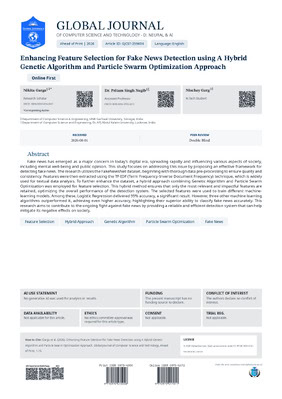
Fake news has emerged as a major concern in todayβs digital era, spreading rapidly and influencing various aspects of society, including mental well-being and public opinion. This study focuses on addressing this issue by proposing an effective framework for detecting fake news. The research utilizes the FakeNewsNet dataset, beginning with thorough data pre-processing to ensure quality and consistency. Features were then extracted using the TF-IDF (Term Frequency-Inverse Document Frequency) technique, which is widely used for textual data analysis. To further enhance the dataset, a hybrid approach combining Genetic Algorithm and Particle Swarm Optimization was employed for feature selection. This hybrid method ensures that only the most relevant and impactful features are retained, optimizing the overall performance of the detection system. The selected features were used to train different machine-learning models. Among these, Logistic Regression delivered 99% accuracy, a significant result. However, three other machine learning algorithms outperformed it, achieving even higher accuracy, highlighting their superior ability to classify fake news accurately. This research aims to contribute to the ongoing fight against fake news by providing a reliable and efficient detection system that can help mitigate its negative effects on society.
The present manuscript has no funding source to declare.
It does not involve direct interaction with human participants or animals. Therefore, it does
not require formal ethics approval or consent to participate.
The research utilizes a publicly available FakeNewsNet dataset sourced from Kaggle for the
task of fake news detection. The dataset contains various categories of news articles and can
be accessed at the following link: [https://www.kaggle.com/datasets/mdepak/fakenewsnet].
Since the dataset is publicly available on Kaggle, no additional repository is required.
However, if there are any restrictions or limitations regarding sharing the dataset.
Nikita Garg, Dr. Pritam Singh Negib, Nischay Garg. 2026. "Enhancing Feature Selection for Fake News Detection using A Hybrid Genetic Algorithm and Particle Swarm Optimization Approach". Global Journal of Computer Science and Technology, Global Journal of Computer Science and Technology - D: Neural & AI GJCST-D Volume 26 (N/A).
Crossref Journal DOI 10.17406/gjcst
Print ISSN 0975-4350
e-ISSN 0975-4172
v1.2
Explore published articles in an immersive Augmented Reality environment. Our platform converts research papers into interactive 3D books, allowing readers to view and interact with content using AR and VR compatible devices.
Your published article is automatically converted into a realistic 3D book. Flip through pages and read research papers in a more engaging and interactive format.
Total Score: 140
Country: Unknown
Subject: Global Journal of Computer Science and Technology
Authors: (PhD/Dr. count: 0)
View Count (all-time): 66
Total Views (Real + Logic): 18
Total Downloads (simulated): 0
Publish Date: 2026 08, Fri
Monthly Totals (Real + Logic):
We use cookies and similar technologies to improve site performance, understand traffic, and enhance your publishing experience. Cookie Policy
Choose which optional cookies Global Journals can use. Your preference applies across this platform and can be updated any time.
These cookies are required for core website functionality and security.

Lorem ipsum dolor sit amet, consectetur adipiscing elit. Ut elit tellus, luctus nec ullamcorper mattis, pulvinar dapibus leo.
