Identity for All, Service to None: A Survey of Post-Adoption Effects of Identification Policy in Nigerian Public Service

1
Gbeminiyi Kazeem Ogunbela
2
Kazeem Oyedele Lamidi
3
Bolanle Waliu Shiyanbade

Send Message

To: Author

GJHSS Volume 21 Issue H8

Article Fingerprint

ReserarchID

0INXN

Identity for All, Service to None: A Survey of Post-Adoption Effects of  Identification Policy in Nigerian Public Service Banner
  • English
  • Afrikaans
  • Albanian
  • Amharic
  • Arabic
  • Armenian
  • Azerbaijani
  • Basque
  • Belarusian
  • Bengali
  • Bosnian
  • Bulgarian
  • Catalan
  • Cebuano
  • Chichewa
  • Chinese (Simplified)
  • Chinese (Traditional)
  • Corsican
  • Croatian
  • Czech
  • Danish
  • Dutch
  • Esperanto
  • Estonian
  • Filipino
  • Finnish
  • French
  • Frisian
  • Galician
  • Georgian
  • German
  • Greek
  • Gujarati
  • Haitian Creole
  • Hausa
  • Hawaiian
  • Hebrew
  • Hindi
  • Hmong
  • Hungarian
  • Icelandic
  • Igbo
  • Indonesian
  • Irish
  • Italian
  • Japanese
  • Javanese
  • Kannada
  • Kazakh
  • Khmer
  • Korean
  • Kurdish (Kurmanji)
  • Kyrgyz
  • Lao
  • Latin
  • Latvian
  • Lithuanian
  • Luxembourgish
  • Macedonian
  • Malagasy
  • Malay
  • Malayalam
  • Maltese
  • Maori
  • Marathi
  • Mongolian
  • Myanmar (Burmese)
  • Nepali
  • Norwegian
  • Pashto
  • Persian
  • Polish
  • Portuguese
  • Punjabi
  • Romanian
  • Russian
  • Samoan
  • Scots Gaelic
  • Serbian
  • Sesotho
  • Shona
  • Sindhi
  • Sinhala
  • Slovak
  • Slovenian
  • Somali
  • Spanish
  • Sundanese
  • Swahili
  • Swedish
  • Tajik
  • Tamil
  • Telugu
  • Thai
  • Turkish
  • Ukrainian
  • Urdu
  • Uzbek
  • Vietnamese
  • Welsh
  • Xhosa
  • Yiddish
  • Yoruba
  • Zulu

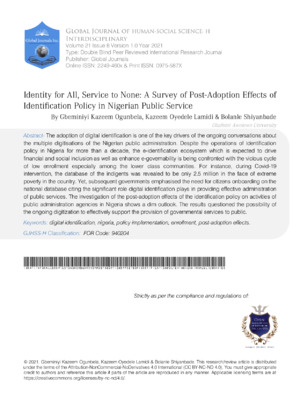
The adoption of digital identification is one of the key drivers of the ongoing conversations about the multiple digitisations of the Nigerian public administration. Despite the operations of identification policy in Nigeria for more than a decade, the e-identification ecosystem which is expected to drive financial and social inclusion as well as enhance e-governability is being confronted with the vicious cycle of low enrollment especially among the lower class communities. For instance, during Covid-19 intervention, the database of the indigents was revealed to be only 2.5 million in the face of extreme poverty in the country. Yet, subsequent governments emphasised the need for citizens onboarding on the national database citing the significant role digital identification plays in providing effective administration of public services. The investigation of the post-adoption effects of the identification policy on activities of public administration agencies in Nigeria shows a dim outlook. The results questioned the possibility of the ongoing digitization to effectively support the provision of governmental services to public.


Funding

No external funding was declared for this work.

Conflict of Interest

The authors declare no conflict of interest.

Ethical Approval

No ethics committee approval was required for this article type.

Data Availability

Not applicable for this article.

Gbeminiyi Kazeem Ogunbela. 2021. \u201cIdentity for All, Service to None: A Survey of Post-Adoption Effects of Identification Policy in Nigerian Public Service\u201d. Global Journal of Human-Social Science - H: Interdisciplinary GJHSS-H Volume 21 (GJHSS Volume 21 Issue H8): .

Download Citation

Detailed analysis of post-disability effects on identification in Nigerian public services.
Issue Cover
GJHSS Volume 21 Issue H8
Pg. 15- 25
Journal Specifications

Crossref Journal DOI 10.17406/GJHSS

Print ISSN 0975-587X

e-ISSN 2249-460X

Keywords
Classification
GJHSS-H Classification: FOR Code: 940204
Version of record

v1.2

Issue date

November 19, 2021

Language

English

Experiance in AR

The methods for personal identification and authentication are no exception.

Read in 3D

The methods for personal identification and authentication are no exception.

Article Matrices
Total Views: 1814
Total Downloads: 781
2026 Trends
Research Identity (RIN)
Related Research

Published Article

The adoption of digital identification is one of the key drivers of the ongoing conversations about the multiple digitisations of the Nigerian public administration. Despite the operations of identification policy in Nigeria for more than a decade, the e-identification ecosystem which is expected to drive financial and social inclusion as well as enhance e-governability is being confronted with the vicious cycle of low enrollment especially among the lower class communities. For instance, during Covid-19 intervention, the database of the indigents was revealed to be only 2.5 million in the face of extreme poverty in the country. Yet, subsequent governments emphasised the need for citizens onboarding on the national database citing the significant role digital identification plays in providing effective administration of public services. The investigation of the post-adoption effects of the identification policy on activities of public administration agencies in Nigeria shows a dim outlook. The results questioned the possibility of the ongoing digitization to effectively support the provision of governmental services to public.

Our website is actively being updated, and changes may occur frequently. Please clear your browser cache if needed. For feedback or error reporting, please email [email protected]
×

This Page is Under Development

We are currently updating this article page for a better experience.

Request Access

Please fill out the form below to request access to this research paper. Your request will be reviewed by the editorial or author team.
X

Quote and Order Details

Contact Person

Invoice Address

Notes or Comments

This is the heading

Lorem ipsum dolor sit amet, consectetur adipiscing elit. Ut elit tellus, luctus nec ullamcorper mattis, pulvinar dapibus leo.

High-quality academic research articles on global topics and journals.

Identity for All, Service to None: A Survey of Post-Adoption Effects of Identification Policy in Nigerian Public Service

Gbeminiyi Kazeem Ogunbela
Kazeem Oyedele Lamidi
Bolanle Waliu Shiyanbade

Research Journals