## I. INTRODUCTION
Homeschooling, also known as home education, has become an increasingly popular and controversial option for the education of children and adolescents in various countries. This practice, which involves education carried out within the family environment, presents itself as an alternative to formal education systems, raising complex and multifaceted questions regarding its applicability in the Brazilian educational context. In this regard, the booklet "Homeschooling: a Human Right of Both Parents and Children," published by Brazil's Ministry of Education (MEC) in May 2021 and updated in October 2022, addresses the exercise of the right to schooling in Brazil and presents examples of successful homeschooling cases in the United States.
The debate on schooling in Brazil gained momentum in a political context marked by the strengthening of conservative currents and interests aligned with neoliberalism, factors that contributed to a significant transformation in the country's political dynamics. This scenario favored the valorization of homeschooling, which until then had been relatively unexplored in Brazil. During President Jair Bolsonaro's administration, this educational modality came to be treated as one of the government's priorities. According to Silva (2021), the arguments used to defend homeschooling are based on specific readings of international treaties and documents signed by Brazil, with the Universal Declaration of Human Rights being one of the main instruments cited in this debate.
This article presents a literature review covering the historical, geographical, and social context of the origins of modern homeschooling up to its arrival in Brazil, along with an overview of the profiles of those who support this model. It then highlights a crucial point to be investigated, which constitutes the objective of this study: to understand the applicability in Brazil of the examples of American homeschooling presented in the Homeschooling Booklet. This study is theoretically grounded in the concepts of "cultural and national identity" (Hall, 1992), "sociodiscursive imaginaries" (Charaudeau, 2017), and "stereotypes" (Amossy, 2011). These notions will serve as the basis for the analysis of the booklet, through a qualitative methodological approach and a descriptive-interpretative focus on excerpts from the material in question. This analysis aims to contribute to a more informed and well-founded debate on homeschooling, providing support for reflection on the implications of this practice in social, cultural, and individual spheres.
## II. HOMESCHOOING: FROM ITS ORIGINS TO BRAZIL
Homeschooling, or home education, has a history that dates back centuries. Practices of educating children at home, where parents or guardians take responsibility for their children's learning, have been found in various cultures and historical periods. There are records of such practices in different societies throughout history, such as in Ancient Greece, for example, where some philosophers and aristocrats educated their children at home, providing them with personalized instruction. However, modern homeschooling, as we know it today, gained momentum in several countries—first in the United States—during the 20th century.
Many intellectuals and critics of traditional education made significant contributions to the evolution of the schooling movement in the 1960s and 1970s. Some of these figures include Paul Goodman, Allen Graubard, Herbert Kohl, Everette Reimer, and Jonathon Kozol. These authors offered radical critiques of the educational system and suggested reforms to the prevailing models of education at the time. During the 1970s and 1980s, there was a notable rise in families choosing schooling as an alternative to the formal educational system. Furthermore, according to Kaya (2015), schooling was also embraced as a movement with Christian roots and, in the early 1980s, became a space for ideological, conservative, and religious expressions regarding educational issues, symbolizing conservatism's quest for self-determination.
John Holt, however, was one of the pioneers of the schooling movement in the U.S. He stood out among those who criticized the educational system and schools as institutions. Holt published several books, including How Children Fail (1964), How Children Learn (1967), and The Underachieving School (1969), which drew attention to the failures of the educational system and emphasized the importance of learning through experience. Holt believed that institutional education was destroying the most significant aspects of children's development, such as creativity and curiosity. Thus, his studies provided intellectual support for families practicing schooling.
According to a report released by the U.S. Department of Education, Office of Educational Research and Improvement (OEM) and the Educational Resources Information Center (ERIC) in 1958, there are two main types of families who choose homeschooling: ideologues and pedagogues. The ideologues are generally religious conservatives who want their children to learn fundamentalist religious doctrines and a conservative political and social perspective. They establish home schools to instill in their children the idea that the family is the most important institution in society. Pedagogues, on the other hand, have a broader interest in learning and may have professional backgrounds in education, have friends or relatives who are educators, have read about education or child development, or be involved in organizations dealing with parenting issues. Both types of families share the common trait of having great confidence in their ability to educate their children with minimal institutional support. These homeschooling parents come from a variety of professions, including accountants, engineers, teachers, doctors, lawyers, and small business owners.
In the U.S., homeshociling is also frequently associated with the ideal of individualism and freedom of choice. It is seen as a way for parents to have more control over their children's education, teaching specific values and religious beliefs, and protecting them from negative influences in public schools (Gaither, 2018).
The image of the self-sufficient American family exercising personal freedom and autonomy plays a central role in justifying homeschooling. Furthermore, the American ideal of innovation and entrepreneurship shapes perceptions of homeschooling. Homeschoolers are seen as self-motivated learners, benefiting from personalized education and achieving academic success (Noe, 2018). This perception aligns with the broader American narrative of self-made success, where individual effort and adaptability are highly valued. In this context, the emphasis on individual rights and freedoms, reflected in the First Amendment of the Constitution, fostered a favorable climate for homeschooling. Additionally, the flexibility of the American educational system and its recognition of diverse learning approaches, such as the Montessori or Waldorf methods, also contributed to the acceptance of homeschooling as a legitimate educational choice (Fogarty, 2019).
By contrast, in Brazil, home education has not received the same level of acceptance or recognition. Strongly influenced by the American model, homeschooling eventually reached Brazil, initially as an alternative for families seeking a more personalized approach to education, tailored to the specific needs and values of their children. In the beginning, the movement was mainly composed of families with religious, philosophical, or ideological motivations, who chose to educate their children at home, outside the formal school environment, largely driven by dissatisfaction with the quality of the formal educational system.
However, homeschooling in Brazil faces legal and regulatory challenges. For many years, there was no specific regulation for home education, leading to legal controversies and court disputes. With the election of Jair Messias Bolsonaro—a strong supporter of the movement, who even made the implementation of homeschooling laws one of his campaign promises—the issue of home education gained prominence in Brazil. Yet it was only months before the next electoral period, in May 2022, that the process of legalizing Bill PL 3261/2015 began, when Brazil's Supreme Federal Court (STF) unanimously ruled that homeschooling is not prohibited by the Brazilian Constitution, provided it meets criteria established by educational authorities. This decision represented a landmark moment for the homeschooling movement in the country, bringing more clarity and foundation to the discussions.
In Brazil, schooling is often viewed through the lens of family and religious preservation. Traditional values, cultural heritage, and close family ties are central to Brazilian understandings of schooling. Parents frequently choose home education to address the perceived moral decline in public schools, ensuring their children receive an education aligned with their cultural and religious beliefs
(Bastos et al., 2020). Additionally, the Brazilian imaginary of protection and social inequality shapes perceptions of homeschooling. In a country marked by educational inequalities and violence, home education is seen as a way to protect children from unsafe environments and provide individualized attention (Sorrentino & Silva, 2019). The image of the caring, protective father emerges as the primary educator, shielding his children from harm and social disparities.
## III. NATIONAL IDENTITY, SOCIAL IMAGINARIES AND STEREOTYPES
The search for understanding the different identity profiles of schooling supporters and adherents, both in Brazil and the United States, can be based on important notions formulated by Hall (1992), Charaudeau (2017), and Amossy (2011), namely national identity, social imaginaries, and stereotypes, respectively.
According to Hall's formulation (1992), the notion of identity is undergoing a process of crisis, so that an individual's identity cannot be conceived as fixed or stable—it is, instead, dynamic and constantly in a state of flux, displacement, and decentering. Didactically, Hall distinguishes three different conceptions of identity: (1) the Enlightenment subject, based on "the conception of a fully centered, unified individual, endowed with the capacities of reason, consciousness, and action" (Hall, 1992, p. 10), configuring an individualistic notion of identity. (2) The sociological subject, by contrast, reflects the complexity of the modern world in which the core of the subject is no longer autonomous or self-sufficient but is formed in the interaction between self and society, in a "continuous dialogue with the external cultural worlds and the identities which they offer" (p. 11). (3) The postmodern subject, meanwhile, intensifies this process of fragmentation of the subject and their identity. In the postmodern era, traditional categories and markers of identity, such as class, gender, or race, have become insufficient to define who we are. Hall argues that these categories have lost their power and relevance, as they fail to capture the diverse and multifaceted nature of contemporary existence. Moreover, he asserts that identity is continuously formed and transformed in relation to the ways we are represented or addressed within the cultural systems that surround us, and that:
It is historically, not biologically, defined. The subject assumes different identities at different times, identities which are not unified around a coherent 'self'. Within us are contradictory identities, pulling in different directions, so that our identifications are continuously being shifted about. (HALL, 1992, p. 277) In this sense, Hall states that identity is seen as part of a broader process of change that is displacing the central structures and processes of modern
societies and shaking the frameworks that once gave individuals a stable anchorage in the social world. He also points out that identity can be influenced by social, cultural, and historical factors, as well as by changes in the structures and processes of modern societies—in other words, it is a construction in constant transformation, composed of multiple, sometimes contradictory or unresolved, identities.
In this context, Hall advances his discussion on the relationship between notions of national and cultural identity in late modernity. Thus, national identity seeks to unify members of a national culture into a common cultural identity, but it is insufficient to capture the complexity and diversity of individual and collective identities. Hall (1992) also emphasizes that national cultures are composed not only of cultural institutions but also of symbols and representations, configuring discourse as a way of constructing meanings that influence and organize both our actions and our conception of ourselves. It is ultimately a structure of cultural power, which often suppresses cultural difference in favor of unification, so that the nation consists of an imagined community.
From this perspective, Hall's conception of cultural and national identity can be articulated with the concept of social imaginaries proposed by Charaudeau (2017), which refers to collective constructions that a society or group shares, shaping how they interpret the world, social events, and human behaviors. These imaginaries are formed from the interactions among various discourses present in a given social context, organizing themselves into systems of thought that give meaning, sustain values, and legitimize practices—that is, they are collective representations that reflect values shared by individuals, values through which they recognize themselves and build their memory of identity. These representations take the form of collective imaginaries that are constructed both through the actions individuals perform and through the judgments about the merit of these actions, their own and those of others. According to Charaudeau, social imaginaries are present in all spheres of social life, from political and media discourses to everyday interactions between individuals, shaping our values, beliefs, and behaviors.
The notion of the imaginary, as proposed by Charaudeau, traces back to Castoriadis (1982). Castoriadis viewed society through the lens of imaginaries constituted by symbolic operations. Thus, he insisted that it is the imaginary that weaves the world, and the subject comes into being only through the imaginary. For this philosopher, the imaginary is not an image of something; it does not mirror anything as if there were a model of reality serving as a starting point for the imaginary. On the contrary, critiquing the prevailing formulations of his time, he suggested that the imaginary is an "incessant creation." As Castoriadis (1982) writes:
"The imaginary is not from the image in the mirror or in the gaze of the other. The very 'mirror,' its possibility, and the other as mirror are first works of the imaginary, which is creation ex nihilo. Those who speak of 'imaginary' understanding by it the 'spectacular,' the reflection, or the 'fictitious,' merely repeat—and very often unknowingly—the assertion that forever trapped them in some underworld of the famous cave: that it is necessary for (this world) to be the image of something. The imaginary of which I speak is not an image of. It is the incessant and essentially undetermined (social-historical and psychic) creation of figures/forms/images, from which alone it is possible to speak of 'something.' What we call 'reality' and 'rationality' are its products."(Castoriadis, 1982, p. 13, author's translation) From the perspective that society functions constitutively in relation to imaginaries and symbols (which are decisively influenced by them), Castoriadis reflects on their workings. Taking religion as an example, he asserts it to be a central imaginary which, as an institution, is surrounded by sanctions (Castoriadis, 1982). These sanctions, in turn, shape societies in broad ways. In other words, the imaginary is the entry point for studying society. Thus, "the institution of society is each time the institution of a magma of social imaginary significations, which we can and must call a world of meanings" (Castoriadis, 1982, p. 404, author's translation), a world structured across various fields, such as religion, politics, law, education, and so on. As we see, every imaginary signification gives meaning to society and weaves its functioning in some way.
This notion by Castoriadis offers a conceptual substratum that dialogues with Charaudeau's (2015, 2017) notion of sociodiscursive imaginaries. Thus, if for Castoriadis (1982) society functions through imaginary significations, for Charaudeau (2017), these significations are anchored in language practices that activate discourse(s), thereby generating the sociodiscursive imaginaries. For Charaudeau, all interpretations relating to life in society are organized through language, so that this organization of meanings, which happens discursively, gives rise to "knowledges of cognition" and "knowledges of belief," which are ordered and articulated through the sociodiscursive imaginaries. Charaudeau argues that imaginaries can be conceived from a personal level to a collective/ community dimension. Thus, there are representations that highlight collective imaginaries manifesting values shared by individuals living in society, values in which they recognize themselves and that form their memory of identity. According to the author:
"There are countless collective imaginaries, and their study occupies a vast domain that should be at the center of the human and social sciences in the coming decades. (...) We will refer to only a few of them, without essentializing them, identifying what we will call 'identity traits.' We will distinguish three types of imaginaries: 1) anthropological imaginaries; 2) imaginaries of belief; 3) socio- institutionalimaginaries."(Charaudeau, 2015, p. 21, author's translation)
From this perspective, anthropological imaginaries arise from the behaviors of individuals living in groups whose motives are generally unconscious but erected discursively as social norms. Among these imaginaries are those related to space, time, the body, and social relations. The imaginaries of belief are shaped by discourses of inculcation, including those related to lineage/history and religious beliefs. The socio-institutional imaginaries concern a mix of practices and representations related to the organization of institutional identities, such as those tied to socioeconomic organization and the educational system. Clearly, these three types of imaginaries articulate integrally and organically within societies.
Thus, Charaudeau's (2017) sociodiscursive imaginaries are one of the main sources for constructing the national identity discussed by Hall (1992). The discourses that permeate society, whether in institutions or in the media context, are responsible for creating and reinforcing the social imaginaries that nurture and sustain national identities. In this way, social imaginaries are a key element in the formation and maintenance of identity representations and narratives related to nationality.
In this context, it is appropriate to integrate into this reflection on the articulations between the notions of (national) identity and (sociodiscursive) imaginaries a third concept that seems to catalyze crystallized forms symptomatic of these articulations, namely the concept of stereotype presented by Amossy (2011). According to Amossy, the stereotype is understood as a stable collective system of representations of the other and of oneself that members of a group imaginatively create, which are manifested in certain linguistic and discursive patterns. Although modern conceptions attribute a pejorative value to the term due to excessive simplification that can lead to prejudice and discrimination, stereotyping, as shared collective representations, is fundamental to social communication and intersubjective exchange, forming the basis of most argumentative practices. Stereotypical images are "co-constructed" in verbal communication and require interpretative work to find the verbal and/or semiotic elements linked to a theme in a specific culture, often being indirect, implicit, or fragmented.
In short, the reflections of Stuart Hall (1992) on national identity, Charaudeau's (2017) formulations on sociodiscursive imaginaries, and Amossy's (2011) conception of stereotypes provide a theoretical and analytical basis for understanding and analyzing identity dynamics in contemporary society. These concepts support analyses of traditional notions of national identity, opening space for the discussion of multiple, fluid, and hybrid identities. Discursive interactions, based on social imaginaries, are marked by the presence of stereotypes, which are crucial for the construction and maintenance of identity narratives related to nationality. In this way, by assuming the identity representations related to the sociodiscursive imaginaries and the stereotypes constructed about the educational system, we can develop an analysis of the object of this article, based on excerpts from the Homeschooling Booklet: A Human Right of Both Parents and Children, published by Brazil's Ministry of Education (MEC), regarding schooling in the United States and Brazil.
## IV. ANALYSIS AND DISCUSSION OF EXCERPTS HOMESCHOOLING BOOKLET
As Pizzani et al. (2013) point out, the cartilha (booklet) genre is understood as an educational material that contains basic and essential information about a given subject, generally presented in a simple and didactic way. A booklet, therefore, can be used to teach fundamental concepts, norms of conduct, safety practices, among other topics relevant to a specific target audience. Additionally, it may include texts, illustrations, graphics, and other visual resources that aid in the understanding and assimilation of the content presented. They are usually prepared with the purpose of instructing and guiding the reader in a clear and accessible manner and are thus characterized by simple, clear, objective, and accessible language, designed to facilitate the comprehension and application of the information conveyed. Thus, the Homeschooling Booklet: A Human Right of Both Parents and Children is a text that exhibits the elements of this genre and, although it may appear to be merely an informative document of an instructional nature, it develops argumentative strategies that mobilize identities, imaginaries, and stereotypes about the field of education.
Published in May 2021 and updated in October 2022 by Brazil's Ministry of Education (MEC), the Homeschooling Booklet: A Human Right of Both Parents and Children is a 20-page document that defines schooling as a form of education carried out by parents themselves, aimed at the integral development of the person, preparation for life, citizenship, and qualification for work. It presents real cases of students in other countries, especially the United States, who adopt homeschooling, and mentions that around 35,000 children and adolescents in Brazil already study under this model, emphasizing the importance of regulation. The booklet also highlights that homeschooling is recognized as a right of families in $85\%$ of OECD member countries and is already legally guaranteed in over 60 countries around the world, as reported in the document itself.
The cover of the booklet contains the title "EduçãoDomiciliar" ("Homeschooling") positioned in the upper corner, standing out in blue, next to an illustration of three people—presumably a traditional family composed of a father, mother, and child, given the context—behind a book whose pages bear the colors of the Brazilian flag (yellow, blue, and green) and below an arch that resembles the shape of a house roof. The subtitle "Um direito tanto dos paisquanto dos filhos" ("A right of both parents and children") appears within a central blue band, with the MEC logo and the slogan of the Federal Government under President Jair Bolsonaro in the bottom corner, as can be seen in Figure 1:

## EDUCACIONDOMICILIAR
## UM DIREITO HUMANOTANTO DOS PAISQUANTO DOS FILHOS
MINISTÉRIO DA EDUÇÂO A
 Figure 1: Cover of the booklet
PÁTRIA AMADA BRASIL GOVERN O FEDERAL
Source: MEC Portal
This cover as a whole contains elements that are already extremely important for understanding what will be addressed throughout the entire document. The subtitle, for example, highlights the term "Human Right" as a persuasive strategy characteristic of a common stereotype found in political texts, since it appears as an argument of authority that instantiates, in an intertextual and interdiscursive way, a voice that proclaims a supposedly universal truth. In reality, however, it is a response to the arguments of groups opposed to homeshociling, who claim that attempts by guardians to reject school enrollment to the point of intentionally not enrolling their child are unconstitutional. This argumentative strategy, marked by the generic and stereotypical use of the expression "human right," can only be fully understood when we consider the communicative and even normative situation in which this term is inserted and how it is employed in other discursive fields with similar agendas, such as the legal, legislative, and academic spheres.
In this sense, the academic debate within the Brazilian educational field has reacted to initiatives aimed at legalizing Homeschooling (HS), encompassing areas such as educational policy, legislation, law, administration, and the history of education. The volume of scholarship has grown significantly, increasingly involving the legal and legislative arenas in line with Brazil's judicial demands, reflected in decisions by the Federal Supreme Court (STF) and the National Congress. Cury (2019) traces a brief history of whether families could compulsorily enroll their children in school or not. According to his analysis of legislation from the Empire to the 19th century, homeschooling was a common and legal practice, a permission reiterated by the federal Constitutions of 1934 and 1946. The 1961 Law of Guidelines and Bases of National Education (LDB) also mentioned the possibility of home education. What was not permitted, under the Penal Code (1940 and still in force), was "intellectual abandonment," meaning that education could not simply be neglected.
Even the 1988 Federal Constitution does not explicitly prohibit HS, although it advances in the sense of indicating the State's duty to ensure, alongside parents, regular school attendance. It is infraconstitutional legislation that renders this type of education illegal, through the Child and Adolescent Statute (ECA) of 1990 and the LDB of 1994. According to the ECA, it is the obligation of parents or guardians to enroll their children in school, which is reiterated by the LDB, whose Article 6 establishes the duty of families to enroll children from the age of four in basic education. In the early 2000s, the National Education Council (CNE) ruled (BRASIL, 2000), prompted by a family wishing to homeschool their children, stating that there was no provision in the current legislation that allowed families to disregard mandatory enrollment. The same stance was taken by the Superior Court of Justice (STJ), which denied this family's request to practice HS.
In 2018, the plenary of the Federal Supreme Court (STF), in a decision of general repercussion, denied another family the possibility of homeschooling due to the lack of constitutional provision (BRASIL, 2018). However, the Court left open the possibility that a bill could regulate HS. The tension between the right and duty or obligation of schooling versus the freedom of choice by families is explored by Cury (2006, 2017, 2019), who draws on Bobbio to point out that there are egalitarian reforms that he calls "non-liberating," in the sense that they limit individual freedoms—such as mandatory schooling, which places rich and poor on the same footing (CURY, 2006). For this author, school education is one of the pillars of equal opportunity in terms of distributing basic knowledge and instilling values that enable participation in social life by all people. These values create a space for coexistence in which people with their differences can meet, recognize, and respect one another, learn the norms of social interaction to exercise freedom within equality and difference, fostering a broader socialization than that carried out by the family (CURY, 2019).
Authors who agree with him also argue that educational and consequently social inequalities would deepen with the regulation of HS in Brazil. For Casanova and Ferreira (2020), the contempt and hostility with which the elite treats school aims to naturalize inequality. Ventura (2020) argues that this could produce a generation that is selfish and insensitive to social problems, widening the social divide. In line with these critics of HS, Barbosa (2016), Oliveira and Barbosa (2017), Ventura (2020), Ribeiro (2020), and Casanova and Ferreira (2020) concur on the individualistic bias of HS, which undermines collective causes such as the defense of public education, favoring each one's private solution.
Nos Estados Unidos, 2,5 milhões de estudantes do ensino fundamental e médio estudam em regime de Educação Domiciliar. Entre esses, está Lindsay, Benjamin e Alex.
Benjamin lendo para o irmao mais novo, Alex.
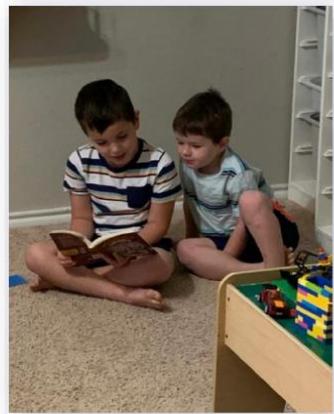

Ao lado, uma aula de historia ao ar livre.
Daniel, o pai das trés crianças, nasceu no Brasil, también estudou em
Educaço Domiciliar e atualmente é major da Forca Aérea Norte-Americana.

 Figure 2: Page 4 of the booklet
At this point, we can highlight an aspect of the sociodiscursive imaginary that constitutes the Brazilian identity related to education, as reflected in the conception of the scholars cited above. Thus, education is conceived as a duty of the State and linked to processes of democratic socialization, aiming to emancipate individuals and mitigate socioeconomic inequalities. This imaginary of the democratization of education has historically become dominant, although it coexists, in practical reality, with the choice by a large portion of the middle class and economic elite to place their children in private education. It is, in fact, common to see many families declare support for public education while enrolling their children in private schools, sometimes even abroad.
These contradictions between the beliefs and values of society are a source of controversy between supporters of schooling (HS) and those who oppose it, often revealing stereotypes that are part of identity imaginaries not only about education, but also about beliefs related to success, well-being, and quality of life. The imaginary of a large segment of the Brazilian population is populated by the belief that being successful in life is closely linked to the American way of life, fueling even the dream of living in the United States. The view of this latter country as the land of opportunity and individual entrepreneurship—stereotypes typically associated with liberalism, despite their distortions—is reflected in the implicit comparison found in the Homeschooling Guide produced by the Brazilian Ministry of Education (MEC).
It is worth noting that the Brazilian government at the time, under President Jair Bolsonaro, was entirely aligned with North American ideals, publicly demonstrating submission to the United States on various occasions, such as when Bolsonaro saluted the American flag. Returning to the Guide, as mentioned, a strategy of persuasion was employed through comparison between schooling in the United States and in Brazil, seeking to establish a picture of the benefits of this educational model and the practices adopted by the U.S. in order to argue for its validity in the Brazilian context.
On page four of the Guide (Figure 2), for instance, photos are displayed of three American children educated at home, whose father, Daniel, is a Brazilian who was also homeschooled and who currently holds the rank of major in the United States Air Force. At this point, one notices a strategy of persuasion directed especially at Brazilian conservative groups who carry with them the sociodiscursive imaginary (Charaudeau, 2017) rooted primarily in the tradition of the patriarchal family, in which the father appears as the stereotype of the family nucleus. Additionally, this relies on the stereotyped imaginary that military professions enjoy great prestige and therefore serve as models to be emulated. In this sense, the father is depicted as a successful Brazilian in the United States, whose children are being educated under the American homeschooling model (like 2.5 million primary and secondary students), representing the ideal stereotype of the happy family, as evidenced by the photos and accompanying comments.
This social imaginary is also tied to historical markers in which military activities were highlighted—such as during the Brazilian Military Dictatorship, defended by the Bolsonaro government—as well as to foreign policy and security relations linked to North American ideals.
Further on, on page 16 of the Guide, three Brazilian students connected to schooling are showcased, with the greatest emphasis—through the more prominent layout on the page—given to Juliana Louback, a young woman who, after receiving her high school diploma (earned through schooling), completed her undergraduate studies, earned a master's degree, and interned in the United States. After finishing her studies, she worked in Brazil as a software engineer at a renowned company for two years; subsequently, she worked at another prestigious firm in Paris and is currently a software engineer at a New York company.

Victor Hugo Duque
"A Engaocao Domiciliar foi um portal para o meu desenvolvimento pessoal e professional. Eaocao Domiciliar é muito mais do que umsystema de ensino:para mim, é um mode de vida."
 Panel label: Amanda Pina.
"Descobri que\
conhecimiento nenhum\
se restringe a opener\
um professor em uma\
sala de aula. Existem\
tantas outras fontes,\
igualmente ou\
superiormente ricas,\
basta buscar."



 Figure 3: Page 16 of the booklet Panel label: Juliana Louback.
Estudou em casa até ingressar na universidade. Fez as provas do Enem e obteve seu certificado de conclusão do ensino médio. Cursou Sistemas de Informação na Unirio, estagiou nos EUA na IBM e fez Mestrado em Ciência da Computação, na Columbia University, com bolsa Capes. Em seu returno ao Brasil, travaíhou por 2 anos como Engenheira de Software na Microsoft. Em seguida, travaíhou no Google, em Paris. Atualmente é Senior Software Engineer, na Gemini Trust Company, LLC. Tradutora do livre "Head First C" de Dawn Griffiths para o portugues,(publicado pela Alta Books Editora.
16
Source: MEC Portal
Once again, there is a reinforcement of the image of the United States as a symbol of personal and professional success and of economic and technological development, aimed at convincing readers of the effectiveness of homeschooling in Brazil. In fact, before prominently introducing Juliana Louback, the guide includes a comment by Vitor Hugo Duque, who states that "family education is more than an education system, it is a way of life," with this last expression clearly being a stereotype that echoes the well-known American slogan "way of life." Just below on the same page, Amanda Pina affirms that "no knowledge is restricted to just one teacher in a classroom," a reductionist view of any educational system, whether public or private, which reaffirms the stereotyped character of the argumentation present in this Guide. Finally, Juliana Louback is presented as someone who "studied at home until entering university," which would attest to the validity and effectiveness of homeschooling. Beyond this, the young woman is associated with a successful career, having completed a master's degree at "Columbia University," worked at Google in Paris, and now holding the position of "Senior Software Engineer at Gemini Trust Company," reaffirming the imaginary of professional success in the technology sector, whose main reference is the United States. This argument reinforces the stereotype representing American society as a symbol of economic, scientific, and technological success, and the American as a born winner—someone who has achieved success in all areas of life. This stereotype, in turn, leads to a social imaginary that, to be successful, it is necessary to adopt the American way of life, which can push Brazilians toward an idealization of a lifestyle far removed from reality and disconnected from their own nation's collective identity.
These persuasive strategies, although appealing at first glance, do not reflect Brazilian reality. In the Brazilian case, national identity has its own characteristics, shaped by a unique history and culture. Disregarding these particularities by making comparisons with the United States can be misleading, as it implies neglecting the Brazilian socio-cultural context and its influence on education. According to Charaudeau's (2017) notion of social imaginaries, it can be said that Brazil has its own social imaginary regarding schooling, where schooling is seen as a collective effort that helps shape a sense of national identity and equality among citizens. Departing from this pattern by opting for schooling is often perceived as a way to avoid social values and hinder social integration. Charaudeau (2017) argues that schooling is often seen as a threat to this ideal of equality, as it can perpetuate social disparities and exclude children from lower socioeconomic backgrounds.
Thus, the differences in social imaginaries surrounding schooling in the United States and Brazil are rooted in historical, cultural, and legal aspects. The social imaginaries about schooling in the two countries illustrate the complex interplay between individual freedom and social values. In the U.S. context, schooling represents freedom of choice and the potential for a personalized educational experience. In Brazil, the focus is on equal access to education and the promotion of social integration. These different social imaginaries shape how schooling is perceived and should be regulated in each country, and therefore it is not feasible to make a direct comparison between them.
## V. FINAL CONSIDERATIONS
This article discussed the relationship between schooling and the proposed "Home Education" in Brazil, based on Hall's (1992) notions of national identity, Charaudeau's (2017) concept of social imaginaries, and Amossy's (2011) understanding of stereotypes. The analysis was carried out using the Homeschooling Guide: A Human Right of both parents and children, published by the Brazilian Ministry of Education (MEC), which seeks to persuade readers of the benefits of schooling in Brazil by comparing it to the context of the United States.
The paper highlighted the argumentative strategies of persuasion used in the Guide, such as presenting success stories of Brazilian homescooling students in the U.S. However, it emphasized the importance of considering the different social and cultural imaginaries of each country when discussing the regulation of homescooling in Brazil, respecting diversity and seeking inclusive and equitable solutions for education, since the historical, social, and educational realities of each country are unique and therefore require specific resources and regulations. Thus, it concludes that it is not possible to use U.S. homescooling practices and outcomes as a benchmark for defining what these practices and outcomes will be in Brazil, but rather to seek a deeper understanding of the real aspects surrounding the regulation of educational models in the country, in order to build educational policies that meet the needs and aspirations of Brazilian society as a whole.
[^1]: Available on: _(p.6)_
Generating HTML Viewer...
Funding
No external funding was declared for this work.
Conflict of Interest
The authors declare no conflict of interest.
Ethical Approval
No ethics committee approval was required for this article type.
Data Availability
Not applicable for this article.
Dr. Paulo Henrique Aguiar Mendes. 2026. \u201cIdentity, Imaginaries and Stereotypes in the Homeschooling Booklet A Right Both of Parents and Children\u201d. Global Journal of Human-Social Science - G: Linguistics & Education GJHSS-G Volume 25 (GJHSS Volume 25 Issue G5): .
Our website is actively being updated, and changes may occur frequently. Please clear your browser cache if needed. For feedback or error reporting, please email [email protected]
×
This Page is Under Development
We are currently updating this article page for a better experience.
Thank you for connecting with us. We will respond to you shortly.