## I. INTRODUCTION
The ideology of the development of metal production to meet the needs of civilization in the 21st century, framed within the new scientific concept of "creative development of the subsoil," must function optimally, simultaneously addressing scientific and productive tasks in three key directions. It must fully eliminate or at least continuously mitigate the inherent contradictions among them, which are historically conditioned by the level of technological advancement.
These Directions Involve:
- Increasing the volume and range of marketable products derived from the subsoil in each time period, to meet the demands of individual nations and the planet as a whole;
- Mandatory preservation of environmental classifiers related to the natural environment;
- Ensuring the long-term availability of a raw material base for metals and other georesources to meet societal needs over historical time scales.
These global and imperative tasks for the world community can be addressed through the united and collaborative efforts of:
- Science, understood as a realm of research activity that supplies production with new knowledge about nature through fundamental and applied studies, conducted by scientists within an integrated system designed to preemptively define everything necessary today by foreseeing and forecasting phenomena of nature that are unobservable or have not yet been empirically established, thereby forming a comprehensive body of knowledge;
- Governmental bodies and international organizations, starting with the UN, which in their national policies and intergovernmental cooperation must consider the issues of social development and economic growth as essential components for solving the collective challenges of humanity. This should be based on trust and mutual understanding, recognizing the absolute interdependence of the economic concerns and problems of individual countries on one another and on the state of the natural environment;
- The system of scientific information dissemination including through periodicals and the organized presentation of scientific production results at conferences, symposia, seminars, exhibitions, and at natural sites such as geological exploration areas, functioning and under-construction mines, processing plants, and metallurgical facilities.
The following facts are widely acknowledged [1]:
1. Natural resources, particularly metals, have been and remain the foundation of global economic development;
2. The portion of the continental Earth's crust which constitutes $25 - 30\%$ of the total area and serves as the most economically viable and safe source of metal production up to the depth of $5\mathrm{km}$, within the range of anthropogenic and technological capabilities will exhaust its potential within 30 to 150 years, depending on the type of metal;
3. In mining practice, ore deposits are depleted 5,000 to 10,000 times faster than they can be regenerated
in the subsoil by current geochemical ore-forming processes;
4. Metals are irretrievably lost during extraction and processing; the natural ecosystem of the subsoil mass and the surrounding biosphere is destroyed, evolving under human influence into a noosphere with increasingly adverse conditions for the existence of civilization;
5. The demand for metals is continuously growing in geometric progression relative to population growth (see Fig. 1).
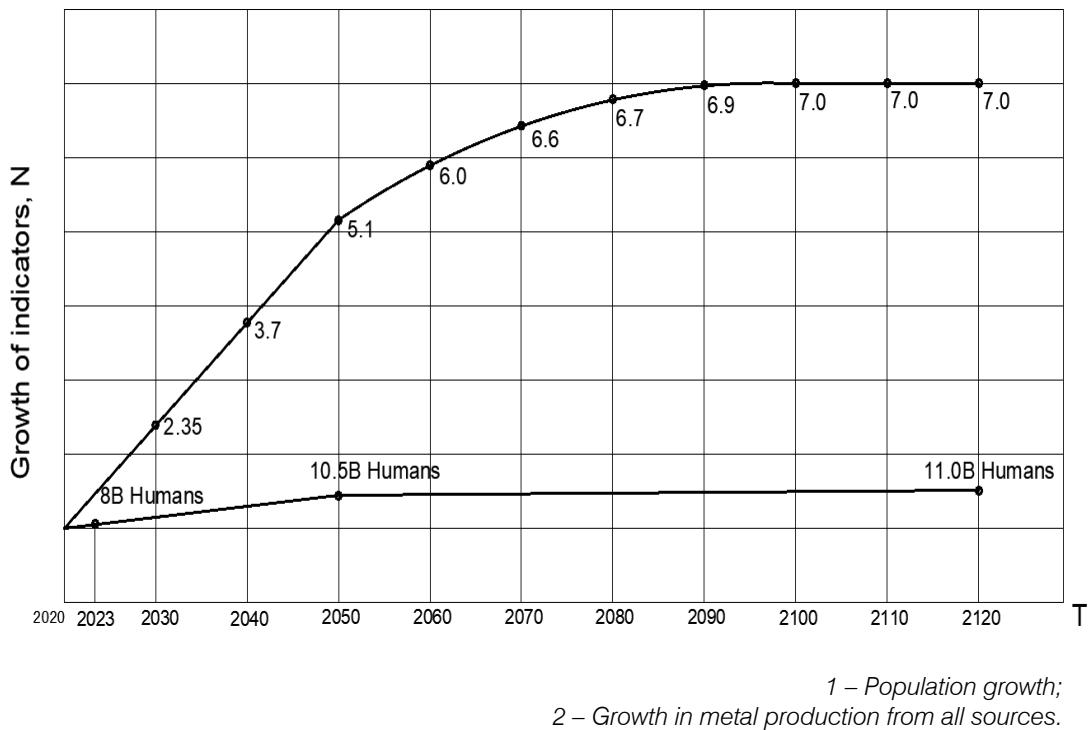
Fig. 1: Dynamics of Global Population Growth and Metal Production In this context, the term "creative development of the subsoil," proposed for use in fundamental and applied research as well as in industrial practice, carries a semantic load aligned with the essential conditions for forming nature-technogenic systems aimed at establishing the material foundations for human society.
Creative development of the subsoil is defined as the synthesis of systems of knowledge and their joint development for the harmonized implementation of technologies in both natural and artificially created technogenic environments. These technologies operate under the principles of resource reproduction, resource conservation, and the preservation of a high-quality natural environment.
Resource reproduction refers to the creation of new georesources during subsoil development and through deliberate human activity, whereby an already-utilized georesource in the form of a finished product is returned to the state of a new georesource representing a recyclable, theoretically infinite cycle within a circular economy framework.
Resource conservation is the outcome of reducing, and ideally eliminating, losses during extraction and achieving full recovery in the process of mineralurgy. It also involves eliminating ore dilution and implementing additional recovery procedures to extract marketable products from previously accumulated production waste (e.g., waste rock, tailings, cakes, slags, sludges, clinkers, etc).
Preservation of a high-quality natural environment comprises the array of positive outcomes resulting from the interaction of technogenic processes with the geological environment. The preservation of the natural characteristics of the subsoil mass even amidst its structural disturbance must be prevented or mitigated through engineering measures planned in advance.
These measures must also aim at conserving biodiversity (flora and fauna), the atmosphere, water flows, terrain morphology, and fertile soil.
The implementation of scientific and production tasks related to the development of metal production in the 21st century, as defined by the three outlined directions within the emerging knowledge system, must be based on interdisciplinary collaboration established through the planning and design of subsoil development strategies. The associated project topics presetting the principles for holistic solutions aligned with the ideology of development should focus on specific categories of tasks, which include heuristic, research, technical, and techno-economic problems [2]. Among these, heuristic tasks are the most complex, as they pertain to areas not yet explored or previously dismissed as unworthy of focused attention.
Heuristic tasks, centrally placed within the ideology of developing the material basis of civilization, serve to identify sources of metal accumulation. These are categorized into reserves in the subsoil referring to the geological environment where ore formation occurs naturally under geochemical laws and geological processes without human (technogenic) intervention and technogenic reserves. The latter are generated by human activity and exist in the subsoil as remnants due to design-related losses, on the surface in the form of sub-economic dumps, in production waste (e.g., enrichment tailings, cakes, sludges, slags, clinkers), and in previously manufactured metal that is circulating through use in machines, equipment, stationary and movable installations, or irrevocably fixed in infrastructure such as reinforcement steel, columns, pipelines, etc.
The system of production technologies can be classified as follows:
1. Physical and technical geotechnologies (PTGT);
2. Physical and chemical geotechnologies (PCGT);
3. Combined geotechnologies that integrate both PTGT and PCGT, as well as open-pit and underground mining methods;
4. Circular economy technologies for the repeated (theoretically infinite) return of previously produced metal into new production cycles via controlled cyclic processes.
The first three technology systems may potentially include, depending on their economic efficiency and combined labor and environmental safety, metal extraction not only from ores of traditional deposits. They also open up the possibility for producing metals from sub-economic reserves, host rocks, primary and secondary geochemical halos, and barriers. The feasibility and application criteria of these possibilities have been considered and resolved in scientific discoveries for which confirmation diplomas have been obtained [3, 4].
### a) Analysis of the State and Potential for Subsoil Development Using Physical and Technical Geotechnologies (PTGT)
Given the real-world conditions, nature-technogenic systems applying PTGT must be capable of operating across any geological environment that constitutes a mineral deposit, delivering consistently high technical and economic performance (TEP). These indicators are defined by the elimination of resource losses and minimization of ore dilution. Therefore, the first priority is to develop viable variants of mining systems and methods for advancing stopping operations and managing the extraction space.
The broad application of new technogenic systems capable of continuously fulfilling these tasks should be evaluated with respect to two geometric characteristics of ore deposit morphology: isometric ore bodies of substantial thickness and "two-dimensional ore bodies with small thickness and steep dip" [5,6,7]. Such an approach to solving the defined nature-technogenic challenge significantly reduces the scope of required scientific and practical studies, allowing for the variation of the design parameters of the developed mining systems across a wide range of mining and geological conditions, mining-technical factors, and technological requirements that need to be accounted for in a cost-effective manner.
Under the current circumstances, the development and transition to innovative technologies that ensure the implementation of the principle of "creative development of the subsoil" requires time for scientific exploration and practical trials within production settings. In light of this objective necessity, the technological transformation must proceed in two parallel directions:
1. Improvement of existing mining system designs for the two morphological types of ore formation identified above, which together encompass all ore accumulations in the subsoil;
2. Development of new technological solutions based on three organizational characteristics of mining operations:
- Direction of mine development by descending (traditional) and ascending (not previously used) methods [8];
- Accessing the deposit (individual ore body) not only through vertical skip, cage, and ventilation shafts, but also via an inclined transport and ventilation shaft driven from top to bottom across the orebody's depth to its lower boundary;
- Extraction using an ascending mode from the lower boundary of mineralization through layered chambers with full thixotropic backfill, arranged
either horizontally or parallel to the transport inclines [9].
There is a need to improve the technological schemes, structural components, and organization of technological processes within two specific mining systems: one involving storage (magazining) of broken ore and the other using borehole blasting combined with controlled caving and/or cemented backfill. These two mining systems, in various configurations, are capable of covering a significant portion of ore deposits, in some cases by artificially creating favorable extraction conditions within the ore-bearing space. For example, comfortable application can be achieved by designing extraction chambers at angles to the horizontal that do not necessarily match the dip of the orebody.
Secondly, these development systems were selected based on their substantial representation in the current registry of applied mining volumes, as well as due to the significant impact that existing deficiencies have on their technical-economic performance and operational safety.
Finally, within the proposed paradigm of theoretical and methodological preconditions that define the specific scientific inquiry embodied in this research stage-i.e., in the context of PTGT one of the most crucial initial components is the mandatory development and validation of technological schemes for open-underground and underground-underground combined mining methods [10,11,12].
### b) Technological Schemes of Physical and Chemical Geotechnologies as an Alternative to the Existing Principle of Ore Deposit Development
Despite the positive results achieved with Physical and Technical Geotechnologies (PTGT)—particularly in the creation of nature-technogenic systems that nearly eliminate resource losses and minimize ore dilution [13,14,15], as well as in the development of processing schemes for low-grade waste ores and enrichment tailings [16,17] to recover previously lost metals PTGT cannot be regarded as the definitive solution to the problem.
The effectiveness of PTGT is highly dependent on a sequence of technological operations that begin with blasting and continue through loading, in-block haulage and transportation to plant storage bins, followed by crushing, grinding, beneficiation processes, tailings transport and deposition, thickening, drying, and concentrate shipment.
As an alternative that can reliably address the identified problems and ensure the establishment of a fully operational, controlled-format system for "creative development of the subsoil," Physical and Chemical Geotechnologies (PCGT) offer a promising solution for massive, hard-rock ores of non-ferrous, precious, and ferrous metals [18,19,20].
Among the physical and chemical approaches, the most viable, technologically feasible, safe, and environmentally effective method for large-scale application is underground borehole leaching. According to the established classification [21], this method belongs to the chemical or combined categories (physicochemical and chemobacteriological) and involves transforming useful minerals into a mobile state in the form of a liquid melt or solution.
The key practical outcomes that should be achieved through PCGT using underground leaching hinge on the following requirements:
- Full extraction of metals with zero loss and no dilution, confirmed by geological exploration;
- Preservation of the integrity of the subsoil mass and the surrounding environment (atmosphere, groundwater and surface runoff, terrain morphology, fertile soil layer, flora, and fauna);
- Overall economic efficiency and safety.
Research in the field of technology development for underground metal leaching from hard-rock monolithic formations comprises a complex of tasks associated with interactions between the geological environment and technogenic systems. In this context, it is important to highlight that current technological schemes are still fundamentally based on erroneous assumptions about how the geological environment interacts with technogenic systems:
1) Technogenic intervention, implemented through leaching and extraction wells, is often universally accepted as a comprehensive solution. It seems simple. However, this analogy is drawn from experiences with hydrous ore deposits (such as uranium), which naturally contain impermeable barriers (aquitards). What is overlooked is the critical requirement for leachability in hard-rock monolithic formations the lack of sufficient fracturing, porosity, and permeability. Therefore, it is essential to calculate and implement artificially induced full-volume permeability and fracturing. Such measures must ensure thorough penetration of the leaching solution into all metal accumulations, including sub-economic reserves, host rocks, and primary and secondary geochemical haloes and barriers unless artificial shielding is required to restrict leachate access.
2) The second method, regularly referenced in scientific literature, is the age-old practice of block caving with magazining of broken ore, which is then irrigated with the leaching solution. This option retains all the disadvantages inherent in current PTGT systems and even exacerbates them, as it combines two technologies where PTGT should instead be completely replaced with PCGT.
3) The technology of underground borehole leaching of metals from hard-rock monolithic formations would be significantly more efficient and economically viable if the leachate solution, enriched with metals, were collected sectionally in the underground space. This would allow for group-selective separation and the targeted extraction of valuable metals through an integrated production complex that combines leach solution generation with mineralurgy.
Thus, the research problem encompasses a portion of the physical and chemical technologies and methods defined by underground leaching, opening up the possibility for realizing the concept of "creative development of the subsoil" based on "resource reproduction and resource conservation under a managed regime aimed at preserving a high-quality natural environment."
### c) Circular Economy of the Return Cycle of used Metal in a Theoretically Infinite Mode for New Production
A distinguishing feature of the current stage in the development of mining enterprises is the need and thus the imperative for the joint, effective, and controlled resolution of two seemingly contradictory tasks.
The resolution of this dual objective subsoil use and its preservation as a transformable resource vital for societal sustainability constitutes the current ideological essence of subsoil development and simultaneously represents the modern ideology of the mining sciences.
Since subsoil development exhibits systemic interaction with the biosphere, its preservation within a comprehensive development framework implies the regeneration not only of Earth's resources but also of the sustainable state of ecosystems within the development area.
An analysis of accumulated practical experience at mining and processing enterprises, alongside scientific research into the identification of metal sources, understanding the reasons and laws behind their accumulation, and investigating the possibilities of metal recovery from these sources, has led to the formulation of general strategic directions for advancing metal production. The metal sources forming the basis of these directions are interconnected and interdependent nature-technogenic systems, each of which can be practically integrated within the overarching format of "creative development of the subsoil":
1) Integration into production of new types of mineral deposits formed on the basis of naturally existing geochemical patterns, which are currently unaccounted for in resource balances. These are excluded from reserve registers either because of omission or due to their qualitative characteristics. These formations are typically found in the vicinity of traditional ore bodies and are referred to as
"haloes" and "barriers," previously considered merely as indicators for mineral prospecting [22,23];
2) Development and practical application of new, previously unidentified physical-technical and physical-chemical geotechnologies, including hybrid versions (PTGT and PCGT), and mineralurgy. These technologies utilize not-yet-explored properties and phenomena of the geological environment to achieve maximal extraction of primary subsoil georesources while preserving the surrounding high-quality environment and ore-forming space [24,25,26];
3) Complete loss-free extraction of metals through two- or three-stage development of primary georesources, in a parallel-sequential format that simultaneously involves the extraction of secondary georesources. These georesources were previously generated in the extraction space from systematic structural elements such as pillar supports, barriers, and inter-block remnants, or from surface-level sources such as waste rock dumps, marginal reserves, tailing storage facilities, and repositories for slurry, slag, and clinker waste [27];
4) Inclusion in production of productive metal accumulations from technogenic migration. These arise as a result of the same ore-forming laws acting upon Clarke concentrations under natural geological processes involving differentiation, migration, dispersion, and concentration. Such accumulations are often referred to as "urban ore bodies" or "urban mines" [28];
5) To the already studied and industrially implemented approaches for producing metals from subsoil reserves, the introduction of continually circulating metallic content within the framework of a circular economy must be added. The creation of a planetary or nationally-scale technogenic system of circular metal economy will function as a non-subsoil-based source for resource regeneration.
Such a system would operate on the principle of a mandatory, controlled, and repeated (theoretically infinite) return of previously produced metal to its original usable state.
This revolutionary shift restoring subsoil resources through externally generated technogenic resources forms a stable raw material base through interdisciplinary scientific collaboration. Functioning in a managed mode, it synergizes with subsoil development, laying the groundwork for the inexhaustibility of mineral resources.
## II. RESEARCH METHODS
### a) Managed Physical and Technical Geotechnologies (PTGT) for "Creative Development of the Subsoil"
Managed PTGT systems for "creative development of the subsoil" can and must be developed based on conclusions and scientifically grounded decisions derived from analytical assessments of the current state of mining operations. These operations are conducted at deposits characterized by a wide variety of mining-geological conditions and mining-technical factors.
Within PTGT, extracted ore is typically divided into two categories of georesources. For contemporary traditional deposits, these are:
- Primary resources (i.e., balance reserves), upon which mining enterprises are designed;
- Secondary resources, derived from the primary ones during extraction and processing (within beneficiation and metallurgical cycles), including losses in various types of pillars in open-pit and underground mines, as well as production wastes such as enrichment tailings, slags, subeconomic dumps, sludges, clinkers, etc.
The concept of developing new PTGT and accompanying technological solutions, as outlined above, must ensure "creative development of the subsoil." This is achieved through observation, analogy, comparison, and critical reassessment of the content and design of technological schemes.
Given the understanding that the development of a deposit constitutes a "large system," it must comprise an ensemble of interrelated, controlled subsystems unified by a common operational goal [29]. The scientific concept of a "large system" emerged as an expression of the systems-based approach to defining and solving functional and operational tasks. Functional tasks include actions required to fulfill the system's intended purpose and maintain its operability, meaning the alignment of environmental conditions with the potential built into technogenic subsystems for subsoil development. Operational tasks address planning of operation sets, resource management, and subsystem development.
The "large system" model plays a central role in solving the key problem of sustaining metal production to meet quantity, quality, and type requirements.
Such nature-technogenic methods rely on the analysis of opportunities derived from analogies tested under laboratory conditions using principles of physics and chemistry. The chosen direction of underground borehole leaching for ore deposits must primarily involve exposure of the entire volume of traditional deposits to the leaching solution, ensuring influence on all metal accumulations formed through geological ore-forming processes.
Accordingly, the analysis process must justify conclusions through the capabilities of technological mineralogy and mining-industrial geology [30]. Technological mineralogy, the foundational science for ore beneficiation, transforms from an informative basis into a critical field within leaching as PCGT is developed.
The pre-design cataloging of any deposit defines technological steps for establishing a comprehensive artificial permeability network in the monolithic rock mass, consisting of technogenic fractures and pores.
A major scientific and practical challenge is the development of technical means and technologies for cumulative explosive charges, including calculations of charge power, placement schemes, and positioning methods in horizontal and vertical boreholes within the ore body. Explosions from cumulative charges must create the necessary fracture and pore network without disintegrating or ejecting rock mass, thereby preserving the structural integrity of the deposit [31].
Preliminary laboratory studies specific to each metal investigating its behavior in minerals and host rocks will determine the optimal composition of chemical reagents, solution concentrations, and leaching solution delivery modes via perforated-pipeline boreholes. The collective or selective composition of the leach solution must be regulated along the ore body's length, upward extension, and thickness, based on data from mineral-technological mapping.
The study and analysis of factors influencing physical, technical, and chemical parameters of the rock create the basis for scientifically justifying improvements and achieving full subsoil resource utilization, while preserving the natural qualities of the subsoil and surrounding environment [32,33].
Carrying out these tasks constitutes a scientifically grounded, synergistically organized domain within mining sciences. Through interdisciplinary investigations, universal patterns described by A.G. Betekhtin, N.M. Fedorovsky, I.I. Plaksin, V.I. Revnivtsev, V.V. Rzhevsky, A.M. Bybochkin, and A.M. Galperin [34-39] have been identified.
The application of PCGT for ore deposit development represents one of the culminating stages in the evolution of mining sciences during the modern era of metal production from the subsoil. The prioritization of underground borehole leaching aligns with the most economically efficient physico-chemical methods in PCGT for metals.
b) The Formation of Mineral Deposits and the Conceptual Evolution of Mining Sciences
Mineral deposits were formed at various levels of the Earth's surface, giving rise to a wide range of geological and physico-chemical conditions for their formation. However, all share a common origin accumulations of mineral matter suitable for industrial use in specific regions of the Earth's crust, formed through geological processes.
1) The transformation of the content and essence of mining sciences from sciences focused solely on subsoil exploitation to interdisciplinary sciences enabling controlled preservation of subsoil integrity has become feasible through the development of
scientifically justified metal reserve balances. These reserves can be exploited in a regime of conservation and reproduction, both from within and beyond the subsoil.
Research in this direction has led to the theoretical formulation of two sources of metal production. One is created by nature and located in the subsoil; the other is manmade, derived originally from the subsoil material, transformed into a final product, and capable of being returned repeatedly to a technogenic, recyclable state.
Every scientific discovery holds both subject-matter and methodological significance, because it prompts a critical reassessment of existing conceptual frameworks [40-42] for interpreting the studied problem. In the quest to discover new metal sources, general scientific principles such as analysis, analogy, and comparison are applied.
The method of understanding and identifying new sources of metal production at the level of scientific discovery is grounded in objective natural laws, while simultaneously addressing questions of scientific methodology, technological organization, and social practice.
The concurrent identification of both a natural geological base of metal resources within the subsoil and a technogenic base outside the subsoil stems from the intrinsic unity of two qualitatively distinct material levels. This unity affirms both the integrity of scientific knowledge and the heuristic value of the correspondence principle when venturing into new qualitative realms of phenomena.
2) The origin of metal production sources from natural and technogenic raw material bases is, first and foremost, defined by materiality: all objects and phenomena are expressions of various states and properties of dynamic matter, characterized by both unity and diversity.
Secondly, reality exists as a continuum of objects governed by the universal law of the unity and struggle of opposites. In our case, concerning metal sources, the contradiction arises from the shared objective of achieving an uninterrupted, historically sustainable supply of metals for civilization.
While the circular economy promises ongoing metal supply through two sources, it also harbors a developing challenge: with the economy increasingly reliant on cheaper recycled metal, primary extraction from the subsoil will begin to decline. Consequently, with some lag, the return flow of used metal will decrease, potentially dwindling to "zero."
Given this negative dynamic between natural and technogenic sources, technological and organizational mechanisms must maintain controlled regulation, preventing crises caused either by raw material shortages or economically inefficient overproduction from one or both sources.
3) The simultaneous development and preservation of subsoil in its high-quality natural state, in line with the objectives of "creative development of the subsoil," must be achieved through a non-contradictory, optimal regime. This is made possible by applying the principles of "dual control" [43,44], introduced as a new scientific term based on L. A. Feldbaum's pioneering work on system control.
Dual control represents a form of coordinated influence applied both for studying the object of control and guiding it toward an optimal state. It is especially relevant when the object's state equations are unknown and initial data are insufficient for calculating optimal control strategies.
Methodological research and engineering design of complex organized systems, grounded in systems analysis, have enabled the creation of a projected consumption and production graph of metals according to their source types (Figure 2, Figure 3, Table 1).
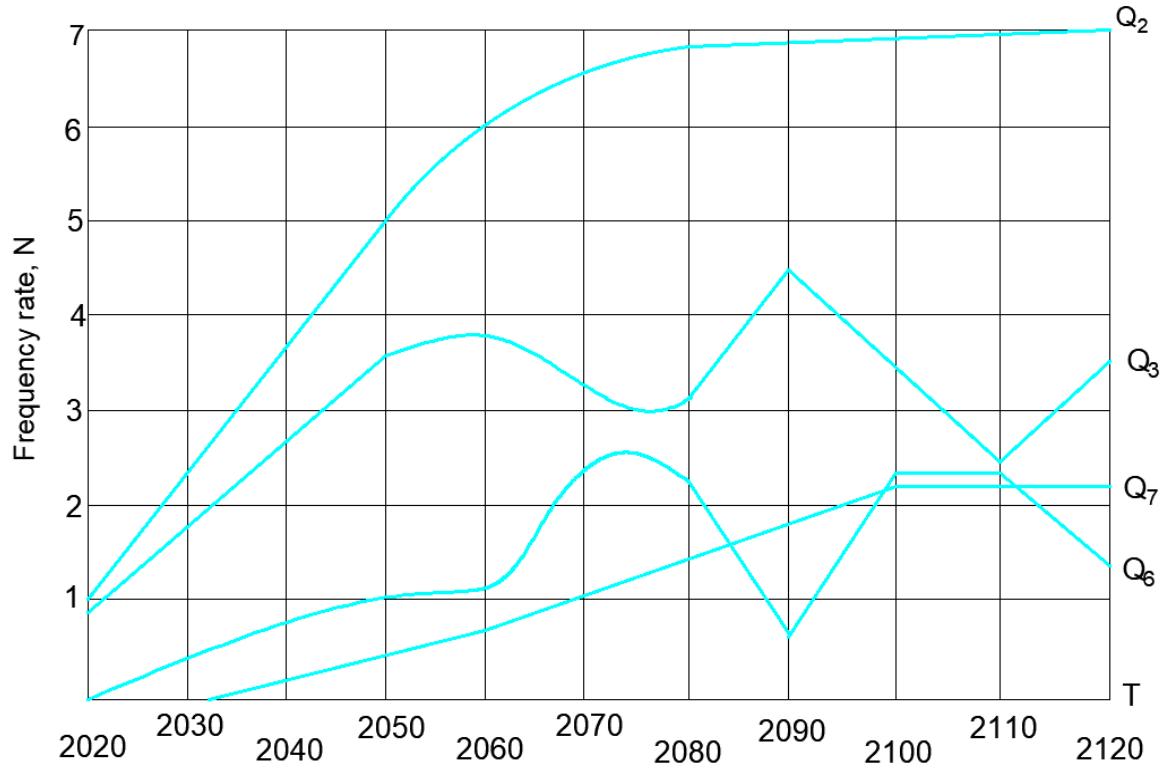
Fig. 2: Projected Metal Production in Total
$(Q_{2})$ and from Sources $Q_{3}$, $Q_{6}$, and $Q_{7}$
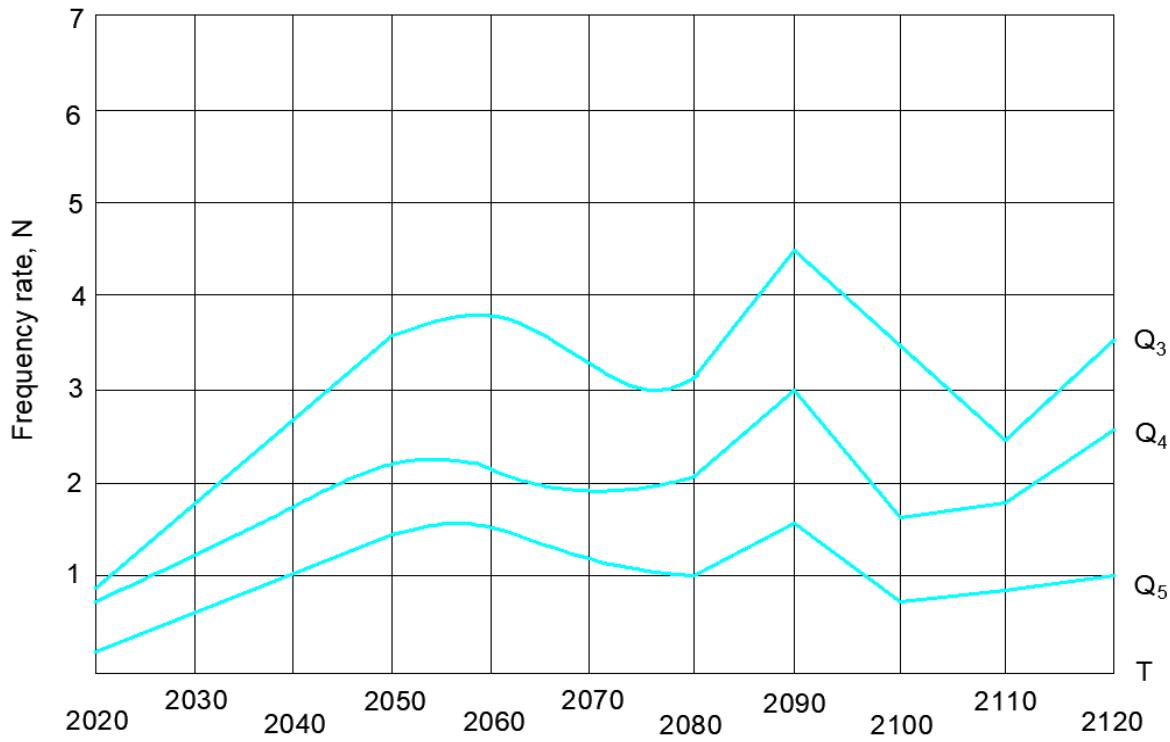
Fig. 3: Projected Metal Production from Source
$Q_{3}$ and its Constituent Components, $Q_{4}$ and $Q_{5}$
Table 1
<table><tr><td rowspan="2">Serial No</td><td rowspan="2">"Quantifiable indicators (sources of metal production)"</td><td colspan="11">Forecast years</td></tr><tr><td>2020</td><td>2030</td><td>2040</td><td>2050</td><td>2060</td><td>2070</td><td>2080</td><td>2090</td><td>2100</td><td>2110</td><td>2120</td></tr><tr><td>1.</td><td>Total production\(Q_2 = Q_3 + Q_6 + Q_7 \)</td><td>1</td><td>2.35</td><td>3.7</td><td>5.1</td><td>6.0</td><td>6.6</td><td>6.7</td><td>6.9</td><td>7.0</td><td>7.0</td><td>7.0</td></tr><tr><td rowspan="3">2.</td><td>\(Q_3 = Q_4 + Q_5, including \)</td><td>0.90.9</td><td>1.850.787</td><td>2.70.73</td><td>3.620.71</td><td>3.710.62</td><td>3.100.465</td><td>3.10.45</td><td>4.50.65</td><td>2.310.33</td><td>2.50.355</td><td>3.50.5</td></tr><tr><td>\(Q_4 \)</td><td>0.750.75</td><td>1.20.51</td><td>1.70.46</td><td>2.220.435</td><td>2.210.37</td><td>1.982.3</td><td>2.050.3</td><td>3.00.435</td><td>1.610.23</td><td>1.70.243</td><td>2.520.36</td></tr><tr><td>\(Q_5 \)</td><td>0.150.15</td><td>0.650.277</td><td>1.00.27</td><td>1.40.275</td><td>1.50.25</td><td>1.120.165</td><td>1.050.15</td><td>1.50.215</td><td>0.70.1</td><td>0.80.112</td><td>0.980.14</td></tr><tr><td>3.</td><td>\(Q_6 \)</td><td>0.10.1</td><td>0.50.213</td><td>0.740.2</td><td>1.080.21</td><td>1.60.265</td><td>2.510.385</td><td>2.280.34</td><td>0.60.087</td><td>2.520.36</td><td>2.340.335</td><td>1.330.19</td></tr><tr><td>4.</td><td>\(Q_7 \)</td><td>00</td><td>00</td><td>0.260.07</td><td>0.40.08</td><td>0.690.115</td><td>0.990.15</td><td>1.410.21</td><td>1.80.263</td><td>2.170.31</td><td>2.160.31</td><td>2.170.31</td></tr><tr><td>5.</td><td>Q1 metal consumption\((Q_1 \geq 0.95 Q_2) \)</td><td>0.95</td><td>2.2325</td><td>3.515</td><td>4.815</td><td>5.7</td><td>6.27</td><td>6.365</td><td>6.555</td><td>6.65</td><td>6.65</td><td>6.65</td></tr></table>
The symbols used in the forecasts presented in Table 1, as well as in Figures 2 and 3, are defined as follows:
- Q1 - Projected metal consumption (Q1 $\geq$ $0.95 \times Q2$ );
- Q2 - Total projected metal production from sources Q3, Q6, and Q7 (Q2 = Q3 + Q6 + Q7);
- Q3 - Metal production from primary georeources of the Earth's subsoil, representing the first group in the georesource classification system developed by Academician M.I. Agoshkov, and secondary georeources formed from primary ones as design-related losses located in the subsoil and production wastes stored on the surface (waste dumps of subeconomic reserves, waste rock, slags, sludges, clinkers, enrichment tailings), in accordance with the principles of designing and implementing mining systems with a "full cycle of ore deposit development" $(Q3 = Q4 + Q5)$;
- Q4 - Mining of metals by nature-technogenic subsoil development systems (primary georesources excluding balance reserve losses in the subsoil), and recovery from surface-stored materials such as enrichment tailings, slags, sludges, clinkers, etc.;
- Q5 - Metal production through extraction of previously left-behind balance reserve losses in the subsoil and reprocessing of wastes stored on the surface, within the framework of the "full cycle of ore deposit development";
- Q6 – Secondary resources in the form of metals and alloys returned to the resource economy under the concept of a "circular economy";
- Q7 – Metal production from sources located in halo zones in both lateral and vertical dimensions, including host rocks, subeconomic reserves of traditional deposits (after recalculating and lowering cut-off grades), and extraction through physical and chemical geotechnologies using underground borehole leaching within the framework of the "new mineral extraction boundaries."
## III. RESULTS AND DISCUSSION
### a) Implementation of PTGT in the Context of "Creative Subsoil Development"
- In the aforementioned context, the use of Physical and Technical Geotechnologies (PTGT) in "creative subsoil development" must be implemented in the sequential order outlined below, as substantiated by the conducted scientific research.
1) Determination of the mining method for deposits that possess significant geometric parameters in terms of strike length, thickness, and vertical extent, taking into account the boundary of mineralization from the surface.
In such cases, the application of both open-pit and underground mining methods requires the determination of the most optimal pit depth. At present, from the perspective of PTGT, an economically efficient approach creating a safe integration of surface and underground mining is seen in the configuration of at least three working areas within a single extraction ore node [45]:
- An open-pit mine using traditional technological schemes for access and extraction;
- An underground mine operating within a similarly conventional scheme;
- An intermediate zone (a level separating the ore fields of the open pit and underground mine vertically), which extends from the pit bottom to the top boundary of the underground mine. This zone enables both development and stopping to be carried out, combining features of both open-pit and underground mining.
The technological scheme gains further development, in line with the scientific implementation of the "creative subsoil development" principle, through the vertical division of underground reserves into two or more underground mining cascades, separated by horizontal levels situated between upper and lower cascades [46].
This vertical segmentation into mining levels allows for varied methods of stoping development one cascade (typically the upper one) may employ downward stopping using traditional mining systems, while another may apply either downward or upward ("bottom-up") stopping. The latter uses layered horizontal or transport-incline-parallel chambers with complete backfilling using hardening materials [47].
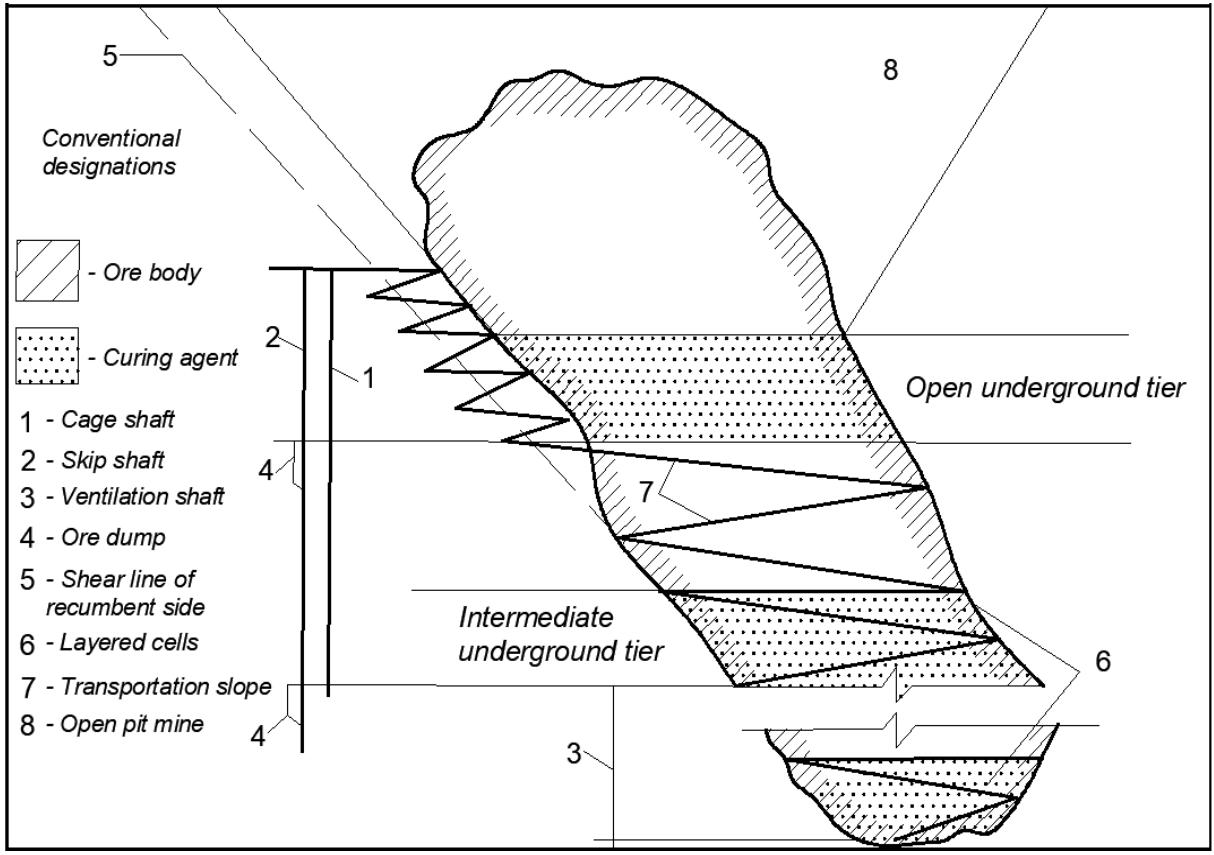
Fig. 4: Technological scheme and design of the combined open-underground and underground-underground geotechnology with the ascending development of underground mining operations using layered chambers with hardening backfill
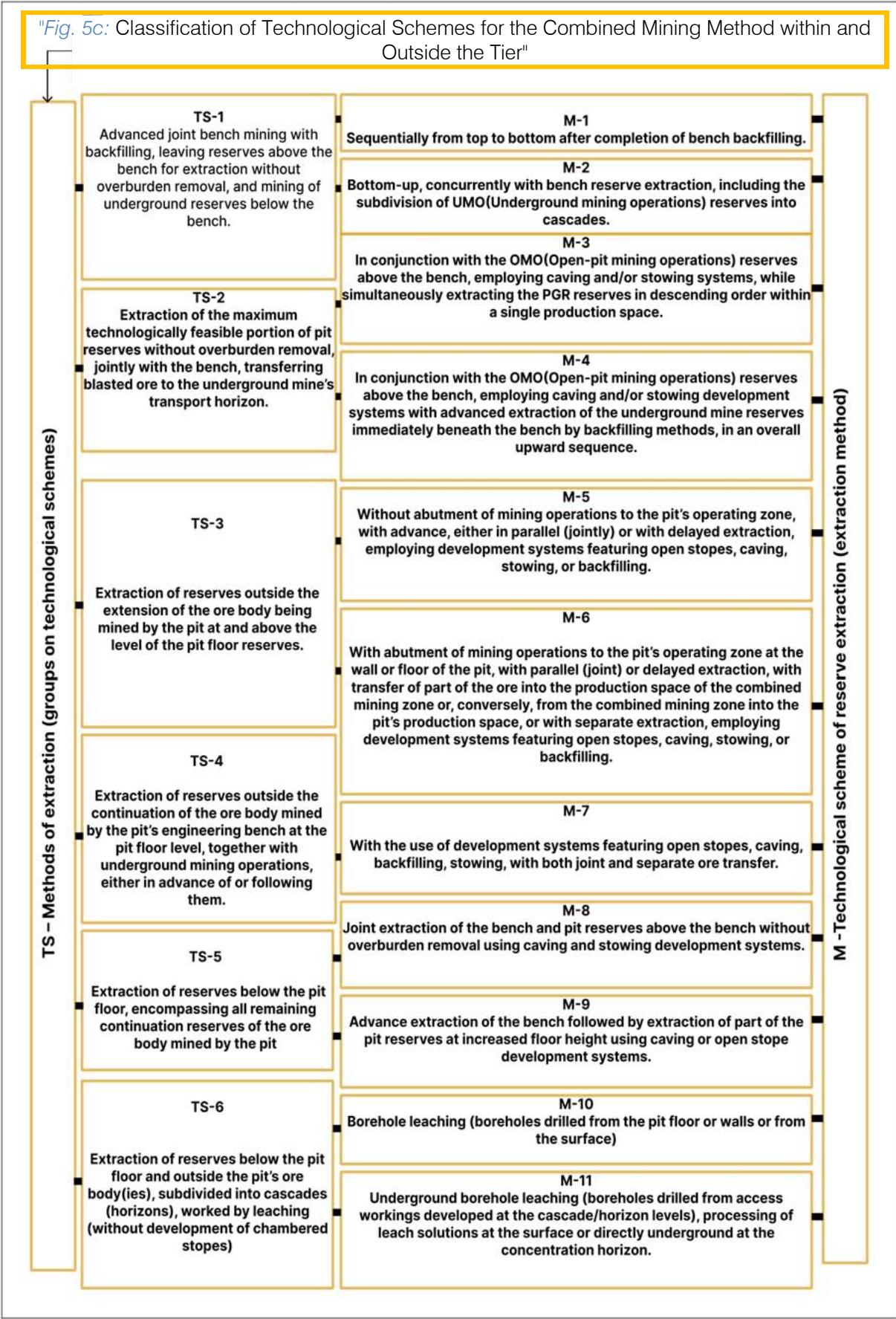
2) The optimization of mining operations that combine open-pit and underground methods either in parallel or sequentially is managed through a three-level classification system for mining development [48]. This classification accounts for the full natural variability in the spatial arrangement of individual ore bodies, the design of reserve access, and the technological schemes for orebody development and stoping (see Fig. 5).
The presented classification serves as a foundational framework for the preparation of technological regulations and technical specifications for the design of combined ore deposit development.
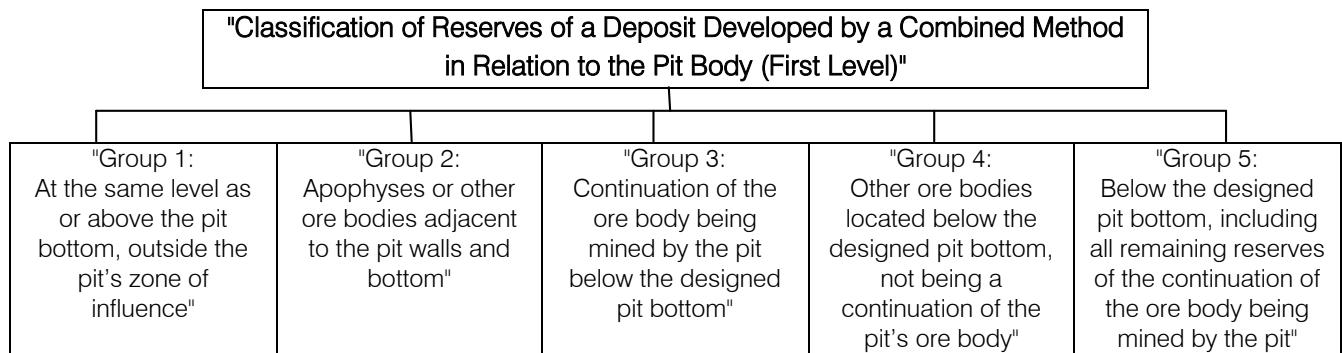
Fig. 5a: Classification of reserves developed by a combined method between open-pit and open-pit mining in a tier and outside a tier in relation to quarry reserves
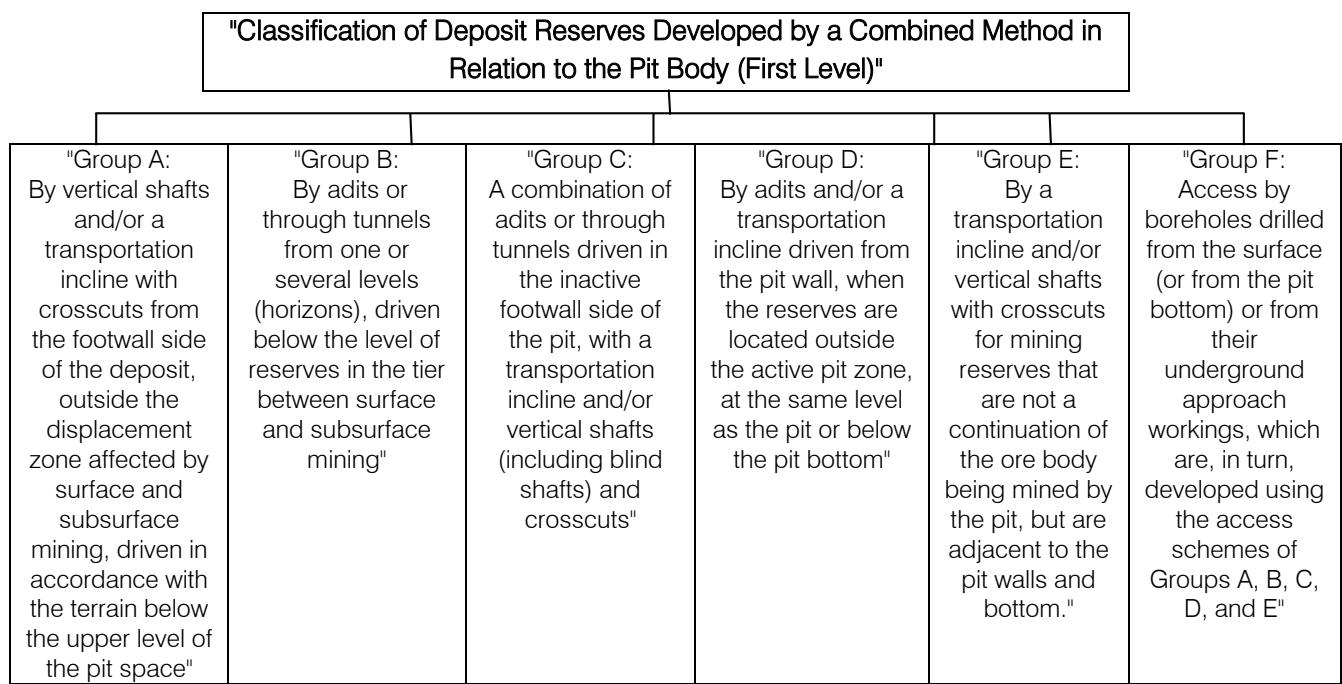
Fig. 5b: Classification of methods for opening reserves between the OGR and the PGR in the tier and outside the tier
3) PTGT systems that meet the requirements of "creative subsoil development" under conditions of traditional deposit exploitation have been designed in such a way as to eliminate deficiencies in the construction of stopping blocks and in the organization of technological processes. Collectively, these deficiencies can be summarized as follows:
- Lack of process controllability and integration during stopping operations, resulting in labor productivity and production capacity per working block falling far below theoretical potential, while production costs exceed profitable thresholds;
- Uncontrolled ore dilution, which, although regulated in project documentation, often exceeds normative levels by 3-5 times in practice;
- Absence of continuous and streamlined ore extraction due to interruptions in drilling and blasting (using shotholes or boreholes).
The proposed variants of mining systems involving magazining for vein-type deposits and borehole blasting for isometric ore bodies have been structurally developed and are operated according to technological schemes that ensure controlled interaction with the geological environment thereby eliminating the above-mentioned shortcomings [49,50].
The developed systems (see Figs. 6 and 7) operate in a controlled, continuous format of a "dual block," positioned on both sides of material-access raises. These systems include a special design element reinforced concrete plugs installed at level horizons that ensures safe, through-passage accessibility for personnel throughout the operational period.
The design of the working blocks and the stoping operations whether using magazining with vertical telescopic shotholes or blasting with borehole fan patterns placed sub-perpendicular to the selected dip angle $(45 - 55^{\circ})$ of thick ore bodies $(4 - 15\mathrm{m})$ enable continuous blasting cycles. This operational mode eliminates the need to construct spiral ramps through waste rock and allows for safe management of the hanging and footwall stability using cable bolt anchoring, which is installed by personnel from the surface platform formed by the broken ore stockpile ("magazine").
Ore dilution is minimized in this system thanks to the controlled exposure of waste rock and the elimination of blasting into "confined surroundings" a common issue when borehole fans are aligned parallel to the ore body strike.
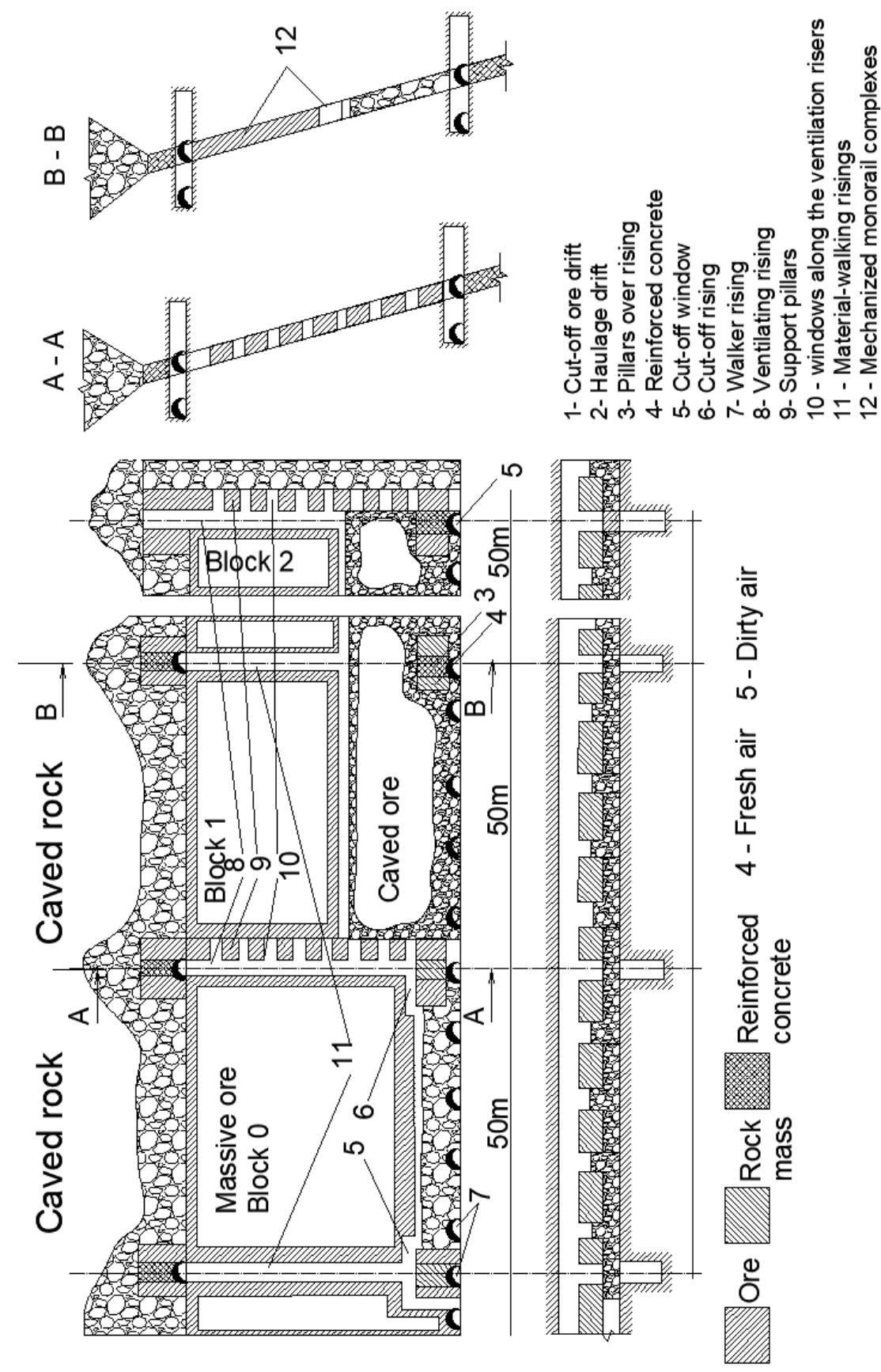
Fig. 6: Development system with ore storage with blasthole breaking by ascending blastholes from a "double block" with material-moving risers equipped with mechanized monorail complexes
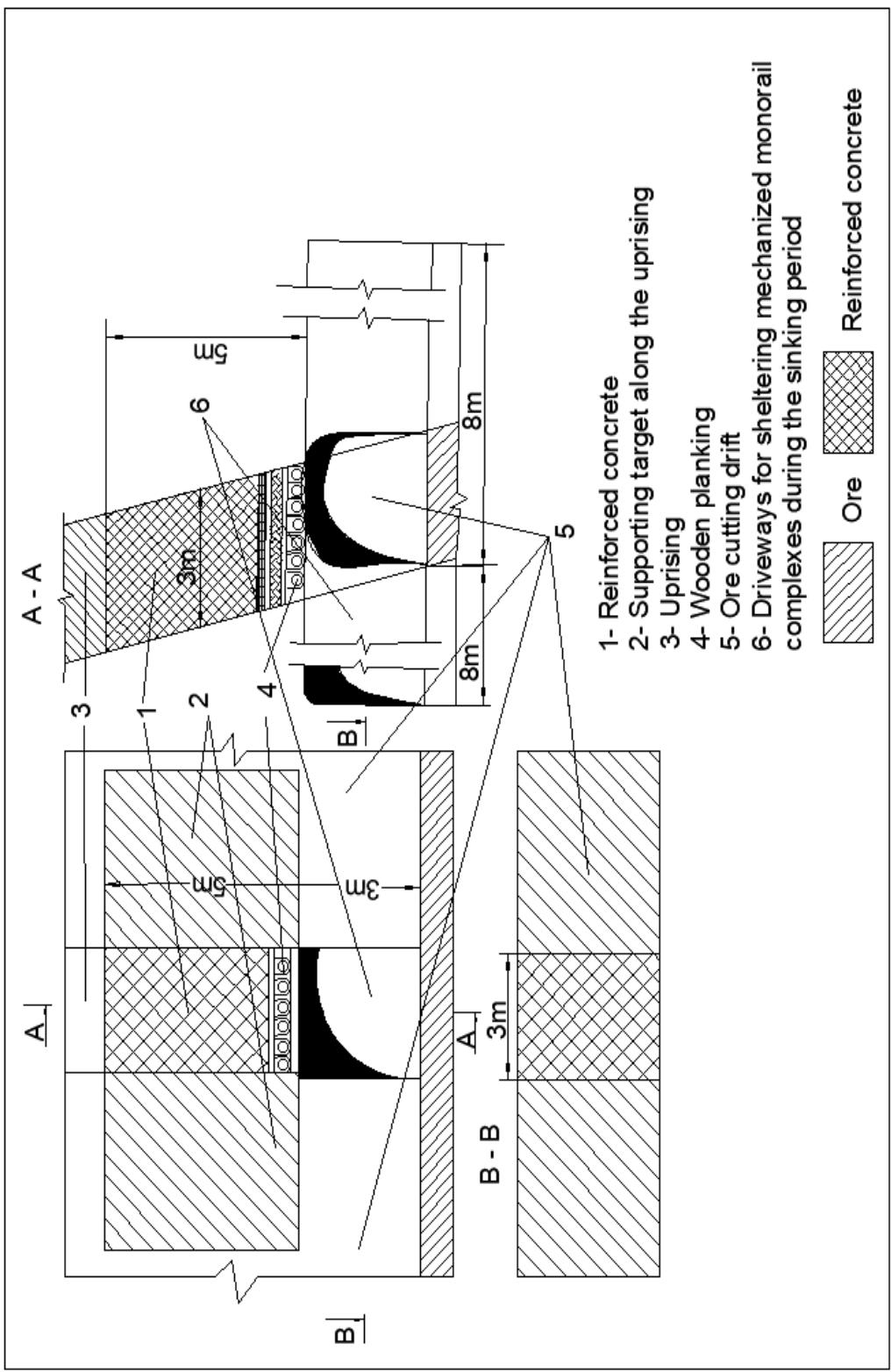
Fig. 6a: The design of fastening the material-moving and ventilation risers on the working and ventilation horizons to ensure their operability in the development system with ore storage
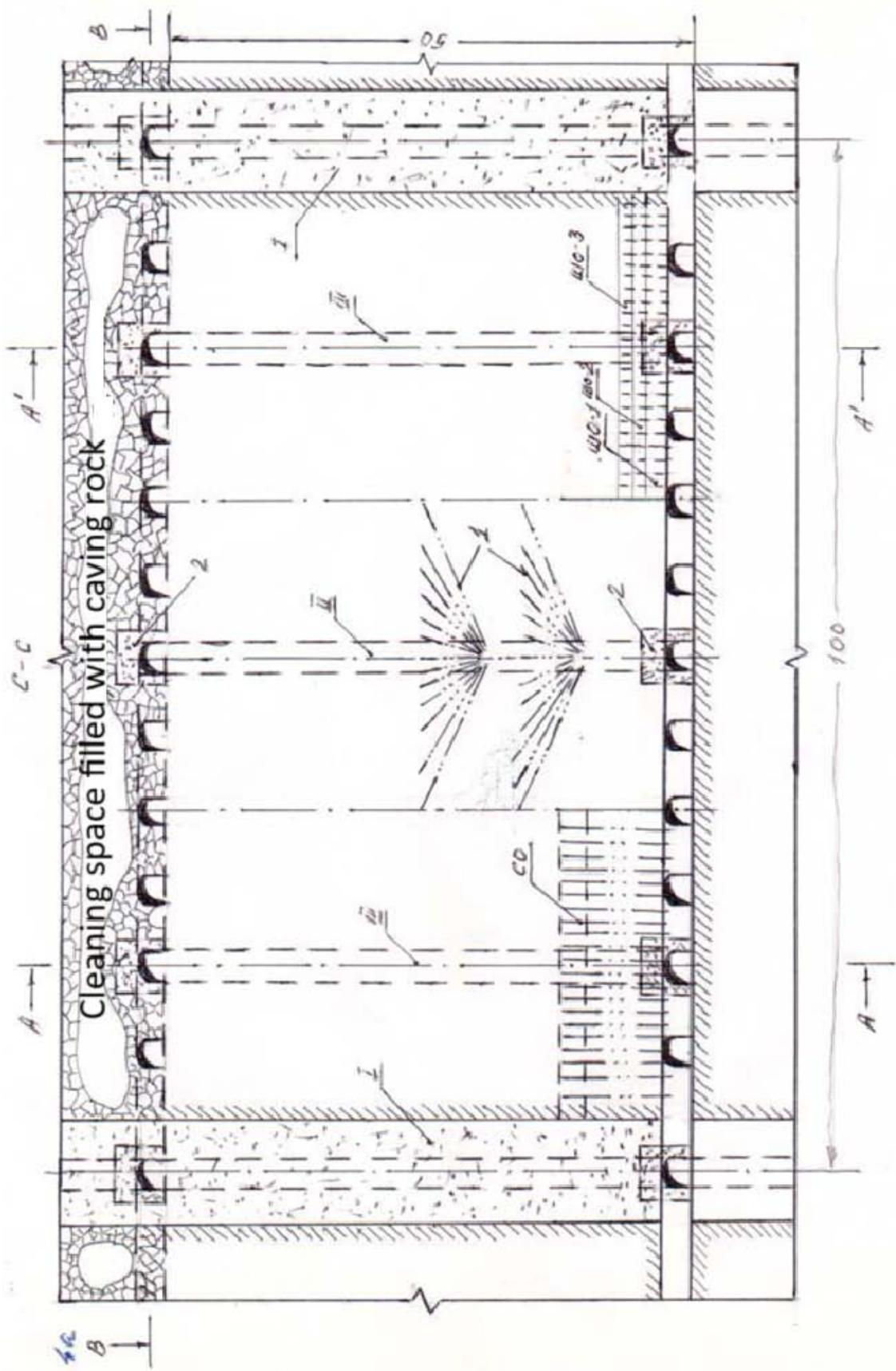
Fig. 7a: Development system with stage-by-stage boring using a monorail mechanized complex with subsequent detection of host rocks alternately with a hardening thixotropic backfill through one chamber.
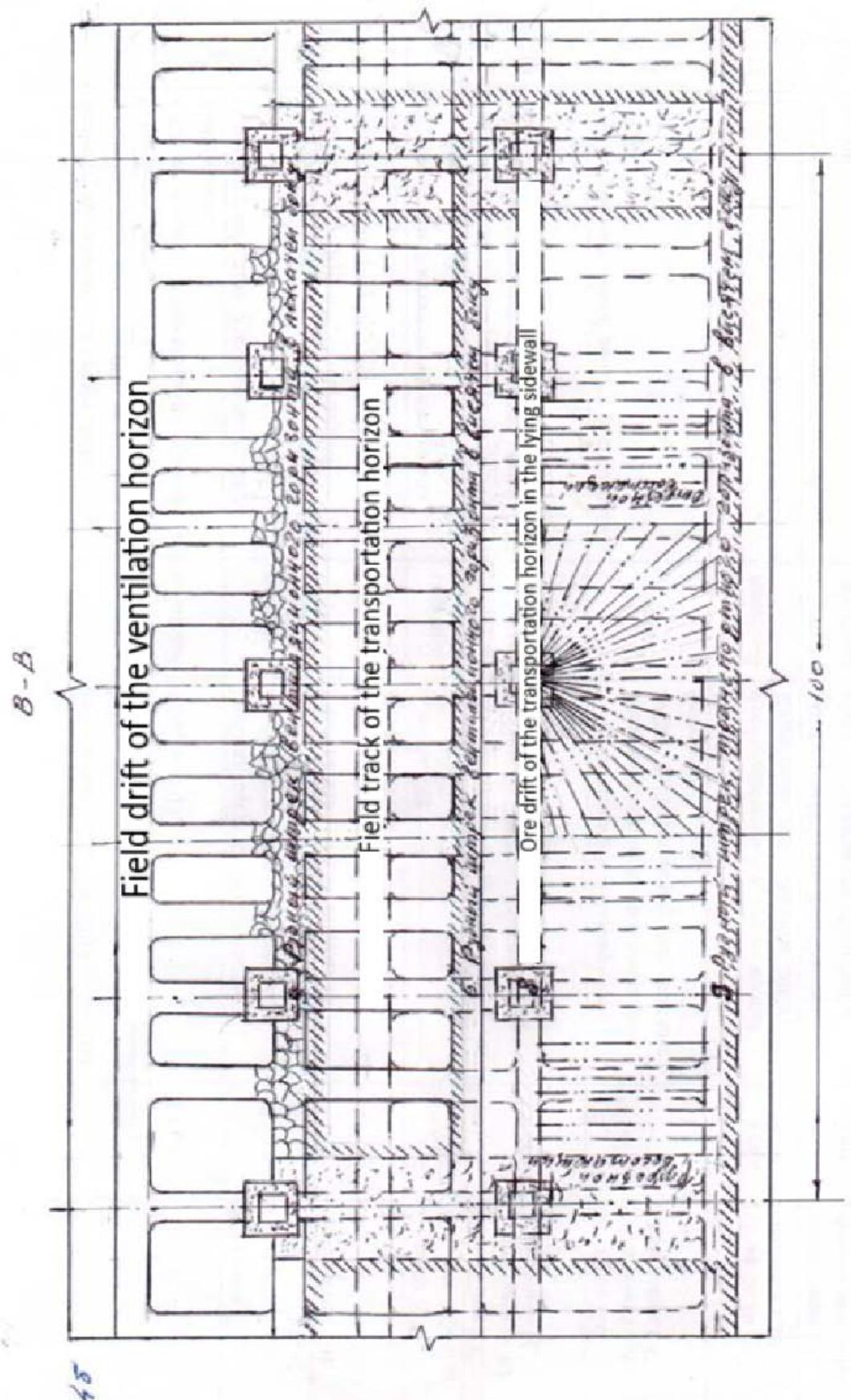
Fig. 7b: Plan of the treatment unit. Section B-B at the level of the ventilation horizon
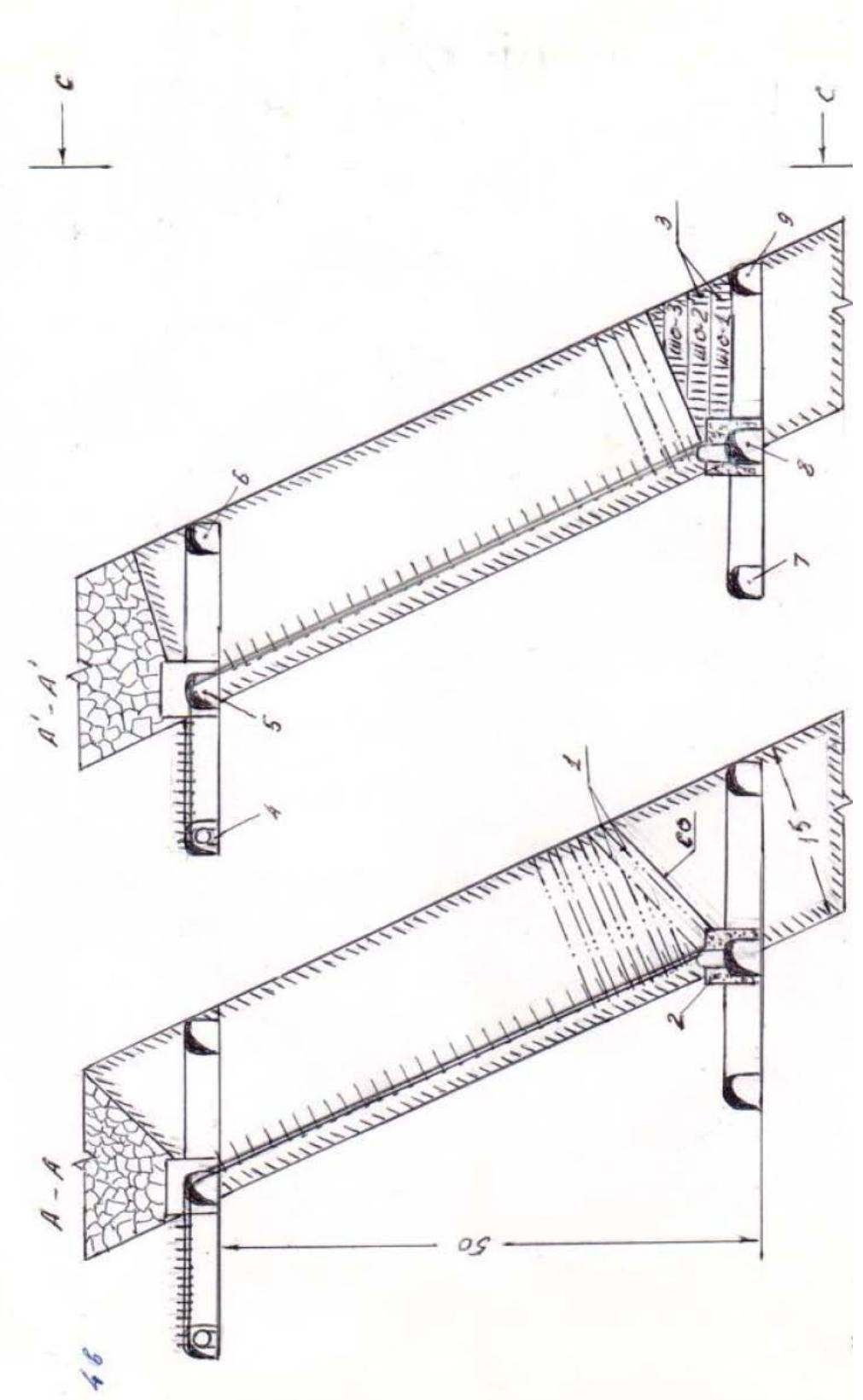
Fig. 7c: Section of working block along vertical A-A and A| - A|
Legend: I, II, III - sequence of working excavation; IIIO-1,2,3-blasthole breaking of cut-off slit; CO- borehole breaking of cut-off slit; fans of holes;
2. Reinforced concrete plug;
3. Vertical boreholes;
4. Field drift of ventilation horizon;
5. Ore drift of ventilation horizon in footwall;
6. Ore drift of ventilation horizon in hanging wall;
7. Field drift of transport horizon;
8. Ore drift of transport horizon in footwall;
9. Ore drift of transport horizon in hanging wall.
Ore bodies with thicknesses exceeding 15 meters can be mined under the proposed technological scheme using block arrangements composed of first- and second-phase chambers, both along the strike and perpendicular to it.
In the case of borehole blasting using the proposed scheme, the first-phase chambers whether aligned along the strike, up-dip, or across the strike are backfilled in a staggered pattern with a thixotropic hardening mixture. The second-phase chambers are backfilled in a controlled manner with caved rock, partially discharged from upper levels.
4) A logical continuation of PTGT applications for "creative subsoil development," following the open-underground and underground-underground combined mining methods utilizing various types of conventional mining systems, is the implementation of site-specific nature-technogenic solutions. These aim to convert previously derived secondary georesources into marketable products through a comprehensive development cycle at each deposit.
The joint application of technologies for producing final marketable products from primary georesources, supplemented with previously generated secondary resources, can be organized by varying the proportion of each. This variation is technologically feasible within certain limits, which are defined by the quantity and distribution of secondary georesources formed in the mining systems' residual pillars e.g., chamber, inter-block, inter-level, barrier pillars and further supplemented by losses accumulated in surface waste and residues (e.g., enrichment tailings, slags, sludges, clinkers, etc.).
The determination of the most efficient ratio between primary and the secondary georesources derived from them together comprising the total metal output under PTGT schemes in a safe production format is based on the criterion of final effectiveness. This relationship follows a dependency illustrated in Figure 8.
5) An important area in the advancement of PTGT technogenic systems is heap leaching, applied for
the selective or collective recovery of metal products from primary and secondary georesources. The main challenges in heap leaching technologies, which hinder the actualization of the "creative subsoil development" principle, include:
- A low metal recovery ratio from the ore heap;
- The often seasonal nature of the core leaching process, i.e., year-round irrigation of heap material exposed to open surface conditions.
A solution to these issues lies in the development of circular irrigation, both vertically and horizontally, via perforated pipes (made of either metal or the more cost-effective polyethylene fiberglass). These pipes are embedded within a reinforcing mesh inside the heap, delivering leaching solution from a centralized preparation source [51]. This in-situ circular irrigation method eliminates the harmful effects of channelization and colmatage (calcium scaling), which otherwise restrict the free flow of the leachate.
The solution is delivered into the heap stack through a calculated number of distribution nodes, maintaining the required pressure from various sides (Fig. 9a).
The proposed technological scheme ensures complete irrigation with $100\%$ coverage of the total heap volume year-round, regardless of weather, and prevents the formation of "dead zones" along the pyramid's flanks. Both ends of the reinforcing network should protrude from the heap to allow for pipe removal and reuse after the completion of the leaching cycle (achieving controllable metal extraction rates above 92–95%).
Full utilization of the allocated mining lease area, along with its considerable conservation and efficient heat use from exothermic reactions within the heap, is achieved through a continuous, alternating layout of even- and odd-numbered heap stacks without inter-heap gaps (Figure 9b).
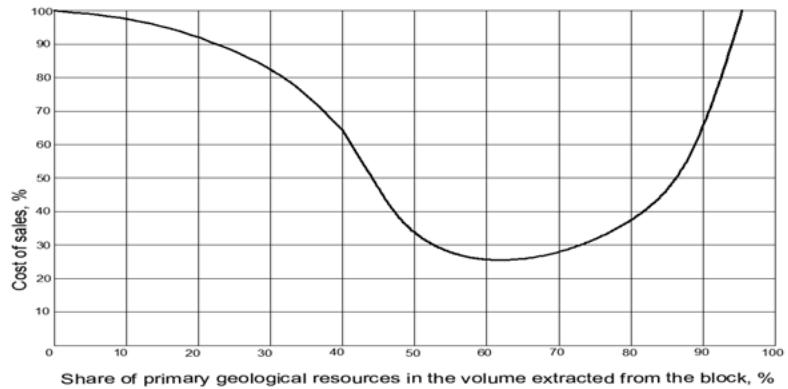
Fig. 8: Dependence of the cost price of the final product on the share of primary georeources in the production volume using FTGT
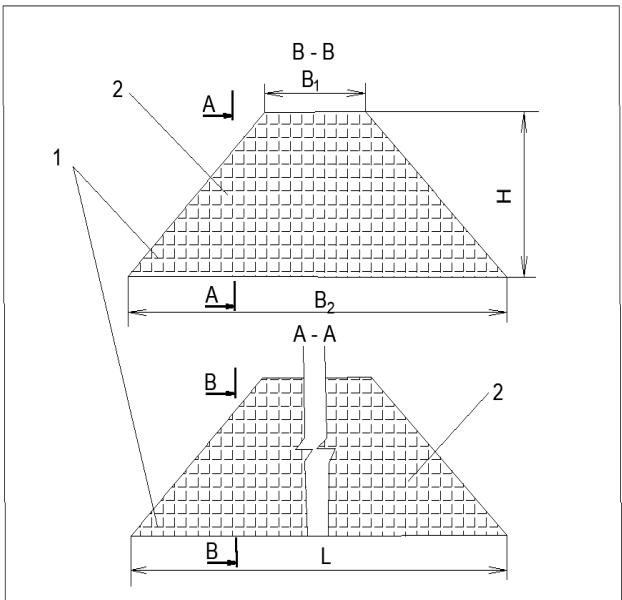
- 1- Ore stack (B1 - width of the smaller side of the stack trapezoid; B2 - width of the larger side of the stack trapezoid; H - stack height; L - stack length;
- 2- Perforated metal or synthetic pipes for feeding the leaching solution along vertical and horizontal planes. Note: odd stacks (1, 3...n-3, n-1) are leached secondarily.
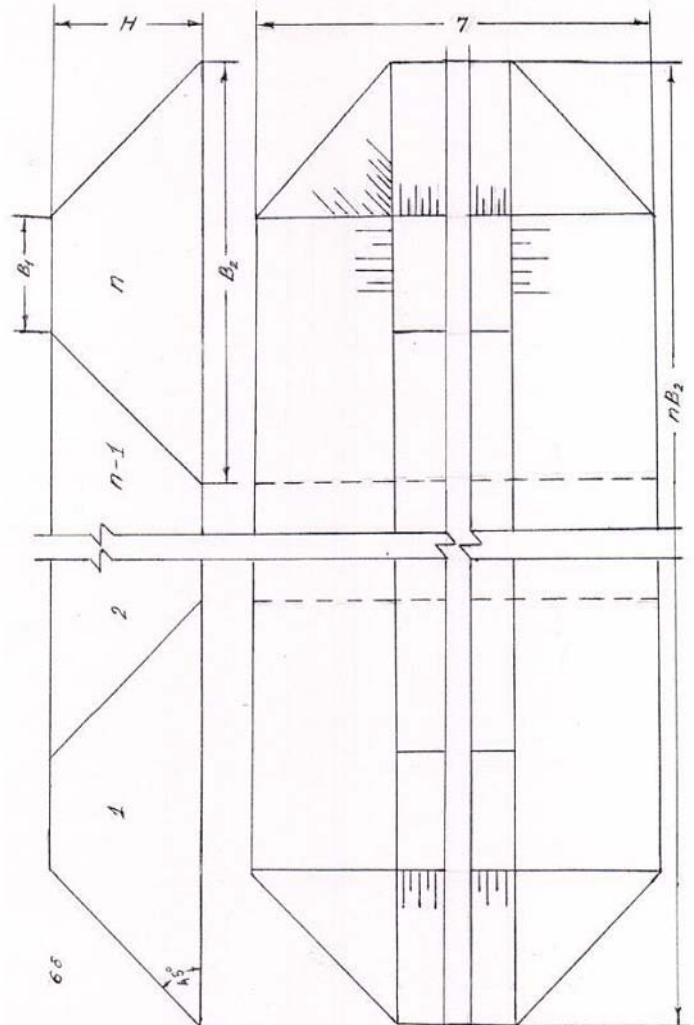
Fig. 9a: Flow Chart of Continuous Controlled Heap Leaching with Continuous Alternate Stacking of Tailings Fig. 9b: Scheme of Continuous Alternate Stacking of Tailings
6) The inevitability of optimizing nature-technogenic systems simultaneously in terms of economy, technological safety, and ecology determines the necessity of implementing "dual control." Under this approach, control actions are applied both to study the controlled object (the geological environment) and to guide it toward an optimal state.
7) In practical conditions of underground underground, multi-level, and parallel-sequential combined mining development, two methods of mine development are assessed: the traditional descending method and the newly proposed ascending ("bottom-up") method.
The proposed technological scheme works in positive synergy with the geological environment by providing proactive exploration and complete clarification of ore body morphology, zones of barren rocks ("windows"), and geological disturbances in advance. This is made possible by accessing the ore body throughout its full vertical extent via preventive transport inclines to the bottom boundary of mineralization, which is bordered by a horizontal drift running to both flanks.
Vertical development using skip and cage shafts proceeds to a depth determined by the economic balance of capital and operating expenditures for the construction and operation of transport inclines. This approach reduces the number of required crosscuts to equal the number of levels between the cascades.
Ventilation shafts are driven to the floor of the lowest horizontal drift. Crosscuts connect vertical shafts to horizontal levels constructed at the floor of the cascading levels up to the penultimate cascade. These crosscuts are equipped to allow passage for trucks (or load-haul-dump machines), which unload into ore passes near the skip shaft.
8) The described technological scheme of stopping using an ascending method is most efficiently and safely implemented in combination with a system involving layered stoping chambers, arranged either horizontally or parallel to the transport inclines.
This scheme offers maximum economic efficiency, eliminates ore losses, limits dilution to no more than $4 - 6\%$, and preserves the mined-out rock mass from any destructive environmental impact both underground and at the surface. This is achieved through the use of thixotropic backfill.
Thixotropy is a physical property typical of water-saturated mixtures with high fine-particle content. When subjected to mechanical action (shaking, stirring, vibration), these mixtures transform from a thick gel into a freely flowing sol. After the mechanical influence ceases, the sol re-solidifies into a dense gel and eventually a hardened mass. This behavior enables the creation of backfills using cement M200 at 70-100
$\mathrm{kg} / \mathrm{m}^{3}$, inert filler at 1000–1250 kg/m3, and water at 250–330 kg/m3, which can be pumped over distances of 1.5 to 1.8 km without forming blockages.
Partitions in the backfilled chambers can be made removable, avoiding the use of reinforced concrete. The proposed mixture consistency virtually eliminates contamination of excavations and forms a dense mass by the time a new drilling and blasting cycle begins.
The creation of a strong rock mass is also facilitated by the constant presence of two exposure planes in the mined layer, which reduces both specific and total explosive consumption for blasting. This in turn improves atmospheric conditions underground by reducing energy consumption and limiting the release of gases during explosions (Figures 10 and 11).
9) The complete set of conducted research provides a practical foundation for the economic and environmental imperative of geological environment utilization and metal production in the 21st century.
The effectiveness of applying the ascending method of underground mine development with layered stoping and full thixotropic backfill, based on exploitation of the physical phenomenon of thixotropy, is presented in Table Please provide if you translated
Volume Calculations for Development and Stopping Operations
1) The height of the slope rise for a length along the strike of $1610 \, \text{m}$ at an angle of $90^\circ$, (tg $90 = 0.1584$ ) - $255 \, \text{m}$. Then
- the amount of ore in the upper tier with a height of 250 m
250
----- x 8 x 1610 x 2.7 = 10,039,261 tons, where 0.866-sin 9o, 2.7 t/m3-bulk weight of ore 0.866
- the amount of ore in the pillar between the upper and lower tiers
45
- - - - x 8 x 1610 x 2.7 = 1,807,067 tons, 0.866
- the amount of ore in the lower tier with a height of 255 m.
255
- - - - x 8 x 1610 x 2.7 = 10,240,047 tons 0.866
2) The amount of ore in the same areas, taking into account horizontal ramps from slopes on each side by $20\mathrm{m}$ (total $40\mathrm{m}$ ), respectively (length along the strike $1650\mathrm{m}$ ): 10,288,684 tons, 1,851,964 tons, 10,494,458 tons
3) The length of the slope from the ventilation horizon of the upper tier to the soil of the lower tier with an ascent of $255 \mathrm{~m}$ at an angle of $90^{\circ}$ ( $\cos 90^{\circ} = 0.9877$ )
#### 1610: $0.9877 \times 550 \times 255 = 3516$ m
4) Associated ore mining from slopes taking into account horizontal ramps of $20\mathrm{m}$ will be $(60 + 3516)$ x $12\times 2.7 = 115862$ tons, from the excavation of horizontal transport and ventilation drifts
$1650 \times 4 \times 12 \times 2.7 = 213840$ tons.
The total associated production will be 329702 tons.
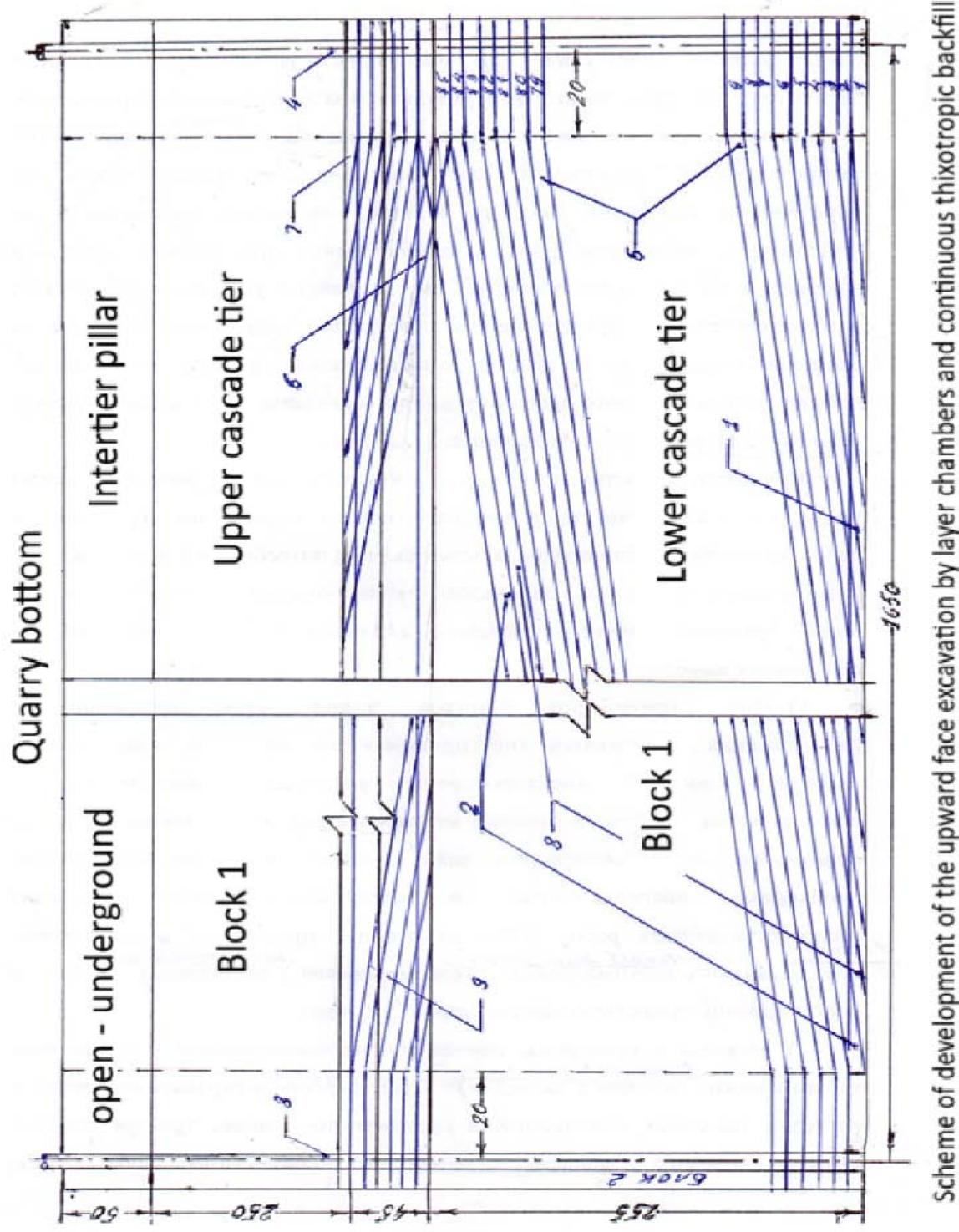
Fig. 10: Layout diagram of synthetic block detachment using a floorless method with a free cover and the VALAZHKA inspection station
Legend: 1. Lower transport and ventilation drift;
2. Transport ore slope;
3. Interblock ventilation stowage riser (emergency exit with mechanized hoist and stair compartment);
4. Flange ventilation and stowage shaft with mechanized hoist and stair compartment;
5. Slice chambers;
6. Transport and ventilation drift of the inter-tier pillar;
7. Transport and ventilation drift of the upper tier;
8. Slice chamber;
9. Underground-underground inter-tier pillar.
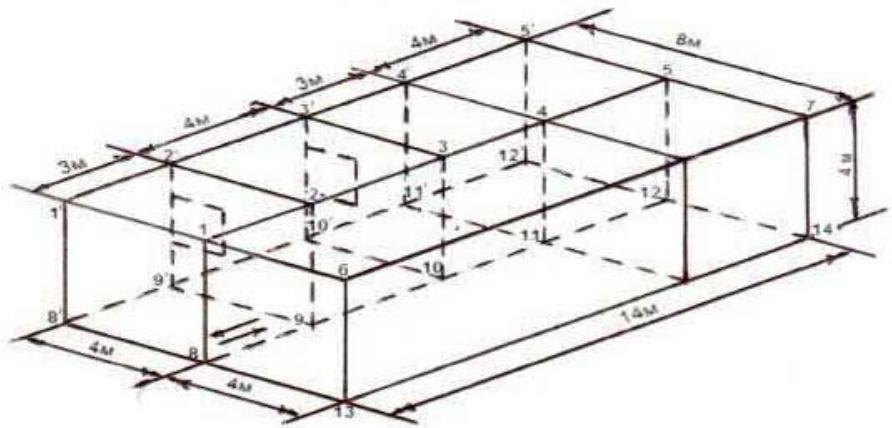
Fig. 11: The order of stoping (end-to-end layer chambers with a transport slope and thixotropic backfill).
1. 6-1'-5'-7-14-13-8'-12'-ore body;
2. 6-1-5-7-14-13-8-12-transport slope;
3. 1-1'-2'-2-9-8-8'-9'-ore pillar;
4. 2-2'-3'-3-10-9-9'-10'
«window»;
5. 3-3'-4'-4-11-10-10'-11'-ore pillar;
6. 4-4'-5'-5-12-11-11'-12'-«window»; 7. -cut;
8. 1-2-3-4-5-12-11-10-9-8-removable jumper between the transport slope and the layer chamber, protecting the thixotropic backfill from the slope; 9.
-traffic route along the slope
Table 2: Comparative analysis of parameters of technological schemes for the development of mining operations
<table><tr><td>Traditional Top-Down Method</td><td>The Proposed Bottom-Up Method</td></tr><tr><td colspan="2">Comparative mining conditions and their parameters</td></tr><tr><td colspan="2">"A standard ore deposit with a strike length of 1,650 m and a depth of 1,000 m. Overburden at the top is 50 m thick. The dip angle of the bed-like deposit is 60°, the ore body thickness is 8.0 m, and the bulk density of the ore is 2.7 t/m3. The economic (balance) reserves of the considered section of the deposit amount to 39.097 million tons."</td></tr><tr><td>1. Opening to full depth by vertical cage, skip and ventilation shafts, crosscuts, field drifts and ramps along the rock between the field and ore drifts every 50 m vertically (the distance between the working blocks, determined by ramps every 3 blocks, is 100 m). The skip hoist is equipped with ore and rock bunkers at two levels at 650 m and 1650 m from the surface. The shafts are driven from the quarry body 50 m above the bottom.</td><td>1. Opening with vertical cage and skip shafts to a level below the soil of the upper tier of underground mining (depth 700 m), ventilation shafts to the full depth and an ore transport slope separately for each section with a length of 1650 m along the strike, driven from the ventilation horizon of the upper tier of the underground section with a crosscut along the rock to the shafts to the mineralization soil at an angle of 90. The shafts are driven from the quarry body 50 m above the bottom, i.e. 350 m below the surface.</td></tr><tr><td>2. The total volume of waste rock workings is:
• Shafts and bins: 118,000 m3
• Horizontal workings: 134,800 m3</td><td>2. The total volume of rock works is:
- shafts and bunkers 73,806 m3;
- horizontal workings 19,500 m3.</td></tr><tr><td>3. Associated ore mining - no</td><td>"3. Incidental (by-product) ore extraction – 329,702 tons"</td></tr><tr><td>4. Extraction of ore from stope blocks with the dimensions of 50 m up and 100 m down the strike by the development system with sublevel breaking by fans of boreholes and caving. Delivery of ore to block ore passes every 200-300 m along rock slopes from each sublevel. Formation of a cut-off slit by boreholes to the sublevel height of 15 m. Ore loss 12-15% dilution 8-10%. Development of stope is downward.</td><td>4. Ore extraction from the tiers and the interlevel pillars is carried out according to a schedule that ensures safety and averaging in terms of volume and quality. The pit depth is 350 m, with overburden thickness of 50 m, lower tier height of 255 m, upper tier height of 250 m, and pillar thicknesses of 45 m and 50 m. The mining method used is layered stopes with drilling and blasting, employing trackless (self-propelled) equipment and subsequent complete backfilling. Stopping operations progress upward, with stopes excavated adjacent to each other and parallel to the haulage incline, or horizontally, in an advancing and/or retreating sequence. Ore losses are 0-2%, and dilution is 4-6%.</td></tr></table>
Note:
1. From the surface to a depth of $400\mathrm{m}$ (with $50\mathrm{m}$ of overlying alluvial sediments and $350\mathrm{m}$ vertical thickness of ore body below), extraction is carried out by open-pit mining. Between the pit bottom and the roof of the upper underground level lies the upper inter-level pillar, $50\mathrm{m}$ in height. The total ore volume in the open pit and pillar amounts to 16.462 million tons.
2. The cross-sectional area of transport inclines, ore and field drifts, crosscuts, and layered chambers is $12\mathrm{m}^2$ ( $4 \times 3\mathrm{m}$ ).
3. The cross-sectional area of the skip and cage shafts is approximately $21\mathrm{m}^2$; for ventilation shafts, ore passes, and waste passes, it is $9\mathrm{m}^2$ ( $3 \times 3\mathrm{m}$ ).
4. The ore volume in the underground section equals 22.635 million tons. Thus, the total ore reserves of the deposit are 39.097 million tons.
Efficiency indicators of PTGT and PCGT applications, taking into account the calculated metrics and additional gains from implementing technological schemes focused on "resource reproduction and resource conservation," are determined across four principal sources of metal production:
1) Extraction of balance reserves from the traditional ore body using a mining method selected from the classification list established by Academician M.I. Agoshkov, with stoping development proceeding in a block-by-block and level-by-level descending sequence.
2) Mining operations employing mining-engineering systems with a full cycle of ore deposit development (see Fig. 12) [52].
3) Application of the proposed combined PTGT methods, with stoping development executed either via the descending (traditional) or the ascending (new) method.
4) Application of PCGT using underground borehole leaching techniques.
Comparison of performance indicators is given in Table 3 (indicators of the classical traditional version of item 1 are taken as 1)
Table 3
<table><tr><td>No. p/p</td><td>Geotechnologies used</td><td colspan="2">Quantity of conditional monometal, units</td><td>Cost of metal production across all production processes</td><td>Labor productivity across all production processes</td></tr><tr><td>1.</td><td colspan="2">"Traditional top-down scheme"</td><td>1</td><td>1</td><td>1</td></tr><tr><td>2.</td><td colspan="2">"Geotechnologies with a full cycle of ore deposit development"</td><td>1,08</td><td>1,04</td><td>0,97</td></tr><tr><td>3.</td><td colspan="2">Combined FHTT</td><td>1,15</td><td>0,94</td><td>1,04</td></tr><tr><td>4.</td><td colspan="2">Combined FHGT with underground well leaching</td><td>1,23</td><td>0,83</td><td>1,07</td></tr></table>
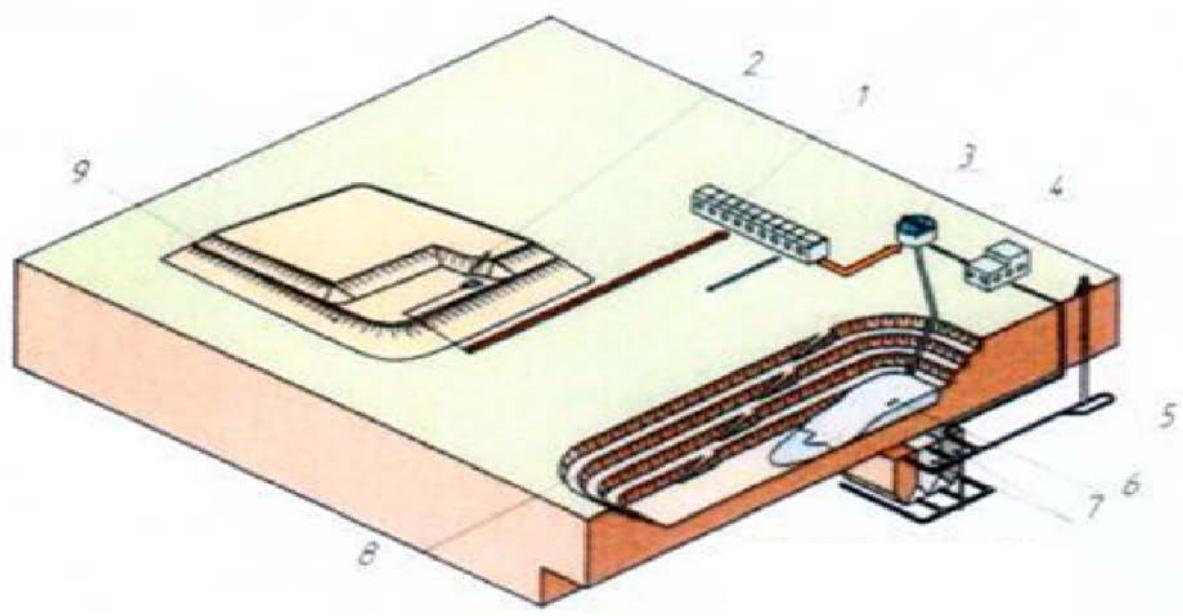
Fig. 12: Mining and engineering system of combined geotechnology with a full cycle of integrated development of deposits:
1. enrichment plant, 2- hydraulic monitor, 3- thickener, 4- backfill complex, 5- underground opening workings, 6- waste storage in the quarry, 7- backfill massif, 8- quarry, 9- hydraulic monitor development of old tailings storage
The presented calculated data require further studies under actual production conditions; however, they undoubtedly reflect prevailing trends and are expected to be achieved. The viability of the technological solutions is ensured by the simplicity of structural elements, the positive interaction between the geological environment and technogenic processes, the compatibility and controllability of production operations, and the safety of their execution.
Thus, the challenge of shaping the essence of 21st-century subsoil use through PTGT systems executed within the framework of resource reproduction, resource conservation, and preservation of a high-quality natural environment will be met in accordance with the principle of "creative development of the subsoil."
III.
2. In proposing the use of PCGT in the mining and mineral processing industry, it is particularly worth noting that, both in practice and even in theory, no specific design contours have been clearly established for an underground mine designed for borehole leaching, despite the apparent removal of key obstacles for constructing such an operation over the past decades.
1) The diversity of mining-geological factors and mining-technical conditions [53], which determine the structural features and technological configurations of technogenic systems including PCGT requires the resolution of complex scientific and practical problems. In response, technological schemes for underground borehole leaching have been developed and proposed, integrated with a unified production process of PCGT-based mineralurgy for extracting metals from productive working solutions (see Figs. 13a, 13b, and 13c).
The practical goal of applying underground borehole leaching under real production conditions is the establishment of a mining and concentration operation that, unlike the current model of subsoil development using existing geotechnologies and mineralurgy, would extract and convert into a marketable product at least the entire volume of metal contained in the developed working block evaluated by traditional methods as balance reserves.
However, for this to be realized, the redox reactions through which compounds of valuable metallic minerals transition into soluble forms must be organized within an artificially created, fully permeable environment inside the monolithic rock mass. This is necessary to ensure that even those volumes of metals classified as subeconomic and therefore excluded from traditional reserve accounting based on geological exploration results also transition into solution.
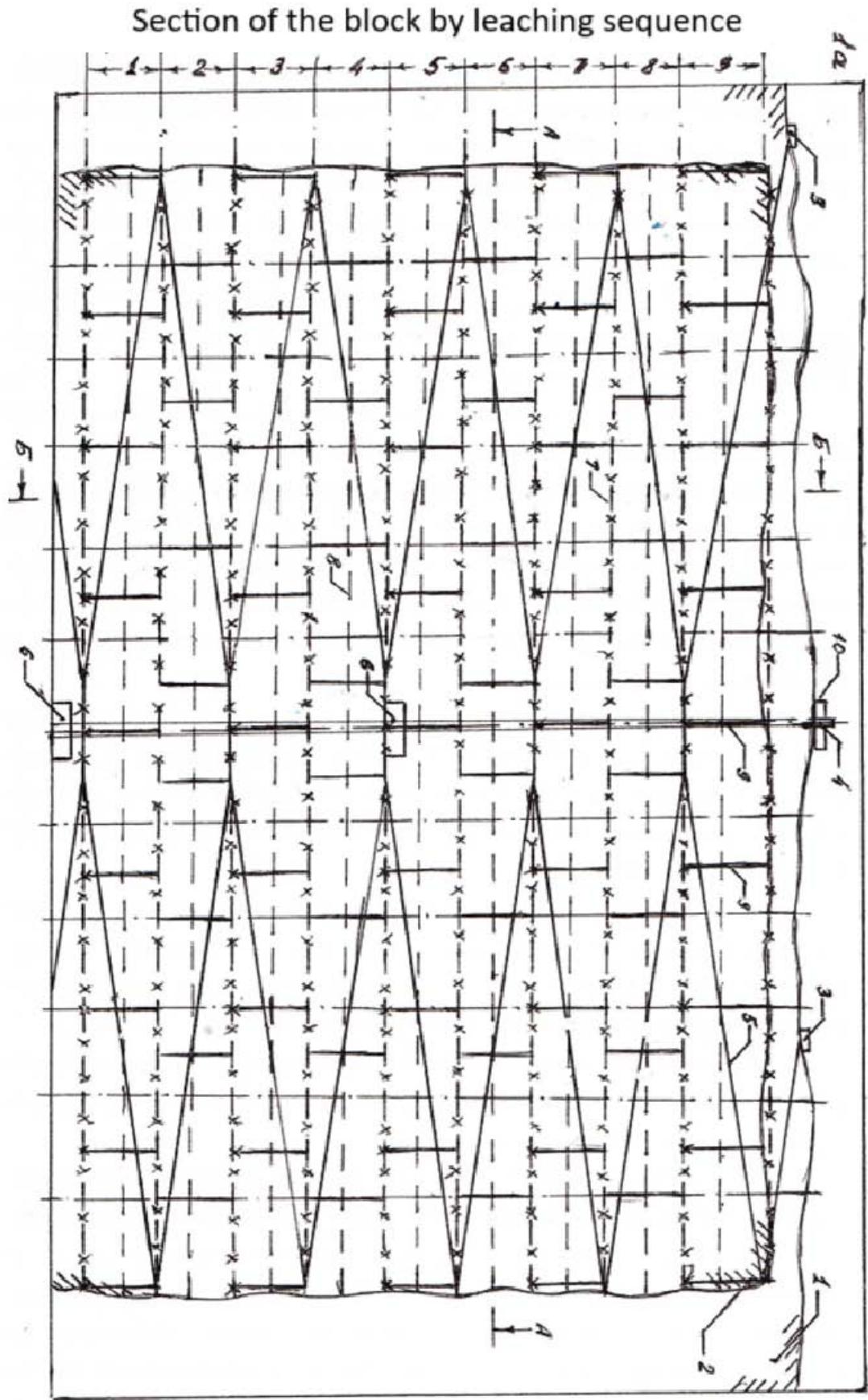
Fig. 13: Technological scheme and design of preparation and cleaning excavation using FHGT with underground leaching and mineralogy.
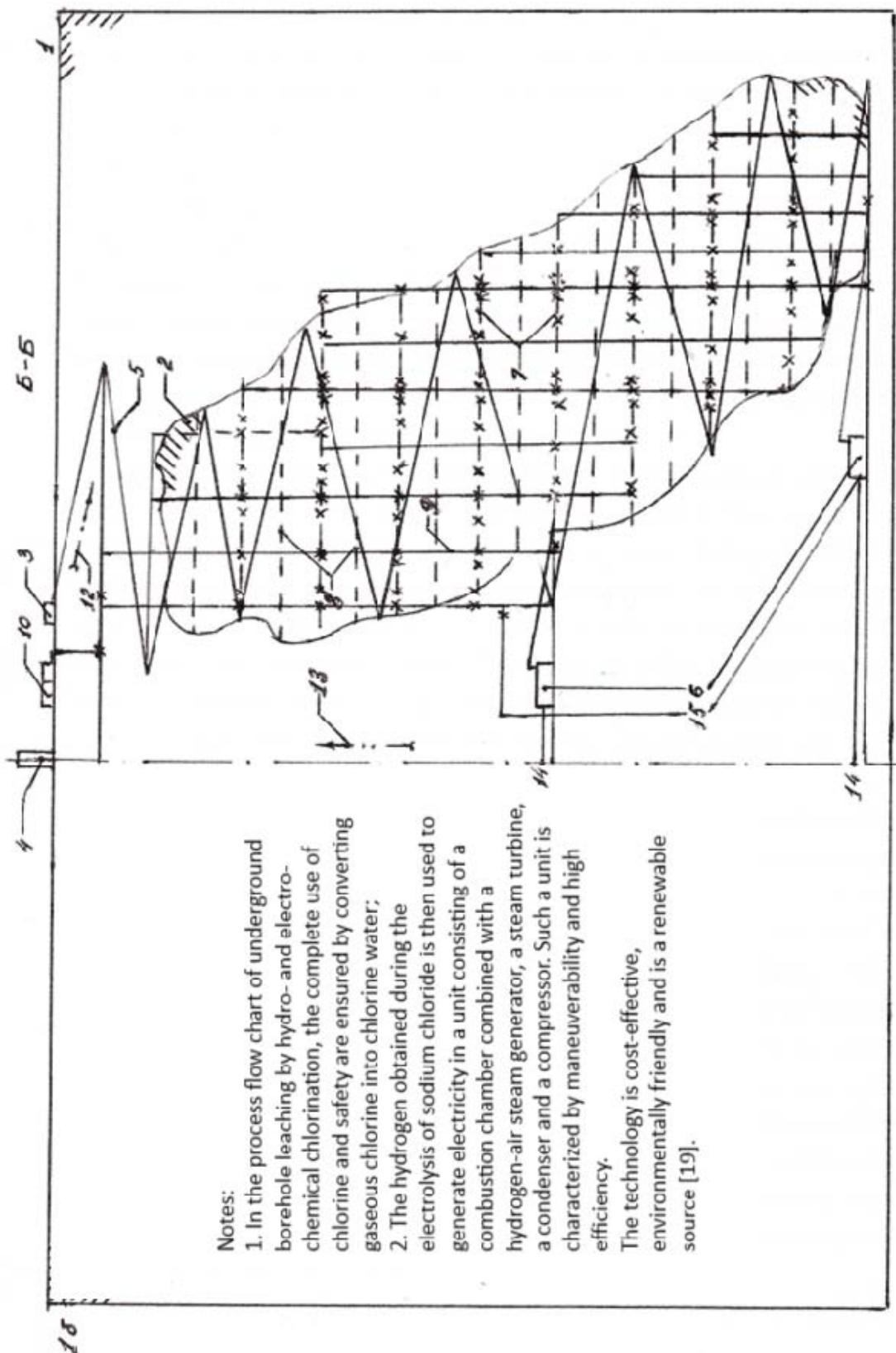
Notes: 1. In the process flow chart of underground borehole leaching by hydro- and electro-chemical chlorination, the complete use of chlorine and safety are ensured by converting gaseous chlorine into chlorine water;
2. The hydrogen obtained during the electrolysis of sodium chloride is then used to generate electricity in a unit consisting of a combustion chamber combined with a hydrogen-air steam generator, a steam turbine, a condenser and a compressor. Such a unit is characterized by maneuverability and high efficiency. The technology is cost-effective, environmentally friendly and is a renewable source [19].
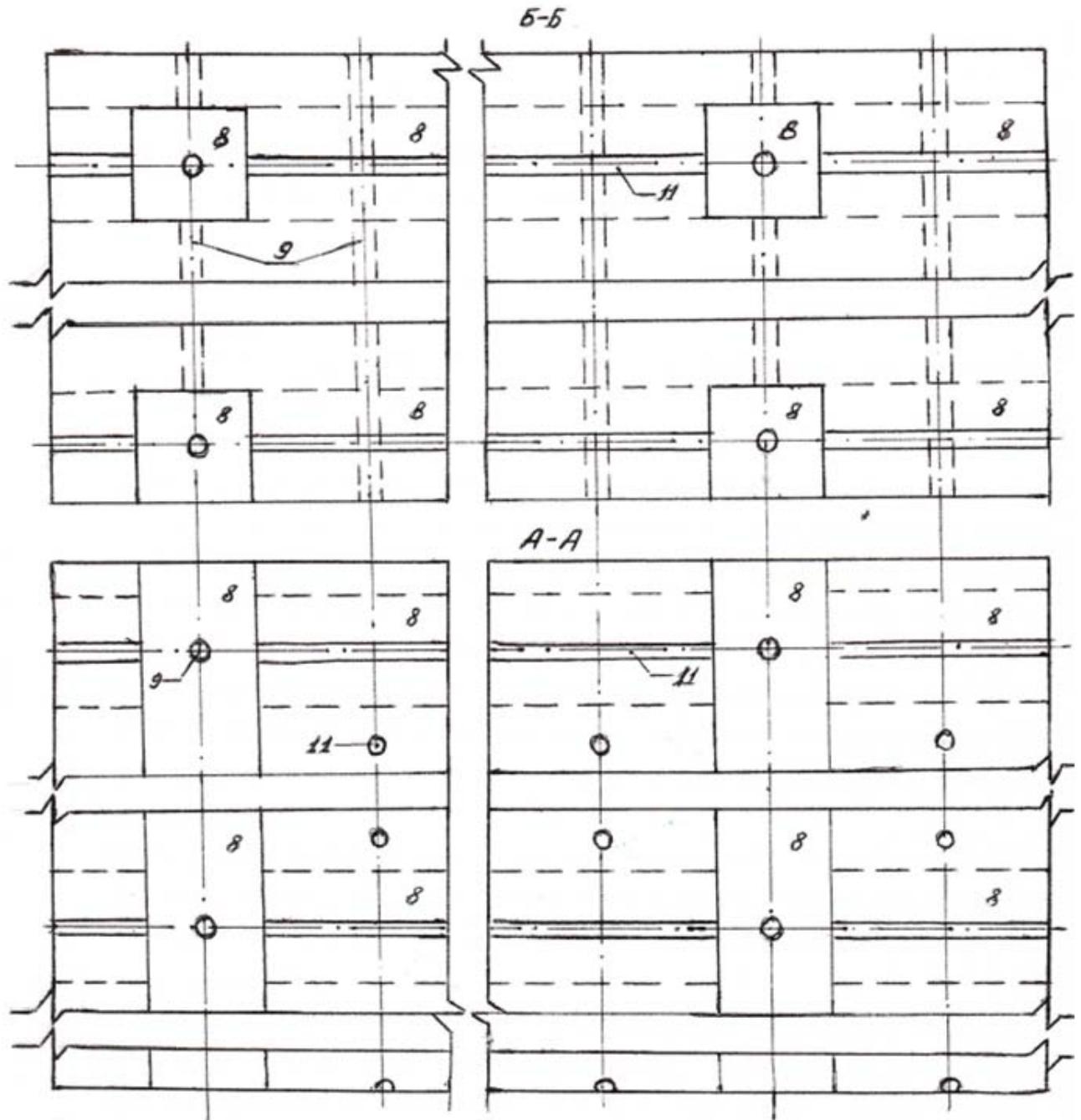
Legend: 1. Surface;
2. Ore body;
3. Portal of transport slope;
4. Skip-cage shaft;
5. Transport slope;
6. Combined underground complex for collection and processing of productive (working) solution;
7. Sectional drifts and cross-sections of injection-receiving and transport pipelines;
8. Sectional drifts and cross-sections for horizontal and vertical fracture-forming wells with cumulative charges;
9. Vertical and horizontal sectional injection-receiving wells for feeding leaching and productive (working) solution;
10. Surface set for preparation and feeding of leaching solution;
11. Vertical and horizontal wells for cumulative charges forming artificial permeability;
12. Injection stream of fresh air;
13. Outgoing stream of polluted air;
14. Commercial product after jigging, selection and sorption;
15. Recycled solution.
2) Considering such a possibility which, by all logic, should become a necessity one may extend the leaching process into the host rocks, which may contain dispersed metal accumulations, even if at much lower concentrations. Pushing further, up to a defined economic threshold, the process may also encompass the leaching of metals contained in primary and secondary geochemical halos. These
halos are currently used by geologists as indicators of the presence of an ore deposit.
In this way, within a preserved natural environment, a "resource-reproductive and resource-conserving" operational setting will be established at the mining and processing enterprise through the application of PCGT with underground borehole leaching.
It should be noted, however, that under natural conditions, which, at each specific deposit (enterprise), operate within a real environment shared with surrounding technogenic facilities, it will be necessary to create artificial barriers to prevent the leaching solution from migrating beyond designed boundaries. In such cases, the feasibility of extracting additional metal quantities outside the traditional ore body should be evaluated based on the solutions to the containment challenge.
The PCGT systems developed in the context described must necessarily be implemented as part of a unified production process conducted entirely underground, thereby eliminating the need for ore processing at a surface beneficiation plant.
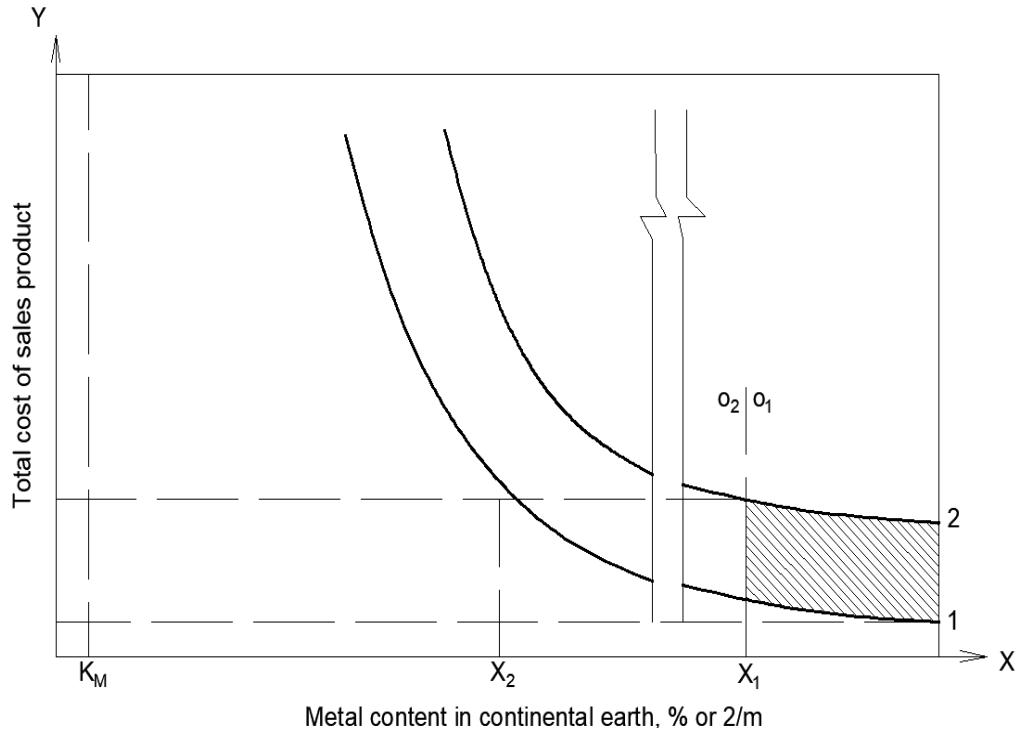
Fig. 14: Graph of the dependence of economic efficiency and additional reproduction of subsoil resources on the applied geotechnologies (FTGT or FHGT)
Legend: 1-new physical-chemical geotechnologies 2-traditional and new physical-technical geotechnologies;
O1-area of application of PHGT (Graph 1) and FTGT (Graph 2) within the limits of economically efficient application of both geotechnologies;
O2-area of economically efficient application of PHGT only;
X1 - minimum permissible industrial metal content in ore mined using FTGT;
X2-minimum permissible industrial metal content during its extraction from all sources within the "new mining boundaries" using PHGT; Km - metal clarke
1) At the same deposit, the use of PCGT compared to PTGT makes it possible to extract additional quantities of metal contained within the concentration range between $X_{1}$ and $X_{2}$ (representing metal content in the continental Earth's crust), with equal production cost.
The shaded area between Graphs 1 and 2, located to the right of the minimum permissible industrial metal content in ore extracted using PTGT, represents the economic gain derived from the application of PCGT (Graph 1) in comparison with PTGT (Graph 2).
2) The amount of additional metal producible by applying PCGT versus PTGT at the same unit cost is determined by the difference between the total metal quantity (defined by the upper content limit
specific to each deposit and metal, common to both geotechnologies) and the lower threshold, defined by metal content $X_{2}$.
Based on these findings and considering the metal sources that determine the possible production volume, we quantify the recoverable amount for each geotechnology PTGT and PCGT specifically for each deposit and type of metal (see Figure 15).
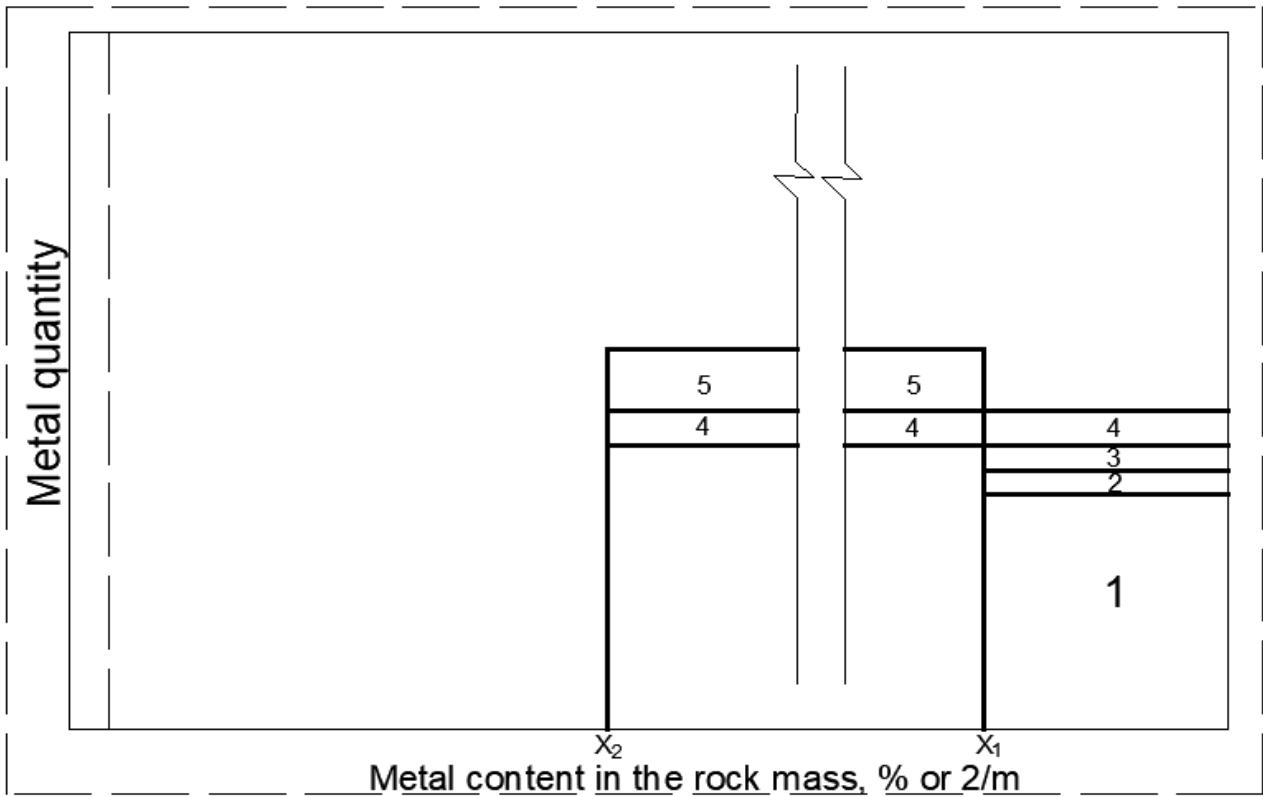
Fig. 13
1-primary georeources from balance reserves of traditional deposits, extracted using FHGT; 2- additional amount of metal from the use of the full current cycle of extraction and processing; 3-additional amount from the use of FHGT due to complete extraction during leaching and mineralogy; 4-additional production using FHGT from off-balance reserves of traditional deposits and from host rocks, 5-additional production using FHGT from geochemical halos and barriers due to a decrease in the value of X2
Note: Additional metal production from host rocks, as well as from geochemical halos and barriers, is possible provided that the dispersion of the leaching solution is not restricted by environmental requirements mandating the construction of a containment barrier.
The described technological scheme assumes a rejection of pumping the productive (working) solution to the surface via boreholes. Instead, the marketable products obtained through precipitation, extraction, selective separation by metal type, and sorption of precious metals are sorted underground and delivered to the surface either via skip hoisting systems or cage hoisting wagons, depending on the volume of extracted metals. If necessary, metal-rich concentrates can also be transported along the decline in buckets by load-haul-dump machines.
A comparative economic analysis between the existing full-cycle PTGT-based subsoil development technology and the proposed PCGT approach using underground leaching is conducted using the performance indicators for mining 1 million tons of ore from a notional deposit with an average monometallic grade of $1\%$ (i.e., 10,000 tons of contained metal in the ore):
- Using PTGT, $98\%$ of metal from traditional balance reserves is recoverable, which equals 9,800 tons of marketable metal product from 1 million tons of ore.
- Using PCGT, sub-economic reserves with a metal grade below $0.3\%$ (average content of $0.2\%$, i.e., 2,000 tons of metal) can also be extracted in addition to the 10,000 tons from balance reserves.
- Additionally, from host rocks and geochemical halos, depending on the economically viable minimum cut-off grade for PCGT with underground leaching, another $0.05\%$ can be extracted. This equals an extra 500 tons of metal per 1 million tons of ore processed.
- Therefore, the application of PCGT enables the total production of 12,500 tons of metal from the same quantity of balance ore reserves (10,000 tons), delivering a $27.5\%$ increase in production compared to PTGT.
- The resource reproduction achieved using PCGT amounts to 2,500 tons, which is $25\%$ more than what was originally explored and approved as reserves in the subsoil under standard classifications.
#### III.3. The Concept Realized through two Interconnected Paths
The concept embedded in the outlined task appears to be addressed through two seemingly independent approaches. However, a deeper analysis of the essence of these two systems reveals their strong interconnection, which can, at first, create highly positive synergy, yet if left uncontrolled may eventually transform into a counterproductive force.
1. Based on this practical application of the universal law of reality, we should not separate extremes in this case, the natural and technogenic environments, both consisting of the same fundamental matter. On the contrary, we must master the whole system i.e., the total volume of available metals as a single organic entity in which opposing components interpenetrate and mutually define the entire process of its evolution.
Through such integrated development, we reproduce the integrity and growth of our key objective: metal production. This deliberate integration of all components into a coherent and mutually beneficial system of previously polarized elements requires the creation of an organizational and technical management mechanism. This mechanism must be multilevel and aligned with market demands and tailored to the production of each metal individually a financial and economic model with built-in responsiveness [54,55].
2. As previously emphasized, a fundamental challenge arises when establishing a permanent circular economy system. The production of metals from primary georesources and the return of previously used and manufactured metals into the resource cycle not only creates an economically favorable reserve from out-of-subsoil sources but also results in the surplus of metal that may not be immediately consumed.
For instance, the global annual steel production amounts to around 2.1 billion tons (according to 2025 forecasts). Simultaneously, up to 1.0 billion tons of scrap metal could enter the market if governments globally mandate its recovery as a formal policy objective.
However, if this entire volume were actually reintroduced into circulation, then despite growing consumption $85 - 90\%$ of mines, concentrating plants, and metallurgical enterprises (blast furnaces, coke batteries, steelmaking units) would face the necessity of closing, since the market would not absorb the more expensive new metal. Customers would favor the significantly cheaper scrap.
At the same time, it must be considered that, within a few years, human civilization may find itself without steel or pig iron, because with the closure of mines, there would be nothing left to enrich or process. Restarting once-shut operations would be necessary, but keeping these facilities on standby for resumption of full-scale operations requires tremendous expense and logistical planning especially for underground mines, whose maintenance in operable condition is particularly costly and complex.
Moreover, not only mining enterprises but also transport, energy, housing infrastructure, along with factories and plants, would need to be preserved in a state of readiness. The workforce qualified personnel across all sectors must also be retained and prevented from dispersing in such intervals of downtime.
The same unresolved challenges are also expected to confront those enterprises responsible for the collection, transportation, storage, processing of scrap metal, and the distribution of recycled products excluding the fraction integrated into infrastructure and structural elements designed to last centuries.
A solution exists: Considering the global scale and significance of the issue, it is necessary perhaps starting at the United Nations level to officially recognize the imminent risk of depletion of classical metal reserves in traditional deposits as catastrophic. In light of this, it is proposed to establish an International Committee for Securing Metal Resources for Global Civilization.
This committee should, in turn, be tasked with drafting and submitting for ratification by the UN General Assembly the following key documents:
- A Global Programme for the Identification of Metal Production Sources, and
- A Subprogramme for the Operational Management and Strategic Development of a Circular Economy in Metal Production.
Each metal, based on its level of reserve availability (from both subsoil and technogenic sources) in comparison with forecasted demand, should be formally accounted for within these programmes. Crucially, this should include country-specific distributions of supply and demand to guide coordinated action on national and international levels.
3. The interdependent metrics of metal production volumes from both subsoil-based traditional sources and circular economy-based technogenic sources may, in the absence of a controlled and well-regulated organizational system, result in the collapse of the intended benefits. Rather than achieving a sustainable reduction in the use of primary georesources, such disorganization could trigger a crisis disrupting the stable supply of metals to the global economy.
The movement of metals in the system of "natural environmental resources" and "technogenic resources outside the subsoil" can be approximately, with an annually changing provision coefficient K0, represented in the following form:
1) MGS = MTS + MNO, where M is metals, GS and TS are, respectively, geological and technological environment, HO is the non-returnable volume, consisting for each individual period of time (year) of a volume that is non-returnable for a long time (including never) (foundations of capital long-term structures, railways on the surface and in underground infrastructure, long-term pipelines, mine support, water transport, etc.), losses (wear to a powdery state, in underwater, underground and outer space) and temporarily non-returnable (machines, equipment, units, structures that have an amortization service life) with a return run-up of very different durations.
2) MGS + MTS = PPM, where PPM is the practical required quantity of metal (PPM ≈ 1.02 RPM, where RPM is the estimated demand for metal).
The new volume included in the required production quantity will, firstly, have a tendency to constant growth due to the growth of the economy (the growth of the population and its welfare). But the growth will be uneven, since the return to circulation of the once produced metal will be uneven over the years due to objective and subjective fluctuations in the volumes of the temporarily non-returnable volume.
This final component will play a decisive role in the reproductive cycle of the circular economy. Therefore, each metal producer from both geological and technogenic sources within the subsoil, as well as technogenic sources outside the subsoil every consumer of these products, and every production and intermediary organization participating in public-private partnerships must maintain a joint accounting system for the acquisition and return of metals.
This accounting, combined with a comprehensive program for coordinating viability and production volumes from both subsoil and technogenic sources, establishes an economically efficient balance that renders the raw material base for metal production effectively inexhaustible over a historical timescale.
Such coordination creates an operational framework for maintaining safe and minimal fluctuations in the capacities of existing mines, concentrators, metallurgical plants, and machinery manufacturers. It also underpins policy decisions regarding the storage of surplus ores, concentrates, metals, and finished metal products (e.g., rails, pipes, rebar, engines, equipment, machines, units, tools, etc.).
Based on this model of an organizational and technical control mechanism jointly monitored by both producers of primary metal (from both source types) and consumers across the value chain (such as factories that purchase metal of various grades, chemical compositions, and physical forms to manufacture a wide array of products needed by the economy) a comprehensive system is defined. This includes:
- Production capacities
- Logistics programs
- Warehouse storage volumes
- Planned shutdowns for maintenance and modernization
- Trade volumes and schedules for delivery operations
This concept of a closed-loop natural-technogenic cycle under managed conditions, as a new direction in the economics of metal production, forms the structural foundation for the broader development of the circular economy, which is now expanding across all dimensions of human activity [56,57].
In the field of metal production, its key advantages are resource conservation and resource reproduction enabled through the synergistic integration of the principle of "creative subsoil development" with the technogenic metal resource base originating from sources outside the subsoil.
The definition of roles, technological interconnections, and the comparative categorization of the two coordinated metal production sources are presented in the proposed Unified Technological Classification (Figure 16) and the Classification of Technological Principles for the Full Development of Primary and Secondary Georesources in a Closed Natural-Technogenic Cycle and Managed Regime (Figure 17).
## IV. CONCLUSION AND FINDINGS
The establishment and implementation of the principle of "creative development of the subsoil," which ensures resource reproduction, resource conservation, and preservation of a high-quality natural environment, is considered at the initial stage of scientific research to represent a fundamental improvement in the integration of these requirements, based on transforming the underlying structure and operations of existing mines.
IV.1. An analytical review of current mining operations and scientific advancements in reducing extraction losses and preserving the stopping and near-ore spaces reveals the predominant application of Physical and Technical Geotechnologies (PTGT), including those integrating surface and underground mining practices within a single deposit.
1) The resulting diversity of technologies is enabled by drilling and blasting techniques for ore fragmentation, hardening backfill to reduce losses
and dilution, and to aid in preserving the natural environment outside the stoping area.
2) A full-cycle development of ore deposits is achieved through the design of mining and engineering systems that incorporate the processing of secondary georesources formed during the extraction of primary resources within the subsoil mass and their surface processing, including waste dumps and industrial residues.
3) The research carried out while maintaining the key functional conditions of PTGT involving alteration of the structural state of the ore body via disintegration has been directed toward ensuring complete
preservation of the natural environment with all its components within the subsoil mass and around the ore-forming space, while also achieving a significant reduction in technogenically generated secondary georesources on the surface.
Thus, the proposed nature-technogenic systems, under the necessary condition of altering the structural state of the ore mass, significantly reduce the formation of technogenic secondary georesources, focusing the extraction process on nearly loss-free recovery with substantially reduced dilution of primary georesources only.
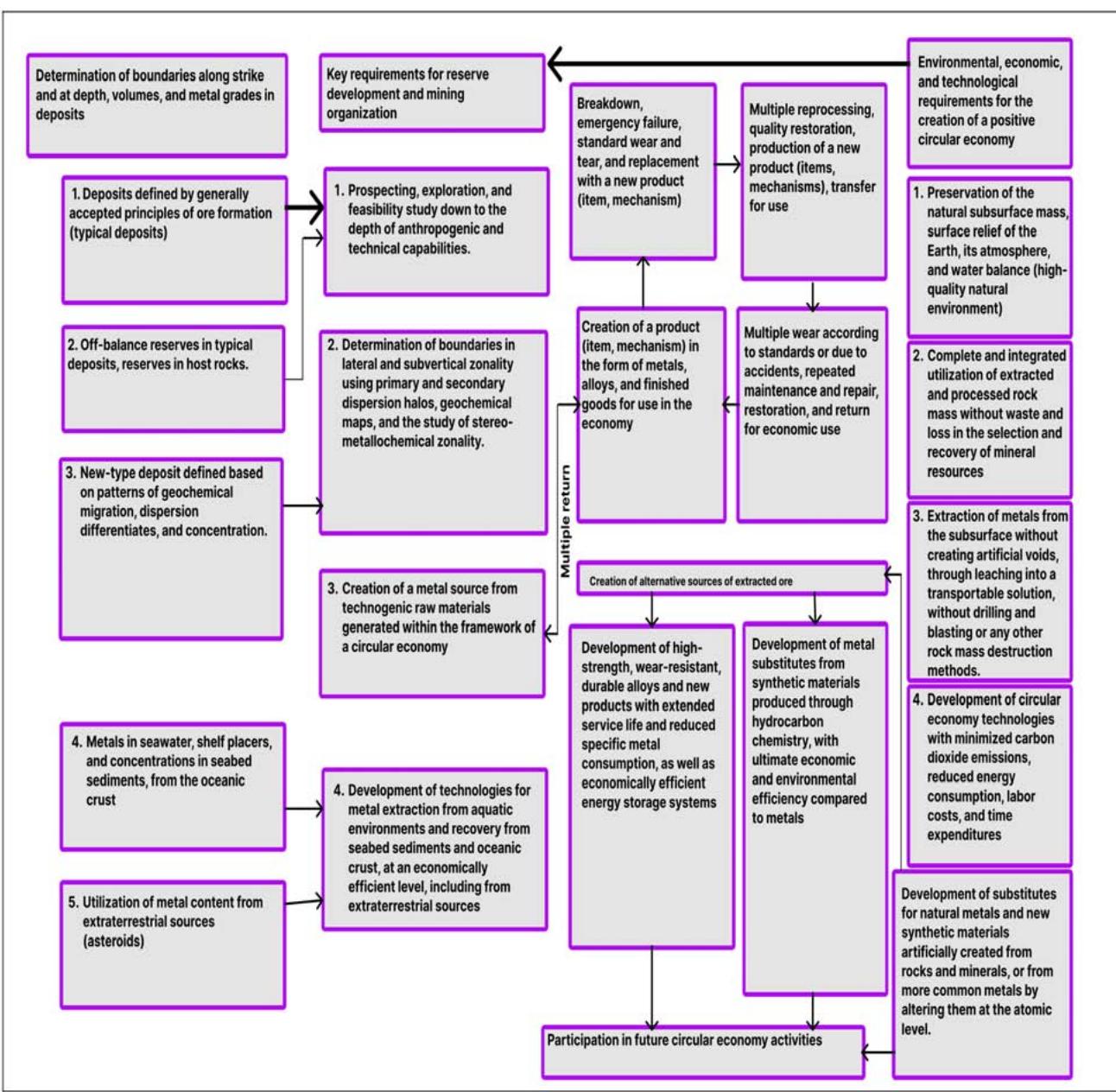
Fig. 16: Combined technological classification of the complete development of primary and secondary georesources from the subsoil in new mining boundaries in a controlled format of a circular economy of metal use and meeting the needs of humanity on a historical time scale
e e e e e e e e e e e e e e e e e e e e pee eoe eoeae eoeae eoeae eoeae eoeae eoeae eoeae eoeae eoeae eoeae eoeae eoeae eoeae eoeae eoeae eoeae eoeae eoeae eoeae eoeae eoeae eoeae eoeae eoeae eoeae eoeae eoeae eoeae eoeae eoeae eoeae eoeae eoeae eoeae
Ae eae eae eae eae eae eae eae eae eae eess
$\therefore m - 1 \neq 0$;
sees
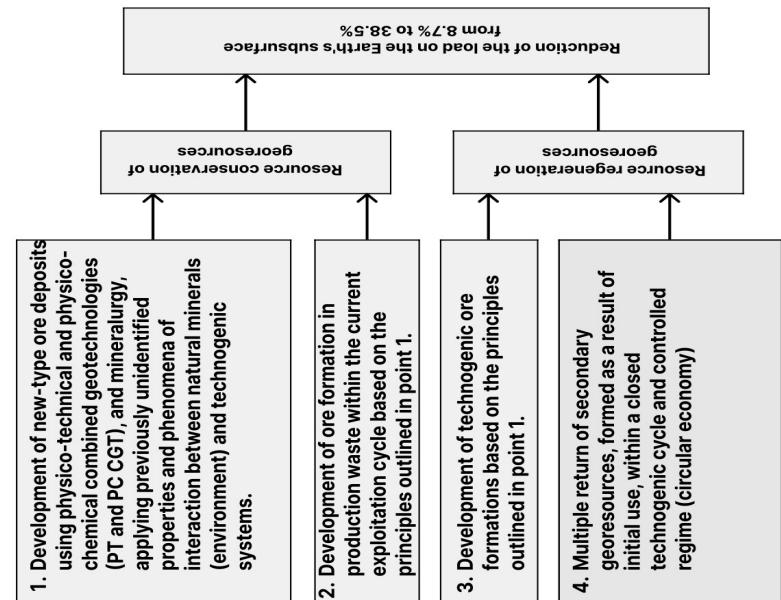
Fig. 15: The amount of metal that can be produced using FHGT and FTGT by new technogenic resource production and resource conservation systems in addition to traditional reserves.
### eessssssss
pseqqnneennnnne e e
0000 nne nnnnne
jouonnueounpuie e e e e e e e e e e e e e e e e e e e e e e e
### e 2
nne nnnnne nee e e e e
s e eee
pue'sdunnpoeaepeq eae
se mse (saa) puesss
ss
XiepuoSe y
e e
M
(1)
((fuiu023jipn21)
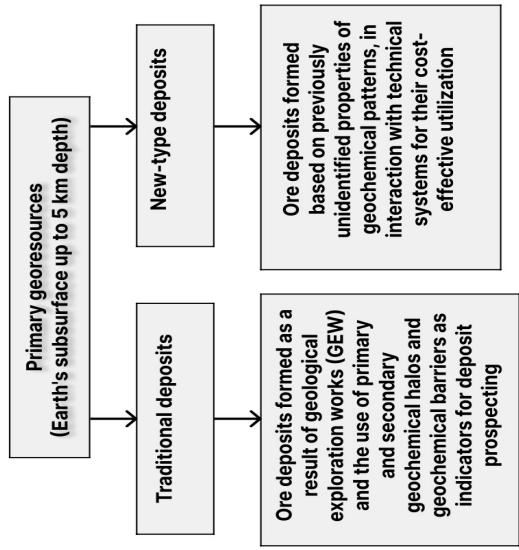
eppepepepepepepepepepepepepepepepepepepepepepepepepepepepepepepepepepepepepepepepepepepepepepepepepepepepepepepepepepepepepepepepepepepepepepepepepepepepepepepepepepepepepepepepepe
IV.
2. Regarding Subsoil Development based on Physical and Chemical Geotechnologies (PCGT), the Conclusions and Key Findings Are as Follows:
#### 1) Research results confirm the feasibility of achieving the highest levels of effectiveness in realizing the
objectives of creative subsoil development through the application of PCGT utilizing underground borehole leaching.
By preserving the natural diversity of the surrounding environment and maintaining the integrity of the subsoil mass, the implementation of PCGT in the proposed technological and structural format becomes a source of both resource reproduction and conservation.
Initial estimates though requiring further refinement indicate a potential increase of up to $25\%$ in recovered metal, based on the $100\%$ utilization of balance reserves in traditional deposits.
2) The proposed technological and structural integration of this nature-technogenic system forms the foundation for a new vision of the underground method of subsoil development. It stands out among possible alternatives as the most economically efficient and operationally safe model for implementing the core essence of the principle of "creative development of the subsoil."
3) The technological scheme has been structurally optimized for applicability within morphologically diverse geological environments such as massive isometric stockwork-type ore bodies and others.
4) The practical implementation of PCGT with underground borehole leaching raises highly complex and responsible challenges for researchers and mining professionals. These challenges arise from a constellation of interrelated issues in mining-industrial geology, technological mineralurgy, rock mechanics, and engineering. They also include the challenge of creating full-volume artificial permeability within a solid rock mass, alongside the development of corresponding analytical methodologies and technical designs for cumulative explosive devices, and the strategic placement of these devices according to blast design protocols within fracture-inducing boreholes.
To develop a technology for pre-creating a comprehensive fracture and pore network, which will ensure full accessibility of the leaching solution to all ore-bearing zones mapped through technological mineralogical studies, the idea of joint-sequential hydroblasting treatment of the ore body has been explored.
A method previously applied in coal seam degassing designed to induce controlled gas permeability and gas yield is now proposed for impulsive stimulation of ore body sections by vertical or horizontal boreholes, drilled in advance. Cumulative charge blasting within these boreholes would then generate directed impulse pressure, acting in concert with solution injection through leaching boreholes from the surface, to achieve full penetration and efficiency of the leaching process.
The minimum value of stress 6ckB on the well contour for the formation of cracks in the radius of the crack formation zone Rtpe is determined by the formula
$$
\sigma_{ckb} = \sigma_{ck} \frac{R_{tp}}{R}
$$
where $\mathbf{6c}\mathbf{x}$ - ultimate compressive stress, MPa; r- well radius, m.
The minimum duration $\tau$ of the pulsed impact on the massif by a continuous compression wave was determined taking into account the failure condition according to the Griffith criterion from the expression
$$
\pi^ {2} |
$$
$$
\tau = - - - -,
$$
C where I is the crack length, m, s is the speed of sound in the massif, m/s.
Given a seismic wave velocity $c = 900 \, \text{m/s}$, the crack length formed in the ore body mass may range from approximately 9 to 13 meters.
The detonation of cumulative charges, while generating additional fracture networks, must be carefully calculated so as not to cause collapses within adjacent or service workings such as sectional drifts, tunnels, and leaching boreholes and without ejecting rock mass from the boreholes.
Cumulative charges used for the controlled creation of a fracture network in a monolithic rock mass play a beneficial role as mechanical agents for exposing ore zones. They operate based on the effect of concentrating explosion energy in a particular direction and/or location.
For demonstration and industrial testing, it is recommended to use cord-type cumulative charges (IIJK3) in various configurations, depending on the orientation of boreholes (vertical or horizontal), borehole diameter, distance between boreholes, placement of charges within adjacent boreholes, and detonation sequence.
The explosive concentration effect, i.e., energy cumulation, is most effectively achieved by focusing the explosion wave in a specific direction, particularly using a reflective surface shaped like a paraboloid of revolution. When detonated, the shock waves focus at the parabola's focal point and, upon reflection, are redirected into the ore mass for maximum impact.
Since the theoretical efficiency of cumulative charges is approximately 2.5 times greater than that of conventional cylindrical charges extended along boreholes, their use results in savings in explosive materials and larger spacing between boreholes. Furthermore, as blasting is not intended for direct ore breakage but rather for creating abundant fracture permeability enhanced by sequential pressurized injection of leaching solution the costs of drilling and blasting will further decrease.
It is also advisable to explore, in future research, the feasibility of using boreholes in each vertical section simultaneously for leaching solution injection and for the deployment of cord-shaped cumulative charges (IIJK3) within the same boreholes.
5) The ore volume extracted during the development of transport declines, sectional tunnels, and service openings for laying pipelines (for both leaching and productive solution transport), as well as for the installation of horizontal and vertical fracture-inducing boreholes, represents approximately $6\%$ of the reserves. This material, fragmented through conventional borehole blasting, will produce uniformly fine-grained rock mass, which can be effectively processed on the surface via continuous heap leaching.
6) The use of chemical reagents that produce gaseous byproducts in free form, potentially hazardous during decomposition, necessitates preventive surface-level measures for neutralization. For example:
- Chlorine gas must be fully dissolved in chlorinated water, thereby ensuring both economic efficiency shouldentire promoting
# 3. On the Role and Place of the Circular Economy in the Overall
1) The primary conclusion distinguishing the fundamentally new direction from the principles of subsoil development that prevailed until the last quarter of the 20th century (and were accompanied by ever-increasing scales of mineral resource extraction) is the growing recognition of the necessity to develop subsoil using reproductive and resource-conserving technologies, with mandatory management by technogenic systems that provide preservation and self-restoration of ore-forming environments.
2) The establishment of a mandatory, permanent public-private management body, tasked with defining principles governing the interaction between sources of metal-bearing raw materials both in the natural environment (subsoil) and in technogenic environments outside the subsoil created within the framework of a closed-loop circular economy in turn enables a synergistic solution to the two-dimensional challenge of guaranteeing metal security for civilization throughout human history.
3) Both pathways operating in coordination toward a unified goal create the conditions for controlled, economically efficient, safe, and technologically feasible metal production, all while preserving the natural living environment in all its aspects.
4) The integration of "creative subsoil development" with a circular economy based on a fully repeating (endlessly-cycling) return of previously produced metals to their initial state provides a foundation for the practical use of several new scientific concepts:
- "Useful raw material base" - which, within the subsoil, contains significantly more metal than the balance reserves determined by traditional geological exploration;
- "Technogenic raw material base" and "technogenic material world of the subsoil-external metal resource base" - representing the additional quantity of metals recoverable from secondary resources formed through new geotechnologies within the subsoil.
5) Modern mining and processing operations, functioning in tandem with the closed-loop return cycle of the circular economy, must eliminate losses in efficiency caused by human factors in hazardous industrial conditions. Therefore, there is a need for a technological management mechanism incorporating:
- Centralized dispatch/control systems - ensuring oversight of efficiency and productivity at every stage of production;
- The use of big data – to eliminate inefficiencies and improve synchronization across technological processes;
- Video analytics and computer vision systems – for automated data collection and process control in areas where human perception cannot keep up due to excessive complexity or speed;
- Corporate cooperation platforms - to simplify and accelerate interactions between teams or personnel roles within an enterprise. In the future, such systems will facilitate machine-to-machine (M2M) coordination;
- Predictive analytics tools – that monitor the health and forecast the behavior of machines and equipment critical.
The goal of creating a historically inexhaustible raw material base for metals capable of meeting the demands of global civilization in a controlled and sustainable manner and realized through the principle of "creative development of the subsoil" can be safely achieved for both humans and the environment, and efficiently for the economy. This is possible through the combined use of subsoil contents and technogenic products formed outside the subsoil as a unified ore source.
The technogenic component formed outside the subsoil, in turn, arises from two independently occurring phenomena of technogenic transformation from raw materials originally derived from the subsoil:
a. The first technogenic product refers to all surface-stored intermediate waste: waste dumps of subeconomic ores, sludges, slags, clinkers, tailings, and others.
b. The second technogenic product is the reconverted mass of metal previously extracted from subsoil contents and transformed back into a usable resource.
A technological solution that enables theoretically endless reuse of the same metal, along with the organization of such production processes serving as the essence of the circular economy in the mining and metallurgical sector can result in annual savings of $8.7\%$ to $38.5\%$ in metal extraction from subsoil resources.
The variability of this production efficiency derives from the need to balance the interactions between the geological environment and the technogenic resource base within the circular economy, ensuring the continuous operation of both sources. Incomplete reuse of previously manufactured metals is explained by their incorporation into irretrievable structural applications, such as long-life foundations and reinforcement embedded in buildings and infrastructure.
6) A review of the current metal raw material base allows for the recommendation to prioritize scientific research at a number of key deposits in the Republic of Kazakhstan.
Deposits of non-ferrous metals are currently under consideration both those previously explored and those still being prospects. These should be prioritized for study with regard to their suitability for the application of underground leaching technologies, with the dual objective of comprehensive development of primary georesources while also preserving the quality of the natural environment.
- One such site is the Shalkiya lead-zinc ore deposit, which contains the largest reserves of ore and metals within the CIS. It consists of gentle-dipping, bed-like layers of sulfide ores with widths ranging from 6.0 to 15.0 meters.
Until 1990, the deposit was accessed via vertical cage and skip shafts, and a transport flank incline with a cross-section of $20\mathrm{m}^2$. The reserves were initially confirmed in 1983. However, at the turn of the 21st century, the owner revised the reserve estimates raising the cut-off grades for zinc and lead. As a result due to reasons still unexplained the zinc content was increased $\%$ tonage decreased 15 and processing million tons undwithin a 5 the results grades across-off grades metal losses currently designed20
- The Kyzylkayin copper-gold deposit, characterized as a vertically descending stockwork system reaching depths of up to 400 meters and containing approximately 1.2 million tons of copper and 60–70 tons of gold, is situated in a protected natural zone where open-pit mining and blasting are prohibited. This site can and should be developed using Physical and Chemical Geotechnologies (PCGT) via underground leaching.
The proposed projects, which are ready for full-scale technical planning and design, could serve as pioneering examples of successful underground leaching-based PCGT application. These selections were made based on initial evaluations using technological mineralogy and mining-industrial geological analysis.
Mining and geological sciences, as a prerequisite for societal prosperity, are once again at the forefront of the technological revolution and serve as a foundation for the future. This paradigm is being reaffirmed by emerging opportunities, each of which could significantly expand the metal resource base in the years to come (see Fig. 19). The scientific and practical challenges relating to their development remain to be addressed to guarantee the principle of continuous substitution between sources.
The key directions are summarized as follows:
1) The current resource assessment is based solely on reserves within the continental Earth's crust, with estimates limited to depths of 5 kilometers and 25–30% of the Earth's surface area, due to both natural and technogenic constraints.
2) It excludes resources from the oceanic Earth's crust, including deposits of metallic minerals in the continental shelf and deep-sea environments notably in the form of placer deposits, ferromanganese nodules, and dissolved elements in oceanic waters.
This long-anticipated area of development is now rapidly progressing toward practical utilization, as shown by key presentations made at the 37th International Geological Congress in Busan, South Korea, August 2024:
- The Norwegian Geological Survey, based on seabed exploration between Norway and Greenland, announced discoveries of three polymetallic deposits, with the following resource estimates:
- Copper (Cu): 28.4, 38.1, and 47.6 million tons
- Zinc (Zn): 35.6, 45.0, and 45.3 million tons
- Cobalt (Co): 0.6, 1.1, and 1.3 million tons
- Silver (Ag): 64,870; 85,200; and 105,530 tons
- Gold (Au): 1,755; 2,317; and 2,856 kilograms
- Manganese (Mn): Including elements applications been developing built facilitybatch pumping via researchers in amount) -temperature naturally and evaluatedable metals-rich These identified reserves theirization conceptsge ge of10 enabling a.
#### ACKNOWLEDGMENTS
The authors express their sincere gratitude for the opportunity to share their thoughts and judgments with geologists, mining engineers, mineral processors, metallurgists, and economists by publishing this work in such a respected journal.
We hope that, thanks to the organizers of this publication, we will have the opportunity to engage in dialogue, receive valuable feedback, and be invited to collaborate on meaningful and mutually beneficial future initiatives.
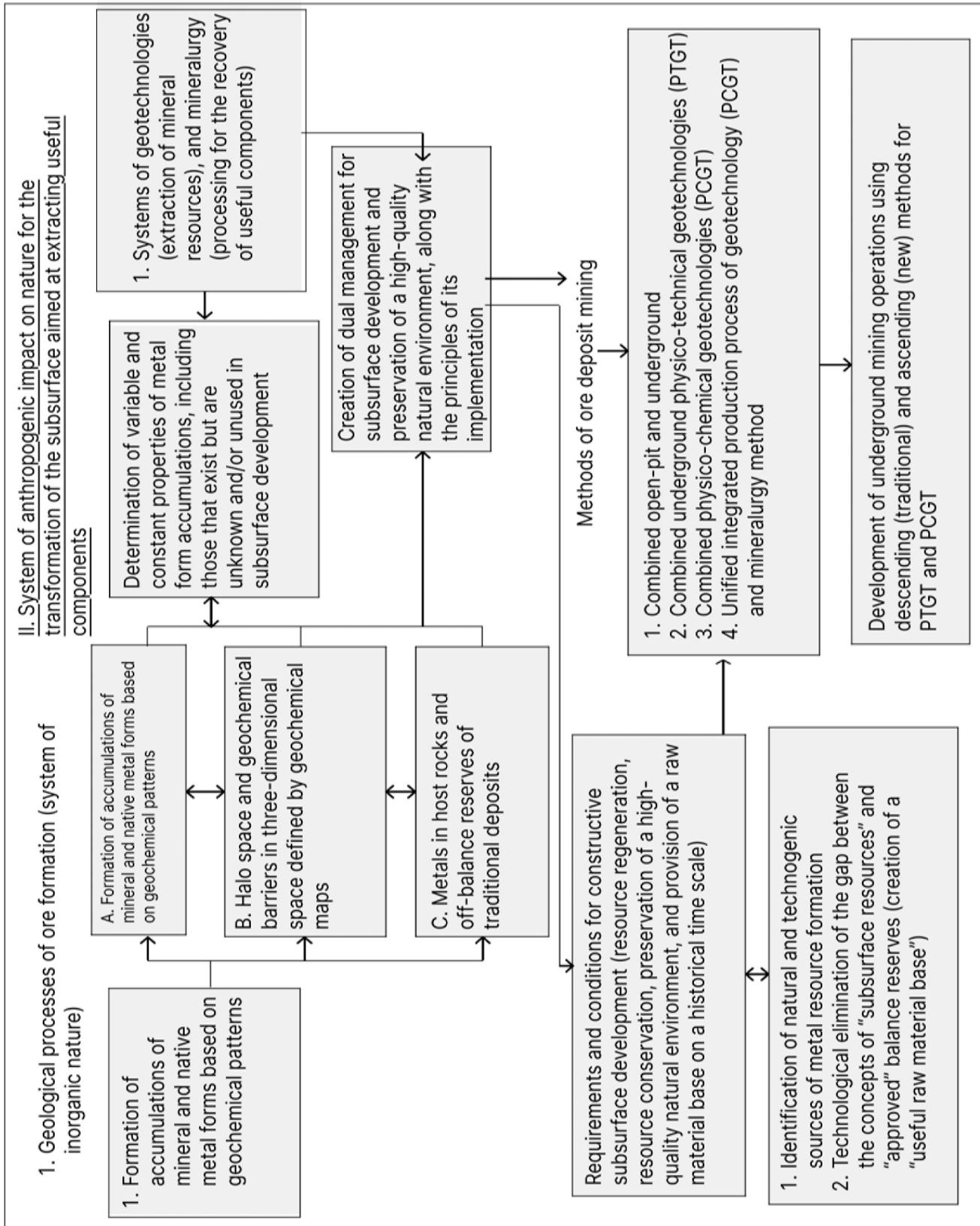
Fig. 19: Schematic diagram of natural-technogenic creative development of the subsoil
Generating HTML Viewer...
References
47 Cites in Article
M Bitimbaev,Zh,M Kunaev,A Konakbaev (2024). Geological and technogenic support for integrated development and preservation of subsurface resources during the exploitation of ore deposits.
K Trubetskoy,Yu. Galchenko,A Myaskov,V Eremenko (1997). Creation and justification of convergent technologies for underground mining of thick solid mineral deposits.
Vitaly Lytkin (2023). PRACTICE OF DISCOVERY OF BLIND ORE DEPOSITS OF HYDROTHERMAL-SEDIMENTARY GENESIS.
M Kunaev,M Bitimbaev,Zh (2025). Phenomenon of the formation of combined accumulations of metals in ore deposits.
Yu Galchenko (2022). Natural-technical system for deposit development using convergent mining technology. // Problems and Prospects of Integrated Development and Preservation of the Earth's Subsurface.
K Trubetskoy,Yu Galchenko (2020). Nature-like technology for integrated subsurface development: problems and prospects.
V Golik,A Vyskrebenets,R Mirgaliev,K Mulukhov,V Khetagurov (2024). DIRECTIONS OF MODERNIZATION OF UNDERGROUND ORE MINING TECHNOLOGIES.
S Abilkassova,L Kalimoldina,Zh. Moldagazyeva (2020). PROBLEMS AND PROSPECTS FOR THE INTRODUCTION OF MASS OPEN ONLINE COURSES IN HIGHER EDUCATIONAL INSTITUTIONS.
M Bitimbaev,Zh,M Kunaev,E Aben,Kh,D Akhmetkanov Integrated subsurface development and preservation of a high-quality natural environment -the foundation of sustainable social development: Monograph.
G Sekisov,A Cheban (2021). Low-Waste Mining Technology for Structurally Complex Deposits with Mixed-Type Process Flows of Ore Extraction and Processing.
K Trubetskoy,M Rylnikova,D Vladimirov,I Pytalev (2022). Provisions and prospects for introduction of robotic geotechnologies in open pit mining.
K Trubetskoy,Yu Galchenko (2010). Fundamentals of Mining: Textbook.
Joel Loow (2022). Understanding technology on mining and its effect on the work environment.
M Bitimbaev,Zh,V Shemyakin,S Skopov (2016). Xray radiometric beneficiation of copper and copperzinc ores in Kazakhstan.
M Bitimbaev,Zh,K Kozhagulov,I Dzhumabayev Ye (2016). Formulation of the task for qualitative improvement of the technical and economic indicators of heap leaching.
M Zh,Kh Bitimbayev,E Yusupov,N Jumabaev Fedotenko-Mixed-type geotechnologies are the basis for cost-effective, safe and ecologically balanced development of ore deposits // Eurasian Mining.
V Driban,B Khokhlov,N Dubrova,M Rozhko (2024). Practice of applying a new approach to assessing the permeability of a mined rock mass. // Problems and Prospects of Integrated Development of the Earth's Subsurface.
K Trubetskoy,Yu. Galchenko,A Shuklin (2024). High-efficiency geotechnology for integrated development of flat and inclined lodes.
V Arens,Zh,E Boguslavsky,O Gridin (2002). Prospects for Using the Physico-Chemical Methods of Hard Mineral Mining.
K Trubetskoy,S Viktorov,A Osokin,A Shlyapin (2024). Rockburst prediction based on submicron particle emission in rocks under deformation and failure.
V Arens,Zh Physico-chemical Geotechnology: Study Guide.
A Chadinova,N Kurmangalieva,T Eszhanov,J Niyazbekov,B Yertayeva (2023). GREENING TECHNIQUES OF THE SYSTEM OF PROTECTIVE MEASURES AGAINST PESTS OF TOMATO.
L Ovchinnikov (1990). Applied Geochemistry.
I Aynbinder,Yu. Galchenko,O Ovcharenko,P Patskevich (2022). Basic trends of advance in geotechnologies for deep-level ore mining.
M Zh,M Bitimbayev,Kunayev (2023). Geotechnologies and Minerallurgy for the Production of Metals from Deposits of new Type.
A Sekisov,A Lavrov,Yu,Yu Rubtsov,A Rasskazova,T Konareva (2021). Physico-chemical geotechnologies for the development of deposits in the Far Eastern Federal District.
A Perelman (1989). Geochemistry: Textbook for geology majors in universities. -2nd.
Unknown Title.
V Eshkin,Yu (1989). Prospecting Mineralogy and Mineralogical Mapping.
S Tsoy (2011). Fundamentals of Designing the Mine of the Future: Study Guide.
V Ershov (1988). Fundamentals of Mining and Industrial Geology.
V Kiryukov,N Ochkour,M Pozhidaeva (1985). Mine Geology: Textbook for Universities.
A Betekhtin Course of Mineralogy: Study Guide.
V Rzhevsky,G Novik,Ya Fundamentals of the Physics of Rocks. 3rd edition.
I Plaksin (1943). On the influence of mineralogical composition on the extraction conditions of precious metals during the beneficiation of polymetallic ores.
V Revnivtsev (1982). The role of technological mineralogy in the beneficiation of mineral resources.
A Galperin,V Yermolov (1993). ERRATA.
A Bybochkin (1995). Environmental safety in the exploration and development of solid mineral resources: Report at the scientific and technical conference.
M Cai,P Li,W Tan Key Engineering Technologies to Achieve Green, Intelligent and Sustainable Development of Deep Metal Mines in Chine.
Kuikui Hou,Mingle Zhu,Yingjie Hao,Yantian Yin,Long An Stability analysis and evaluation of surrounding rock of ultra-deep shaft under complicated geological conditions //Front.
K Trubetskoy,Yu. Galchenko,A Shuklin (1990). High-efficiency geotechnology for integrated development of flat and inclined lodes.
A Feldbaum (1972). List of contributors.
M Barsky,E Barsky (2020). Criterion for efficacy of separation of a pourable material into N components.
M Bitimbaev,Zh,M Kunaev,A Yusupov Kh,I Dzhumabayev Ye (2024). Physico-technical geotechnology of full resource-reproducing and resource-saving subsoil development using upward underground mining.
M Bitimbaev,Zh,A Yusupov Kh,E Aben,Kh (2024). Method for Developing Deposits by Horizontal Layers with Backfilling" // Committee on Intellectual Property, Ministry of Justice of the Republic of Kazakhstan.
Sayat Alimkulov,Aisulu Tursunova,Assel Saparova,Kairat Kulebaev,Alfiya Zagidullina,Ahan Myrzahmetov (2024). Resources of River Runoff of Kazakhstan.
No ethics committee approval was required for this article type.
Data Availability
Not applicable for this article.
How to Cite This Article
Marat Bitimbayev. 2026. \u201cIdeology of development of the material basis of civilization in the format of creative development of the subsoil in the 21st century\u201d. Global Journal of Science Frontier Research - H: Environment & Environmental geology GJSFR-H Volume 25 (GJSFR Volume 25 Issue H1): .
Explore published articles in an immersive Augmented Reality environment. Our platform converts research papers into interactive 3D books, allowing readers to view and interact with content using AR and VR compatible devices.
Your published article is automatically converted into a realistic 3D book. Flip through pages and read research papers in a more engaging and interactive format.
Our website is actively being updated, and changes may occur frequently. Please clear your browser cache if needed. For feedback or error reporting, please email [email protected]
Thank you for connecting with us. We will respond to you shortly.