
I. INTRODUCTION
Live music is part of the larger set of activities, artistic expressions and creative practice that is part of the African cultural and creative economy (CCE). It is well accepted that the cultural value chains of the African CCE, and here live music in South Africa is no exception, pride themselves in strong creation and innovative artistic and collective creativity which is inspired by a rich heritage, strong traditions, and authentic cultural expressions. South Africa, unlike many of our counterparts on the continent (Joffe 2021), has a relatively well-functioning live music value chain with strong production technologies, efficient distribution mechanisms, appropriate infrastructure for exhibition and a few important support industries. It is unique in having a strong system of governance for culture (Joffe et al. 2019) with albeit flawed or inadequate policies, funding systems, institutions, legislation and cultural infrastructure. Nevertheless, work in the Global South CCE is dominated by informality and COVID 19 has had an enormous impact on the work life and identity of cultural workers and cultural practitioners.
This informality underpins the atypical nature of cultural and creative work which is characterised by insecurity, precarity and uncertainty. The CCE thrives on innovation and creativity so that in an environment where policies cohere with public and private funding and programmes, the youth would be poised to take full advantage of the opportunities to grow the African CCE. The poor organisation of Africa's CCEs, the inadequate governance systems and institutional arrangements, and the lack of attention, regulation and support given to the informal economy impacts on these prospects for its contribution to livelihoods and sustainable development. This lack of attention extends to poor data on cultural occupation and work in the African CCE although the South African Cultural Observatory (SACO) has been making impressive gains in filling in missing gaps in the South African CCE through their bi-annual mapping reports amongst many others (SACO 2022).
The high percentage of cultural production taking place in the informal economy has placed the spotlight on this fluid relationship between formality and informality for the live music sector. In South Africa this dominance is evidenced by forty-three percent (43%) of all cultural jobs being informal while the CCE has more freelancers and contractors than other non-cultural jobs – 32.5% compared to 8.3% respectively (SACO 2020). Even established formal CCE businesses are micro or small, characterised by precarious labour conditions with poor to no social protection coverage for cultural workers, whether fully employed or freelancers. Many artists, musicians, freelancers and own account workers move between the two economies as economic conditions dictate. The result is that much economic activity is outside the purview of the state, tax regulation, registration or measurement. Covid 19 has heightened awareness of the high proportion of cultural production in the informal economy as cultural workers were unable to access Covid relief from the state due to multiple factors such as not being unregistered, having no tax compliance certificates, or unable to produce cancelled contracts for work (Joffe 2019). It has also though highlighted the importance of social capital generated within communities of practice within the live music sector, in social structures at community level or through strong intermediaries active in the broader CCE (IKS Consulting 2021). A strong legacy that the live music ecosystem builds on in South Africa as well is that of a robust civil society, innovative labour legislation and a progressive constitution.1
In this paper we first offer theoretical considerations focused on the intersections between cultural and creative work, decent work and informality. The methodology section examines the focus on the live music ecosystem in South Africa and highlights current research limitations. A brief overview of South Africa's live music ecosystem follows noting the value chain and cultural occupations as well as the underpinning support institutions. The research findings are presented using the 10 ILO Decent Work indicators. The paper concludes by suggesting several areas where opportunities exist to support the live music ecosystem.
II. THEORETICAL CONSIDERATIONS
Research on the nature of informal cultural work has increased in the last few years but it remains embryonic (Alacovska 2018; Alacovska and Gill 2019; PEC and British Council 2021; Dinardi 2019; Joffe et al. 2022; Mcguigan 2010; Snowball and Hadisi 2020) while that about decent work in the cultural and creative economy has not yet penetrated the academic realm beyond ILO considerations (ILO 2019; Saxena 2021). There has however been robust theorizing about the nature of cultural work and creative labour, specifically in the global north (Gill and Pratt 2008; Hesmondhalgh and Baker 2010; Mcguigan 2010; Oakley 2006).
This paper highlights three key characteristics of creative and cultural work (CCW):
First, it is atypical, characterised by non-standard employment contracts, from freelance to own-account work, from part time to temporary, and from casual to permanent: These work modalities require that creative and cultural workers are in a 'permanently transitional' state (McRobbie 2004). CCW can be distinguished by the prevailing labour contract: freelancers and fixed term or permanent (Brook et al. 2020: 573). There are many reasons for the growth of freelancing notably the "integration of global markets, government policies that promote privatisation, and the advent of digitalisation" (Mackinlay/Smith 2009). Distinctive characteristics of CCW include the uncertainty of demand and markets; the passion and pleasure that cultural and creative workers experience from their work; the time bound nature of work and innovation; the multiplicity and diversity of skills needed and the implications for collaborative work as well as collective action; and the increasing fragmentation and casualisation of jobs (Comunian and England 2020; Merkel 2019; Morgan and Nelligan 2018). Several barriers exacerbate the insecurity of
CCE working conditions such as class (Eikhof and Warhurst 2012); gender (McRobbie 2016); race and ethnicity (Malik et al. 2017); social networks (Nelligan 2015); and education (Banks and Oakley 2015). Notable South African academic research focused on gender and music include the work of Moelwyn-Hughes (2013) and Allen (2000) on representation, gender and women in black South African popular music.
Second, it is precarious: This precariousness has become commonly accepted especially after the 2008 global financial crisis with commonalities emerging between low paid unskilled workers as part of the gig economy with more highly skilled workers typical of the CCE. The reasons for this precariousness is multifaceted (De Peuter 2011; McRobbie 2016) and include the fuzzy boundaries of what constitutes CCW work such as the uncertain length of employment (ranging from short term contracts, subcontracting and freelancing); the 'fragmented and individualized' nature of CCW making collective action unusual; the presence of very few regulatory frameworks that support workers or provide social protection; and, the persistence of unpaid work (internships or work for 'exposure') despite some being able to earn substantial income. In addition, work-life balance is blurred across many cultural occupations. This blurring is not only required (much of live music for instance takes place at night or on weekends) but is also often accommodated as artists and creatives are 'doing what they love' so that "the passion and pleasure taken from work have strong implications for the ways CCW behave in the labour market and their freedom and autonomy to create" (Hesmondalgh and Baker 2010). This results in 'always being on' (Gill 2010) with implications for whether payment is received. Artists and creatives hold dear to the idea of being their own boss or what Florida refers to as 'soft control' (Florida 2002:130), involving "forms of self-management, peer recognition and pressures and intrinsic forms of motivation". Finally, the rise of neoliberalism with its attendant insecurity and instability have resulted in cultural policy trends validating entrepreneurialism, job creation, above the public good of cultural work (O'Connor 2022). This was heightened by Covid-19 as the "pandemic brought the hype of the African cultural economy into question with signs of distress almost immediate" (Joffe 2021, p.3) and amplified "some long-instituted feelings of precariousness as well as the inscribed social tendency to sacrifice labour to the prevailing demands of economic priority" (Banks 2020, p. 3).
Third, it is underpinned by informality in the African context: This axiomatic precariousness of CCW is overlaid by informality defined by the ILO as "all economic activities by workers and economy units that are—in law or in practice—not covered or insufficiently covered by formal arrangements" (ILO 2002). In the Global South informality underpins much of CCW and exacerbates the precarity of employment in the CCE. Contrary to the belief that the informal economy was marginal and with economic growth would be absorbed by urban industrialization (Moser 1978), the informal economy remains large and is growing: the ILO reports that of employed people work in the informal economy, of this population live in developing countries. In Africa, over of youth employment is informal (Munyati 2020). There has been little consideration about the informal economy in relation to CCW. While some authors (Alacovska and Gill 2019; Boyle and Joham 2013; Merkel 2019; Stewart and Stanford 2017) have shone a spotlight on this relationship in the Global North where the spread of the gig economy, deregulation, outsourcing, flexible or temporary work as become a prominent feature, there is much less consideration of informality in the Global South. SACO has provided evidence that the share of informal economy work in cultural production is or more (SACO 2019), and the Policy and Evidence Centre have recently published 10 reports on the relationship between the cultural and creative economy and the informal economy (PEC and British Council 2021).
The high proportion of informality in the African CCE ensures that the benefits spoken about by UNCTAD (2018) or UNESCO (2013) of employment, creativity, dialogue, innovation and development, are unequally distributed. This is particularly true for emerging artists, women, migrants and those living with disabilities (Castle and Feijoo 2021; Chen 2012l and Vanek et al. 2014). This outcome seriously compromises countries' ability to achieve the 2030 Sustainable Development Agenda (Culture Action Europe 2019). The 2022 SACO mapping study showed a decline in cultural employment in the formal economy (from in
2015 to in 2017 for non-cultural occupations; and from in 2015 to in 2017 for cultural occupations), while those working in cultural occupations in the informal economy increased in 2017 (SACO 2022).
Research in the Global South suggests some benefits to informality such as flexibility and the autonomy it engenders in this project based CCE. The rapid growth and productivity of Nollywood has been attributed to the flexible informal economy it operates within (Lobato 2010) while other studies in Latin America suggest the those working in informal settlements (Favelas) experience more independence and control over their cultural work than their counterparts in the formal economy (Dinardi 2019). In most African cities, the informal sector is the main economy. It is growing and becoming more important for urban survival (Magidi, 2021). The PEC and British Council (2021) explored the 'benefits' of informality for diverse cultural workers such as agility, autonomy and flexibility required by the CCE without ignoring problems associated with informality such as insecurity, harassment, lack of status, poor earnings, exploitation and loss of voice.
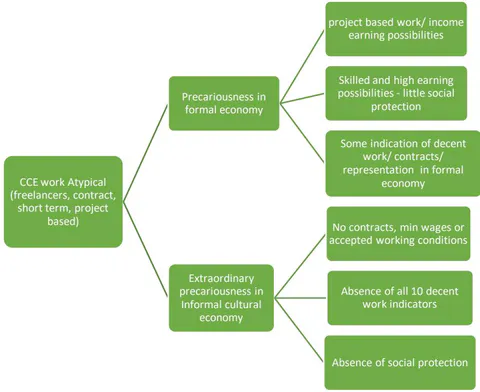
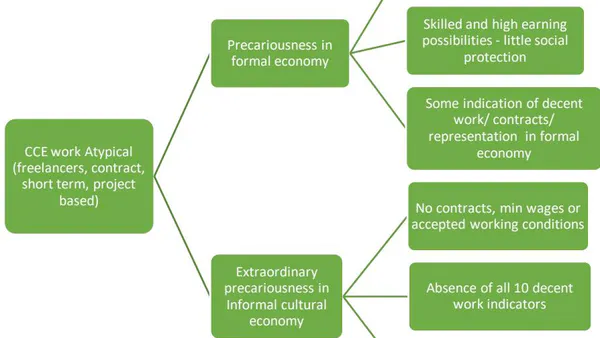
Not only should this literature on the atypical and precarious nature of CCW be brought into conversation with that on informality to better understand informal cultural value chains and work relationships in the CCE, but it is also vital that it be brought into conversation with the Decent Work agenda of the ILO. Decent work is defined by the ILO as "opportunities for everyone to get work that is productive and delivers a fair income, security in the workplace and social protection for families, better prospects for personal development and social integration".
III. METHODOLOGY
This paper draws from commissioned research from the ILO on promoting a decent work agenda in the African cultural and creative economy. It included the voices of workers and employers, their respective organisations and government officials and was guided by the ILO's 10 indicators of Decent Work.
The Live Music ecosystem in South Africa was chosen as a case study because it is a vital part of the CCE in South Africa; its diverse nature from informal settings to established venues and festivals; the range of intermediary organisations which support and underpin this ecosystem (trade unions, music markets, rights organisation foundation, funders, training and education bodies); as well as the substantial documentation on the growth and characteristics of this ecosystem (Concerts SA 2016. 2020; Ansell 2005; IKS Consulting 2021; Music in Africa Foundation (MIAF 2022; SACO 2019, 2022). In addition, it remains the dominant form of income generation for musicians.
Limitations include the voices of migrant or child labour; intermediaries (training and education, music markets and conferences, business and legal support services) and the need to differentiate the application of decent work indicators by genre of music (from hip hop to gospel, from electronic music to jazz to R&B).
IV. THE SOUTH AFRICAN LIVE MUSIC ECOSYSTEM
The live music ecosystem includes a myriad of occupations and role players (see Figure 2). Drawing from SACO (2021:51) but adapted for live music, the key players are music creators (composers, songwriters, lyricists, adaptors, arrangers), facilitators (promoters, agents), retailers (broadcasters, social media, streaming platforms, festivals/events) and users (venues, restaurants and pubs, festivals/events).
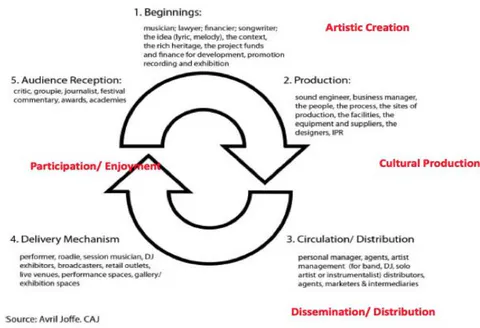
IKS Consulting (2021) has helpfully outlined the various functions in each stage to identify cultural occupations, skills and competencies to identify the respective skill sets pertaining to live music (see Figure 3).
Beginnings
- Talent
- Musical skills
- Technical (including digital skills)
- Supporting the musician while creating (advice, emotional support, identifying sources of food, rent and household expenses & upkeep of instrument expenses)
- Ability to coordinate a creative team
- Ability to source appropriate space and equipment
- Understanding of IP law and processes
- Ability to evaluate return on investment prospects and access funding
- Bookkeeping/accounts
Production
- Musical skills
- Technical skills and 'ear' for sound values
- Contract knowledge
- Ability to access & coordinate relevant production resources
- Ability to coordinate a creative team
- Bookkeeping/accounts
- Design skills
- Catering
- Transport
- Ability to manage and sustain a production venue long-term
Circulation Distribution
- Musical skills
- Technical skills and 'ear' for sound values
- Contract and IP knowledge
- Ability to access & coordinate relevant performance resources
- Ability to coordinate a creative team
- Marketing skills and contacts
- Bookkeeping/accounts
- Catering
- Transport
- Ability to manage and sustain a performance venue long-term
Delivery Mechanisms
- Musical skills
- Technical skills and 'ear' for sound values
- Hospitality industry skills
- Contract, publishing & IP knowledge
- Ability to access & coordinate relevant performance and/or sales resources
- Ability to set up and dismount performance equipment
- Ability to coordinate a creative team
- Marketing skills and contacts
- Bookkeeping/accounts
- Ability to sustain a sales and revenue infrastructure long-term
Reception
- Understanding of musical content and context and performance standards
- Understanding of audience
- Research skills
- Communication skills
Figure 3: Cultural occupations, skills and competencies (adapted from IKS Consulting, 2021)
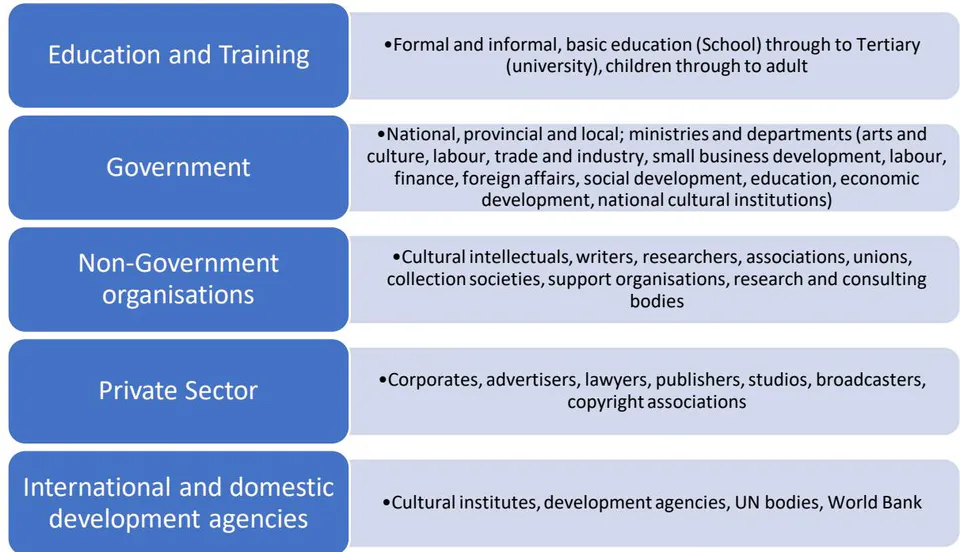
The live music ecosystem is supported by intermediary institutions from education and training, government, non-governmental organisations, the private sector, as well as international organisations (see
Figure 4). There are also intersections with different professions such as engineering or law and other sectors such as media and further education and training (OECD, 2012).
Live music practitioners move fluidly between formality and informality as they engage with formal businesses (established live venues, registered festivals and promoters) and informal venues and events. Figure 5 below highlights key distinctions to be made regarding decent work conditions. Informal work is often characterised by higher levels of precarity, insecurity and vulnerability than that which exists in the formal live music ecosystem (Joffe and Wangusa 2022).
The formal part of the ecosystem is not monolithic and shows varying levels of compliance to decent work conditions (and associated contracting practices), often differing by genre. A festival promoter focused on Jazz for instance reported that as the community was small, trust was high which was not
necessarily the case in other genres such as pop, R&B, or gospel.
Informal Versus the Formal Live Music Sector in SA
Formal Sector
- Dominated by large concert promoters, small and medium sized festival promoters, very few dedicated live music venues, established premises such as hotels, restaurants and pubs.
- Registered agents and managers support big names and established artists.
- Some evidence of contracts, norms and standards relating to working hours, pay and hospitality services.
Informal Sector
- Dominance of SMMEs and individuals makes
- Venue types include student and corporate gigs, clubs, family gatherings, churches
- Offers low barriers to entry for aspiring musicians
- Contracts are mostly verbal
- Rampant tax evasion
- Chaotic and largely unregulated
- Limited access to government social security programmes
Figure 5: Informal versus the formal live music ecosystem in SA
V. THE SOUTH AFRICAN LIVE MUSIC ECOSYSTEM AND THE DECENT WORK AGENDA
The Decent Work agenda of the ILO, launched in 1998, has four pillars including rights at work;
employment creation; social protection; social dialogue and tripartism (see Figure 6). Table 1 below provides detail drawn from live music practitioners about the current practices in South Africa.
| Decent work indicators | Practice in the South African Live Music Ecosystem |
| 1. Employment opportunities | There is a projected 7,9% growth of live music revenue over the next five years (PWC quoted in ConcertsSA 2016). This does not include revenue from informal settings (clubs, restaurants, bars, churches, and family gatherings).It is difficult to measure as it is characterised by informality with income opportunities, rather than employment, mostly of a freelance, casual or part time nature. Opportunities are also seasonal with little expectation of income generation all year round. Technical producers expressed optimism about employment opportunities for young people. Covid-19 restrictions were not uniformly negative with a few established artists reporting substantial demand while for many (youth, emerging artists) it represented increased vulnerability: 90% of the live music ecosystem lost income which resulted (for some) in selling personal instruments to pay basic costs while others considered leaving the sector (IKS Consulting 2021). |
| 2. Adequate earnings and productive work | ·Live music is not only one of the highest earners in the music value chain with related revenue streams that can be leveraged off of it (CSA 2016, p. 7), but it also provides income to a range of artists, cultural workers and cultural and non-cultural professionals in the sector. ·Income can be earned from a range of sources such as "fees, branding, merchandising, royalties2 and sync deals3" (Joffe and Wangusa 2022). ·Since musicians do not expect to work every day of the week, many rely on 2-3 gigs per month to earn fairly. ·MIA's recent Revenue Streams for Music Creators in South Africa report (2022) reported an average income of R13 000 per month. ·Live music is seasonal, meaning that it is exceedingly difficult to earn income all year round which results in hardship and mental health challenges. This may be different in the informal economy where micro live shows abound although these are not always fee paying. "It is only in places such as New York or Los Angeles where musicians can expect to earn a living from being in live music: even in London only 5% of musicians earn an income solely from the music". ·Some good practices emerging from established promoters included payment of a 50% upfront fee with the balance paid a week before the live show. ·Musicians must fund costs when these are not borne by venues such as backline, rehearsal costs, hospitality in addition to regular layout of funds for transport and the purchase4 and maintenance of instruments. ·During Covid 19 additional costs related to high data costs, energy blackouts and poor cellular connectivity all with implications for livestreaming. Livestreaming was rejected by some since it would not reach their target audiences in the townships. |
| 3. Working time arrangement | ·Working time arrangements show a wide range in live music. Trading time for live music used to be mostly 7pm until late but with the Covid-19 pandemic, day time sets became popular, especially Sunday afternoons. ·There is little uniformity with respect to many elements: a signed contract or any contract at all; negotiations with band leaders on price or working conditions; agreement on set lengths (50-60 mins), number of sets (1, 2 or 3) or rest times (30-40 mins); specification about responsibilities related to occupational health and safety. ·Good practice is evident from established festival promoters to formal live venues but how contracts are structured depends variously on the band, the genre, the day of the week, the deal (combination of flat fixed fee and door takings). It is negotiated band for band and changes over time. ·The Event Technical Production Services (ETPS) forum submitted draft guidelines to the South African Department of Employment and Labour for unique sector employment codes which, if approved, will delineate standards of practice, minimum wages, working conditions, ethics and rights of workers. ·Poor practice is evident in some established live music venues with reports that in one establishment: "sets are played for 5 hours with food provided to the band only at the end of the evening". ·These poor practices are linked to the absence of contracts for most musicians. For those who sign contracts, respondents noted how easily these are breached with some musicians so financially desperate that they opt to play for food in some of the smaller venues or for 'exposure'. |
| 4. Combining work, family and personal life | ·Disturbances to the work life balance are a key characteristic of CCW. Live music in particular is dependent on leisure hours (evenings, weekends) and therefore has a direct impact on work life balance. ·This is particularly difficult for women musicians who besides contending with family responsibilities at night or on weekends also need to worry about late night transport (access and safety) or extended time away if touring (not to mention the prevalence, in South Africa of gender based violence – especially when alcohol is involved - on the streets, in bars, in public spaces and public transport). ·Many musicians seek secondary jobs to sustain their career. With high unemployment in all sectors of the economy key supplementary income sources are corporate work, private or university tuition or merchandising. |
| 5. Work that should be abolished | ·While exploitative conditions abound in the informal economy of CCW given the lack of regulation and general desperation of those with no income generating activities, none of the respondents whether active in the informal or formal parts, commented on this aspect. |
| 6. Stability and security of work | ·The seasonality of the live music calendar, tourism links, general unemployment, as well as the overriding informality present in the ecosystem, means additional income streams are essential for musicians. ·Additional income streams can be found from fees, branding, merchandising, royalties, sync deals, corporate work and teaching, but are often insufficient to make a living. ·Job security in the context of CCW is virtually impossible. |
| 7. Equal opportunities and treatment in employment | ·The live music ecosystem is male dominated and in some areas largely untransformed (i.e. predominantly white). ·Practices and opportunities privilege men. ·It is largely a night-time economy which has implications for women musicians and cultural practitioners such as lack of access to transport, unsafe streets, and the extent of gender-based violence in the South African society. ·Being on tour provides added challenges to women in the music ecosystem given family responsibilities, exploitation and abuse that occurs on tour. |
| 8. Safe work environment | ·Safe work environments are also subject to the hierarchy of venues described earlier with large events and formal establishment mostly observing basic safety and health standards and regulations while non-compliance is widely observed in smaller and informal events. ·An oft quoted problem is poor stage construction as well as the absence of dressing rooms, which primarily impacts women musicians. ·There are regulations for large events (thanks to the South African Promoters Association) which rely on enforcement by the joint operations committee5 of a local municipality. ·During Covid 19 desperation for work and limited funding enabled what some called 'cowboy' promoters who took risks, flouted health and safety |
| 9. Social security | ·There is little to no social security and musicians as all cultural practitioners are not covered by South Africa's sophisticated labour relations legislation and associated regulations which protect employees (because they are not covered by the definition of 'employee'). ·This impacts musicians' and cultural practitioners' access to health care, disability provisions, maternity leave, employment injury, unemployment insurance, old age benefits, or compensation for death of a family member, in other words, all forms of social protection including forms of collective bargaining enjoyed by other workers. ·Live music practitioners are paid principally for results or for projects rather than time spent working. ·There are new developments supported by the South African Law Reform Commission (SALRC, 2021) and the musicians union, TUMSA that will benefit live music artists and practitioners' access to social security whether in the formal economy or the informal economy. |
- Respondents did not believe that any of the decent work indicators were present in the live music ecosystem.
- Respondents were familiar with concepts related to decent work with one emphasising the importance of knowledge: "Education and training is the foundation of decent employment because once an artist has knowledge he cannot be easily exploited, and he is able to work professionally and widen his/her career choices".
- Social dialogue is still embryonic in the live music ecosystem despite the existence of a trade union, TUMSA, which was established in 2016 and formally registered in 2018.
- TUMSA is also working to improve the professionalism within the ecosystem to overcome the stigma of musicians 'not taking life and their work seriously' and of 'rampant drug abuse'.
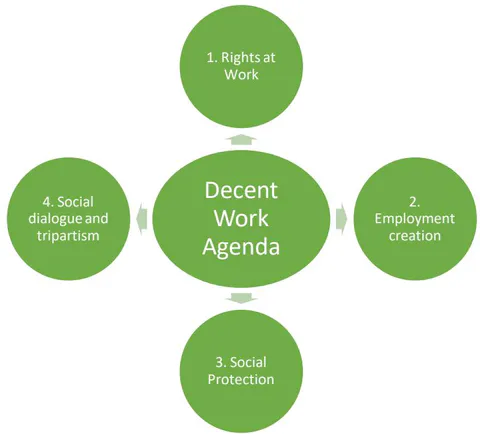
The first pillar "Rights at work" cannot be assured in the South African live music ecosystem as "norms and standards are absent in this sector" (Joffe and Wangusa, 2022). Joffe and Wangusa argue that "while there are pockets of good practice, even 'excellence', there are a few areas where consistency is needed" (2022). The SA live music ecosystem is differentiated by the size, status and financing of the gig. The top layer is characterised by regulation, professionalism, and international standards in remuneration, health and safety and contracts. Licenses to the South African Music Rights Organisation (SAMRO) and performance licences are also observed.
As a result, working conditions, pay and security vary by nature and size of the venue or event. A respondent from TUMSA explained how this works:
"The big players would be your international promoters those who would book international acts to come and perform in Africa... in stadiums or in massive venues like a Standard Bank arena, or the Cape Town jazz festival... maybe 2,3,4,5 times a year and then on the same stage, you would have some of your most prominent local artists at the time, people who are popular at that time. They would share the stage with those international artists [...] and get a lot of a play – on radio and TV and they would make a lot of money for those appearances, because of the exposure and the revenue that's available from various sources because of the high-profile nature of those events".
The next layer are other big venues and hotel chains, restaurant, clubs and spaces where there might be food, drink and even a dance floor. These events regularly host live music.
"[It includes] your 5000 or your 3000-seater which have fairly regular events... where high profile local artists would be the main liners, and those would be the same artists, that you would find supporting the international artists. The next layer down would be either bands, or it would be one or a full band or two-man band or three-man band or women bands and then also it may either also be one or two DJ".
The layer below includes smaller venues such as hotels, restaurants, bars, churches and clubs where there is typically little collection of music royalties.
"[Here] you would typically just have one person with a backing track, they would sing or maybe play a few instruments, maybe they've got loops going... the same artists play in the same venue three or four nights a week... but these days it's different. People want instant gratification... just one night a week... just the sort of background music".
As musicians move through the hierarchy they discover "less and less enforcement of decent work standards and norms" (Joffe and Wangusa 2022). These decent work deficits have been severely impacted by the Covid-19 pandemic with key fault lines exposed especially in relation to remuneration, working conditions, social protection, and gender inequality.
Decent work, while visible in the more formal areas of the live music ecosystem (dedicated live music venues, established festivals and the like), is largely absent in the rest of the live music ecosystem especially in informal establishments and for many musicians working informally. Importantly this formality/informality duality exists throughout. The same is true of festivals, concerts and other gigs were the formality/informality distinctions for decent work persist. A few established live venues and some promoters provided evidence of good practice (standard fees, contracts, attention to occupational health and safety, working time). For live venues this included either full flat fee or part fixed fee and a door percentage as well as payment 24-48 hours after the gig, while live venues and festivals offered contracts that specified fees, hospitality, promotion responsibilities, rehearsal and call times.
However, for others, some problematic practices persist. While venue owners and festival promoters tend to have a contract with the band leader band members are not always paid or not paid appropriately. This non-payment is justified by some as it is considered an 'honour' to be part of the band or play with the band leader especially if a recording might result; delayed payment to band members even if the band leader was paid timeously; a lack of consistency with respect to hospitality, set times or number of sets played. Venue owners believe this practice is out of their hands.
The "Employment Creation" pillar is likely to follow from the slow expected recovery largely on the back of "paid-for music streaming services, increasing from R1.73bn in 2016 to R2.05 billion in 2020" (PWC, 2016). However the lack of consistency in income generation means that multi-tasking and multi-skilling within live music is common, with one musician explaining that "I am at different times an Artist Manager, Booking Agent, Promoter and Creative Producer". Opportunities are driven by a vibrant festival and nighttime economy in some areas. Established artists are often dependent on their managers and booking agents to perform the role of securing income opportunities.
The third pillar "Social Protection", when not provided by the state, needs to be individually accommodated. However the lack of regular income and the few existing opportunities means that for many, there is simply insufficient earnings to ensure protection. Notable exceptions include the formal structures of orchestras or ensembles that "may offer additional permanent employment benefits like medical aid, life/disability insurance and retirement annuity, as well as instrument insurance and an allowance for reeds and strings" (Gcingca 2022). Working with corporates also does not necessarily mean that there is surplus on the income to accommodate social protection requirements. During the pandemic corporates were also under huge financial strain so that some managers and agents had to make exceptions about using backing tracks (two or three songs in a maximum of 30 minutes). Some music practitioners found a solution to the low fees earned by musicians and produced prerecorded tracks. These tracks earned a usage fee with the agents or managers producing additional content for the online event both at the front and back of the prerecorded track. With many puzzling over how to monetise these online performances, one respondent concluded that 1 million streams would be needed to "earn an equivalent to a performance by a mid-tier artist at a large music festival".
Musicians and cultural practitioners in the live music ecosystem rely on festivals to boost their earnings. Usually (outside of Covid-19), South Africa has a vast array of festivals across many genres from electronic music, popular music (Splashy Fen Music Festival), jazz festivals, Rock, pop, indie, hip hop and dance music festivals, and a host of gospel music festivals (Cape Town International Gospel festival, Gospel Under the Stars, Macufe). Respondents noted that rather than standard rates, fees are based on several criteria such as the presence of a sponsor, what the ticket price is, where the venue is (urban centre or smaller town, indoor or outdoor). For some, flat fees are most acceptable as its "too risky" to rely on door takings.
Promoters, on the other hand, seemed cognisant of exploitative arrangements and argued that a standard fee for backup musicians is necessary to avoid these. However, many noted how poorly understood contracts were explaining that "Artists are unable to justify their charges. Basic accounting of what band leader wants, what each member needs to receive, administration costs, sound engineering, rehearsal, drummer base etc. is often not known [...]
only one artist (out of 100s) distinguishes each item in their quotation whereas others are offended if asked".
For most musicians balancing work, family and personal life is a personal choice or a necessity if this is the only form of livelihood possible or desirable. A good work-life balance in the live music is less about regulating working time, reducing working hours or creating predictable schedules, or even providing flexible working arrangements since these are built into the very nature of live music, with festivals and concerts severely compromising family life whether for women or men. This is an added imperative to consider social protection arrangements so that paid leave, whether maternity/paternity/family leave, is available.
Transformation of the gendered nature of the live music ecosystem is slow but changes are evident with women occupying positions of venue owner, instrument player, DJ and in technical production. However, for the latter, women in technical production still face the challenge of not being taken seriously "because of societal norms and social constructs in South African society" (Joffe and Wangusa 2022). Power and hierarchy in our patriarchal society also impact women in this ecosystem severely, with respondents noting that the experiences of women by men translate into new forms of exploitation by some women.
Many of the respondents reported that their employment/ work opportunities are dependent on a conducive policy environment supporting the live music ecosystem from direct value chain support (venues, festivals, expertise, small business) to related support of safety, transport, education, hospitality and tourism, especially in the night-time economy. Much of the direct value chain support has been deeply affected by COVID, while related support mechanisms remain poorly integrated and, at times, absent (such as a nighttime policy).
There is cause for optimism in the work of the SALRC which has provided a definition of a self-employed worker that consists of own-account workers as well as wage workers to support their integration into the definition of "employee" in key labour relations legislation (Unemployment Insurance Act, 2001; the Unemployment Insurance Contributions Act, 2002; and the Basic Conditions of Employment Act, 1997). Importantly they made provision for maternity and parental benefits for workers in the informal sector in this legislation. The inclusion of CCW in the informal economy provides the first opportunity to extend social protection measures to the CCE. It also paves the way to develop norms and standards relating to working conditions, occupational health and safety, etc.
Importantly, two key intermediaries, the South African Guild of Actors (SAGA) and the Trade Union of Musicians of South Africa (TUMSA) have done substantial work to lobby for amendments to labour laws. SAGA lobbied government to alter the definition of an employee to include cultural workers which will provide access to regulatory provisions in the same way as the new category of 'dependent contractor' in labour statistics (SAGA 2020; SALRC 2021). SAGA has also successfully negotiated contracts with major producing bodies in the respective CCE sectors to ensure terms and conditions provide some, if limited, protection to freelancers while TUMSA has lobbied for amended labour laws and suggested changes to the Basic Conditions of Employment Act so that even though many musicians have multiple employers and are often juggling up to 10 contracts per week (whether oral or written), they remain workers.
The final pillar, "Social Dialogue" requires two parties, representative worker bodies (such as TUMSA with its 200 plus members and affiliation to COSATU) and representative employers' bodies. Despite the excellent advocacy and mobilising work by TUMSA in its short existence (established in 2016), its ability to negotiate, consult or exchange information is hampered both by the absence of employer bodies in the live music ecosystem as well as a reluctant partner in government.
Finally, to evaluate the scope for the promotion of decent work in the live music ecosystem, we need to acknowledge those factors that hinder its promotion. This relates to a lack of solidarity in the ecosystem - 'we are on our own' - with difficulties in accessing both financial and non-financial support. The lack of solidarity results in a lack of information or transparency throughout the live music value chain resulting in an absence of known fees or norms and standards in the industry. Young musicians, women and the disabled are most likely to "earn lower fees, have poorer contracts and face greater levels of precarity" (Joffe and Wangusa 2022). This is not to say there is no solidarity as evidenced during Covid 19 when live music venues and musicians who were grant recipients supported others who they knew to be in a dire situation, with recordings and live streaming2.
The reach of education and training about how to succeed as a live musician is inadequate for certain groups of people (children or young adults) and there are few "mechanisms (incentives, subsidies, training programmes) to enable ongoing consistent mentoring from established venue owners, festival promoters, performers, and musicians" (Joffe and Wangusa 2022). A critical absence is in adequate basic business support from the provision of services, spaces or skills training, contract support such as standard agreements for promoters, musicians, booking agents and managers or event planning for small festivals.
VI. FINAL THOUGHTS AND OPPORTUNITIES FOR SUPPORT
Our research into live music reveals an ecosystem that is struggling, in which decent work conditions are largely absent across the live music value chain, and in which for some, insecurity has become critical. While there is indeed some evidence of decent work, this is largely confined to the established larger players in the formal economy (venues and festivals). All other spaces for live music in the formal economy and most of the informal economy is fraught with decent work deficits from unpaid pay, exploitative conditions, gender inequality, and poor health and safety provision.
The live music ecosystem responses to the Decent Work indicators also reveals inadequacies in the ILO's primary policy response of formalisation (ILO 2018). These CCW work experiences show that the drivers of informality remain powerful, namely, in the ILO's own words, "the economic context, the legal, regulatory and policy framework's and to some micro level determinants such as a low level of education, discrimination, poverty and... lack of markets" (ILO n.d.). In the absence of these drivers being addressed, the existence and growth of the informal economy is assured. New developments such as digital technologies have also facilitated the shift to informal working. This interrogation of formalisation needs to accommodate the large number of people working in the informal economy, since "supporting the working poor in the informal economy is a key pathway to reducing poverty and inequality" (Chen 2012, p. 6). A dominant focus therefore on enforcing formalisation could "drive the informal economy underground or may reduce the informal economy in ways harmful to those (previously and perhaps still) dependent upon it" (Brown et al. 2014: 11).
In this regard it is necessary to bring this literature on the atypical and precarious nature of CCW into conversation with that on informality to better understand informal cultural value chains and work relationships in the CCE. This is because informal cultural and creative workers are not necessarily similar to those in the rest of the informal economy where labour intensity and low skill is more common, and earnings are low. Rather, in the CCE there can be substantial capital investment, both self-taught skills and formally acquired skills even tertiary education, and the possibility (not guarantee) of high incomes earned
(Comunian and England 2020; SACO 2019). Eveleigh (2013) expounds on the affordances of informality:
"While this segment of the Creative Economy looks (and is in a structural sense) chaotic, unregulated and mostly disorganised (in the sense of representative associations able to engage and lobby the state), practically it is effective, productive, flexible and - in respective arts disciplines - skilled, even where self-taught, exhibiting a high degree of business acumen (even where management and accounting functions are weak).
Despite the recognition in the literature that precariousness and CCW is axiomatic, the context of high unemployment and the extent of the informal economy in South Africa means that there are gradients of precariousness in CCW not seen in Global North contexts. This is overlaid by the legacy of Apartheid which institutionalised racism and discrimination against black people. That this precariousness is deepened if you are a black woman living in informal settlements with poor education, is clear; but that this precariousness is further deepened if most of your live music income is derived from work that cannot be considered decent by any indicators set by the ILO and by a lack of legislative coverage – whether labour standards or social protection- is not often recognised.
The live music ecosystem needs a well-managed circuit for venues which combine dedicated live music spaces with related spaces such as restaurants, clubs, pubs, and hotels. It will also require a well-defined strategy (focusing on both remuneration and musical rights) for digital uptake so that musicians are able to self-record, live stream and promote their own content. Social capital in the form of solidarity within the live music ecosystem has been found to be supportive especially when combined with mentoring, infrastructure access and financial support.
There are several areas where opportunities exist to support the live music ecosystem and enhance its status. As one respondent simply stated: "afford the sector the same respect as any other sector".
First, there is increased potential to earn income from livestreaming and post the livestreaming performance3. The exposure livestreaming offers locally and globally and the reach beyond the core metropolitan urban centres can be leveraged for branding, marketing and collaborations, but would require attention to data costs and those relating to studio time (CSA 2021: 24-29).
Second, are the opportunities to be gleaned from the robust evidence-based research currently being conducted by government, agencies and consultancies such as the DTI, SACO, Concerts SA, IKS consulting, Music in Africa Foundation, especially against cultural occupations and music revenues. Third, is the important role played by intermediaries in any ecosystem acting as a buffer between government and individual music practitioners and playing the role of information repository and dissemination, funding and scholarship support, training and mentoring as well as facilitating access to more established financial institutions and other corporates. Here, there are substantial opportunities extending from MOSHITO, Concerts SA, National Arts Council, Pro Helvetia, Music in Africa Foundation, SAMRO Foundation, TUMSA as well as the Higher Education sector. The latter provides opportunities to provide structured support to live music from contract management, decent work to IP rights and the impact of digital technologies on the business models of live music. The latter also plays a crucial role, along with other public theatres, in providing access to their well-equipped spaces as well as music recording studios for live streaming and pre-recording opportunities.
Fourth, is the important place of policy and regulation in supporting the live music ecosystem. Here, the system of governance for culture in South Africa is perfectly poised to support the growth and viability of the live music ecosystem especially since the endorsement of the Revised White Paper (DAC, 2020) and the engagement of the music ecosystem participants in the Creative Industry Masterplan process , notwithstanding some critical concerns relating to the lack of trust between civil society and government and the poor historical trajectory of policy implementation. There are also areas of policy and regulation that need urgent attention such as marshalling of supply side instruments such as reducing tariffs on equipment (PA systems, speakers, microphones, lights or staging) or subsidising the purchase of backline for live music venues. A key area for live music is appropriate policy for the night-time economy (noise by laws, alcohol licencing, street security, transport and incentives to create a conducive environment). These policies and regulations would give live music the recognition of a highly integrated ecosystem, largely located in the urban economy in which music and entertainment licences should receive similar priority as does liquor and health licences. Central to this non-monetary support would be a sectoral determination to afford live music practitioners labour rights and extend social protection to all cultural and creative workers.
Finally, there is the opportunity to involve all social partners from those who participated in the government's Masterplan process (DTI, 2022) as well as those that will be called up to support the development of a music industry implementation strategy (DSAC, 2023) to support a 'charter' of decent work that live music venues, concert and festival promoters, recording studios and even smaller establishments sign allowing them to attract funding, support, investment as well as employ the musicians of their choice in conditions that are considered 'decent'.
ACKNOWLEDGEMENT
We acknowledge the International Labour Organisation for the opportunity to work on this assignment "Promoting decent work in the African cultural and creative economy" and for their invaluable feedback, as well as Avril Joffe's co-author, Ayeta Wangusa. Avril Joffe and Florence Mukanga-Majachani conducted the live music case study.
Funding
Funding was received from the International Labour Organisation's Regional Office for Africa for a forthcoming study on 'Promoting decent work in the African cultural and creative economy'.
Footnotes
https://www.facebook.com/OfficialMacufe/ (p.10) ↩
Webinar on 11th November 2021 hosted by IKS Consulting and South African Cultural Observatory on Impact Analysis: Live Music and its Venues and the South African Economy during COVID (p.11) ↩
The Concerts SA study reported that the majority of respondents (60%) had "given exclusive rights to the master recording to the artist. 30% reported agreeing to an equal sharing arrangement between the venue/platform and artist. For 10% of participants, the venue/platform retains exclusive rights ownership" (CSA, 2021: 24). (p.12) ↩