## I. INTRODUCTION
Time is neither a neutral, nor an unbiased concept in Humanities. Therefore, time narratives demand deep research, and further studies to understand the complexities of each concept, and its impact upon the present to individuals and society.
As a social construction based on nature observations, eastern civilization gained a lot from the development of a common measure scheme (Bell; Mau, 1971). The actual calendar and its standartized time has been globally disseminated, - making life and activities across the globe possible and interconnected. This unified cultural time can be considered as an institutionalized mechanism that enables social interactions to occur at a specific time and place, whereas coordinating social actions of various agents. (Duby, 1998, 2002).
Although the individual biological times, known as circadian rhythms, may differ, and sometimes, even oppose to the social rules, humans have been adapting and surpassing nature time in multiple ways (Scollon, 1998). For example, the rupture from the need of sun light that was brought by the advances of electricity. Multiple time complexities become so, humanly imbricated in one another. Either from a physiological, physical, emotional, or cultural perspective, time became the central asset for human relations once it was capitalized and made into a merchandise in the modern era.
As quantified time, regarded as the hours, the clocks and all other measured artifacts, these human constructions became the units of measure, which coordinate society (Cipolla, 1992). Thus, measured time can be recognized as a major civilized force since Industrial Revolution, which shaped the globalized world and has been crucial for the Civilization Process (Elias, 2002).
Furthermore, the work of the social psychologist Levine (1997), demonstrated how each culture has a different time concept, and relates to it in unique formats. Rules about waiting, punctuality, and time measurement can vary enormously from one region to another. Levine (1997) measured temporal differences among various cultures considering, economic vitality, industrialization, population size, climate, and cultural orientation. He created the concept of the 'pace of living,' which portrayed how fast life would be rated in each region of the globe.
For Levine (1997), a multitemporal society moves back and forth among nature time, event time, and clock time. As a consequence, each culture and individual relates to time in its unique way. Levine (1997) called this "Geography of Time." In this situation, reaching temporal prosperity would mean an equal balance between productive and leisure time (remarkably similar to what is required on mental health practices nowadays in pursue of balance between both times). This balance of eight hours to work, eight hours for leisure time, and eight hours for sleep has been the flag-movement connected with Labour's Force and Labour's Day (Nyland, 1986).
According to Franco Junior (2005), the linear conception of time was easily spread because the world follows a Christian conception of time that begins with creation and ends with the final judgment. According to Newman (1996), chronological divisions of time affect us profoundly despite their fundamental arbitrariness, because they evoke anxieties, but at the same time, bring hope.[^312] As linear time cannot avoid these fear associations, it continues to bring anxiety related to the Apocalypse, the end of times, and Armageddon stories.
Meanwhile, humanity does create new combinations and explanations towards past, present, and future, the relevance and comprehension of each of these temporal frames also changes according to different historical moments (Elias, 1989). To this extent, it is possible to foresee that the future brings a whole new set of concepts, versions, and possibilities. Consequently, the future does not mean any time ahead, but much further than that. The future is also the infinite of possibilities, dreams, expectations, foresight, colonization, dispute, divergences brought onto the present through imagination (Appadurai, 2013).
For Duby (2002), the fear of the end of the world, so present in the Middle Ages, has crossed the centuries, and it is something that endures. "My mother, for example, was not convinced that the end of the world would not come soon" (Duby, 1998:140). Until today, any different natural phenomenon like a comet passing near the Earth, or unusual similar reasons are enough to make the fear of the end reinforced again (McBride, 1998).
In addition to natural disasters and other unpredictable factors, humanity is really capable of producing the end, exterminating nature, and our own species. According to Schwartz (1992:23), "If the terrors of the year 1000 are not a certainty for historians today, those of the year 2000 will certainly be for future historians. On the threshold of a new millennium, man has the proud conviction that perhaps he is not far away the day he will be able to blow up the planet."
Therefore, the fear, panic, anxiety associated with the future, grow in consonance with future thinking. Within Social Psychology, future imagination and its narratives are dialogies co-constructed through a multiplicity of resources (Bakhtin, 1999, 2010). Built interactively, within the social and historical ecodynamics of relationships, these meanings are ways in which individuals understand and deal with situations and this phenomena. Throughout mediated language, multiple meanings are widely found in the ways people speak up about the future.
According to Gould (1999, 2000), the world is organized as a set of stories imbricated in one and another. Futures as well as other temporal meanings are mixed in this network of relations, expectations, imaginations, interconnections. A dialogic method within this frame can provide an in-depth comprehension of the uses of the word-future. The construction of this discursive field and method, as Certeau would say (2002) is based on our ability to marvel and surprise, analyse, and describe forms and uses of everyday language. Within this process, the focus are on the discursive practices built across the word 'future' involving a combination of aspects between the individual and social scope (Beck, Mahony, 2018).
The concept of Imaginable Futures can offer uncountable insights into the task of redressing the manifold and urgent discontents that society faces. Social imaginaries serve as the "invisible cement" (Castoriadis, 1982:143) that binds a given society together. These social meanings can be carried out through time and space because of language. Such stability requires the reproduction of meanings across individuals and cultures. Imagination is both individually and socially produced, bringing vitality to the continuity of social imaginaries, and therefore, to social cohesion.
The term imaginable is frequently used to describe something like the normative and experiential worlds of specific groups, imagined future scenarios, or a particular mindset. A recent book, Social Imaginaries: Critical Interventions (Bryan, Knight, 2019), refers to a range of kinds of imaginaries, for example, "capitalist, constitutional, cosmopolitan, democratic, ecological, economic, feminist, global, historical, hypermodern, humanitarian, nationalist, political, politico-juridical, populist and religious," among others. Such imaginaries are nested within the broader social imaginary – that is, the web of meanings that binds a particular society together. Paniagua (2019) also argue that Future Studies and courses keen to acknowledge this diversity of approaches should involve both real-facts and fictional ones.
Gagnebin (1997, 1999) explains that a method that renounces the security of predictability, and that engages into the practical comprehension and use of language enables the construction of new meanings and hypothesis. Therefore, to investigate Imaginable Futures from the Social Psychology perspective means to approach the intersections of the individual and the social across this topic. By using a Survey Questionnaire, which was applied to different people across the globe, the objective of this research was to enlighten the intersection between the individual and the social towards Imaginable Futures.
The main focus of this paper is to use Social Psychology to understand the multiple relations that cross the individuals about their future relations and future imaginations. The fact that Social Psychology studies the intersection of the individual and the social while pursuing to identify the strengths and challenges within this relationship, makes it possible to develop and advance the Future Studies discussion through critical analysis.
## II. METHODOLOGY
The survey called Imaginable Futures - International Survey with 40 questions was designed and applied to anonymous people in all different parts of the globe by using the internet. As the goal of this study was to reach the Globalized Future rather than its particularities, either personal or demographic; consequently, personal details of the responders were not requested. The main goal was to capture this multifaceted and imbricated Future thinking and Future imagining that crosses everyday life.
Imaginable Futures was understood as a composition of foresight, expectations, scenarios, visions, which crosses one's thinking and relations when dealing with the future both internally and externally. This relation with the future was not only cognitive, but emotional, social, historical, sensorial. For all of the above, the survey had a variety of questions, which inquired about how someone feels about the future, the impact of the future on health and wellness, and enquiries about what each person expected about the future, what they would like to take to the future and if the SDG's would be achieved.
The survey questions were made as scale response. The survey demanded answers on the intensity - frequency of each activity and its imagination. This way, results would show an overview of the importance of each item onto one's life. The graded answers were: "never" $(0\%)$, "rarely" $(25\%)$, "sometimes" $(50\%)$, "most often" $(75\%)$; "always" $(100\%)$. There were also questions with multiple choice answers, for
### 37) Your age group
312 responses example, 'does the future impact your overall health?' Besides the closed questions, there were open ones so that the participants could answer freely.
The survey was developed in Google Forms, and shared worldwide through a link. All collected data was anonymous. The Survey was shared through social media (Instagram, Facebook, plus Twitter), plus what's app messages. It was also reshared by some groups and individuals.
The IF Survey was fully developed in English, and responded in English. Afterwards, results were automatically generated through Google forms and Excel table into figures with number of responses and percentages. The Figures that follow are based on the results from 312 responders. The spontaneous method of gathering responders was effective as it provided a wide participation from all continents and age groups. The possibility to access the results of the survey and to receive a follow-up of the participation also generated positive feedback.
This procedure towards data production met the standards of Open Science and anonymous treatment of personal data. Figure 1 below show the age group of the participants and Figure 2 show their continent.
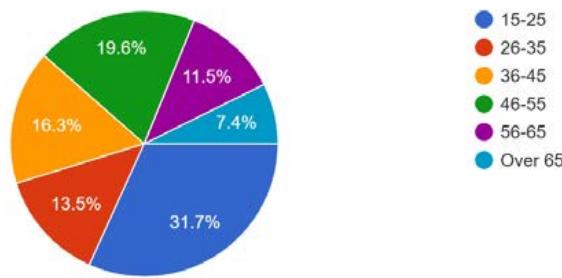 Figure 1: Age group of the 312 participants. Figure 1 above shows that there were $32.2\%$ responders between 15-25 years of age, followed by $19.5\%$ who were 56-65 of age, $15.6\%$ who were from the age group 36-45. Most responders were young adults. Next, Figure 2 will show the continent of each participant (Figure 2).
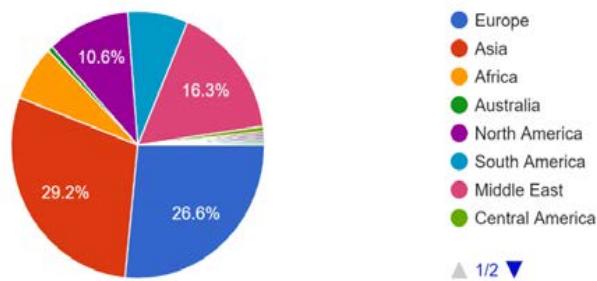 38) Your continent 312 responses Figure 2: Continent of the 312 participants.
The data shows that there were $29\%$ responders from Asia, followed by $26.4\%$ from Europe, and $16.6\%$ from Middle East, and $10.7\%$ were from North America. As it can be seen in the Figure above, all continents were represented, though Asia was the one with the highest percentage. Next, the results will be presented.
## III. RESULTS
The results were tabulated in the Figures below. It is important to mention that this research only show some of the Figures (the complete Research Report with the 40 Figures is available in the Research Gate website as Imaginable Futures – full report).
Each Figure below shows the distribution of answers for that specific question. Attention is necessary for the comprehension of some answers that repeat themselves because all questions provided one option for a free answer. Therefore, some responders sometimes did not mark the given answer, and repeated it again as 'others.'
1. How do you rate your personal future in 10 years from now? Please rate 1 to very negative, 2 to mild negative, 3 to neutral, 4 to mild positive and 5 to very positive.
312 responses
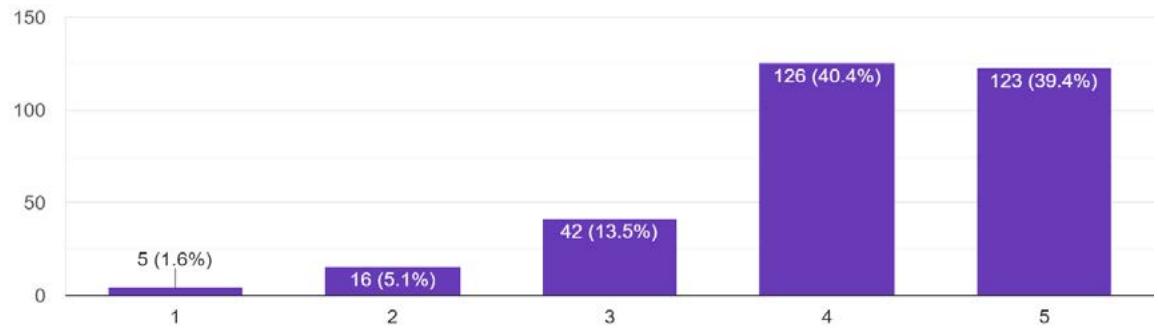 Figure 3: Rate to personal future as rate 1 to very negative, 2 to mild negative, 3 to neutral, 4 to mild positive and 5 to very positive in 10 years from now.
The Figure above shows that $40.4\%$ of the responders rate their personal future as "mild positive," $39.7\%$ rate it as "very positive," $13.4\%$ as "neutral," $4.9\%$ as "mild negative" and only $1.6\%$ as "very negative."
The next Figure shows the respondents' ratings towards the global future.
This way, the largest number of answers shows that the individual future is well imbricated with positiveness. This can mean that responders are expecting a quite positive future on their personal level.
2. How do you rate the world's future in 10 years from now? Please rate 1 to very negative, 2 to mild negative, 3 to neutral, 4 to mild positive and 5 to very positive.
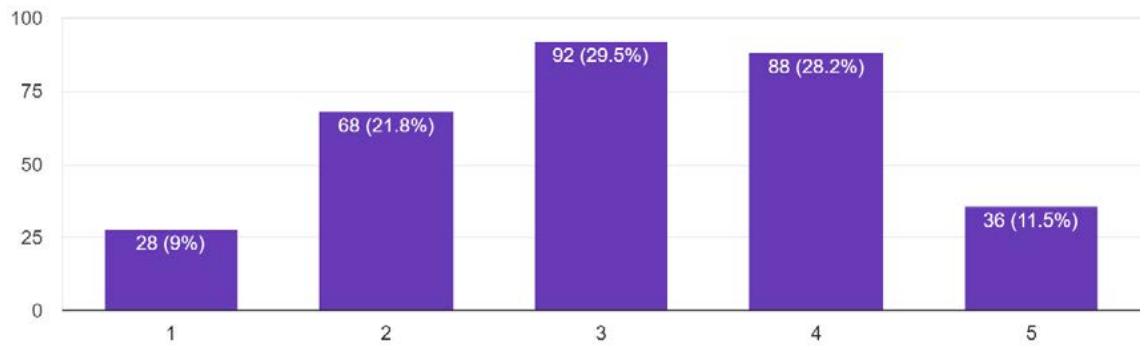 Figure 4: Rate to world's future as rate 1 to very negative, 2 to mild negative, 3 to neutral, 4 to mild positive and 5 to very positive in 10 years from now.
As it can be seen from the Figure above, the evaluation towards the global future is not as positive as the individual future. Most of the answers are in the neutral zone, whereas mild positive global future has $28.7\%$ of the answers, and $21.8\%$ show a mild negative global future. It looks much more like an equal balanced distribution of answers for both positiveness and negativeness. Therefore, the global future looks more balanced than the individual perspective from Figure 3, which is much more pending to positiveness.
The next Figure (Figure 5) will show how the responders rate humanity's growth or decline.
3. On the overall aspect, do you consider humanity is...
312 responses
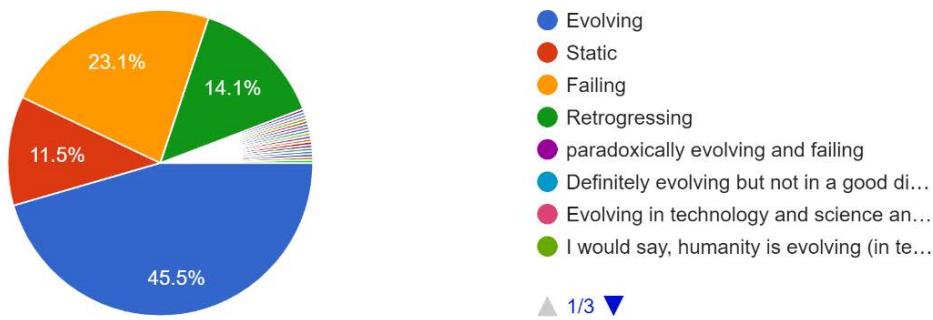 Figure 5: Estimate about humanity's evolution.
Figure 5 shows how responders are evaluating humanity's progress or not. Figure 5 demonstrated that almost half of the responders, $45.6\%$ said humanity is evolving. Nevertheless, $23.5\%$ mentioned humanity is failing, which also relates to the $14.3\%$ responders, who evaluated that humanity is retrogressing. If $23.5\%$ is added with $14.3\%$ the total amount is $37.8\%$ of participants who say humanity is going backwards and failing as a whole. Only $11,1\%$ said humanity is static and there were some other minor explanations with around $5\%$ of the answers. On the overall, humanity seems to be slowing down on progress and advances, or maybe, it looks not so appealing anymore.
To evaluate the frequency of future thinking around one's personal future, Figure 6 shows the following rates.
4. How often do you think about your own future? Please, rate 1 for Never, 2 for Rarely, 3 for Sometimes, 4 for Frequently and 5 for Always.
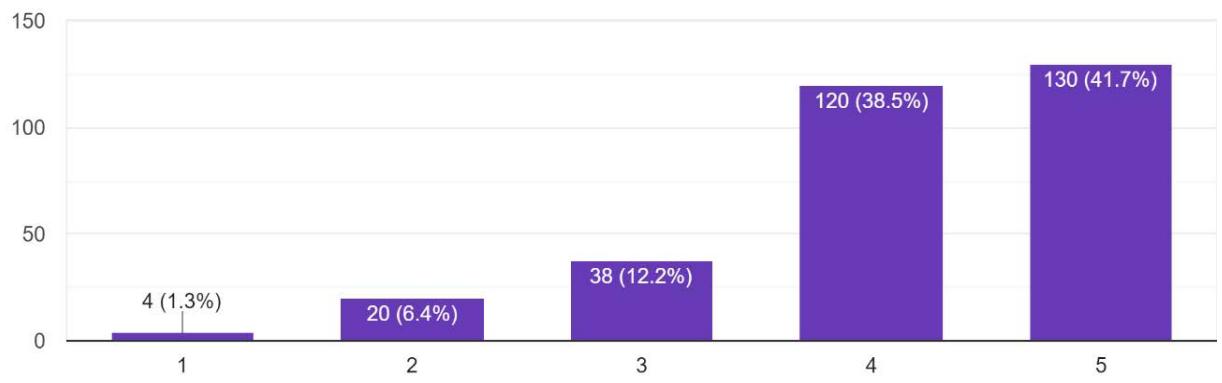 Figure 6: Frequency of personal future thinking being 1 for Never, 2 for Rarely, 3 for Sometimes, 4 for Frequently, 5 for Always.
Figure 6 above shows the frequency of future thinking on the individual foresight perspective. The answers show that $41.7\%$ of the responders say "always" think about their personal future, followed by $38.8\%$ that "frequently" think about their own futures. The lowest scores were for "sometimes" with $12.1\%$;
"rarely" with $12.1\%$; and "never" with $1\%$. The results indicate that future thinking is "frequently or always" present in the thoughts and thinking, which denotes not only its importance in this times of Anthropocene, but also how humanity is being future-led.
5. How often do you think about humanity's future? Please, rate 1 for Never, 2 for Rarely, 3 for Sometimes, 4 for Frequently and 5 for Always.
312 responses
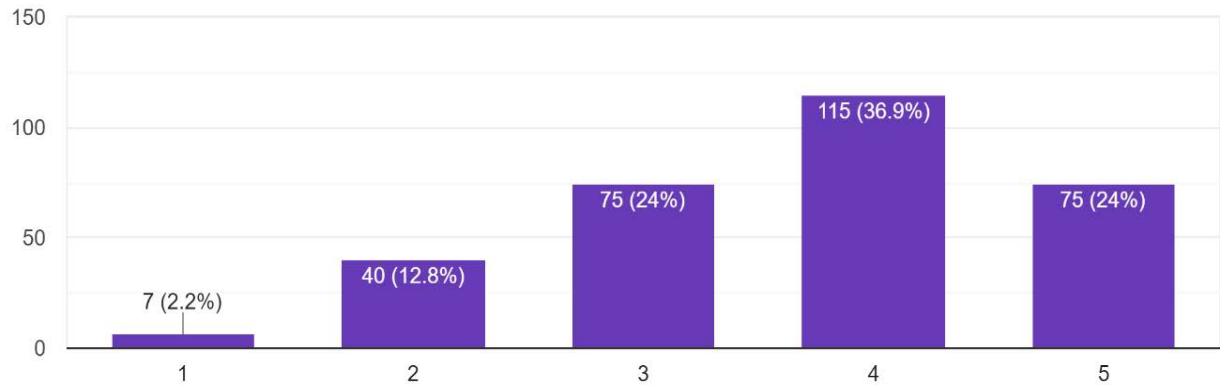 Figure 7: Frequency of world's future thinking being 1 for Never, 2 for Rarely, 3 for Sometimes, 4 for Frequently, 5 for Always.
Figure 7 rates the frequency of future thinking related to the world's future. The frequencies are $36.5\%$ saying that they "frequently" think about the world's future, next comes "always" with $24.4\%$, "sometimes" got $24.1\%$ of the responses, while the lowest scores are "rarely" with $13\%$; and "never" with $2\%$.
On average, the comparison between Figure 6 and 7 clearly shows that the responders think more about their own future than on the worlds' future. This also resonates with the initial questions when responders said they would have a more positive future on the personal level rather than on the global level.
Figure 8 brings the importance evaluation of past, present, and future.
6. What is the most important time for you?
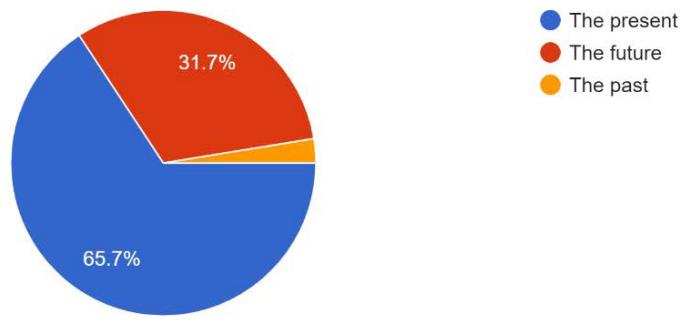 Figure 8: Importance of past, present, and future.
The majority of the responders mentioned that the "present" is the most valuable time (65,8%), followed by the "future" (31,9%), and the "past" with 0,3%. It is important to note that the past becomes totally left behind on the runway to the future.
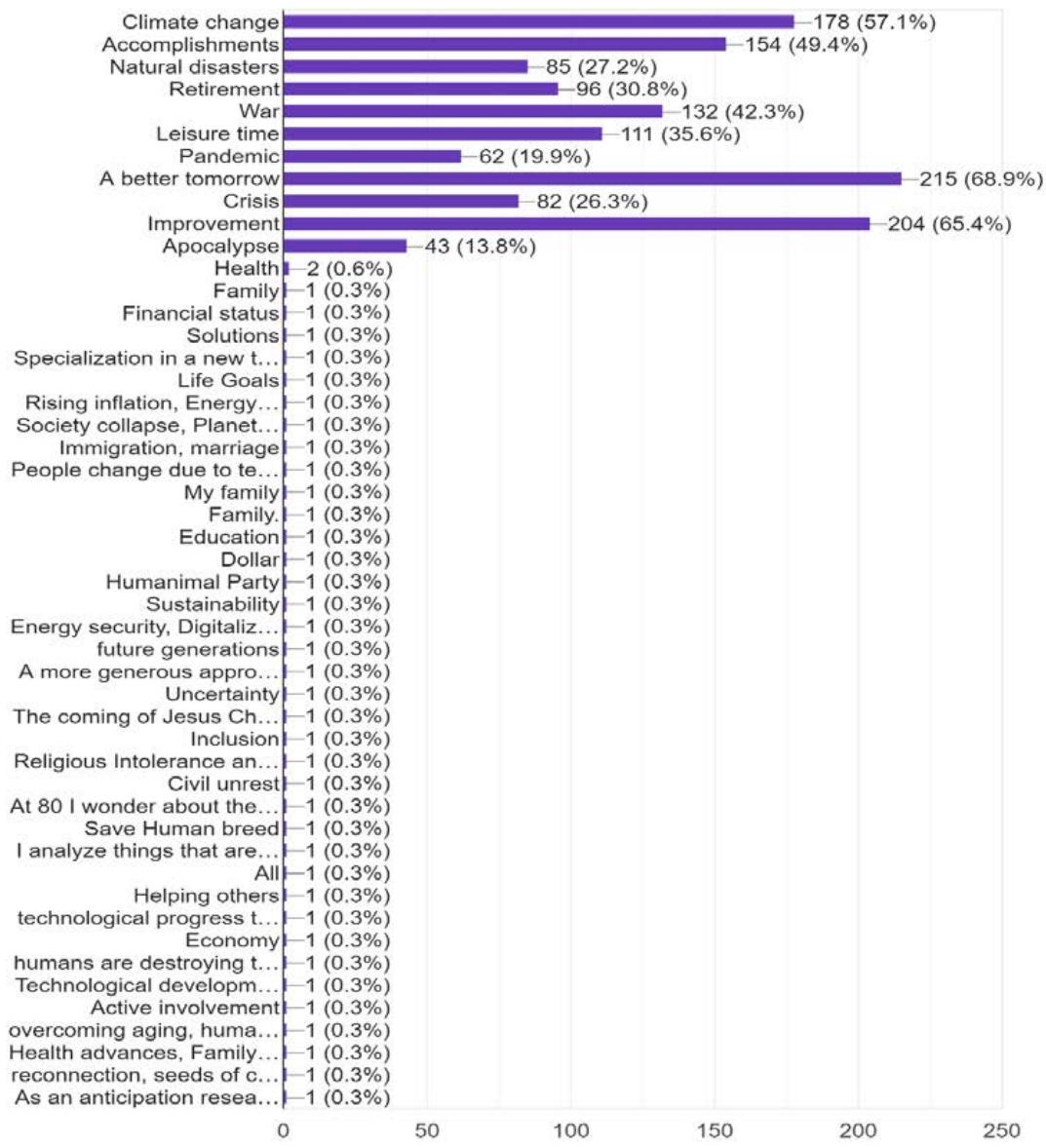 7) When you think about the future, which of these topics are involved. You can tick more than one. 312 responses Figure 9: Topics involved in Future Thinking with the Highest Frequency.
When thinking about the future, the Imaginable Future Survey also inquired what thoughts and ideas were frequently associated with it and the answers with the highest rate were, "a better tomorrow", $(69.4\%)$, "improvement" $(65.5\%)$, "climate change" $(56.4\%)$, "accomplishments" $(50.2\%)$, "war" $(42.3\%)$, among others. It is also possible to note that there is a need to think in better futures and improvements, but at the same time, issues like climate change and war cannot be dismissed. It is interesting to mention that responders were quite aware of their needs and aspects that need to be addressed in the near future.
Figure 10 indicates feeling involved while thinking about the future.
8. When you think about the future, which of these feelings are involved? You can tick more than one.
one. 312 responses
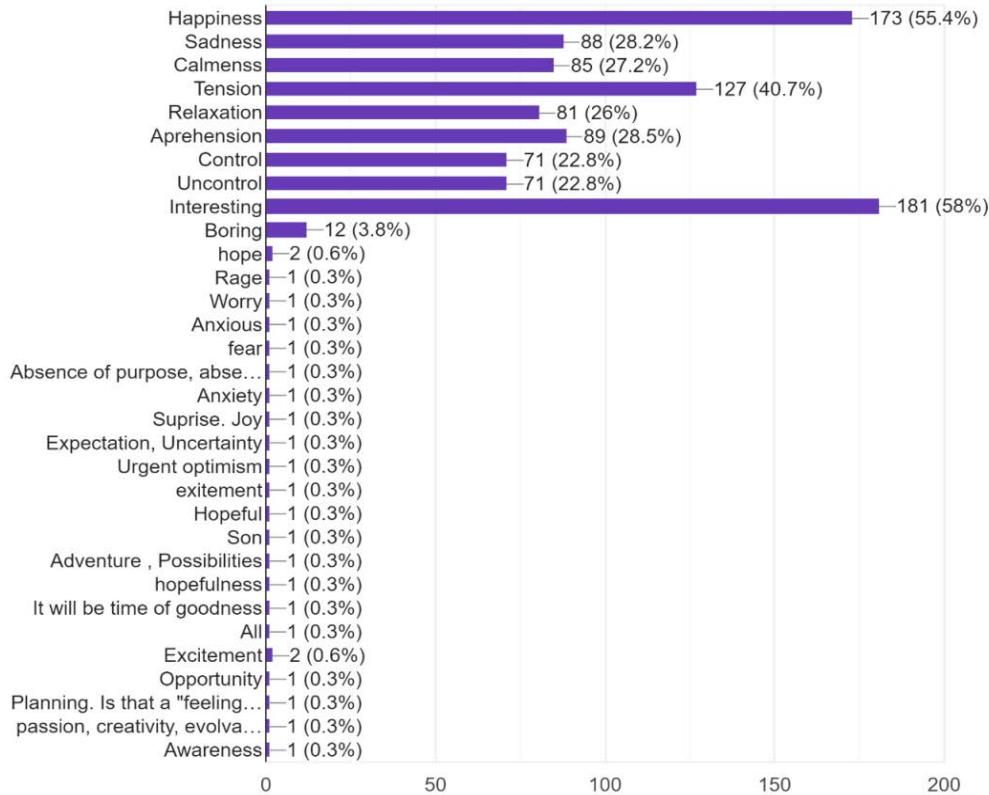 Figure 10: Feelings involved towards future thinking.
312 responses
The largest number of responders mentioned "interesting" (58,3%) when thinking about the future, followed by "happiness" (56%). Next came "tension" with 41%, and "sadness" and "apprehension" got the same score with 28,7%. "Calmness" was mentioned by 27,7%, and "relaxation" among 26,1%. What these
Figure 11 shows the responders rating towards the future.
figures show is a rather ambivalent mixture of feelings and rates which include opposite emotions, for example: tense x calm, happy x sad, control x uncontrol, apprehension x relaxation. Would this also reflect an ambivalent society that moves through unbalanced actions?
9. What's your vision of the future? Choose 1 for very pessimistic, 2 for mild pessimistic, 3 for neutral, 4 for mild optimistic and 5 for very optimistic.
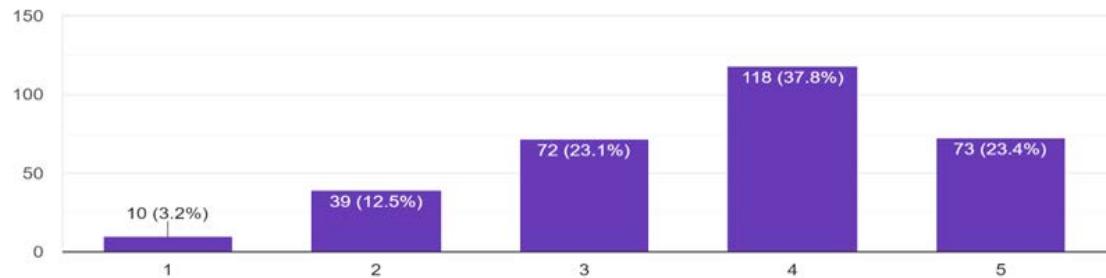 Figure 11: Future vision rate being 1 for very pessimistic, 2 for mild pessimistic, 3 for neutral, 4 for mild optimistic, and 5 for very optimistic.
As shown in Figure 11, the highest rate was for "mild optimistic" (37.5%), "very optimistic" (23.5%), "neutral" (23.1%), "mild pessimistic" (12.7%), "very pessimistic" $(3,3\%)$. The data shows a prevalence of optimism. This shows that there is optimism and hope for the future.
Figure 12 brings the impact of future thinking and foresight on overall health.
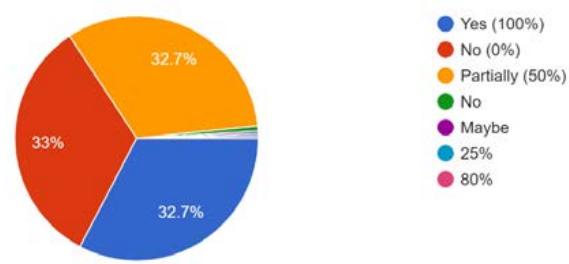 10) Does your vision about the future impact your overall health? 312 responses Figure 12: Impact of future on overall health.
Equally rated $32.6\%$ out of the 312 responders said future thinking does have an impact on overall health, and $32.6\%$ said it partially influences overall health. However, $33.2\%$ of the 312 respondents said it does not influence their health. All in all, there are more answers showing that there is a correlation between health and future thinking, which was exactly one of the aims of this research.
The relationship between future and mental health is addressed in Figure 13.
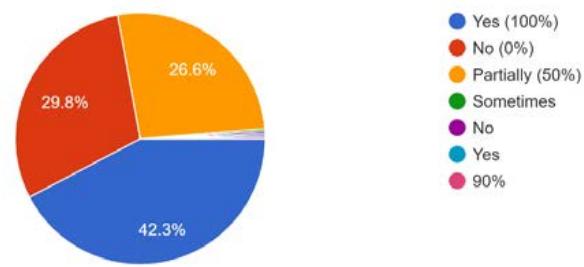 12) Does your vision about the future impact your mental health? 312 responses Figure 13: Impact of the future on mental health.
For the above question about the relation of future thinking on mental health, there is a rise of positive answers, which are $42\%$ of participants out of the 312 who responded "yes" when asked if their mental health was impacted by future thinking. Thirty percent of the respondents said the future had "no" relation to their mental health, and $26.7\%$ said "partially," among other answers. Consequently, there is a correlation on mental health and future thinking, and although not hegemonical, this may be due to the difficult in establishing such relations.
Figure 14 elucidates the relation between anxiety and future thinking.
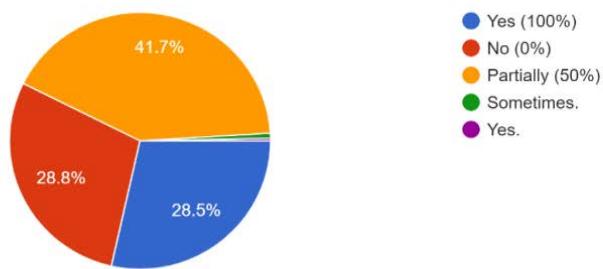 14) When thinking about the future, do you feel anxiety? 312 responses Figure 14: Anxiety feeling connected to the future.
As established in the Figure above (14), the majority of the respondents mentioned anxiety is "partially" $(41,4\%)$ future-related, followed by $29\%$ who said "yes" - anxiety is connected to the future, and Figure 15 brings human capacity in destroying the planet.
28,7% see no correlation between both. Overall, if the positive plus the partially positive answers are added, most of the respondents (70,4%) match anxiety and future.
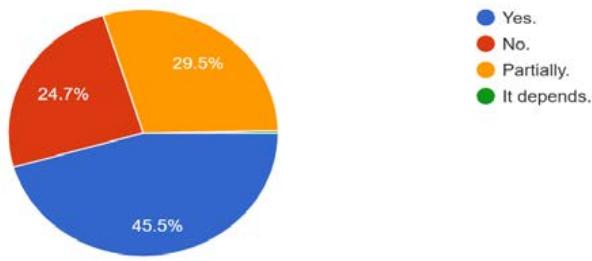 20) Do you think we can destroy the planet in the future? 312 responses Figure 15: Human capacity in destroying the planet.
The Figure above (15) clearly shows that $45.6\%$ of the 312 respondents ticked "yes," $29.3\%$ ticked "partially," and $24.8\%$ said "no." Although aware that humanity can destroy the planet, probably the actions that may reduce this threat are not happening of being efficient.
Figure 16 inquired about humanity reaching the SDG goals by 2030.
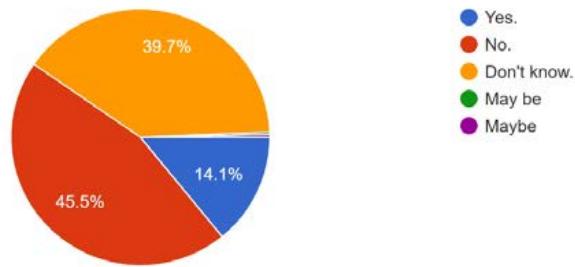 22) Will we reach the 17 UN-Sustainable Developmental Goals by 2030? 312 responses Figure 16: Rate expectation in reaching the 17-UN-SDG goals by 2030.
From the 312 participants, $45.9\%$ said humanity is "not" reaching the goals by this deadline, $39.4\%$ do not know it, $14\%$ answered it will reach it. Although this is a very realistic outcome, it is also tragic as it will bring uncountable consequences.
Figure 17 demonstrates if the participants trusted that the construction of the future was in humanity's hands and the answers are shown next.
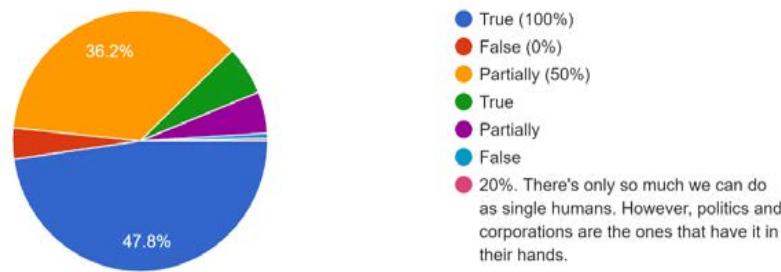 29) The construction of the future is in humanity's hands... 312 responses Figure 17: Relation between future construction and humanity's responsibility.
Finally, when asked if the responders believed that the future was in humanity hands, the positive response rate was $48.2\%$, partially with $35.8\%$, and other answers got $16\%$ of the choice. Thus, it is all with us to prepare a future for all.
## IV. ANALYSIS
This survey targeted Future Imagination in multiple aspects from health issues to reaching global SDG's goals. There is a complexity of factors when addressing and investigating the future that cannot be easily or linearly grasped. There are vectors and issues that cross both individual, social, and cultural aspects.
From the Figures shown in the results, it is possible to note that the present and the future are the most important times for humanity now. The past and historical data, hence so important, have become minor issues in the face of Anthropocene urgency. The future does occupy a great part of human thinking nowadays.
Another interesting aspect of the data is a slightly rupture between individual and global futures. There is a tendency in evaluating and expecting a better individual future whereas the global futures are collapsing. This can be due to a defence response in trying to encapsulate one's expectation in order to survive.
The mix of feelings associated with the future also show the large spectrum of possible futures that can vary from something very calm to tension and apprehension. Although with a high number of answers towards an optimistic future, when inquired if the SDG goals would be reached by 2030 or humanity's capacity to destroy the planet.
These destructive forms received many answers, and they had the highest ratings in responses. For instance, humanity will not reach the goals and it can destroy the planet.
This is exactly in consonance with what Jae (2023) says in his recent article about Decolonizing Futures Practice, which involves new designs, approaches, and methodologies. In his words, "a decolonized futures practice is methodological plural and open to alternative ways of thinking and being" (Jae, 2023).
A good point is that the capacity to construct the future is still in humanity's hands. Therefore, there are lots that everyone can do and contribute towards a better tomorrow.
## V. CONCLUSION
In the literature review about Future Studies, there is little data that consider the individuals as active participants of the future or take Social Psychology to study the future narratives. Most of them, use large data sets and point to one direction or another within a foresight perspective. Anthropocene and other nature concepts are being added to the debate like Ecology, Regeneration, Hermeticism (Schimelpfenig, 2023). Nevertheless, if Imaginable Futures do not connect with the individual self, there will be isolated designs where the individual is not the central piece of its own future. It is crucial to focus on individual foresight, expectations, imaginations, motivations towards a future that should include everyone both in their singularity and collectiveness. Otherwise, the future will continue bringing the same challenges that are being experienced at the present moment, the lack of inclusivity, concentration of power and risky decision-taking.
As the future is created through actions and imagination, it is imperative to look at the Imaginable Futures that are being developed and act responsible towards it. On the verge of so many crisis, collapses, and challenges, humans tend to encapsulate themselves in isolation and self-futurism, as if it would not depend of be influenced by collective action. It is not that individuals do not wish to construct a better future for all, but as global targets are not met, wars collide and apprehension rises, the basic structure which still lies in our DNA is to survive, and to survive may be meaning now to shut-down inside oneself.
Many more issues crossed this research and brought indicatives for further research like the training for the future that is being required and also the need to keep a connection with the past through objects. In this sense, future literacy should not be limited to a couple of groups leading humanity, but the ability to include everyone. It is necessary to foster and develop new ideas and images of as many futures as possible and make sure they are as diverse as inclusive, and equally distributed.
Some of the Imaginable Future data from this survey already suggests a sense of hopelessness and introversion when dealing with the future. On the other hand, this shows that our foresight and imagination is even more decisive to construct better futures. Nevertheless, better futures require much change on society's thinking and acting. Working towards plurality and connections can bring some hope ahead. Einstein is deeply correct when saying that imagination is more important than knowledge.
To imagine is to dream, and to dream is the first step in the direction of accomplishments. Once someone imagined that we could fly, and we went to the moon and back. Once someone imagined it was possible to cross the oceans, produce large crops, talk to people miles away, see the light in the dark, and this is the world we live in. However, without a politicized future (Dobroć, Lösch, 2023), and a humanized technology, humanity will continue at bay, being the byproduct of general forces - just like an Ancient Man from the caves, being subject to climate and threats.
## ACKNOWLEDGEMENT
The present research acknowledges that the guest research period at JLU has been fundamentally important to the completion of this research.
[^312]: responses _(p.4)_
Generating HTML Viewer...
References
28 Cites in Article
(2019). Social Imaginaries: Critical Interventions.
Sherry Ortner (2013). Between Utopia and Despair<i>The Future as Cultural Fact: Essays on the Global Condition</i>. By Arjun Appadurai. London: Verso, 2013..
Mikhail Bakhtin (1999). Marxism and philosophy of language.
Mikhail Bakhtin (2010). Mikhail Bakhtin The Problem of Speech Genres.
W Bell,J Mau (1971). The sociology of the future Theory; cases, and annotated bibliography.
Rebecca Bryant,Daniel Knight (2019). The Anthropology of the Future.
Cornelius Castoriadis (1992). Institution.
Michel Certeau,De (2002). Michel de Certeau: the cunning of unreason.
Carlo Cipolla (1992). The machines of time.
Paulina Dobroć,Andreas Lösch (2023). Transformation through (re-)politicisation of socio-technical futures: how cultural semiotics can improve transformative vision assessment.
Georges Duby (1998). Year1000, year 2000: on the track of our fears.
Georges Duby (2002). Theyear thousand.
Norbert Elias (1989). Sobre el tiempo.
Norbert Elias (2002). The civilizing process -state formation and civilization.
Franco Junior,Hilary (2005). The year 1000: time of fear or hope?.
Jeanne Gagnebin,Marie (1997). Seven lessons on language, memory and history.
Jeanne Gagnebin,Marie (1999). History and narration in Walter Benjamin.
S Gould (1999). Questioning the millennium.
Stephen Gould (2000). Questioning the Millennium.
Kevin Jae (2023). Decolonizing Futures Practice: Opening up authentic alternative futures.
J Kable,S Lee,T Parthasarathi,W Joseph (2021). The Ventral and Dorsal Default Mode Networks Are Dissociably Modulated by the Vividness and Valence of Imagined Events.
Robert Levine (1997). A geography of time: the temporal misadventures of a social psychologist or how every culture keeps time just a little bit differently.
Alfred Mcbride (1998). Millennium plans new $18m Technical Center in USA.
(1996). Centuries' ends, narrative means.
Chris Nyland (1986). Capitalism and the History of Worktime Thought.
Karla Paniagua,Robert Schimelpfenig (2019). Anticipatory Thinking as a Critical Design Skill: About the Design of Tomorrow one-year program.
Hillel Schwartz (1992). Associate Editors.
Ron Scollon (1998). Mediated Discourse as Social Interaction.
No ethics committee approval was required for this article type.
Data Availability
Not applicable for this article.
How to Cite This Article
Dr. Monica Mastrantonio. 2026. \u201cImaginable Futures: A Psychosocial Study on Future Expectations and Anthropocene\u201d. Unknown Journal GJHSS-C Volume 23 (GJHSS Volume 23 Issue C5): .
Explore published articles in an immersive Augmented Reality environment. Our platform converts research papers into interactive 3D books, allowing readers to view and interact with content using AR and VR compatible devices.
Your published article is automatically converted into a realistic 3D book. Flip through pages and read research papers in a more engaging and interactive format.
Our website is actively being updated, and changes may occur frequently. Please clear your browser cache if needed. For feedback or error reporting, please email [email protected]
Thank you for connecting with us. We will respond to you shortly.