Obong UniversityTo: Author
Article Fingerprint
ReserarchID
21762
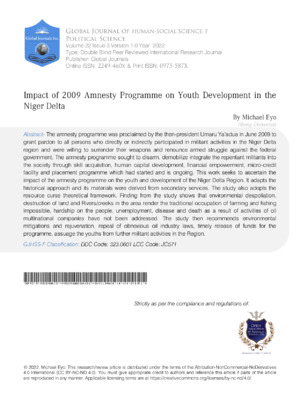
The amnesty programme was proclaimed by the then-president Umaru Ya’adua in June 2009 to grant pardon to all persons who directly or indirectly participated in militant activities in the Niger Delta region and were willing to surrender their weapons and renounce armed struggle against the federal government. The amnesty programme sought to disarm, demobilize integrate the repentant militants into the society through skill acquisition, human capital development, financial empowerment, micro-credit facility and placement programme which had started and is ongoing. This work seeks to ascertain the impact of the amnesty programme on the youth and development of the Niger Delta Region. It adapts the historical approach and its materials were derived from secondary services. The study also adopts the resource curse theoretical framework. Finding from the study shows that environmental despoliation, destruction of land and Rivers/creeks in the area render the traditional occupation of farming and fishing impossible, hardship on the people, unemployment, disease and death as a result of activities of oil multinational companies have not been addressed. The study then recommends environmental mitigations and rejuvenation, repeal of obnoxious oil industry laws, timely release of funds for the programme, assuage the youths from further militant activities in the Region.
Prof. Abomaye-Nimenibo Williams Aminadokiari Samuel. 2026. \u201cImpact of 2009 Amnesty Programme on Youth Development in the Niger Delta\u201d. Global Journal of Human-Social Science - F: Political Science GJHSS-F Volume 22 (GJHSS Volume 22 Issue F3): .
Crossref Journal DOI 10.17406/GJHSS
Print ISSN 0975-587X
e-ISSN 2249-460X
Explore published articles in an immersive Augmented Reality environment. Our platform converts research papers into interactive 3D books, allowing readers to view and interact with content using AR and VR compatible devices.
Your published article is automatically converted into a realistic 3D book. Flip through pages and read research papers in a more engaging and interactive format.
Total Score: 102
Country: Nigeria
Subject: Global Journal of Human-Social Science - F: Political Science
Authors: Michael J. Eyo, Harrison Otuekong Ataide (PhD/Dr. count: 0)
View Count (all-time): 144
Total Views (Real + Logic): 1736

Total Downloads (simulated): 42
Publish Date: 2026 01, Fri
Monthly Totals (Real + Logic):
This paper attempted to assess the attitudes of students in
Advances in technology have created the potential for a new
Inclusion has become a priority on the global educational agenda,
The amnesty programme was proclaimed by the then-president Umaru Ya’adua in June 2009 to grant pardon to all persons who directly or indirectly participated in militant activities in the Niger Delta region and were willing to surrender their weapons and renounce armed struggle against the federal government. The amnesty programme sought to disarm, demobilize integrate the repentant militants into the society through skill acquisition, human capital development, financial empowerment, micro-credit facility and placement programme which had started and is ongoing. This work seeks to ascertain the impact of the amnesty programme on the youth and development of the Niger Delta Region. It adapts the historical approach and its materials were derived from secondary services. The study also adopts the resource curse theoretical framework. Finding from the study shows that environmental despoliation, destruction of land and Rivers/creeks in the area render the traditional occupation of farming and fishing impossible, hardship on the people, unemployment, disease and death as a result of activities of oil multinational companies have not been addressed. The study then recommends environmental mitigations and rejuvenation, repeal of obnoxious oil industry laws, timely release of funds for the programme, assuage the youths from further militant activities in the Region.


Lorem ipsum dolor sit amet, consectetur adipiscing elit. Ut elit tellus, luctus nec ullamcorper mattis, pulvinar dapibus leo.