## I. INTRODUCTION
The modernization of agriculture is driven by various factors, including population growth, urbanization, changing dietary patterns, globalization, climate change, and advancements in science and technology. It aims to address the challenges of feeding a growing population sustainably, enhancing food security, reducing poverty, promoting rural development, and mitigating environmental degradation. While agricultural modernization offers opportunities for increasing productivity, profitability, and competitiveness, it also poses challenges related to access to technology, knowledge, resources, and environmental sustainability. Therefore, achieving sustainable 15 agricultural modernization requires a balanced approach that considers social, economic, environmental, and ethical dimensions to ensure inclusive and equitable development while safeguarding natural resources and ecosystem integrity. The modernization of agriculture represents a transformative process aimed at enhancing productivity, efficiency, and sustainability in the agricultural sector. In response to changing socioeconomic, environmental, and technological dynamics, countries worldwide are embracing modern agricultural practices and technologies to meet the growing demand for food, ensure food security, and promote rural development. Before the emergence of the modern agricultural tools and techniques, the farmers were suffering so much from the drudgeries of agricultural works. These suffering of theirs were include not only physical, but also psychological stress. Bentley et al. (2019) found in their study that the psycho-social risks, such as high demands, role conflict, lack of managerial or co-worker support, stress, bullying and discrimination in the work environment, are detrimental to both health and well-being of older workers and can also increase the probability of early retirement. This is one of the reasons why many of the farmers don't want to be in agriculture and their mass shifting towards the urban and semi urban areas.
In this paper we will discuss how the farm mechanization has impacted on psychological health of the farmers positively and has reduced their occupational stress to a significant extent.
## II. METHODOLOGY
This study was conducted in Raipur Gram Panchayet and village, Sriniketan block, Birbhum district of West Bengal. Total 150 farm families were selected for the study with a class interval of 3 (2.75 to be precise). The sampling method used for the study is as follows-
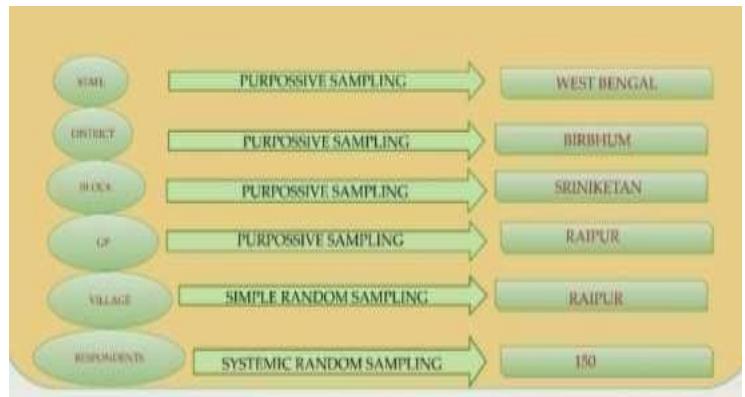
Pilot Study: A pilot study, pilot project, pilot test, or pilot experiment is a small-scale preliminary study conducted to evaluate feasibility, duration, cost, adverse events, and improve upon the study design prior to performance of a full-scale research project. We have done a pilot study with $10\%$ samples of the total respondents to see whether the questionnaires are applicable and capable for extracting the required information from the tribal women of the area under study.
### a) Methods of Data Collection
Preparation of Interview Schedule: On the basis of the findings of pilot study interview schedule was prepared with the help of review literature and by the assistance of chairman of Advisory Committee. The schedule consists of Agro-economic, Socio- personal and Techno managerial.
Pre Testing of Interview Schedule: Main objective of this performance is to detect the discrepancies that have emerged and to eliminate them after necessary modification in the schedule. The individuals who responded in pretesting have been excluded in the final sample for the study.
Techniques of Field Data Collection: The respondents were personally interviewed during summer vacation. Local language (Bengali) was used to retrieve the information from the respondent. The entries were done by the student investigator himself at the time of interview.
### b) Statistical Tools
The statistical tools used for the study are coefficient of correlation and step down regression.
Coefficient of correlation: The correlation coefficient is a statistical measure of the strength of the relationship between the relative movements of two variables. The values range between -1 and +1. If the calculated number greater than +1 or less than -1 means that there was an error in the correlation measurement. A correlation of -1 shows a perfect negative correlation, while a correlation of 1.0 shows a perfect positive correlation. A correlation of 0 shows no linear relationship between the movements of the two variables.
### Correlation Coefficient Equation:
Where, rxy - The correlation coefficient of the linear relationship between the variables x and y
xi - The values of the x-variable in a sample $\bar{x}$ - the mean of the values of the x-variable yi- the values of the y-variable in a sample $\bar{y}$ - the mean of the values of the y-variable
Stepwise Multiple Regressions: Regression analysis is a widely used statistical approach that seeks to identify relationships between variables. The idea is to pool relevant data to make better informed decisions and is a common practice in the world of investing. Stepwise regression is the step-by-step iterative construction of a regression model that involves automatic selection of independent variables. The availability of statistical software packages makes stepwise regression possible, even in models with hundreds of variables.
## III. RESULTS
The correlation of coefficient between dependent variable Improvement of Psychological health (Y) and the 13 independent variables (X1.....X13)
<table><tr><td>SI No.</td><td>Variables</td><td>Correlation Coefficient</td><td>Remark</td></tr><tr><td>1</td><td>Age (X1)</td><td>0.0328</td><td></td></tr><tr><td>2</td><td>Educational Qualification (X2)</td><td>-0.02186</td><td></td></tr><tr><td>3</td><td>Total Monthly Income (X3)</td><td>-0.0228</td><td></td></tr><tr><td>4</td><td>Monthly Expenditure on Health Issues (X4)</td><td>-0.02225</td><td></td></tr><tr><td>5</td><td>Family Size (X5)</td><td>-0.153005</td><td>*</td></tr><tr><td>6</td><td>Cultivated Crops (X6)</td><td>-0.04155</td><td></td></tr><tr><td>7</td><td>Available Land (X7)</td><td>-0.00495</td><td></td></tr><tr><td>8</td><td>Presence of Health Centre (X8)</td><td>0.090</td><td>*</td></tr><tr><td>9</td><td>Usage of Modern Equipment(X9)</td><td>0.0615</td><td>*</td></tr><tr><td>10</td><td>Health Consciousness (X10)</td><td>0.092047</td><td>*</td></tr><tr><td>11</td><td>Relation with Relatives and Neighbors (X11)</td><td>-0.018</td><td></td></tr><tr><td>12</td><td>Physical Drudgeries Caused byFarming (X12)</td><td>0.1749</td><td>*</td></tr><tr><td>13</td><td>Psychological Drudgeries Caused by Farming (X13)</td><td>0.1416</td><td>*</td></tr></table>
This is clearly visible Family Size (X5), Presence of Health Centre (X8), Usage of Modern Equipment (X9), Health Consciousness (X10), Physical Drudgeries Caused by Farming (X12) and Psychological Drudgeries Caused by Farming (X13) have significant correlation with the dependent variable Improvement of Psychological health (Y3).
Family size is a two way serrated saw. In the one hand it would give the strength to walk in the farming field but on the other hand it would surely give more burden to feed empty stomach. If the survival expenditure of the family is more than there would be a very small amount of resource left to be spend on the mental health issues presence of health center and health consciousness would create a significant positive impact on the mental health status of the respondents. Usage of the modern equipment will lessen the physical and psychological drudgery of the respondents, which would be very helpful to improve their mental health.
The Model of the correlation of coefficient between dependent variable Improvement of Psychological health (Y) and the 13 independent variables (X1.....X13)
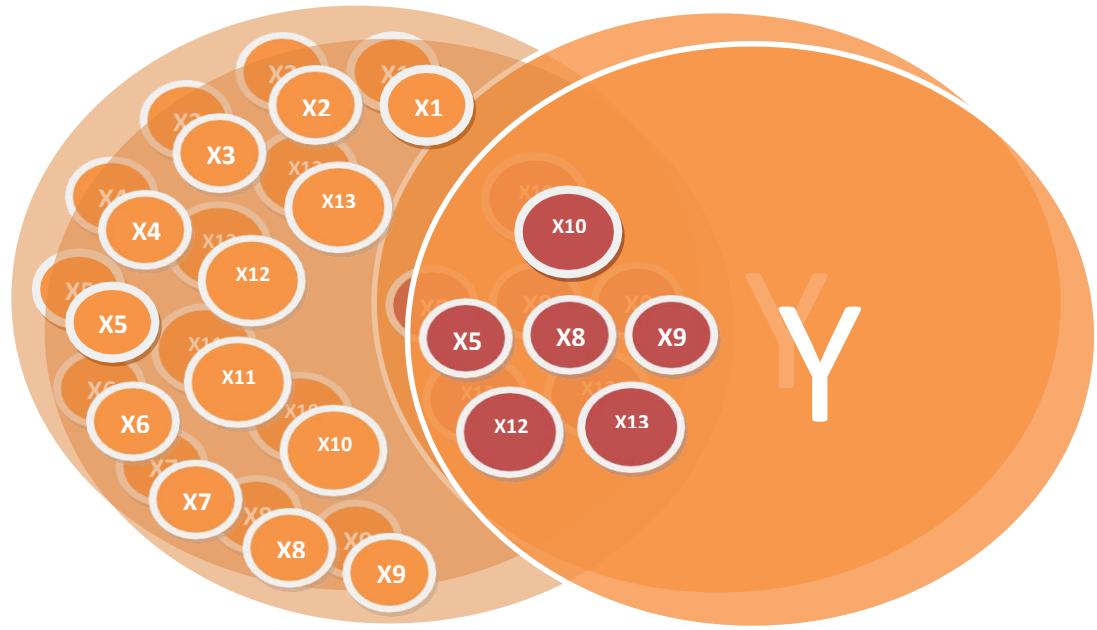
- X5-Family Size
- X8- Presence of Health Centre
- X9 - Usage of Modern Equipment
- X10 - Health Consciousness
- X12 - Physical Drudgeries Caused by Farming
- X13 - Psychological Drudgeries Caused by Farming
Step down regression of 13 independent variables vs dependentvariables Improvement of Psychological health (Y)
<table><tr><td>Name of the Variables</td><td>B</td><td>Beta</td><td>t</td></tr><tr><td>Age (X1)</td><td>0.017</td><td>0.064</td><td>0.455</td></tr><tr><td>Educational Qualification(X2)</td><td>0.335</td><td>0.504</td><td>3.222</td></tr><tr><td>Total Monthly Income (X3)</td><td>-0.001</td><td>-0.482</td><td>-1.208</td></tr><tr><td>Monthly Expenditure on Health Issues (X4)</td><td>-0.144</td><td>-0.062</td><td>-0.167</td></tr><tr><td>Family Size (X5)</td><td>-0.233</td><td>-0.220</td><td>-1.056</td></tr><tr><td>Cultivated Crops (X6)</td><td>0.002</td><td>0.383</td><td>1.109</td></tr><tr><td>Available Land (X7)</td><td>0.749</td><td>0.330</td><td>1.751</td></tr><tr><td>Presence of Health Centre(X8)</td><td>0.016</td><td>0.006</td><td>0.020</td></tr><tr><td>Usage of Modern Equipment (X9)</td><td>1.016</td><td>0.349</td><td>2.355</td></tr><tr><td>Health Consciousness (X10)</td><td>0.200</td><td>0.306</td><td>0.773</td></tr><tr><td>Relation with Relatives andNeighbors (X11)</td><td>0.062</td><td>0.208</td><td>0.930</td></tr><tr><td>Physical Drudgeries Causedby Farming (X12)</td><td>0.540</td><td>0.178</td><td>0.781</td></tr><tr><td>Psychological DrudgeriesCaused by Farming (X13)</td><td>0.125</td><td>0.179</td><td>0.546</td></tr></table>
$$
R ^ {2} = 0. 5 8 7 8
$$
- The result depicted in the above table revealed that step down regression analysis between exogenous variable Improvement of Psychological Health (Y) Vs 13 Causalvariables.
- It has been found that the $R^2$ value is 0.5878. It is to infer that $58.78\%$ of variance in the consequent variable have been explain by the combination of these 13 causal variables.
Step down regression $9^{\text{th}}$ step for Improvement of Psychological health (Y)
<table><tr><td>Name of the Variables</td><td>B</td><td>Beta</td><td>t</td></tr><tr><td>Health Consciousness (X10)</td><td>0.306</td><td>0.460</td><td>3.783</td></tr><tr><td>Relation with Relatives andNeighbors (X11)</td><td>0.599</td><td>0.264</td><td>2.047</td></tr><tr><td>Psychological DrudgeriesCaused by Farming (X13)</td><td>0.890</td><td>0.306</td><td>2.344</td></tr></table>
The above table presents the stepwise regression and it has been depicted that 3 casual variable), Health Consciousness (X10), Relation with Relatives and Neighbors (X11), Psychological Drudgeries Caused by Farming (X13) has been retained in the last step. The $R^2$ value being 0.8138 shows that 81.38% of variance in the consequent variables has been explained by the combination of only these 3 casual variables.
Health consciousness is a key factor to detect mental health. Communication can improve the mental health status of an individual. If people are more health conscious more communicative and less stressed then it would surely improve their psychological health.
Step down regression of 13 independent variables vs dependentvariables Improvement of Psychological health (Y)
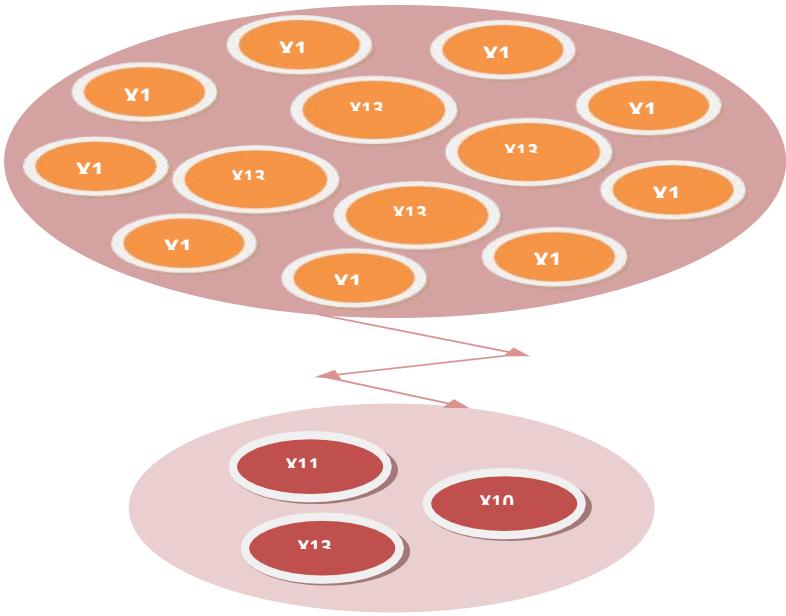 X10 - Health Consciousness X11 - Relation with Relatives and Neighbors X13 - Psychological Drudgeries Caused by Farming
## IV. DISCUSSION
In case of Exogenous Improvement of Psychological health (Y3) after doing research study we can easily say that the coefficient of correlation is visible Family Size (X5), Presence of Health Centre (X8), Usage of Modern Equipment (X9), Health Consciousness (X10), Physical Drudgeries Caused by Farming (X12) and Psychological Drudgeries Caused by Farming (X13) have significant correlation. And in case of step down regression the result revealed that the analysis between mentioned exogenous variable vs 13 causal variables. it has been found that the $R^2$ value being 0.5878 shows that $58.78\%$ of variance in the consequent variable have been explain by the combination of these 13 casual variable. And in the 9th step or final of step down regression it has been depicted that 3 casual variables has been retained in the last step. The $R^2$ value being 0.8138 shows that $81.38\%$ of variance in the consequent variables has been Health Consciousness (X10),
Relation with Relatives and Neighbours (X11)and Psychological Drudgeries Caused by Farming (X13) explained by the combination of only these 3 casual variables.
The recommendation which we can give to the policy makers:-
- The women should be encouraged to have more localized and cosmopolitan information to change their present scenario. The government's schemes and programmes which are beneficiary and useful for purchasing latest agricultural equipment should be known by the tribal women. For this a proper bridge should be made in between the government agencies and the tribal women. Opinion leaders who can get the firsthand information from the government agencies and to communicate these information to the other stake holder, should be identified and trained properly.
- As we have found that, this particular village is quite remote and backward. It is very much late to adopt new technology or implements. So, the main problem we can say there is a communication gap, if a contact person or opinion leaders would be there it will be easy for them to adopt things easily and if the contact person is women it will be more comfortable for them to communicate.
## V. CONCLUSION
Saju et. al. (2023) has found in their study that the quantifiable variables associated with farmers's well being are attachment family, friends and peer groups, belongingness and other social engagements. In this study also we have found out that farm mechanization effectively increases the health consciousness of the farmers and establishes better communication and relationship with relatives and neigh bors. It was also evident from the study that mechanized way of farming significantly reduces not only the physical but also the psychological drudgeries of the farmers. The number of the members of the family is negatively significant with the psychological health of the farmer. It indicates that lesser the family size better would be the psychological health of the members. Henceforth, we can conclude from the study that, usage of modern equipment in the farming is pretty much helpful in maintaining a good psychological health of the farmers and their subsequent mental, physical and social well being.
### ACKNOWLEDGEMENT
The authors are grateful to the Department of Agricultural Extension, Seacom Skills University.
Authors Contribution: Both the first and second authors have contributed in problem identification, ideation, data collection and formulation of conclusion.
Generating HTML Viewer...
Funding
No external funding was declared for this work.
Conflict of Interest
The authors declare no conflict of interest.
Ethical Approval
No ethics committee approval was required for this article type.
Data Availability
Not applicable for this article.
Anannya Chakraborty. 2026. \u201cImpact of Farm Mechanization on the Psychological Health of the Farmers: A Holistic Study in West Bengal, India\u201d. Global Journal of Science Frontier Research - D: Agriculture & Veterinary GJSFR-D Volume 24 (GJSFR Volume 24 Issue D1): .
Our website is actively being updated, and changes may occur frequently. Please clear your browser cache if needed. For feedback or error reporting, please email [email protected]
×
This Page is Under Development
We are currently updating this article page for a better experience.
Thank you for connecting with us. We will respond to you shortly.