
I. INTRODUCTION
In India goods and service tax was a historical movement for implementation a significant indirect tax reforms. It means that mixed up various number of indirect taxes which(levied by both central and state government) to made up a single tax and give a big advantage for customer to filling a tax return.
II. LITERATURE REVIEW
Monika Sehrawat, Upasana Dhanda (December 2015) defined goods and service tax and the key tax reform and explain the concept, feature, advantages and challenges of GST.
Dr. N. Bagyalakshmi (2015) studied that impact of GST on various sectors and challenges for GST implementation and founded those benefits of introduction of GST, and suggested various measures to overcome challenges of GST.
Deepika Bendapudi & Sheba M Sam (2015) studied GST and its impact on government and retail sector and founded various provision of GST and its impact of GST on retail sector and government revenues.
Ruth Priyanka Immanuel, Wiston Terence (2015) studied that GST and its impact on tax burden and founded that tax burden on individuals and benefit of GST on different sector of the market.
Milan Deep Kour, Kajal Chaudhary, Surjan Singh, Baljinder Kaur (November 2016) studied the impact of GST after its implementation and founded that the present condition of indirect tax and the GST, benefits and challenges for GST.
III. OBJECTIVES OF THE STUDY
a) To know the changes of various tax rates.
b) Impact of GST in different sector after implementation.
c) Changing in product price.
IV. RESEARCH METHODOLOGY
Sources of Data: The source(s) of data is based on secondary. This includes to journals, articles, newspaper highlights and various website.
V. DATA ANALYSIS
a) The main highlights of the GST is as follows:
i. In 1stjulyGSTcomes effect for the public.
ii. From coming of GST it does not expected have much impact of inflation.
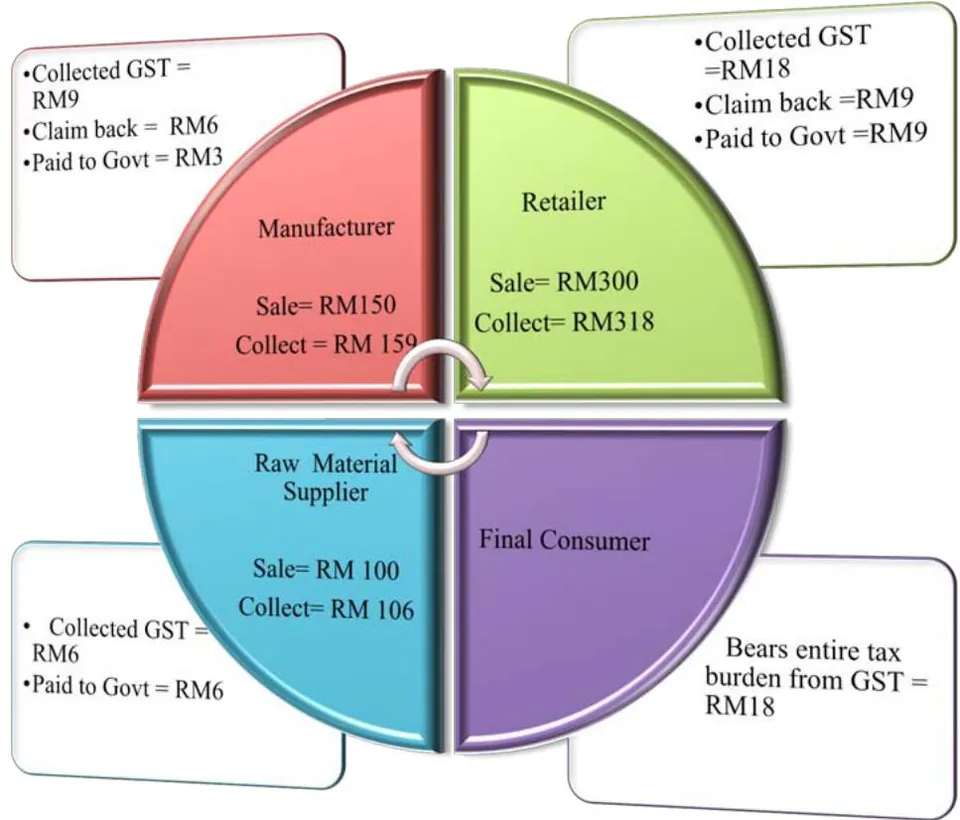
iii. GST system, tax collected only VALUE ADDED TAX AT EVERY STAGES.
iv. It means single tax (collected at multiple tax).
v. The overall final consumer will bear GST charged only.
vi. It will depend on respective state government who control the price of commodities.
vii. In GST petroleum product does not have much space.
viii. The Finance Minister "ARUN JATIELY" gave the information to the public for GST Launched event in parliament central hall on Friday midnight.
ix. The GST embodies the principle of "ONE NATION, ONE TAX, ONE MARKET".
x. In GST rate tax fall in under various categories: 0%, 12%, 18% and 28%.
xi. The biggest advantage of GST reduction in the multiple tax burden of goods.
xii. It gave various cheat- sheet points:
a. GST is a biggest game changer in Input tax credit.
b. The tax paid on each stage on production to consumer but with the help of GST tax is Paid on last point of supply chain.
c. The government was included an ANTI-PROFITEERING clause in GST.
d. The petroleum product like: petrol, diesel, aviation turbine fuel, alcohol was left out in GST.
VI. IMPACT OF 5 SECTORS OF INDIA'S ECONOMY
a) Real Estate
During the new tax structure of India having input credit benefits various builders have Buy their raw materials at the base price of property project which is launched at 1stJuly 2017 will be compare to more cheaper. For buying during construction properties will be attract 12% to 5.5% rate earlier(including value added tax and service tax).Real estate buyer have more prosperous and quicker to take cost benefit on to Property buyers. For new projects input credit passed by the buyer at 100% and land 50%.Any tax rate change under GST purely depends on demand and supply.
b) E- Commerce
E-Commerce website like Amazonian, Snap deal, etc. It collects TCS (tax collected at source) which is fixed at 1%, and it pay to the Seller at a listed website. It is more expensive. The latest update by GST is that TCS collected (sector 52 of the CGST/ SGST act, 2017).
c) Travel and Tourism
IT depends on room rates for their slab for hotel and lodges. It comes out 7.5% of the GDP. For the business class fares will goes increase 9% to 12%.
d) Ride Halling Apps
TAX rate will rise 14.5% to a range between 29% to 43% for driver that who does not work for olla and uber cab. The individual pay 25,000 for EMI but it rise and they pay around RS.35,000 to 40,000 for post GST.
e) Smart Phones
IT raise 12% to range of 8% to 18% after implementation at various stage.
Ex: APPLE consider for their phone 7.5% after reduction of price of their apple mode
Standard-Rated GST
VII. KEY FOCUS FOR SUCCESSFUL GST IMPLEMENTATION
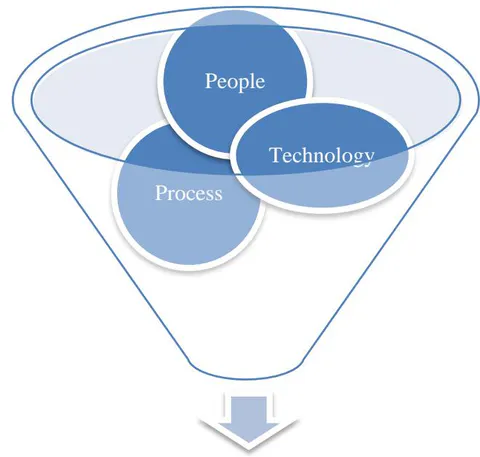
a) People:-Education & training, Selling for the upcoming GST, Communication Plan.
b) Process: Business Process flows and document flows, place and time of supply, rules and managing cash flow, Supply chain analysis of suppliers and customer, Transitional issues.
c) Technology: IT System configuration and modification, Current IT system caters for GST.
To understand and identify the "AS It" and "To Be" in order to be GST compliant.
VIII. A TURNING POINT IN HISTORY
With the introduction of GST, indirect tax will have a flat rate of around 18%. In the current system consumer pay 25-26% more than the cost of production. Inflation:
Currently, certain goods have a lower tax rate such as food products, gold(1-2%), small cars(8%) etc but under the proposed GST almost all the products will be charged at a uniform rate much higher compared to the current level of these products. Thus these products are likely to get dearer.
Earlier Experience:
6 time out of inflation has increased after introduction of GST.
1 out of 2 times inflation fell after the GST rate was decreased.
Inflation tends to rise when there is a change in the rate or structure of tax. It might not comply with macro-economic concepts but trends some time defines more than anything else.
7 times out of 10 inflation rose after GST was increased.
IX. GOODS AND SERVICE TAX
| Total Indirect Tax Collections (in Rs.) | Total Direct Tax Collections (in Rs.) | Total Tax in GDP Ratio | Change in Total Tax to GDP Ratio | |
| Current | 13.5 | 6.8 | 17.80% | Not Applicable |
| At Rnr of 18% | 13.5 | 6.8 | 17.80% | 0% |
| At 25% | 16.4 | 6.8 | 19.70% | 1.90% |
RNR= Revenue Neutral Rate Whereas Tax to GDP Ratio is expected to remain unchanged. It is expected to increase by 1.9% at RNR of 25%. Thus at 25%, government would get the money to boost the GDP through increasing its capital expenditure.
a) Structure of GST
For India has implemented GST structure by Canadian model of dual GST.
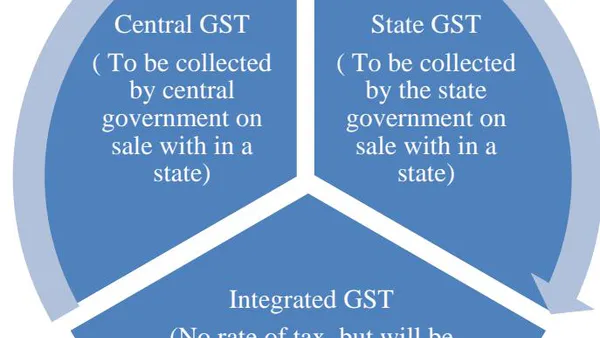
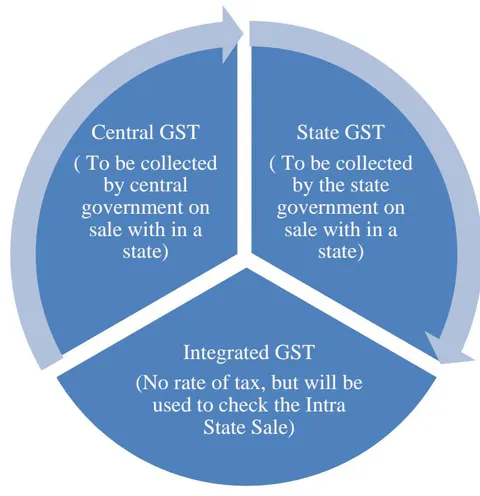
b) 3 types of GST collected by
i. CGST (central goods and service tax): Collected by central government.
ii. SGST (state goods and service tax): Collected by state government.
iii. IGST (Inter Goods and Service Tax): It is applicable on inter-state sales. It work between state and central government For help in smooth transfer.
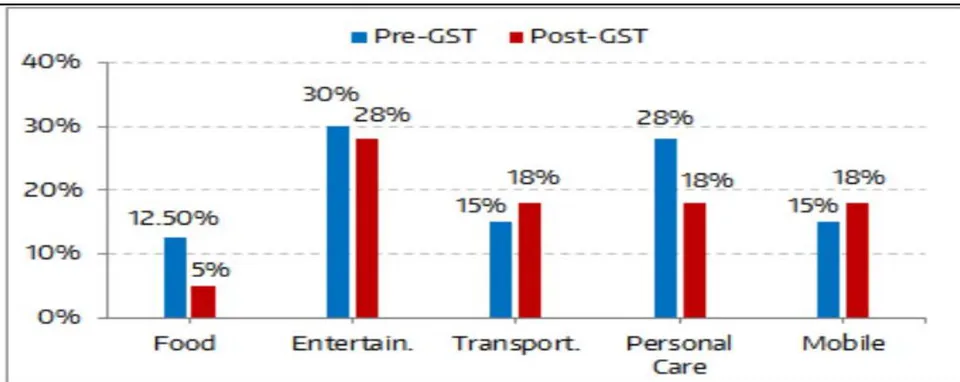
c) Impact on Price on GST
Expecting in reduction in price of FMCG goods such as shampoos, chocolates, eating out, small cars, DTH.
For increasing in price luxury cars. Tabaco Products, Aerated beverages. textiles.
X. IMPACT OF GST ON VARIOUS SECTORS
Before implementation of GST most of tax burden held by it service, telecommunication the insurance industry, business support service, banking and financial service, etc. But after implementing market are unified. There are various sector which impact on GST like Logistics, Pharma, Telecommunications, Textile, Agriculture, FMCG, Freelancers, Automobiles, Startups etc.
a) Positive Impact on GST
i. There is no inter-state tax.
ii. There will be no burden of check post.
iii. It gives benefit transport industry and suppliers of goods.
iv. From inter-state tax there are more goods will be imported and exported among states.
v. They leads to reduction in tax evasion.
vi. Tax benefit GST provide that the reduction the price of goods in the long run.
vii. In India GST will gain the trust of foreign investor.
b) Negative Impact on GST
i. Smuggled goods may travel freely throughout the country.
ii. The local people may feel discriminated.
XI. DECISION TAKEN BY 21 GST COUNCIL MEETING
a) Second Review Meeting
The 21 GST council meeting was held on 9th September 2017 at Hyderabad. In GST council meeting, various decision are pertaining to the implementation and regulation of GST was decided.
There are major decision are highlights in 21st GST council meeting:
i. Artisans turnover of up to Rs. 20 lakh exempt from registration under GST.
ii. Last date for filling of sales return or GSTR-1 extended by a month to October 10, 2017.
iii. The overall GST collection robust with over 70%.
iv. GST rate are reduced in 30 items like roasted gram, idli/dosa butter, oilcakes, raincoats, rubber band etc.
v. Khadi sold through KVIC stores to be exempted from GST.
b) GST Return Filling
i. The due date for filling GSTR-1 for July was be extended up to 10th October 2017. For tax payers with annual turnover of more than Rs. 100 crores, the due date for filling July GSTR-1 return will be 3rd October, 2017.
ii. The due date for filling July GSTR-2 return was be extended up to 31 October, 2017.
iii. The due date for filling July GSTR-3 return was be extended up to 10th November 2017.
iv. The due date for all other GSTR-1, GSTR-2, GSTR-3 returns will be mentioned at a later date.
c) Decision in 22nd Meeting in GST Concil
i. It was held on 6 th October 2017.
ii. Relaxation for small and medium enterprises.
iii. To facilitate the easy payment and return filling for small and medium business with annual aggregate turnover up to Rs. 1.5 crores.
iv. Return filling to required quarterly basis.
v. The registered buyers from small tax payer would be eligible to avail input tax credit on a monthly basis.
vi. Small enterprises which aggregate turnover is less than Rs. 20 lakh are free for obtaining registration.
d) Composition scheme under GST
Note: service providers cannot opt for composition scheme.
| Types of business | CGST | SGST | TOTAL GST |
| Traders (Goods) | 0.50% | 0.50% | 1% |
| Manufacture | 1% | 1% | 2% |
| Supplier of food or drinks for human consumption (without alcohol) | 2.50% | 2.50% | 5% |
XII. DATE AND PERIOD FOR FILLING TAX RETURN
For annual aggregate turnover more than INR 1.5 crore:
| PERIOD | DATES |
| Jul - Oct 2017 | 31 Dec 2017 |
| Nov 2017 | 10 Jan 2018 |
| Dec 2017 | 10 Feb 2018 |
| Jan 2018 | 10 Mar 2018 |
| Feb 2018 | 10 Apr 2018 |
| Mar 2018 | 10 May 2018 |
XIII. CONCLUSION
The structure of GST which was changed after implementation of GST. During the implementation of GST procedure it make various impact on different sector like: changing in product price due to increasing and decreasing tax slab rates, abolition of various indirect tax in the states as well as central level. As it is expected by the Government that in long term GST will grow India's economy but long distance has to travel in this root.