
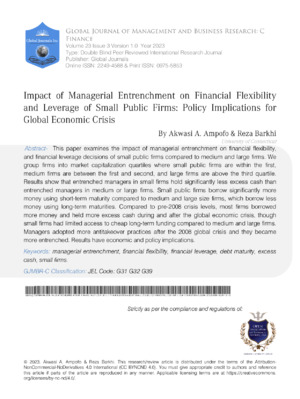

Impact of Managerial Entrenchment on Financial Flexibility and Leverage of Small Public Firms: Policy Implications for Global Economic Crisis

1
Akwasi A. Ampofo
Akwasi A. Ampofo
2
Reza Barkhi
Reza Barkhi
1 University of Connecticut, Virginia Tech

Send Message

To: Author

GJMBR Volume 23 Issue C3

Article Fingerprint

ReserarchID

C: FINANCEWZFV0

Impact of Managerial Entrenchment on Financial Flexibility and Leverage of Small Public  Firms: Policy Implications for Global Economic Crisis Banner
  • English
  • Afrikaans
  • Albanian
  • Amharic
  • Arabic
  • Armenian
  • Azerbaijani
  • Basque
  • Belarusian
  • Bengali
  • Bosnian
  • Bulgarian
  • Catalan
  • Cebuano
  • Chichewa
  • Chinese (Simplified)
  • Chinese (Traditional)
  • Corsican
  • Croatian
  • Czech
  • Danish
  • Dutch
  • Esperanto
  • Estonian
  • Filipino
  • Finnish
  • French
  • Frisian
  • Galician
  • Georgian
  • German
  • Greek
  • Gujarati
  • Haitian Creole
  • Hausa
  • Hawaiian
  • Hebrew
  • Hindi
  • Hmong
  • Hungarian
  • Icelandic
  • Igbo
  • Indonesian
  • Irish
  • Italian
  • Japanese
  • Javanese
  • Kannada
  • Kazakh
  • Khmer
  • Korean
  • Kurdish (Kurmanji)
  • Kyrgyz
  • Lao
  • Latin
  • Latvian
  • Lithuanian
  • Luxembourgish
  • Macedonian
  • Malagasy
  • Malay
  • Malayalam
  • Maltese
  • Maori
  • Marathi
  • Mongolian
  • Myanmar (Burmese)
  • Nepali
  • Norwegian
  • Pashto
  • Persian
  • Polish
  • Portuguese
  • Punjabi
  • Romanian
  • Russian
  • Samoan
  • Scots Gaelic
  • Serbian
  • Sesotho
  • Shona
  • Sindhi
  • Sinhala
  • Slovak
  • Slovenian
  • Somali
  • Spanish
  • Sundanese
  • Swahili
  • Swedish
  • Tajik
  • Tamil
  • Telugu
  • Thai
  • Turkish
  • Ukrainian
  • Urdu
  • Uzbek
  • Vietnamese
  • Welsh
  • Xhosa
  • Yiddish
  • Yoruba
  • Zulu

This paper examines the impact of managerial entrenchment on financial flexibility, and financial leverage decisions of small public firms compared to medium and large firms. We group firms into market capitalization quartiles where small public firms are within the first, medium firms are between the first and second, and large firms are above the third quartile. Results show that entrenched managers in small firms hold significantly less excess cash than entrenched managers in medium or large firms. Small public firms borrow significantly more money using short-term maturity compared to medium and large size firms, which borrow less money using long-term maturities. Compared to pre-2008 crisis levels, most firms borrowed more money and held more excess cash during and after the global economic crisis, though small firms had limited access to cheap long-term funding compared to medium and large firms. Managers adopted more antitakeover practices after the 2008 global crisis and they became more entrenched. Results have economic and policy implications.

Funding

No external funding was declared for this work.

Conflict of Interest

The authors declare no conflict of interest.

Ethical Approval

No ethics committee approval was required for this article type.

Data Availability

Not applicable for this article.

Akwasi A. Ampofo. 2026. \u201cImpact of Managerial Entrenchment on Financial Flexibility and Leverage of Small Public Firms: Policy Implications for Global Economic Crisis\u201d. Global Journal of Management and Business Research - C: Finance GJMBR-C Volume 23 (GJMBR Volume 23 Issue C3): .

Download Citation

Flexible finance impacts and implications.
Journal Specifications

Crossref Journal DOI 10.17406/GJMBR

Print ISSN 0975-5853

e-ISSN 2249-4588

Keywords
Classification
GJMBR-C Classification: JEL Code: G31 G32 G39
Version of record

v1.2

Issue date

October 3, 2023

Language

English

Experiance in AR

The methods for personal identification and authentication are no exception.

Read in 3D

The methods for personal identification and authentication are no exception.

Article Matrices
Total Views: 1100
Total Downloads: 19
2026 Trends
Research Identity (RIN)
Related Research

Published Article

This paper examines the impact of managerial entrenchment on financial flexibility, and financial leverage decisions of small public firms compared to medium and large firms. We group firms into market capitalization quartiles where small public firms are within the first, medium firms are between the first and second, and large firms are above the third quartile. Results show that entrenched managers in small firms hold significantly less excess cash than entrenched managers in medium or large firms. Small public firms borrow significantly more money using short-term maturity compared to medium and large size firms, which borrow less money using long-term maturities. Compared to pre-2008 crisis levels, most firms borrowed more money and held more excess cash during and after the global economic crisis, though small firms had limited access to cheap long-term funding compared to medium and large firms. Managers adopted more antitakeover practices after the 2008 global crisis and they became more entrenched. Results have economic and policy implications.

Our website is actively being updated, and changes may occur frequently. Please clear your browser cache if needed. For feedback or error reporting, please email [email protected]
×

This Page is Under Development

We are currently updating this article page for a better experience.

Request Access

Please fill out the form below to request access to this research paper. Your request will be reviewed by the editorial or author team.
X

Quote and Order Details

Contact Person

Invoice Address

Notes or Comments

This is the heading

Lorem ipsum dolor sit amet, consectetur adipiscing elit. Ut elit tellus, luctus nec ullamcorper mattis, pulvinar dapibus leo.


High-quality academic research articles on global topics and journals.

Impact of Managerial Entrenchment on Financial Flexibility and Leverage of Small Public Firms: Policy Implications for Global Economic Crisis

Akwasi A. Ampofo
Akwasi A. Ampofo University of Connecticut, Virginia Tech
Reza Barkhi
Reza Barkhi

Research Journals





























































