
I. INTRODUCTION
The United Nations 'Alma Ata Declaration' in 1978 called on "all governments to formulate national policies, strategies and plans of action to launch and sustain primary health system." However, the health system in India received low priority in the central and state budgets. Even less than 1% of the GDP on health expenditure was found in 1999, one of the lowest in the world. (Zakir, 2008).
In 2002, India's National Health Policy acknowledged the sorry health situation and suggested a basket of reforms from co-opting rural doctors to medical tourism (Shyam, 2008). Subsequently, the Congress-led United Progressive Alliance (UPA) government of India integrated public health as a critical component into its common minimum program after it formed government at the center in 2004.
A Need for robust and concerted policy in targeting rural India forced the UPA government to introduce National Rural Health Mission (NRHM) as its flagship health program in 2005 (Scheme 1) (Hussain, 2011). Accordingly, NRHM was launched on April 2005 throughout India with a commitment of the government to carry out the necessary architectural corrections in the basic health care delivery system. It covers the entire country but focuses on eighteen states, identified to have weak public health indicators and weak health infrastructure (Nandan, 2011).
Sub Health Centre (SHC) Level
5 to 6 villages1
First level Contact between the Primary Health Care System and the community.
Nurses stationed in SCs perform deliveries and refer only complicated cases to PHCs.
SCs look after family welfare, nutrition, immunization etc.
Total SCs were- 145272 (MOHFW, 2010)
Second Level
Primary Health Centre (PHC) Level
- PHC is referral unit for about six Sub Centers.
30-40 villages
- Several activities of PHC include curative, preventive and promotive healthcare as well as services like 3 staff nurses; 1 LHV for 4 – 5 SHC; emergency services 24*7 handled by nurses. Total PHCs were 22370 (MOHFW, 2010).
Third Level
Block Level Hospital/CHC
1 Lakh population
- CHC serve as first referral units for four to five PHCs
100 villages
Provide facilities for obstetric care and specialist consultations.
Total CHCs were 4045 (MOHFW, 2010).
Abbreviations: Community Health Centre (CHC), Primary Health Centre (PHC), Sub Health Centre (SHC), Ministry of Health and Family Welfare (MOHFW)
Scheme 1: Illustrative Structure of NRHM
NRHM launched to provide equitable, affordable, and quality health care to the rural population, particularly the vulnerable groups. NRHM program's special focus had been on the Empowered Action Group (EAG) states, as well as the North Eastern States, including Jammu and Kashmir, and Himachal Pradesh. The main purpose of the mission is on establishing a fully functional, community-owned, decentralized health delivery system with inter-sectoral convergence at all levels to ensure simulation actions on a wide range of determinants of health like water, sanitation, education, nutrition, social and gender equality.
The targeted objectives of NRHM (Scheme 2) were to reduce infant mortality, and maternal mortality rates following the Millennium Development Goals (MDGs). These objectives were expected to be achieved through promoting institutional births and thereby protecting both the mother and the newborn. The NRHM has woven everything around this core programme. The programme facilitates expectant mothers to be escorted by Accredited Social Health Activist (ASHA) to a public or private hospital. She is paid Rs 700 per case (as incentives plus costs). Even the mother also gets cash maternity benefits.
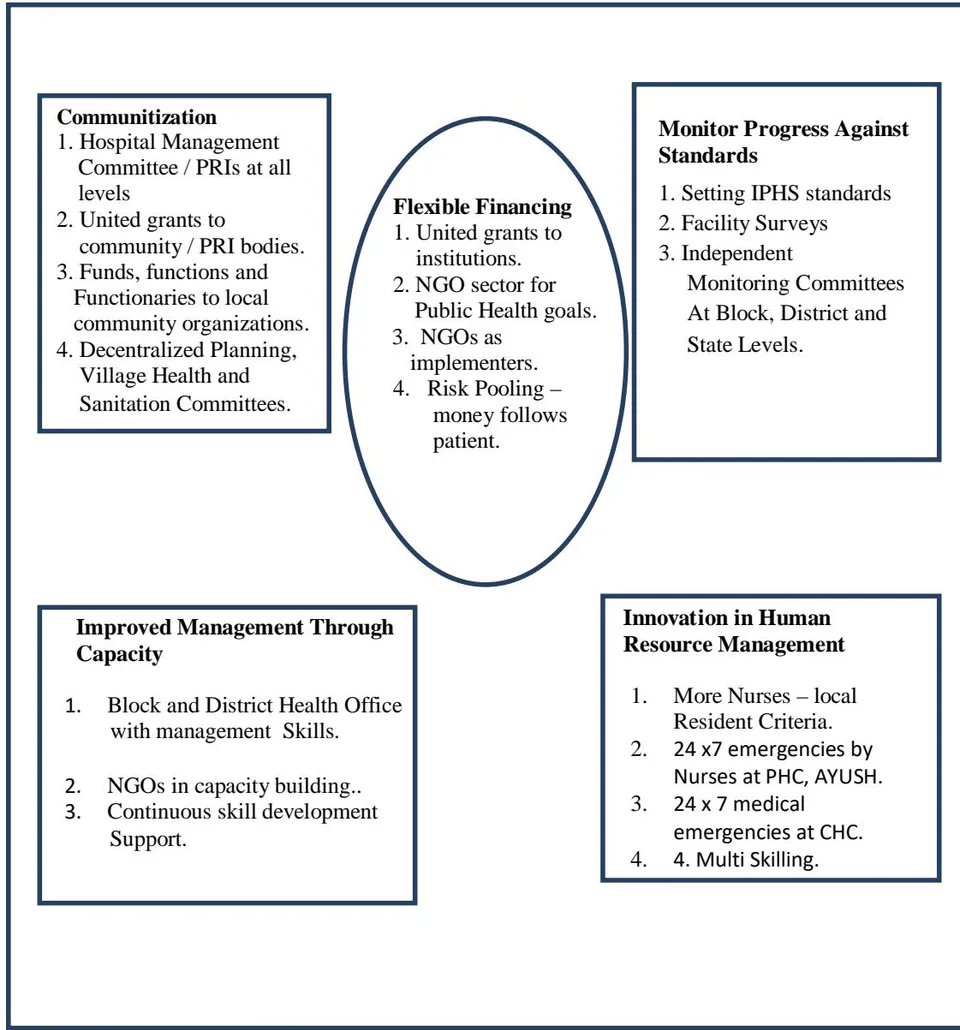
Scheme 2: Five Major Approaches of NRHM
II. MAJOR PLANKS OF NRHM
Appointment of ASHA in each village (one each for 1000 population),
Health insurance for the poor, and the involvement of the non-profit sector, especially in undeserved regions.
Fostering PPP (Public-Private Partnerships);
Improving equity and reducing out of pocket expenses;
Introducing effective risk-pooling mechanisms and social health insurance (Sharma, 2014).
The major achievements of NRHM are illustrated in Table 1.
| S. No. | Indicators | 2005 Baseline | NRHM Target | Achievement | % improvement in Baseline |
| 1. | IMR | 58/1000 live births | 30 | 42/1000 Live births (2012) | 28% |
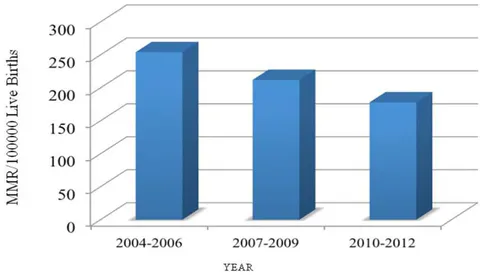
| 2. | MMR | 254/100,00 live births | 100 | 178/100,00 Live births (2010 -12) | 30% |
| 3. | TFR | 2.9 | 2.1 | 2.4 (2012) | 17% |
| 5. | Maintain TB Cure Rate | 86% | Above 85% | 88% | 2% |
| 7. | Malaria Morality per 10,000 | Reduce by 50% | 60% by 2012 | 49% | |
| 10. | Dengue Morality Reduction Rate | 50% by 2010 and sustaining at that level until 2012 | - | ||
| 11. | Cataract operation | Increasing to 46 lakhs until 2012 | |||
| 12 | Public Health as% of GDP Sub centres | 0.9% | 2 – 3% | 1.04% (2011 – 12) | 16% |
| 13 | Sub Centres | 146,026 | 178,267 | 148,366 (2012) | 2% |
| 14 | PHCs | 23,236 | 29,213 | 24,049 (2012) | 3% |
| 15 | CHCs | 3,346 | 7,294 | 4,833 (2012) | 44% |
| 16. | Medical Officers (Allopathy) | 20,308 | 28,984 (2012) | 43% | |
| 17 | ASHAs | 250,000 (in ten states) | 889,736 (2012) | 100 |
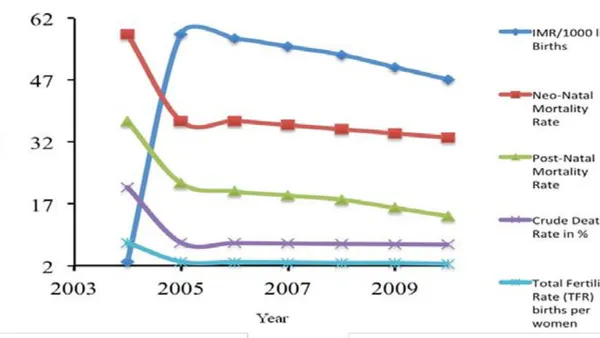
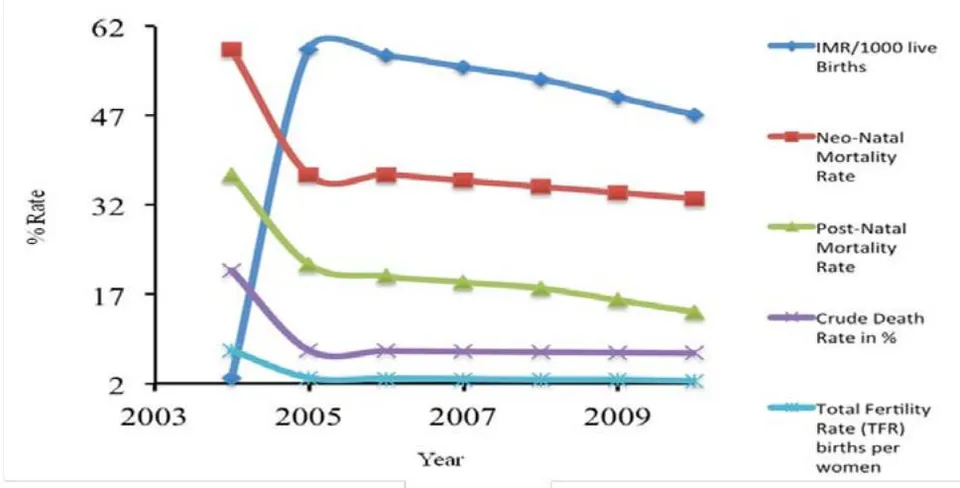
Thus, NRHM led a tremendous transformation in the Indian health sector on several counts. Firstly, around 7.5 lakh ASHAs worked at the grassroots level and have successfully mobilized women from the valuable communities to come to institutions (the number of beneficiaries under Janani Suraksha Yojana had increased from seven lakhs in 2005 – 2006 to over 86 lakhs in 2008 – 2009) (Express Healthcare, 2019). Secondly, NRHM played a crucial role in addressing basic healthcare issues of the rural population as rural people primarily rely on the public. healthcare that comprises of Sub-Centers (SCs) and primary health centers (PHCs) for immediate health needs, and Community Health Centers (CHC) and district hospitals are opted for in case of complicated procedures and specialist care. The Sub-Centre is the first spot of contact for seeking public health care that provides preventive care; a Primary Health Centre works as the first point of contact with a qualified doctor; and CHC provides specialist care, including (Ayurveda, Yoga and Naturopathy, Unani Siddha and Homeopathy (AYUSH) care. Thirdly, NRHM had several achievements to its credit like; it has increased health finance, improved infrastructure for health delivery, established institutional standards, trained healthcare staff and provided technical support; facilitated financial management, assisted in computerization of health data, suggested central procurement of drugs, equipment, and supplies, mandated the formation of village health and hospital committees and community monitoring of services (Jacob, 2017) Fourthly, to target mortality, morbidity, and inclusive social development, NRHM since its inception led a comprehensive war on undernutrition, ill health and ignorance. To address these issues, the Government of India launched NRHM in April 2005 with a clear objective of providing quality health care in the remotest areas by making it accessible, affordable and accountable (Ministry of Health and Family Welfare, Government of India, 2009). Therefore, NRHM has made a remarkable impact on the public system of health care in the country (Figure 1 and Figure 2).
III. EVALUATION OF NRHM
To monitor, review, and evaluation of NRHM, the government of India established annually Common Review Mission (CRM) to examine and document progress on key process parameters of the NRHM strategies, to identify key constraints limiting the pace of architectural correction in the health system envisaged under the NRHM, and to recommend policy and implementation level adaptations that could accelerate achievements of the goals of the NRHM. Subsequently, these reports highlighted the track record of progress made by NRHM from time to time (Table 2).
| Reports | Achievements under NRHM | Recommendations |
| First CRM (November 2007) | Selection and Training of ASHAs Unveiling of JSY; Constitution of Hospital Development Societies, VHSCs.Setting up of integrated State and District Societies.Sub-Centres, PHCs, CHCs, district hospitals are fully functional.Planning and Monitoring with Community Ownership.Convergence of programmes for combating/preventing HIV/AIDS, chronic diseases, malnutrition, providing safe drinking water, etc., with community support. | Need for the Reformation of health sector governance; decentralization of Panchayat Raj Institution;Strengthening the ASHA Programme; monitoring against Norms and Fully Functional Facilities; Improved maternal and Child Survival.Need for preventive and promotive health. |
| Second CRM (November, 2008) | General increase in utilization of public health services like, increase in number of outpatients, in-patients, increase in the institutional deliveries; Increasing services in PHCs and CHCs; expansion of paramedical, nursing and medical education in all states.Significant improvements also found in infrastructure, drugs, diagnostics, sanitation and dietary arrangements.Improvement in Reproductive and child health development was found. | Need to revitalize PHCs and CHCs.Mainstreaming AYUSH programmeEnhance community participation in the hospital development committeesExpedite the activation of VHSCs. |
| Third CRM (Nov. 2009) | Improvement in strengthening of the public health service system; remarkable upgradation of infrastructure in health sector; Expansion of human resources. | Rationalizing upgradation of facilities; strengthen quality assurance function at state and district level; efforts to integrate disease control programme. |
| Fourth CRM (Dec. 2010) | Availability of laboratory, diagnostic services, drugs; Emphasized child health, nutrition, family planning, disease control programme | Need to enhance quantum of human resources in order to reach IPH norms; Need to reexamine policies of professional/technical education. |
According to the report of 'NRHM: The Progress So Far' (Ministry of Health and Family Welfare, 2012) states that NRHM has reduced IMR at a higher rate than earlier, increased institutional deliveries, raised the figures of full immunization, constituted Rogi Kalyan Samitis, appointed and trained ASHAs, constituted Village Health Committees, created village health and nutrition days, provided mobile medical units, and co-located Ayurveda, Yoga, Unani, Siddha and Homoeopathy (AYUSH) and another number of health facilities. Moreover, to assess the working of NRHM, it is very difficult to evaluate the cost-effectiveness of a national project NRHM as it has multiple goals, all of which have not been achieved to the same extent. Further, health depends on a several numbers of factors, such as living and working conditions of people, education, degree of social integration, awareness, belief systems, quality of the environment, and access to health facilities, etc. However, based on certain studies and reports, the evaluation of NRHM has been done.
The International Institute for Population Sciences (IIPS, 2010) Mumbai has produced a voluminous fact sheet of concurrent evaluation of NRHM 2009. The report establishes that there are pronounced inequalities between states and the achievements are far from satisfactory.
According to Special Bulletin on Maternal Mortality in India 2007 – 09 of Sample Registration Scheme (SRS, June 2011), which showed that Maternal mortality ratio varies from 8.1 in Kerala to 390 in Assam, and the maternal mortality rate varies from 4.1 in Kerala to 40.0 in Uttar Pradesh/Uttarakhand.
According to SRS Bulletin 2012 (SRS, 2012), while for the whole country, IMR has declined to 44, ff the differences between urban and rural localities and across different states have persisted. While the urban IMR has declined to 29, the rural IMR was still 48.
According to the Report of World Bank (2012), "the out-of-pocket expenditure on health in India reduced by 9 percent points; 68 percent in 2005 to 59.4% in 2011.
Though NRHM focused on the expansion of infrastructure, human resources, and service coverage. However, quality aspects had received inadequate attention, only 15 percent of Primary Health Centres (PHCs) and Community Health Centres (CHCs) had been able to meet Indian Public Health Standards (IPHS), quality gaps are repeatedly articulated in government audits and in all four Common Review Mission (First CRM 2007; Second CRM 2008; Third CRM 2009; Fourth CRM 2010) reports. The 6 CRM quoted, 'quality of care is compromised, and infection control was a problem in all states. The quality of care is poorer in the Empowered Action Group states with huge variation across districts and health facilities. High human resource vacancies, inappropriate postings of the staff, and skill gap due to constant high attrition, clubbed with unavailability of adequate infrastructure such as Intensive Care Units (ICUs) at several district hospitals or Functional Operation Theatres at First Referral Units (FRUs), and inadequate biomedical waste disposal mechanisms severely undermine the quality of care. Large network of private health care sector also remains unregulated, despite the Clinical Establishments (Registration and Regulation) Act, 2010 (Ministry of Health and Family Welfare, 2010) which only eight states and seven UTs have adopted but implementation remains arduous and slow.
According to WHO 2011, 53 percent of all deaths in India although were attributed to non – communicable diseases, the focus of the NRHM was largely been on Reproductive and Child Health (RCH) which got nearly two thirds of all financial resources. The non high focused states did expend non communicable disease services, but the scope was limited in range of services. Several studies and government reports suggest that inefficient use of already scarce financial and other resources, lack of performance management and accountability mechanisms continue to mar the public health system. According to WHO estimates, 20 – 40 percent of resources spent on health are wasted because of diversion to least priority areas, de-motivated health workers, and inappropriate use or overuse of medicines and technologies.
Eleventh Five Year Plan document (National Health System Resource centre) reviewed NRHM led to following conclusions: (a) 17, 318 Village Health and Sanitation Committees were constituted against the target of 1.80 lakh by 2007; (b). no united grants were released to Village health and Sanitation Committees pending opening of bank accounts by them; (c) against the target of three lakh fully trained ASHAs by 2007, the initial phase of training (first module) was imparted to 2.55 lakh, (e) there had been a shortfall of 9,413 (60.19%) specialists at the
CHSs. As against the 1950, CHCs expected to be functional with seven specialists and nine staff nurses by 2007, none has reached that level.
IV. CONCLUSION
On the one side, NRHM proved to be a landmark flagship programme of the government of the India, as it successfully reduced IMR, MMR, and TFR and has made Indian health care delivery system accessible, affordable and quality health care services to the rural population of India, particularly the vulnerable groups. Moreover, the NRHM became instrumental in the developing of new and up-gradation of the existing infrastructure in the health sector. On the other side, NRHM, no doubt, focused on the expansion of Infrastructure, human resources, and service coverage. However, quality aspects had received inadequate attention. Insufficient funds, poor performance management and less accountability mechanisms continue to mar the Indian public health system. Though, NRHM could not fulfill its 100 percent predetermined targets to raise Indian public health standards at par with the health system of developed countries, still, it proved to be a beneficial health programme as it reduced IMR, MMR, Malaria, and other noncommunicable disease's victimized people of India for several decades, etc. The efficacy of the programme largely depends upon its continuance to date though clubbed with NHM (National Health Mission).
Footnotes
to 6 villages (p.1) ↩