### CHAPTER I
## I. INTRODUCTION
Video gaming has become an increasingly popular and globally recognized phenomenon in recent years. Video game industry is more significant than music and movie in worth and growth together, and its revenue is $152.1 billion in 2019 and is expected to reach$ 257 billion by 2025. There are almost 2.5 billion active gamers globally, and 38% of gamers are young people from 18 to 34 years old (1).
A video game is considered as the central concept of leisure to the young population in their free time, and part of them consider it as a hobby, and others could take it professionally and make money through playing these games by content creation as Livestream or uploading videos on YouTube. Moreover, making money by tournament's prize pool, singing with teams, and getting salaries from 3000 $\$ to$ 5000 $\$ (2)$.
Furthermore, in 2017, the Saudi Arabian Federation for Electronic Sport was established. That presents the growth in the gaming community and industry in the country. There are multiple devices to play video games, such as PC, PlayStation, Xbox, etc. According to an online gaming survey, playing time is about 8 hours and 27 minutes per week. $^{(3)}$ Therefore, body structure and posture are essential for playing, especially handgrip, pinch grip, and wrist position, all of the presser and primary tools. Furthermore, while playing, there are multi repetitive movements such as flexion and extension of the fingers and opposition of the thump. The wrist should be in a midline position to gain the appropriate shape of the hand in playing.
However, repetitive motion of all elements may lead to significant hand grip or pinch grip problems. Furthermore, there are two types of risks of injury related to playing that are acute injuries such as falling could happen as some cases show Achilles tendon tears, dislocated patella, and fractures, and overuse Injuries such as tennis elbow, runner's knee, jumper's knee, little leaguer's shoulder, shin splints, and wrist tendonitis secondary could show (4), which decreases the quality of life among young adults. In the past, gaming research has explored several domains, such as gaming effect behavior or psychological state among young adults and the influence of spending more time on video games (5).
Furthermore, other studies show the effect of prolonged use of smartphones on hands among medical students, and they found out that there is no impact on hands strength. However, excessive smartphone usage may lead to weakness on the dominant hand among medical students (6). Moreover, the number of studies and research that show the relationship between video games overuse and hand-grip strength is limited (7). However, the duration of playing and the strength of the hand is the primary goal of this study and aims to investigate the impact of video games on hand-grip strength. Moreover, it shows a gap that needs to be covered, and the point of this research is to reduce the gap and increase knowledge in this area.
On one hand, a new systematic review published in 2021 showed that video games are an effective tool for improving health-related physical fitness and motor competence in healthy-weight children and adolescents. Otherwise, active video games may be counted as a strategy to improve health $^{(8)}$. Another systematic review published in 2019 shows that playing video games positively affects older adults' motor skills, cognitive skills, and perceptual skills $^{(9)}$. Moreover, another Systematic Review and Meta-Analysis talk about the effects of an active video game on health-related physical fitness with obesity shows a good influence on BMI, and body fat percentage, so AVG might be an acceptable approach to fight childhood obesity $^{(10)}$.
On the other hand, scientific research shows a precise correlation between video games and anxiety in males and straightforward relation between females playing video games and depression (11). Furthermore, another study shows that boys who play video games have lower level of anxiety than girls who play video games (12). However, an updated Cross-sectional study published in 2022 investigated video game disorder and mental well-being among university students. It shows that some of them with VGD got more hours of playing video games per week, less sleep time per day, and a higher body mass index (13).
### a) Statement of the problem
Is there a difference between prolonged user of the video game and non-user of the video game in their grip and pinch strength?
### b) Purpose of the study
The aim of the present study is to investigate the effect of prolonged use of the video game on the grip and pinch strength in prolonged users compared with the non-user of video game.
### c) Significant of the study
There are limited studies related to hand grip strength and pinch grip strength with cell phone or video game prolonged use. The importance of this study is increasing the amount of information and studies related to pinch and grip strength. Moreover, studying this would insight into the underlying factors which contribute to hand grip strength and pinch grip strength and any relation with prolonged video game use.
### d) Hypothesis
## i. Null Hypothesis
There is no difference between prolonged using and non-using of video games in hand grip strength
## ii. Alternative Hypothesis
There is difference between prolonged using and non-using of video games in hand grip strength.
### CHAPTER II
#### SUBJECTS, MATERIALS AND METHODS
## II. MATERIAL AND METHODS
This study was carried out in the King Abdul-Aziz University, Faculty of Medical Rehabilitation Sciences, to investigate the effect of prolonged use of video gaming on grip and pinch strength in young adults.
### a) Subjects
Forty male students were selected from King Abdulaziz University. All participants signed a written informed consent before participation. The participants were divided into two groups.
Group 1: It consists of 20 students with a score of 29 or more on the gaming addiction Test.
Group 2: It consists of 20 students who do not play video games at all
### b) The inclusive criteria
Male students at King Abdulaziz University-1 age from 18 to 24.
Video game users with a score of 29 or more on the Game Addiction Test.
### c) The exclusion criteria
Wrist pain
Severe neurological disease
Upper limb injury or upper limb pain
Diabetes
Activity that requires repetitive movement of the hand
### d) Design of study
Forty male students were selected from King Abdulaziz University divided into two groups. Group 1 consists of 20 students with a score of 29 or more on the gaming addiction test. And group 2 consists of 20 students who do not play video games at all. The subject in both groups was assessed for the handgrip strength by using dynamometer and pinch strength by using pinch meter.
### e) Instrumentation
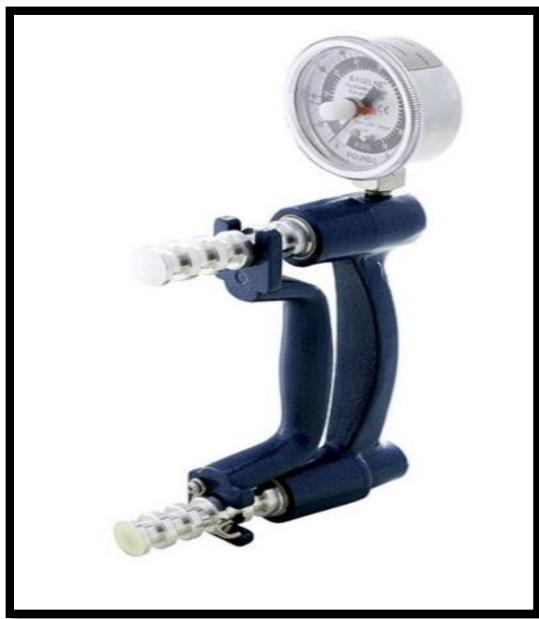 Figure 1: Handheld dynamometer.
The handheld dynamometer (Fig. 1) was used in this study is Jama handheld dynamometer manufactured in U.S. A. It has a meter with a scale ranged from 0-90 kilogram or from 0 to 200 pounds. Also, it has baseline hydraulic pinch gauge was used to measure pinch power.
### f) Procedures
## i. Video Game Addiction Test (VAT)-1
VAT is designed to detect video game addiction and consists of 14 items which are scored on a 5-point Likert scale (0=never, 1=seldom, 2=sometimes, 3=often, and 4=very often). Score 0-14 indicates gaming behavior doesn't seem problematic score
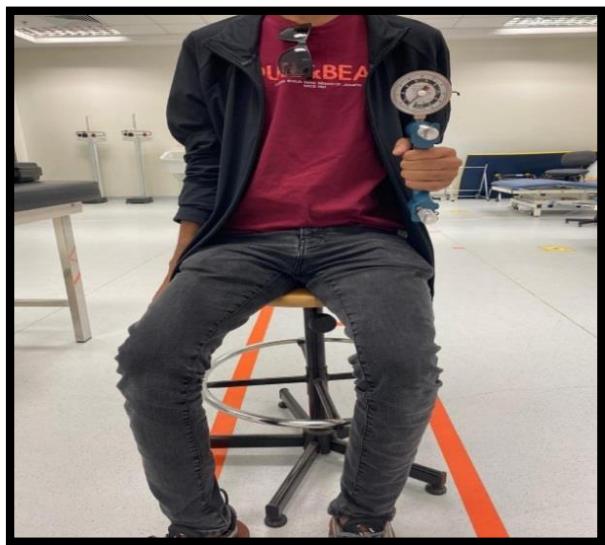
Figure 3: Measurement of grip strength by using (handheld dynamometer). Frontal view
 Figure 2: Pinch Meter
15-28: indicates gaming habit could be unproductive
29-42: indicating some level of video game addiction
43-56: indicating addiction to playing video games.
## ii. Grip strength
The strength of the grip was measured by using dynamometer. the subject was instructed to sit at standard chair with back supported, feet rested on ground with $90^{\circ}$ flexion hip and knee. The subject was asked to hold arm vertically to the side of trunk; with elbow $90^{\circ}$ flexion. After the dynamometer is positioned in the subject's hand, then he is asked to grasp the dynamometer as much force as he can. The dominant hand was evaluated first then the non-dominant hand.
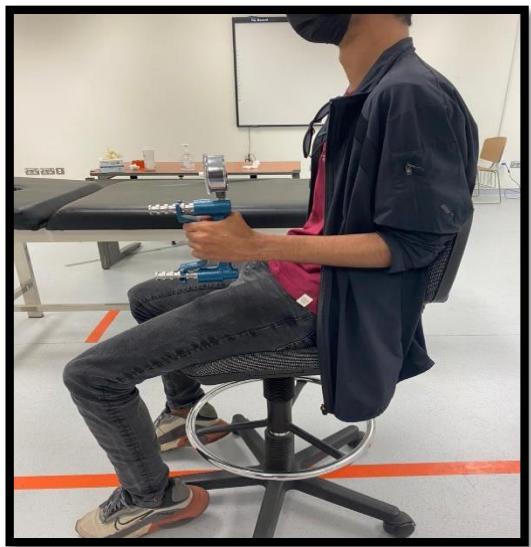 Figure 4: Measurement of strength by using (handheld dynamometer).Sagittal view
## iii. Pinch strength-3
Each subject was instructed to sit at standard chair with back supported, feet rested on ground with $90^{\circ}$ flexion hip and knee. The subject was asked to hold
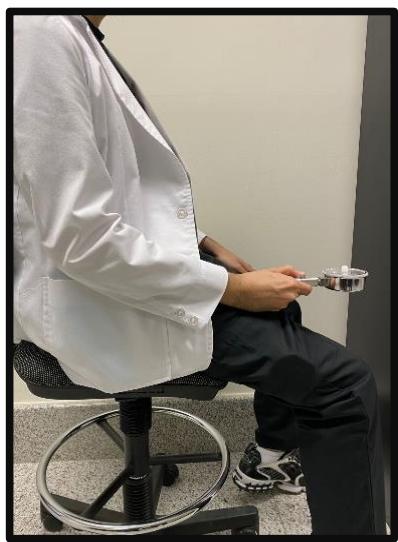 Figure 5: Measurement of pinch strength by using (pinch meter) Sagittal view
### g) Statistical Analysis
Statistical analysis was done by using the statistical package for social sciences (SPSS) version 20. Mean and standard deviation was calculated for all quantitative data. Unpaired t-test was used to compare between study group and control group. Correlation tests was used to find out the relationship between hand grip and pinch strength and the number of hours of playing video games. The alpha level was set at 0.05 for all analysis.
#### CHAPTER III
## III. RESULTS
The aim of this study was to investigate the investigate the effect of prolonged use of video gaming on grip and pinch strength in young adults. the strength of the hand grip and pinch was measured by Handheld dynamometer Data were collected and then analyzed. Descriptive and analytic statistics were used.
### a) General Characteristics of the subjects
arm vertically to the side of trunk; with elbow $90^{\circ}$ flexion. After that, the subject was instructed to pinch between thumb and lateral aspect of index in both dominant and non-dominant hand by using pinch meter.
 Figure 6: Measurement of pinch strength by using (pinch meter) Frontal view
Forty male students participated in this study; they were divided into two groups. Group A consists of 20 students who are prolonged user of video games. And group B consists of 20 students who do not play video games
Group (A): Twenty students who are prolonged users of video games were included in this group. The data in table (1) their mean age $(21.64 \pm 1.26)$ years, their mean height $(174.8 \pm 7.45)$ cm, their mean weight $(77 \pm 12.88)$ kg, and their mean BMI $(25.1 \pm 6.34)$.
Group (B): Twenty students who are not users of video games were included in this group. The data in table (1) represented their mean age $(20.95 \pm 1.36)$ years, their mean height $(175.40 \pm 5.43)$ cm, their mean weight $(74.2 \pm 9.02)$ kg, and their mean BMI $(24.1 \pm 2.345)$.
Unpaired t test between the two groups showed no significant differences for age (P value was 0.09), height (P value was 0.78), weight (P value was 0.59) and BMI (P value was 0.51).
Table 1: General characteristics of subjects in each group.
<table><tr><td rowspan="2">Items</td><td>Group(A)
Video game users</td><td>Group(B)
Non-users</td><td colspan="2">Comparison</td></tr><tr><td>Mean±SD</td><td>Mean±SD</td><td>t-value</td><td>P-value</td></tr><tr><td>Age (years)</td><td>21.64±1.26</td><td>20.95±1.36</td><td>1.7</td><td>0.09</td></tr><tr><td>Height (cm)</td><td>174.8±7.45</td><td>175.40±5.43</td><td>0.28</td><td>0.78</td></tr><tr><td>Weight (Kg)</td><td>77±12.88</td><td>74.2±9.02</td><td>0.53</td><td>0.59</td></tr><tr><td>BMI</td><td>25.1±6.34</td><td>24.1±2.345</td><td>0.67</td><td>0.51</td></tr></table>
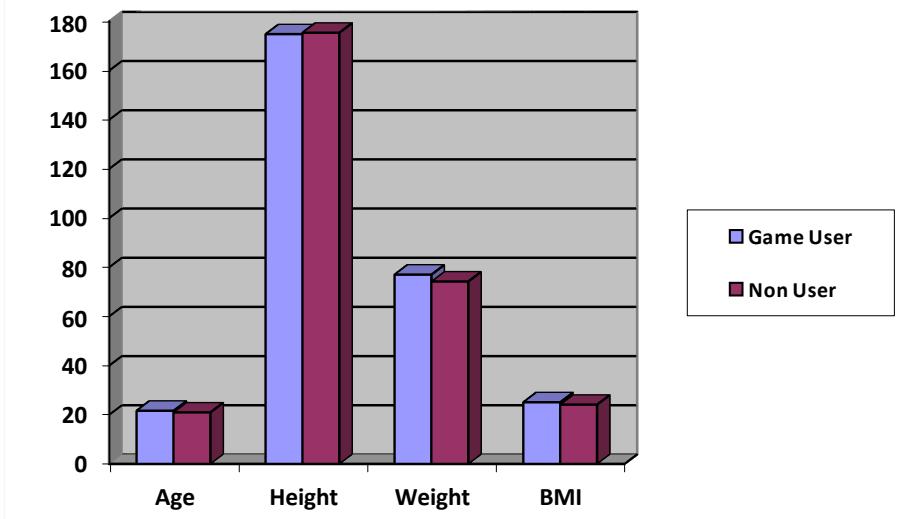 Fig. 7: Mean values of age, height, and weight in both groups.
### b) Comparison of the mean values of the hand grip and pinch strength between both groups
There was a significant decrease in mean values of hand grip strength of the prolonged user group compared with mean values of the non-user group as the mean value of grip strength for prolonged user group (A) was $(37.41 \pm 9.18)$ and for the non-user group (B) was $(43.6 \pm 8.43)$, P-value was (0.03), While there was non-significant difference between both groups in the mean values of pinch strength, P-value was (0.06) as demonstrated in table (2) and illustrated in fig (7).
Table 2: Comparison of the mean values of the hand grip and pinch strength between both groups.
<table><tr><td rowspan="2">Items</td><td>Group(A)
Video game
users</td><td>Group(B)
Non-user</td><td colspan="2">Comparison</td></tr><tr><td>Mean±SD</td><td>Mean±SD</td><td>t-value</td><td>P-value</td></tr><tr><td>Hand Grip Strength</td><td>37.41±9.18</td><td>43.6±8.43</td><td>2.27</td><td>0.03*</td></tr><tr><td>Pinch strength</td><td>7.27±1.41</td><td>9.35±4.92</td><td>1.99</td><td>0.06</td></tr></table>
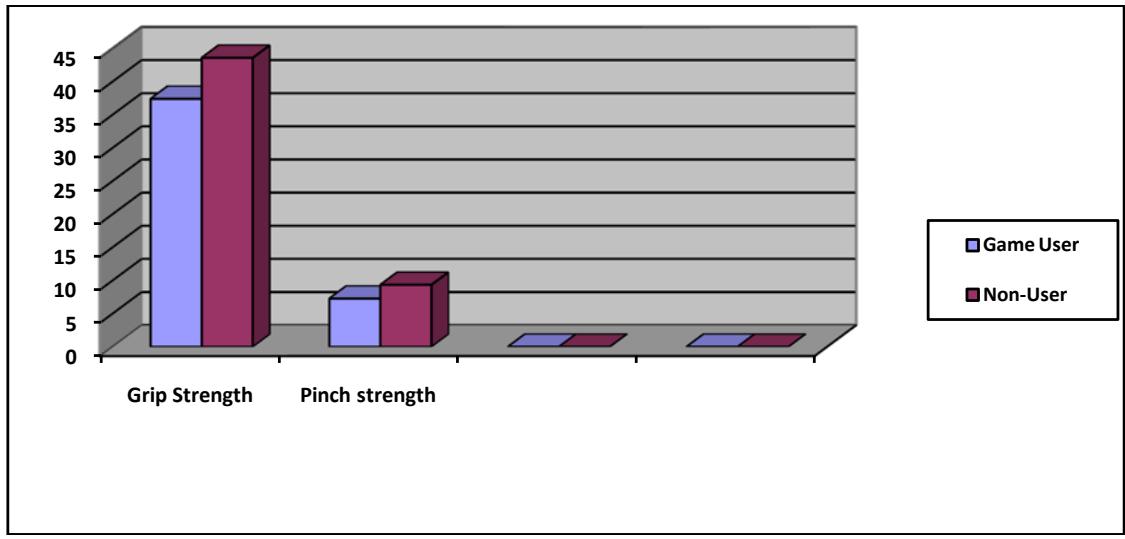 Fig. 8: Comparison of the mean values of the hand grip and pinch strength between both groups
### c) Correlation analysis
1. The correlation between Video game addiction Test (VAT) and hand grip and pinch strength
The results showed a non-significant correlation between Video game addiction Test (VAT) and hand grip strength and pinch strength (r = -0.28, p=0.21 and r = -0.077, p=0.73 respectively). Data were listed in table (3) and fig. (8,9).
Table 3: Correlation between Video game addiction Test (VAT) and hand grip and pinch strength.
<table><tr><td></td><td colspan="2">Video game addiction Test (VAT)
Mean±SD (35.05±7.29.)</td></tr><tr><td rowspan="2">Grip Strength (prolonged user group)Mean±SD
(37.41±9.18)</td><td>r</td><td>p-value</td></tr><tr><td>-0.28</td><td>0.21</td></tr><tr><td>Pinch Strength (prolonged user group)Mean±SD
(7.27±1.41)</td><td>-0.077</td><td>0.73</td></tr></table>
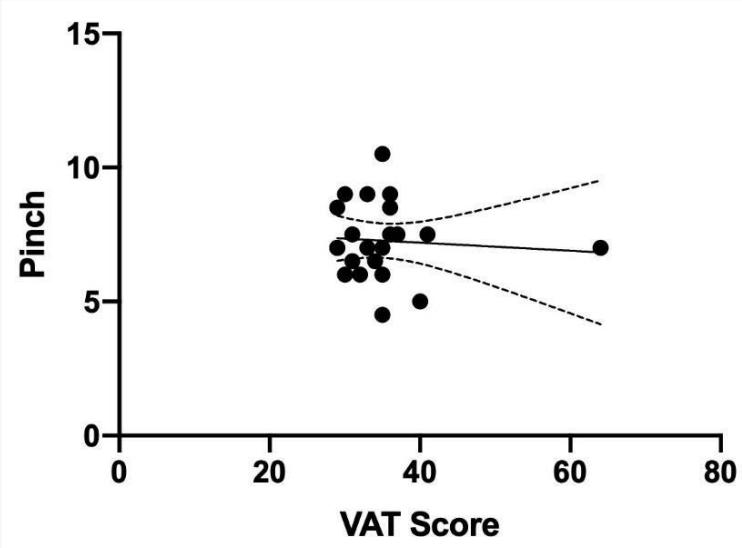
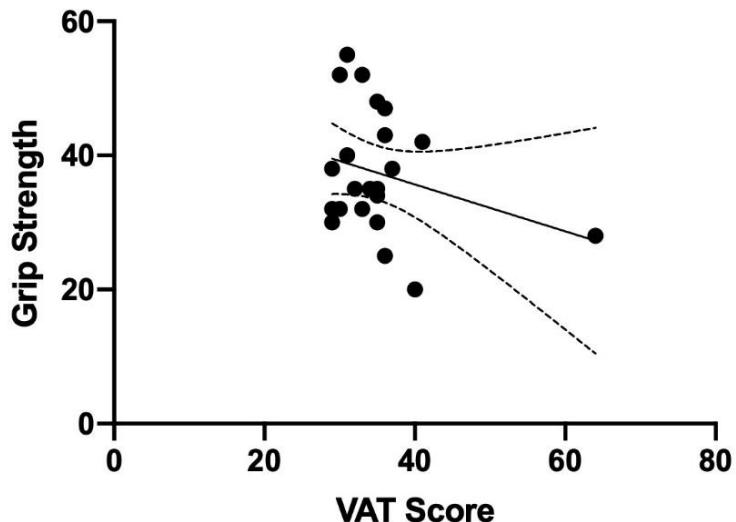 Figure 9: Correlation between pinch strength and video game addiction test (VAT)
2. The correlation between hours of playing and hand grip and pinch strength
The results showed a non-significant correlation between hours of playing and hand grip and pinch strength (r=-0.09, p=0.68 and r=-0.08, p=0.72 respectively). Data were listed in table (3) and fig. (10, 11).
Table 4: Correlation between hours of playing and hand grip and pinch strength.
<table><tr><td></td><td colspan="2">Hours of Playing
Mean±SD (26.55±13.67.)</td></tr><tr><td></td><td>r</td><td>p-value</td></tr><tr><td>Grip Strength (prolonged user group)Mean±SD
(37.41±9.18)</td><td>-0.09</td><td>0.68</td></tr><tr><td>Pinch Strength (prolonged user group)Mean±SD
(7.27±1.41)</td><td>-0.08</td><td>0.72</td></tr></table>
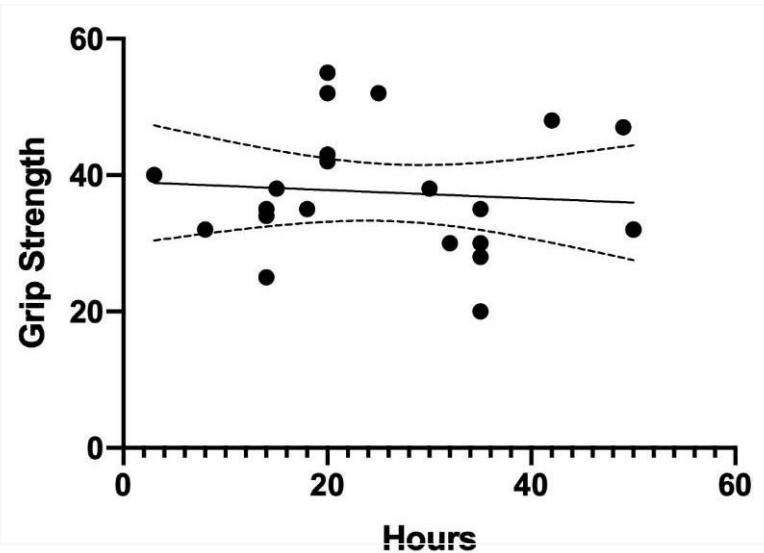
Figure 10: Correlation between grip strength and video game addiction test (VAT)
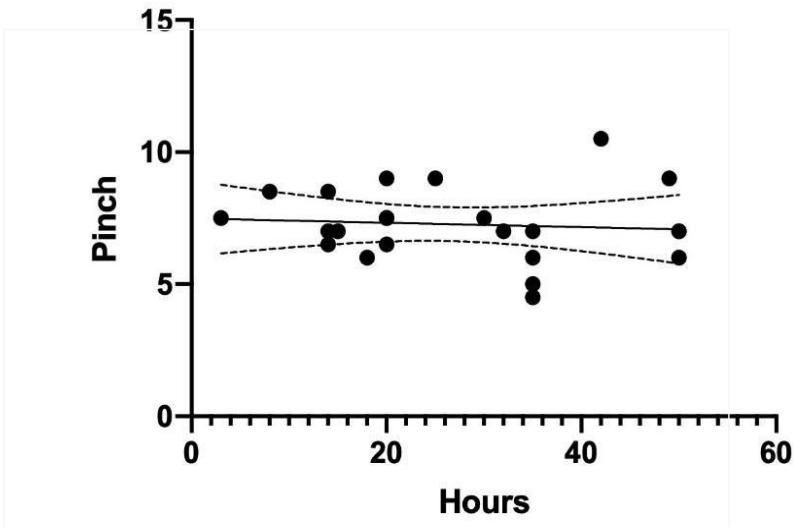 Figure 11: Correlation between grip strength and Hours of Playing
#### CHAPTER IV
## IV. DISCUSSION
Young people around the world wonder if there are any side effects of prolonged use of video games, like weakness in grip and pinch strength, that may affect their activity of daily living in the future.
This study was conducted to investigate the difference in grip and pinch strength between people with prolonged use of video games and those who do not use video games. In this study, 40 persons participated in this study and their hand grip strength was evaluated by handheld dynamometer, and their pinch strength was assessed by using a pinch meter.
The study showed a significant decrease in grip strength with participants in prolonged users group of video games, while there was no significant difference in pinch strength between both groups. This comes in agreement with Din and Hafeez 2021, who stated that increasing smartphone addiction will decrease the strength of the handgrip and increase upper limb disability after they tested 112 participants aged between 18 and 24 years old. The tests were smartphone addiction scale short version (SAS-SA) for addiction level, a dynamometer for measuring handgrip strength, and a quick DASH questionnaire for the upper extremity function.[14]
Our results are also supported by Sharan et al. (2014), who investigated that mobile device are risk factors and may lead to injuries to the thumb and forearm muscles. Movements involving the frequent and increasing use of the thumb and fingers have been identified as potentially injuring the muscular system. Other factors include keyboard spacing, control devices, and end-of-range movement for the thumb while sending messages on social media platforms. They assessed 70 people aged between 5 and 56 who reported muscle and bone pain in their upper limbs were analyzed after extensive use of HHD, for example, Mobile phones, game controllers, and tablets. They found a correlation between HHD hours and pain and upper limb injuries.[15]
Furthermore, our results are supported by the result of Osailan 2021, who investigated the relationship between smartphone prolonged use and the strength of hand grip in young population. They examined 100 persons aged 18 to 34 years old for the weight and height and they evaluated the strength of hand grip strength by a handheld dynamometer. The study found that the smartphones prolonged use of has a significant effect on grip strength and hand function. (16)
Our results are also supported by the result of Radwan et al., 2019 who investigated the effect of extensive use of smartphones on the strength of hand grip and pinch strength in children. They assessed 60 children whose ages were from 9 to 15. They use the short version of smartphone addiction scale, they divided 60 children into a low-frequency smartphone user group, and smartphones prolonged user group. They used a hand-held dynamometer to assess handgrip strength and a pinch meter to assess pinch strength. The study found that prolonged use of smartphones was related to the decrease of strength in hand grip and pinch strength in children. (17).
Unlike our result, Shousha et al. (2021) the Cross-sectional Study of the impact of smartphone use on neck muscles and handgrip Strength was conducted on 90 students aged 13 to 17. Any participant with neuromuscular diseases or previous surgeries was excluded. They were asked to use iPhone 8 Plus or Samsung Note 7 and divided into two groups based on the use of their phones for more than or less than 4 hours per day for eight weeks. Handgrip strength of dominant and non-dominant was measured three times using a dynamometer. The results showed no statistical difference in the strength of the hand on both sides. On the other hand, there was a marked difference in the forward head translation. $^{(18)}$
Unlike our results, the results of Alshahrani et al., 2021 examined the impact of smartphone use on pinch strength, hand grip strength, and the endurance of the flexors and extensors of the neck in college students. The result was established after assisting 40 male students whose ages were from 18 to 27; then, according to the score of the smartphone addiction scale short version, they divided 40 male students into two groups; smart-phone addicted and non-addicted groups. The strength hand grip and pinch grip was assessed by the dynamometer and the endurance of neck muscles was evaluated by endurance test. The study found that prolonged use of smartphones significantly affects neck muscles endurance but did not affect the strength of the hand grip nor pinch grip strength.[19]
The results of the current study contradict the results of Marina et al, (2018) who reported that overuse of smartphones in young people showed a significant lowering of ulnar nerve velocity, which leads to an increased the angle of head position forward and causes neck pain, on the other hand, there is no effect on handgrip strength and conduction of median nerve velocity. The result was established after assisting 60 normal subjects whose ages were from 14 to 18 years, then divided into two groups; group A represents those who use smartphones less than four hours per day, and group B represents those who use a smartphone for more than four hours per day. The instrumentation that was used was a Dynamometer for the handgrip (Computerized Electromyography) (EMG) was used to record median and ulnar nerve conduction velocity and a (Universal goniometer) to measure the angle of the joint (20)
The limitations of our study were that it was only applied to male and that the sample size was small.
## V. CONCLUSION AND RECOMMENDATIONS
### a) Conclusion
There was a significant decrease in the strength of hand grip in the prolonged user group, while there was a non-significant decrease in the pinch strength in the prolonged user group compared with non-user of the video games.
### b) Recommendations
1. Further research is needed to investigate greater sample number.
2. More studies are needed to investigate the influence of combined posture and hand function in video game users.
3. Video game users should reduce the number of hours to maintain hand muscle and strength.
4. Maintain and increase hand muscle by using hand grip activity like SPACARE finger and hand tool.
#### LIST OF ABBREVIATIONS
<table><tr><td>Abbreviation</td><td>Name</td></tr><tr><td>VGT</td><td>Video game Test</td></tr><tr><td>VGD</td><td>Video game disease</td></tr><tr><td>AVG</td><td>Active Video game</td></tr><tr><td>BMI</td><td>Body Mass Index</td></tr></table>
1. P T. Orthopedic injuries from video games: A literature review and implications for the future [Internet]. Orthopedic Injuries from Video Games: A Literature Review and Implications for the Future. clinmed journals; 2020 [cited 2022 Jan 5]. Available from: Orthopedic Injuries from Video Games: A Literature Review and Implications for the Future
2. O'Connell B. How much do esports players make? [Internet]. The Street. The Street; 2019 [cited 2022 Jan 2]. Available from: https://www.thestreet.com/personal-finance/how-much-do-esports-players-make-15126931
3. Combs V. 8 hours and 27 minutes. that's how long the average gamer plays each week [Internet]. Tech Republic. TechRepublic; 2021 [cited 2022 Jan 2]. Available from: https://www.techrepublic.com/article/8-hours-and-27-minutes-thats-how-long-the-average-gamer-plays-each-week/
4. P T. Orthopedic injuries from video games: A literature review and implications for the future [Internet]. Orthopedic Injuries from Video Games: A Literature Review and Implications for the Future. clinmed journals; 2020 [cited 2022 Jan 5]. Available from: Orthopedic Injuries from Video Games: A Literature Review and Implications for the Future
14. Din ST. Relationship of Smartphone Addiction with Hand Grip Strength and Upper Limb Disability. Ann Clin Med Case Rep. 2021; V6(6): 1-7.
15. Sharan D, Mohandoss M, Ranganathan R, Jose J. Musculoskeletal disorders of the upper extremities due to extensive usage of hand held devices. Annals of Occupational and Environmental Medicine. 2014; 26(1).
16. Osailan A. The relationship between smartphone usage duration (using smartphone's ability to monitor screen time) with hand-grip and pinch-grip strength among young people: An observational study. BMC Musculoskeletal Disorders. 2021; 22(1).
17. Radwan NL, Ibrahim MM, Mahmoud WS. Evaluating hand performance and strength in children with high rates of smartphone usage: An observational study. Journal of Physical Therapy Science. 2020; 32(1): 65-71.
#### APPENDIX
#### Appendix 1
#### THE VIDEO GAME ADDICTION TEST
How often do you find it difficult to stop gaming?
 Figure 12: Correlation between pinch strength and Hours of Playing Panel label: never.
 Panel label: seldom.
 Panel label: sometimes.
 Panel label: en.
$\bigcirc$ very.
often
How often do you continue to play games, despite your intention to stop?


How often do others say you should spend less time on games?


 Panel label: en.
$\bigcirc$ very.
How often do you prefer to game instead of spending time with others?
 Panel label: never.
 Panel label: seldom.
 Panel label: sometimes.
 Panel label: often.
 Panel label: very. Panel label: often.
How often do you not get enough sleep because of gaming?
 Panel label: never.
 Panel label: seldom.


How often do you think about gaming, even when you're not online?


How often do you look forward to the next time you can game?
 Panel label: never.
 Panel label: seldom.
 Panel label: sometimes.
 Panel label: often. Panel label: O very.
often
How often do you think you should be gaming less often?
 Panel label: never.
 Panel label: seldom.
 Panel label: sometimes.
 Panel label: often. Panel label: O very.
often
How often have you unsuccessfully tried to spend less time on gaming?
 Panel label: never.
 Panel label: seldom.
 Panel label: sometimes.
 Panel label: often.
O very.
often
How often do you feel restless, frustrated, or irritated when you cannot game?
 Panel label: never.
 Panel label: seldom.
 Panel label: sometimes.
 Panel label: often.
 Panel label: very. Panel label: often.
How often do you rush through your daily responsibilities to play games?
 Panel label: never.
 Panel label: seldom.
 Panel label: sometimes.
 Panel label: often.
 Panel label: very. Panel label: often.
How often do you neglect to do your work because you prefer to game?
 Panel label: never.
 Panel label: seldom.
 Panel label: sometimes.
 Panel label: often.
 Panel label: very.
often
#### 0-14: Your gaming behavior doesn't seem problematic
You might play video games regularly or enjoy the occasional binge, but you don't let it interfere with your life. Gaming is likely a healthy hobby for you.
#### 15-28: Your gaming habit could be unproductive
You sometimes let video games get in the way of other important activities but you're most likely not addicted yet. Keep an eye out on how your gaming habits change over time and practice moderation to make sure it stays under control.
29-42: You may have some level of video game addiction
You may have realized (especially after taking the quiz) that your gaming habits are negatively impacting other parts of your life. You may want to put measures in place to moderate your gaming or quit for a few weeks to see how
#### 43-56: You're likely addicted to playing video games
At this level, video games are a huge part of your life. You likely think about them even when you're not playing and let it affect your other daily decisions.
You may also find that you are playing video games as an escape from another uncomfortable issue. It's important to understand the reason behind your gaming habit to make progress towards controlling it.
If previous attempts to moderate or stop your gaming have been unsuccessful, you may wish to get others involved to support your cause. More info on that below.
https://voltcave.com/video-game-addiction-test/
Impact of prolonged use of video gaming on grip and pinch strength in young adult
1 1
2418 24 pok 00
#### 4.5.15.12
4y
21 21
We are Occupational Therapy students at King Abdulaziz University
This is a survey for our undergraduate research about the Impact of prolonged use of video gaming on grip and pinch strength in young adults.
If you are a student male 18-24 at king Abdulaziz University, playing video games, non-playing video games, and willing to come for OT lab to participate, please continue.
To be aware:
-Participation is voluntary
Information will be confidential
If you agree to participate please continue with the questions.
Generating HTML Viewer...
References
18 Cites in Article
P (2020). Orthopedic injuries from video games: A literature review and implications for the future.
V Combs (2021). 8 hours and 27 minutes. that's how long the average gamer plays each week.
P (2020). Orthopedic injuries from video games: A literature review and implications for the future [Internet]. Orthopedic Injuries from Video Games: A Literature Review and Implications for the Future.
U (2018). National Library of Medicine (NLM).
S Rithisha,Y Gupta,P Shilpshree,K Jayashri,S Palak (2020). The relationship between smartphone usage duration (using smartphone's ability to monitor screen time) with hand-grip and pinch-grip strength among young people: an observational study.
C Comeras-Chueca,J Marin-Puyalto,A Matute-Llorente,Vicente Rodriguez,G Casajus,J Gonzalez-Aguero,A (2021). The Effects of Active Video Games on Health-Related Physical Fitness and Motor Competence in Children and Adolescents with Healthy Weight: A Systematic Review and Meta-Analysis.
Ya-Ling Wang,Huei-Tse Hou,Chin-Chung Tsai (2019). A systematic literature review of the impacts of digital games designed for older adults.
Cristina Comeras-Chueca,Jorge Marin-Puyalto,Angel Matute-Llorente,German Vicente-Rodriguez,Jose Casajus,Alex Gonzalez-Aguero (2021). Effects of Active Video Games on Health-Related Physical Fitness and Motor Competence in Children and Adolescents With Overweight or Obesity: Systematic Review and Meta-Analysis.
R; Gmtejpt (2017). Problem video game playing is related to emotional distress in adolescents.
Christine Ohannessian (2018). Video game play and anxiety during late adolescence: The moderating effects of gender and social context.
Abdel Rouf,S Gabr,H Al-Wutayd,O,Al Batanony,M (2022). Video game disorder and mental wellbeing among university students: a cross-sectional study.
S Din (2021). Relationship of Smartphone Addiction with Hand Grip Strength and Upper Limb Disability.
Deepak Sharan,Mathankumar Mohandoss,Rameshkumar Ranganathan,Jeena Jose (2014). Musculoskeletal Disorders of the Upper Extremities Due to Extensive Usage of Hand Held Devices.
Ahmad Osailan (2021). The relationship between smartphone usage duration (using smartphone’s ability to monitor screen time) with hand-grip and pinch-grip strength among young people: an observational study.
Nadia Radwan,Marwa Ibrahim,Waleed Salah El-Din Mahmoud (2020). Evaluating hand performance and strength in children with high rates of smartphone usage: an observational study.
T Shousha,N Abo-Zaid,H Hamada,M Abdelsamee,M Behiry (2021). The of use on neck flexion angle and hand grip power among adolescents: Cross-sectional study.
Adel Alshahrani,Mohamed Samy Abdrabo,Sobhy Aly,Mastour Alshahrani,Raee Alqhtani,Faisal Asiri,Irshad Ahmad (2021). Effect of Smartphone Usage on Neck Muscle Endurance, Hand Grip and Pinch Strength among Healthy College Students: A Cross-Sectional Study.
Emam Elnegmy,Ahmed Elnahhas,Amena Hendawy (2018). Effect of prolonged smartphone use on cervical spine and hand grip strength in adolescence.
No ethics committee approval was required for this article type.
Data Availability
Not applicable for this article.
How to Cite This Article
Dr.Wesam Qurban. 2026. \u201cImpact of Prolonged use of Video Gaming on Grip and Pinch Strength in Young Adult\u201d. Global Journal of Human-Social Science - H: Interdisciplinary GJHSS-H Volume 23 (GJHSS Volume 23 Issue H8): .
Explore published articles in an immersive Augmented Reality environment. Our platform converts research papers into interactive 3D books, allowing readers to view and interact with content using AR and VR compatible devices.
Your published article is automatically converted into a realistic 3D book. Flip through pages and read research papers in a more engaging and interactive format.
Subject: Global Journal of Human-Social Science - H: Interdisciplinary
Authors:
Dr.Wesam Qurban, Dr. Ashraf Darwesh, Mr. Saleh Bin Amer Almalhan, Mr. Salem Bin Mohammed Bahmeshan, Mr. Abdulaziz Bin Ahmed Alghamdi, Mr. Mohammed Bin Hamed Alamari (PhD/Dr. count: 2)
Our website is actively being updated, and changes may occur frequently. Please clear your browser cache if needed. For feedback or error reporting, please email [email protected]
Thank you for connecting with us. We will respond to you shortly.