I. INTRODUCTION
The technological progress in the era of the internet has drastically transformed our daily lives and the operations of businesses. For example, marketing activities have become significantly more complicated than before the rise of social media (Habibi et al., 2016; Hoang et al., 2019). Social media has become an integral ingredient of today's marketing environment (E. Keller & Fay, 2012; Liu et al., 2018). It has become a progressively salient stage for brands to demonstrate their products (Binwani & Ho, 2019; Choedon & Lee, 2020).
Recently, "Social Media-Based Brand Community" (SMBBC) has been used to characterize brand communities on social media platforms like Facebook and Weibo (Habibi et al., 2016; Hoang et al., 2019). "Brand community is a specialized, geographically unbound community built on an organized network of social connections amongst brand aficionados" (Liao & Wang, 2020). At the same time, Brand Community Participation (BCP) has been recognized as a behavioral framework that measures a customer's capacity for disclosing personal information, contributing ideas and output to the brand, learning, and developing a stronger bond with the retailer by engaging in decision-making (Carlson et al., 2019). SMBBC may inform companies about their consumers' needs, product improvements, and competitiveness (Carlson et al., 2019; Kang & Shin, 2016). SMBBC also helps clients understand the companies products and services and other customers' reviews (Hoang et al., 2019).
Marketing professionals are now more interested in SMBBC (Islam et al., 2018; Kamboj & Rahman, 2017). Hook et al. (2018) suggested studying consumer brand community involvement. The components of SMBBC include shared awareness, shared rituals and traditions, and responsibility to the community (Habibi et al., 2014, 2016). SMBBC can be developed by businesses, their subsidiaries, or their agents, and they consist of consumers who enjoy certain brands of businesses (Hoang et al., 2019; Munnukka et al., 2015). Companies mainly introduce brand communities to get good brand results (Coelho et al., 2019; Relling et al., 2016). Thus, significant firms should engage with brand communities and validate members' triumphs to build confidence. It maintains and improves the community's brand equity and regularity (Burgess & Jones, 2020). BCP is growing in popularity in academia and management circles since research demonstrates that customer involvement may benefit firms and customers (Carlson et al., 2019; Merz et al., 2018).
Technology encourages buyers to interact with fashion businesses (Kim & Ko, 2012). The fashion genius Coco Chanel said, "Fashion is not just clothing." Fashion is in the sky, on the street, and in ideas, lifestyles, and events (Brogi et al., 2013). Asian fast fashion brands are overgrowing. Fashion sector spending is expected to rise nearly annually (Bashir et al., 2020). Asian fashion is predicted to expand by (2022-2027) to US 410.80 billion in 2022 (Statista Digital Market Outlook, 2022).
Bangladesh's fashion income reached US 1.81 billion in 2022. By 2027, revenue is predicted to climb \(17.37\% (CAGR 2022-2027) to US)4.03 billion (Statista Market Forecast, 2022). It boosts competitiveness and profits in the Bangladeshi fashion sector. This research uses "Fashion Brands," "Retail Fashion Brands," and "Luxury Fashion Brands" interchangeably. OBCs, allow fashion businesses and buyers communicate without time, place, or topic limits, changing one-way engagement into intuitive and user-friendly two-way direct conversation (A. J. Kim & Ko, 2010). Online shoppers may buy anytime. They can instantly exchange brand experiences and have access to many stylish things (Brogi et al., 2013). Researchers examined brand value based on customer brand understanding (Dew & Kwon, 2010).
Businesses increasingly use social media to build brand awareness, making it a hot issue (Hudson et al., 2015). Brand awareness is how much customers link a brand with the desired product (Sasmita & Mohd Suki, 2015). In previous years, companies looked cautious about using social media for marketing, but they now invest heavily in brand design and firm-related social media marketing, for instance, in interactive websites and brand communities (Bashir et al., 2020; Hudson et al., 2015). Companies use popular social media such as Facebook, YouTube, and Twitter for engaging clients. On these platforms, consumers create brand communities, and businesses utilize these communities to promote their products (Bashir et al., 2020; Islam et al., 2018).
When a person contemplates information regarding the product and identifies with its subsisting brand knowledge more densely, the brand association will be more intense. Association with feelings, features along with advantages can create a brand association. All these components assist in building up brand image (Lee, Goh & noor, 2019; Enjelina & Dewi, 2021). Moreover, the brand image tells the story of what consumers think and feel about the company (D. Lee et al., 2011; Roy & Banerjee, 2007). Faircloth (2005) states brand image is the "overall mental image that consumers have of a brand and its uniqueness compared to the other brands". It helps customers understand their wants and desires and distinguishes them from the competition (Anwar et al., 2011; Lien et al., 2015). Social media is a prevalent issue because companies use it to promote their brands (Bashir et al., 2020; Hoang et al., 2019). Thus SMBBC enhances customer happiness, connection skills, and corporate performance, according to a study (Clark et al., 2017). Several studies investigated the relationship between SMBBC's commitment to brand awareness and brand loyalty. Besides, a few researchers studied online brand community participation on brand awareness, brand association, and perceived quality of luxury fashion items (Bashir et al., 2020; Hoang et al., 2019). However, hardly any researchers have examined the influence of social media-based brand community engagement on fashion brand image in Bangladesh.
Thus, this research work considered customers participation in the social media-based brand community of prominent fashion brands and sought to respond to the following research questions:
RQ 1: How does Participation in an SMBBC Influence the Brand Image of Fashion Brands?
RQ 2: How does Brand Association Mediate the Relationship between SMBBC Participation and Brand Image?
RQ 3: How does Brand Association Mediate the Relationship between Brand Awareness and Brand Image?
RQ 4: How does Brand Awareness Mediate the Relationship between SMBBC Participation and Brand Association?
To answer the above questions, the theoretical background of SMBBC participation has been developed through a literature review. We have also clarified all the keywords and built up our model and hypotheses. Besides, to simplify the research, the phrases "consumer involvement," "community participation," and "brand community engagement" are used as synonymous. Additionally, the words "Social Media Based Brand Community (SMBBC)," "Virtual Brand Community (VBC)," and "Online Brand Community (OBC)" have been used interchangeably. "SMBBC participation" and "Facebook brand page involvement" are considered synonyms. To evaluate our hypotheses, we designed a questionnaire and gathered data before putting the model to the test. Finally, we examined the results and recommended future research directions.
II. LITERATURE REVIEW AND HYPOTHESES
DEVELOPMENT
a) Theoretical Underpinning
Social media is one of the biggest channels for brand-related information exchange since its interactive features allow users to participate, collaborate, and share knowledge (Cheung et al., 2020;
Kusumasondjaja, 2018). It can reach more people than print, TV, and radio (Bowen, 2015). Influential brands utilize social media to develop, sustain, share, and communicate with potential users in the interactive marketplace (Bulecarca & Bulecarca, 2010; Severi & Ling, 2013). Customers may also express their opinions on products and services on social media (Kaplan & Haenlein, 2010). Social media content may profoundly affect people (Poynter, 2008). Social identity theory has been applied in this research to shed light on how customers recognize and associate themselves in a Social Media Based Brand Community (SMBBC)(Hoang et al., 2019). According to this theory, Online Brand Communities are social organizations in which members can not only join and partake but also quit and denounce readily (Pournaris & Lee, 2016).
b) Social Media-based Brand Community Participation and Brand Association (BAs)
Brand association is regarded as one of the primary elements of brand equity (Zdravkovic & Till, 2012). The effectiveness of a brand's facilities is known as "brand association" (Chinomona & Maziriri, 2017; Enjelina & Dewi, 2021). Aaker (2009) states, "Brand association is something associated in memory with a brand." It aids consumers in processing, organizing, and retrieving product-selection-related information stored in memory (Dew & Kwon, 2010). A brand association consists of every concept, feeling, knowledge, image, expertise, trust, and action that revolves around the brand and is tied to the brand node (Aulia & Brilliana, 2017). Besides, brand associations serve as the foundation for developing brand loyalty and purchase decisions. It is based on the perception or understanding of products, product qualities, brand positioning, packaging, price, or user image (Zdravkovic & Till, 2012). Brand associations are essential for both marketers and consumers. Marketers deploy brand associations to differentiate, positioning, and extend the brand, to produce positive thoughts and emotions about brands, and to suggest the characteristics or benefits of purchasing or consuming an identifiable brand. Consumers who participate in Facebook brand pages gain access to brand-related information such as product variety, features, and benefits (Schivinski & Dabrowski, 2015). This information can be presented in written or graphical form and they can be provided by the firm or by other Facebook brand page members (Naylor et al., 2012). Such engagement leads to the progressive formation of utilitarian, emotional, community-based, and cognitive brand connections in the customers' thoughts (Langaro et al., 2019). Moreover, Bashir et al., (2020) demonstrate that brand community membership highly predicts brand association. Thus, it is reasonable to propose the following hypothesis:
H1: Social Media Based Brand Community Participation (SMBBCP) positively correlates with Brand Association (BAs).
c) Social Media-based Brand Community Participation and Brand Awareness (BAw)
Brand awareness is a crucial component of brand equity and influences customer brand knowledge (Chinomona & Maziriri, 2017; Enjelina & Dewi, 2021). It might be a central element of marketing (K. L. Keller, 1993). Brand awareness is the ability of prospective customers to recognize or recall a brand, which helps them associate items with brands (Aaker, 2009; Cheung et al., 2020). For a purchase, this competence must be sufficient (Aulia & Brilliana, 2017). Simply, brand awareness is connected to the strength of persistence and understanding of a brand in a consumer's brain and mind(Hoang et al., 2019; Molinillo et al., 2017). Visibility, association, and powerful combinations with related offerings and purchasing knowledge create brand recognition (Severi & Ling, 2013). It also comes from consumers' repeated, memorable brand experiences (Kim et al., 2018). Brand name, tagline, packaging, and advertising produce this manifestation (Cheung et al., 2020; Datta et al., 2017). When consumers have had previous experience with the brand, they are better able to recognize it. This results in recognition of a brand. Customers' exact memories of a brand are part of its "brand recall." (K. L. Keller, 1993).
Participation in SMBBC emerges when consumers receive content provided by both the brand and others chasing the same brand. Consumers can also participate by contributing ideas and developing new brand-related content (Langaro et al., 2019; Schivinski & Dabrowski, 2015). Due to their participation, people have more chances to determine the brand name, logo, and other brand features (Buil et al., 2013). Consumers are encouraged to participate actively and offer confirmation by liking, commenting, or providing new material. This enhanced opportunity for brand-consumer contact is anticipated to influence brand recognition (Buil et al., 2013; Langaro et al., 2019). Therefore, the following hypothesis is put forward:
H2: Social Media Based Brand Community Participation (SMBBCP) positively correlates with Brand Awareness (BAw).
d) Social Media-Based Brand Community Participation and Brand Image
Brand image (Bl) includes characteristics, amenities, sentiments, and consumer connections. Bl is the collection of ideas that affect how customers perceive a brand, including aspects that distinguish it from competitors, its personality, and its promised advantages (Aulia & Briliana, 2017). Bl also includes consumers' knowledge and beliefs about a brand's products and non-products (D. Lee et al., 2011). Brand image increases consumer perception of product or service quality (Cham et al., 2014; Wu, 2011). It helps buyers choose brands that meet their demands. Brand image may attract first-time clients and provide the company with a competitive edge (Cham et al., 2014; Wu, 2011). Unlike low-image brands, high-image brands can extend into other areas (Hamid et al., 2015). A product's image may reduce brand extension failures by ensuring durability and consumer satisfaction (Hannes, 2019; Taqi & Muhammad, 2020).
Brand image affects a company's future profitability, long-term cash flow, customer compliance to pay high prices, and strategic decisions. BI may also affect stock prices, sustained competitive advantage, and marketing (Chen, 2010; Farzin & Fattahi, 2018). Brand community participation affects brand image. Community engagement also affects brand image. Brand communities have shown that customer authorization and consumer-created content may boost brand image (Cova & Pace, 2006; Muniz & Schau, 2007). Therefore, we propose the following hypothesis:
H3: Social Media Based Brand Community Participation (SMBBCP) Positively Correlates with Brand Image (BI).
e) Brand Association and Brand Image
Brand image is expressed by any information that predominately occurs in brand association and is tied to the brand name in consumer recall (K. L. Keller, 1993; Sasmita & Mohd Suki, 2015).
Taylor et al. (2007) argued that brand association positively correlates with brand image. When a person considers facts about the product and identifies more strongly with his existing brand knowledge, the brand connection will become stronger. The relationship between a brand and emotions, characteristics, and benefits can generate a brand association. These factors contribute to brand development (Enjelina & Dewi, 2021; J. E. Lee et al., 2019). The brand connection supports constructing a brand's image, resulting in the acquisition of competitive advantage, revenue, and anticipated advancement (Khan & Jalees, 2016). The following hypotheses are therefore posited:
H4: Brand Association (BAs) Positively Correlates with Brand Image (BI).
The Mediating Role of Brand Awareness
Meanwhile, the literature examined the theoretical link between SMBBC involvement, Brand association, and Brand awareness. However, following a thorough analysis of prior studies, we have concluded that there is a lack of online research on the relevance of brand awareness as a mediator between SMBBCP and brand association. Simply, SMBBCP provides participants with information about the products and services, which increases brand awareness, and when participants are aware of the products via brand communities, the brand association is strengthened. Therefore, based on the above debate, the following hypothesis has been developed:
H5: Brand Awareness (BAw) Mediates the Relationship between SMBBCP and Brand Association (BAs).
g) The Mediating Role of Brand Association
Brand awareness (BAw) is acknowledged as the first stage of brand-related information acquisition (Barreda et al., 2016; Buyukdağ, 2021). It is vital for initiating the communication process (Barreda et al., 2015), in contrast, brand image (BI) is one of the aspects that not only enhance the effectiveness of marketing communication but also produce brand-related information (K. L. Keller, 1993). Prior research indicated that brand awareness (BAw) positively impacts brand image (BI) (Bernarto et al., 2020; Mulyono, 2016). BAw has a significant influence (Barreda et al., 2016; Buyukdağ, 2021) and a relationship with the BI (Karam & Saydam, 2015). Brands with a high BAw produce products with a high BI (Dewi et al., 2020; Tariq et al., 2017). Therefore, brand image will be enhanced by brand awareness (Saydan & Dulek, 2019). When customers have strong brand recognition, it is not difficult to create a positive brand image (Mulyono, 2016; Sean Hyun & Kim, 2011).
Based on the preceding discussion, the theoretical link between brand awareness, brand image, and the brand association has been established; nevertheless, there are few studies evaluating the mediating function of brand association between brand awareness and brand image. In addition, SMBBC plays a crucial role in creating brand associations, which generates a stronger brand image. Therefore, we have developed the following hypotheses:
H6: Brand Association (BAs) Mediates the Relationship between Brand Awareness (BAw) and Brand Image (Bl).
H7: Brand Association (BAs) Mediates the Relationship between SMBBC Participation and Brand Image (BI).
III. RESEARCH METHODOLOGY
This section shows how the data for the study's constructs were gathered, analyzed, and operationalized.
a) Statistical Analysis Technique
To perform the descriptive statistical analysis, we used SPSS version 25. Partial least squares (PLS) path modeling was utilized to evaluate the measurement and structural model with the SmartPLS3.
b) Data collection
The survey sampled young consumers who possessed smartphones or smart gadgets and were regarded as part of the digital generation, engaged actively in online social networking, and had purchased items from favorite brands such as Aarong, Yellow,
c) Measures
All construct measures were developed following the precise definitions found in the literature review. The variables utilized to assess contextual factors, brand community participation, brand awareness, brand association, and brand image were derived from past empirical research. Brand community participation has been measured utilizing six items adopted from the study by (Langaro et al., 2019). Besides, brand awareness, brand image, and brand association have been measured using five, three, and five items consecutively adopted from the study (Sasmita & Mohd Suki, 2015). The items are available in the appendix section. The perceptions of the respondents regarding the items have been evaluated on a 5-point Likert scale ranging from 1 (strongly disagree) to 5 (strongly agree).
d) Data Preparation and Analysis Techniques
The researcher used descriptive statistics with SPSS version 25. SmartPLS3 was used to evaluate the hypothesis and conceptual model using partial least squares (PLS) path modeling. We used SEM with PLS to test ideas and analyze data. According to Ringle et al. (2020), scholars frequently use PLS-SEM. However, PLS-SEM and CB-SEM are two SEM estimation techniques (Astrachan et al., 2014). PLS-SEM focuses on explaining variance in endogenous variables, whereas CB-SEM estimates the covariance matrix and ignores explaining variance (Hair et al., 2017). PLS-SEM has many advantages over CB-SEM. PLS-SEM develops a theory and makes a prediction, whereas CB-SEM evaluates an existing idea. Second, PLS-SEM can explore formative and reflective interactions, whereas CB-SEM only analyzes reflective ones (Hair et al., 2017). Richter et al. (2016) say PLS-SEM can handle intricate models with multiple indicators and constructs, is handy with small sample sizes, and give valuable latent variable scores for research.
IV. ANALYSIS AND FINDINGS
a) Respondents Profile
The following are the demographic characteristics of the participants (n = 445): (n = 285) of the responders were male, whereas (n = 157) were female. Other information regarding the respondents is provided in Table 1.
| Particulars | N | % | Particulars | N | % |
| Gender | Yearly frequency of buying brands | ||||
| Male | 285 | 64.04 | Occasionally | 235 | 52.81 |
| Female | 157 | 35.28 | Seldom | 101 | 22.70 |
| Prefer not to say | 2 | 0.45 | Frequently | 78 | 17.53 |
| Education | When necessary | 31 | 06.97 | ||
| MPhil/PhD | 17 | 3.82 | Yearly expenditure on brands | ||
| Postgraduate/Masters | 199 | 44.72 | More than 10000 | 110 | 24.72 |
| Undergraduate/Honors | 167 | 37.52 | 6001-10000 | 98 | 22.02 |
| HSC | 62 | 13.93 | 2001-6000 | 213 | 47.87 |
| Profession | Less than 2000 | 18 | 4.04 | ||
| Student | 154 | 34.61 | Other amounts | 6 | 1.35 |
| Private service | 103 | 23.15 | Favorite fashion brands | ||
| Govt. service | 78 | 17.53 | Aarong | 155 | 34.83 |
| Business/Self-employed | 67 | 15.60 | Cats Eye | 86 | 19.33 |
| Unemployed | 27 | 6.07 | Ecstasy | 43 | 9.67 |
| Housewife | 16 | 3.60 | Gentle Park | 35 | 7.87 |
| Frequency of access to social media | Yellow | 32 | 7.19 | ||
| Daily | 279 | 62.70 | Dorjibari | 25 | 5.62 |
| Once in every 5 days | 55 | 12.36 | Le Reve | 16 | 3.60 |
| Once in every 10 days | 48 | 10.79 | Sailor | 15 | 3.70 |
| Once in every 15 days | 38 | 8.54 | Zara Fashion | 14 | 3.15 |
| Once in a month | 21 | 4.72 | Others | 24 | 5.39 |
| Others | 4 | 0.90 | Participating in brand page | ||
| Time spent in social media in every visit | More than 3 years | 08 | 0.18 | ||
| Less than 1 hour | 238 | 53.48 | More than 2 years | 28 | 6.29 |
| 1-2 hours | 142 | 31.91 | Less than 1 year | 409 | 91.91 |
| More than 2 hours | 65 | 14.67 | Total | 445 | 100% |
b) The Measurement Model
The researcher investigated convergent validity using item loadings and Average Variance Extracted (AVE). In this experiment, the AVEs of every measuring construct was more significant than.50, demonstrating acceptable convergent validity (Hair et al., 2019; Henseler et al., 2015). A single item (Baw5) was deleted from the construct Brand Awareness due to poor loading value. The Cronbach's Alpha (CA) and Composite Reliability (CR) coefficients were all greater than the recommended value of 0.70 (Hair et al., 2019). As a result of this, the criteria for the item and construct reliability have been satisfied, as shown in Table II.
Table II: Constructs Loadings and Reliability
| Construct Name | Outer Loadings | Cronbach's Alpha | Composite Reliability | Average Variance Extracted (AVE) |
| Brand Association (BAs) | 0.796 | 0.860 | 0.552 | |
| BAs1 | 0.733 | |||
| BAs2 | 0.730 | |||
| BAs3 | 0.721 | |||
| BAs4 | 0.724 | |||
| BAs5 | 0.802 | |||
| Brand Awareness (BAw) | 0.697 | 0.815 | 0.524 | |
| BAw1 | 0.746 | |||
| BAw2 | 0.681 | |||
| BAw3 | 0.689 | |||
| BAw4 | 0.775 | |||
| Social Media Based Brand Community Perception (SMBBCP) | 0.877 | 0.908 | 0.621 | |
| SMBBCP1 | 0.787 | |||
| SMBBCP2 | 0.776 | |||
| SMBBCP3 | 0.809 | |||
| SMBBCP4 | 0.856 | |||
| SMBBCP5 | 0.798 | |||
| SMBBCP6 | 0.694 | |||
| Brand Image (BI) | 0.683 | 0.825 | 0.611 | |
| BI1 | 0.816 | |||
| BI2 | 0.763 | |||
| BI3 | 0.764 | |||
| Deleted Item: Baw5 |
When examining discriminant validity, the researchers were interested in how unique a construct is in compared to others (Hair et al., 2019). In this case, inter-correlations between variables (off-diagonal values) are more significant than the average extracted variance's square roots (diagonal elements). So, it suggests a fair level of discriminant validity (Fornell & Larcker, 1981); see Table III.
Table III: Discriminant Validity: Fornell-Larcker Criterion
| SMBBCP | BAs | BAw | BI | |
| SMBBCP | 0.788 | |||
| Brand Association | 0.643 | 0.743 | ||
| Brand Awareness | 0.629 | 0.659 | 0.724 | |
| Brand Image | 0.457 | 0.595 | 0.496 | 0.781 |
The heterotrait-monotrait ratio of correlations (HTMT), a complete and consistent technique for assessing discriminant validity in SEM, was proposed by Hessenler et al. (2015). Under a strict protocol, HTMT values lower than 0.85 are acceptable. However, HTMT>.90 is permitted in a more liberal approach. As shown in Table IV, the constructs here satisfy the required specification (Hair et al., 2019; Kline, 2015). The researcher also checked the discriminant validity of item cross-loadings and found that they complied with the requirements.
Table IV:HTMT
| SMBBCP | BAs | BAw | BI | |
| SMBBCP | ||||
| Brand Association | 0.767 | |||
| Brand Awareness | 0.798 | 0.883 | ||
| Brand Image | 0.580 | 0.800 | 0.707 |
c) The Structural Model
The summary of hypotheses regarding direct impacts is shown in Figure 2 and Table V. In the case of immediate effect, all the ideas were accepted, except hypothesis H3. Specifically, SMBBCP was negatively associated with BI (H3: SMBBCP→Bl: , t= 1.956, p < 0.05, BCI LL: -0.004, UL: 0.252).
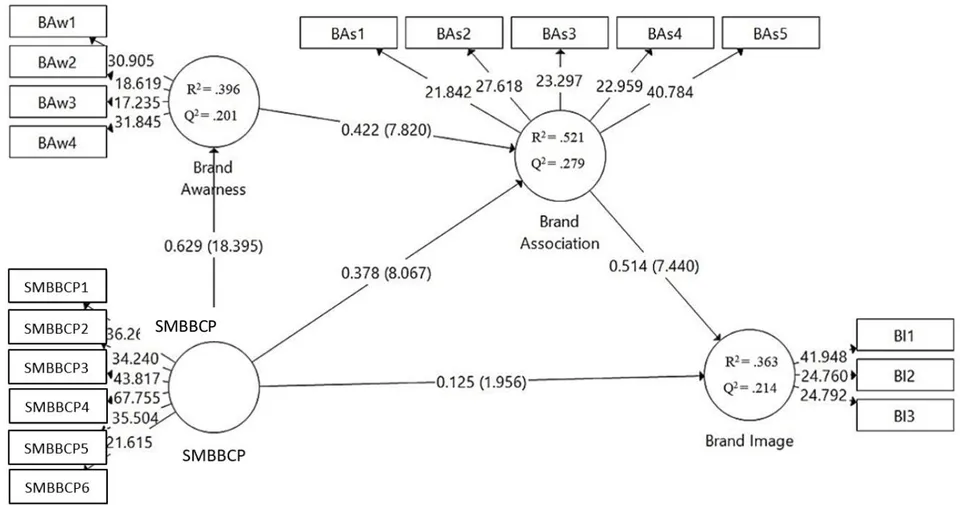
The mediating effect of BAs has been checked to find whether it works as mediating factor between the relationships SMBBCP BI. Here, in the case of BI, BAs (H6: SMBBCP BAs BI, , t= 5.570, p < 0.01, BCI LL: 0.125, UL: 0.260) mediated the association between SMBBCP and BI. Similarly, BAs significantly mediate the relationship between BAw and BI (H7: SMBBCP BAs BI, , t= 5.022, p < 0.05, BCI LL: 0.139, UL: 0.303). Besides, BAw significantly mediates the relationship between SMBBCP and BAs (H8: SMBBCP BAw BAs, , t= 6.905, p < 0.05, BCI LL: 0.194, UL: 0.345).
Table V: Summary of Hypothesis Testing for Direct Relationship
| Relationship | Beta Coefficient | Std. Dev | T Statistics | P Values | BCI LL | BCI UL | VIF | f2 | Decision | |
| H1 | SMBBCP→BAs | 0.378 | 0.047 | 8.067 | 0.000 | 0.273 | 0.459 | 1.654 | 0.181 | Accepted |
| H2 | SMBBCP→BAw | 0.629 | 0.034 | 18.395 | 0.000 | 0.556 | 0.688 | 1.000 | 0.654 | Accepted |
| H3 | SMBBCP→BI | 0.125 | 0.064 | 1.956 | 0.051 | -0.004 | 0.252 | 1.706 | 0.015 | Rejected |
| H4 | BAs→BI | 0.514 | 0.069 | 7.440 | 0.000 | 0.364 | 0.635 | 1.706 | 0.243 | Accepted |
| H5 | BAw→BAs | 0.422 | 0.054 | 7.820 | 0.000 | 0.315 | 0.521 | 1.654 | 0.224 | Accepted |
Hair et al. (2017) recommended assessing and to report the relationship magnitude. coefficient of determination—denotes the exogenous construct(s) ability to predict endogenous variable variability (Memon et al., 2017). According to Hair et al. (2019) and Henseler et al. (2009), values of 0.75,
0.50, and 0.25 indicate strong, moderate, and weak predictive power, respectively. is the exogenous variable's contribution to . Developed a criterion stating that values over 0.35, 0.15, and 0.02 indicate a big, medium, and small effect size, respectively (Cohen, 1988).
Table V: Summary of Hypothesis Testing for Specific Indirect Effect
| No. | Relationship | Beta Coefficient | Std. Dev | T-Stat | P Values | BCI LL | BCI UL | Status |
| H6 | SMBBCP→BAs→BI | 0.194 | 0.035 | 5.570 | 0.000 | 0.125 | 0.260 | Accepted |
| H7 | BAw→BAs→BI | 0.217 | 0.043 | 5.022 | 0.000 | 0.139 | 0.303 | Accepted |
| H8 | SMBBCP→BAw→BAs | 0.265 | 0.038 | 6.905 | 0.000 | 0.194 | 0.345 | Accepted |
According to Chin et al. (2008), represents both out-of-sample prediction and in-sample predictive strength for the endogenous construct. Hair et al. (2017) specified that in the structural model, values greater than zero for a given reflective endogenous latent variable show the predictive importance of the structural model for a specific dependent construct.
V. DISCUSSION ON FINDINGS
From the findings, it can be seen social media-based brand community participation (SMBBCP) has a significant effect on both brand association (BAs) and brand awareness (BAw). Consumers are found to assist in community activities when they develop into members of online brand communities (OBCs). Their talking over and distribution of brand-related impressions, beliefs, and happenings via OBCs result in strengthening the brand-customer association as well as intensifying other customers' brand awareness (Bashir et al., 2020; Brogi et al., 2013). Previous studies also support the findings (Langaro et al., 2019). We also found that BAw has a positive and significant influence on BAs and brand image (BI), which is also in line with other studies (Bernarto et al., 2020; Dew & Kwon, 2010; Mulyono, 2016; Severi& Ling, 2013). BAw assists in the formation as well as the reinforcement of BAs. It also aids in constructing a clear BI (Tariq et al., 2017). However, we found a weak relationship between SMBBCP and Bl. Contrary to the findings of Woisetschlager (2008), our study shows that there is no meaningful relationship between SMBBCP and Bl. Finally, we did find a positive and significant relationship between BAs and Bl. According to Khan and Jalees (2016), Bl is constructed with the assistance of BAs, which induce competition, returns, and future advancement.
Both the durability and longevity of brand-customer or brand-follower relationships can be built through the strength of OBC (Pournaris & Lee, 2016). Through the ardent and skilled management of OBC, marketers can design a place for customers wherever they become engaged, interchange information as well as develop brand perceptions (Hur et al., 2011). This research broadened the literature on social media-based brand community (SMBBC) by examining the relationship of SMBBCP with the brand association, brand awareness, and brand image. It also examined the relationship between brand awareness and brand association, brand image and brand association, along with the mediating effect of brand association and brand awareness, respectively. Both theoretical and managerial implications are described in the following discussions.
a) Theoretical Implication
To the best of our knowledge, this research is one of the first studies to examine the mediating effect of brand association in the relationship between SMBBCP and brand image, as well as between brand awareness and brand image. The mediating effect of brand awareness in the relationship between SMBBCP and brand association has also been examined here. The results can be used to develop research on SMBBC (Hoang et al., 2019). In this study, Social Identity Theory was used to clarify how customers identify with the brand community of the products or services they have purchased (Ashforth & Mael, 1989). This study expands on the theory from the perspective of social media by demonstrating how involvement in a brand community on social media affects brand association, with brand awareness serving as a mediating factor. Additionally, it proves how brand association may serve not only as a bridge between brand awareness and brand image but also between participation in social media-based brand community and brand image.
b) Managerial Implication
In the contemporary age of social media, aside from the theoretical contributions, this research can also provide input to firms' managers or owners of SMBBC. First, the existence of an enthring and valued brand community, particularly on the social media platform, is essential for building up a firm's competitive advantage (Habibi et al., 2016; Munnukka et al., 2015). Second, the members of SMBBC ought to communicate intimately so they can identify themselves with the group (Datta et al., 2017). Consumers begin participating in community activities after becoming members of online brand communities (OBCs). Their discussion and sharing of perceptions, impressions, and expertise about brands, by OBC, accelerate other customers' brand awareness and intensify the association between brand and customer (Brogi et al., 2013). Third, managers can add to and reinforce the brand image by dint of forming brand communities and encouraging customers to favorably take part in those communities (Bashir et al., 2020). A functioning community's members have a propensity for appraising the brand image of the community owners. This circumstance should be a stimulus for marketing managers to make financial contributions to an OBC (Woisetschlager et al., 2008). Marketers can employ OBC to create both effective and enduring bonds either with their customers or prospective customers (Pournaris & Lee, 2016). Fourth, to let the customers join in heartfelt and friendly conversations with both the brand and other participants, brands offer grounds through their social media platforms. As luxury fashion brands are giving more importance to imparting palatial values to individuals in all possible ways, employing social media for marketing has emerged as a suitable avenue to enchant luxury buyers at present. That's why luxury fashion brands ought to take part in social media activities to a great extent.
VI. LIMITATIONS AND FUTURE RESEARCH
After turning into online brand community members, consumers not only begin to devote themselves to community activities but also talk over and coordinate their passion, point of view, and brand-related occurrences. The whole conversation via online brand community results in the improvement of customers' brand awareness as well as association between brand and customer (Brogi et al., 2013). For the purpose of increasing customer participation in online brand communities, a few dependable and cooperative customers may be granted additional incentives. Organizations can engage a full-time manager like a brand community manager. These managers may regularly engage in various special and intriguing activities to engage consumers in virtual brand communities, resulting in the development of sensory, pleasurable, and emotional experiences. Consequently, they pave the way for brand development and community affiliation (Qiao et al., 2021).
This study has some limitations that provide an exciting scope for further research. First, the research is conducted based on the data collected from Bangladeshi consumers of retail fashion brands using a survey questionnaire on the social media platform (Facebook). As a result, the results are limited to a single country and a single social media platform. Future research can address this limitation by looking into the structure of the relationships studied here in different countries and social media platforms. Second, the sample size is determined at 445. Future studies could be conducted with a larger sample size, and the findings could differ. Third, the quantitative method was used to conduct the study. However, considering the nature of the study, the target population, and the context and variables selected, the qualitative approach can also be considered for future research. Fourth, the study employed data that were cross-sectional to some extent. Longitudinal studies, where the same sample units of the population are measured repeatedly over some time, can be suggested for use in future research. Fifth, PLS-SEM has been used by the researchers for the present study. Other analytical tools can also be considered for future research. Sixth, this research may lack other mediating variables (such as perceived values, trust, satisfaction, and motivations) (Islam et al., 2018; Kang & Shin, 2016). Finally, the convenience sampling technique was used in this study, which limited the findings' generalizability. Probability sampling techniques can be suggested for future research to improve the validity and generalizability of the research findings.
VII. CONCLUSION
The study's goal is to determine how membership in a social media-based brand community affects an individual's view of the brand image of a company. The purpose of the study was also to evaluate the role of brand association and brand awareness as a mediator between two variables. To achieve the objectives mentioned above, a comprehensive review of the relevant literature and the development of seven hypotheses were done. To make the process of collecting appropriate data for the study more manageable, a well-structured questionnaire was developed and circulated across online social media sites. The data for the study comes from 445 individuals who were picked at random using the convenience sampling technique. These clients are active on the fan pages of a variety of fashion companies and have access to many social media networks. Brand associations and brand awareness were positively associated with social media-based brand community participation (SMBBCP); however, there was no link between SMBBCP and brand image. The study's findings indicate a correlation between SMBBCP and positive brand associations, and brand awareness. There is also a positive feedback loop between brand awareness and brand association, as well as a positive link between the brand association and brand image. These two components contribute to positive brand perception. According to the study's findings, brand association functions as a mediator between brand awareness and brand image, as well as between SMBBCP and brand image. In addition, there is a concept known as "brand awareness," which may be considered a compromise between the SMBBCP and the brand association. The study's potential for far-reaching repercussions has been evaluated, and these effects have been considered in connection with the scope of future research. If the constraints of the current study can be solved, marketing managers can utilize the potential of community fan sites to increase corporate profitability.