
I. INTRODUCTION
The Libyan construction industry has confronted many challenges over the past decades. More specifically, there have been some issues related to the availability of funds required to projects completion as well as technical problems during execution phases. Therefore, it is hard to stay in today's competitive market because the world of construction is changing and developing rapidly. However, the construction industry consumes huge quantities of resources and produces a plenty of waste (Banawi, M. Bilec, 2014). In fact, there are several types of waste (Muda) which are considered as activities that customers are not interested in paying for (pascal, 2014). In other words, waste can be any human activity that consumes resources, but does not add value to the product or service (Womack &Daniel, 2003). According to (Shingo, 1984), Waste can be specifically classified into 7 types of waste, and they can be summarized as follows: Over-Production waste is known as overuse of resources. For example, in production line, activities may be achieved too far ahead of the timetable that has already customized to perform these activities Extra Process is also a term that indicates to placing more into the product or operation that won't be valued by customers Inventory is also called as work-in-process which is presently unneeded or in surplus of requirements. The next waste is Transportation which is any materials or information that does not move efficiently among several processes at work. Waste of Waiting is any delay that is caused by idle materials, workers and information among the operations that are not concurrent. Motion is any movement of employee or equipment that is not necessary and does not add any value to products. Additionally, Waste of Correction Defects is reworking or rectifying the mistakes. The Correction will cause extra cost and waste time. Finally, Waste of Human Under Utilizing is not to benefit from the full capabilities of talent people. In brief, Waste is anything that does not add value to the product or services, and it takes time, consumes resources or occupies space. However, Sudhakar and Vishnuvardhan (2017) show that the measurements of the activity productivity are based on the ratio of the output and input for some construction works within an activity through the schedule, and it help plan an activity more accurately.
II. WASTE IN CONSTRUCTION PROJECTS
As mentioned earlier, Waste in the construction field, on the other hand, has been kept in consideration as the subject of many researches recently, and researchers apply many ways to reduce or eliminate the waste in the construction area (Hosseini; Wong & Zavichi, 2015). However, project managers seem that they conceptualize the Waste as physical waste. But from the lean perspective, which is an action strategy with the main objective of bringing down waste (Banawiand Melissa, 2014). There are a variety of hidden wastes can be noticed on the projects such as activities that do not add value to the process (Hosseini; Wong & Zavichi, 2015). In other words, the vast majority of construction managers agree that the construction projects confront various of wastes such as surpass, delays, and errors (Al-Aomar, 2012). Consequently, most of construction projects rarely complete on time, as will be mentioned later. The next terms explained more about some concepts in this regard.
III. LEAN APPROACH
Lean is a systematic procedure to eliminate different types of waste (Amitha, Shanmugapriya, 2016).

Lean can also end the waste formed through the altering in progressed activities within project. Lean is also the series of tools that is utilized to eliminate the aforementioned sorts of waste. Moreover, lean is an integrated system of essential tools that can be utilized to reduce or eliminate different types of waste, and thus it is considered an effective tool to saving the cost resulted from delays in construction projects, for instance.
IV. LEAN CONSTRUCTION
Back to almost twentieth century, an automobile manufacturing firm was called Toyota from Japan suffered several major issues like high costs, poor level of quality and high cost of raw material. However, in the late of 1940s, a Japanese engineer named Ohno released the spark of the Toyota Production System (TPS) that is identified as Lean Production (Abdelhamid, 2005). Additionally, Japanese were able to figure out that the mass production wouldn't be valid in Japan for some reasons which were the torn economy, the small local market and the competitiveness with the foreign market (Pascal, 2015). Nevertheless, lean approaches have been successfully applied widely, it has also been adopted in construction field, which are the International
Group of Lean Construction (IGLC) and the Lean Construction Institute (LCI) (Abdelhamid, 2005).
V. VALUE STREAM MAPPING (VSM)
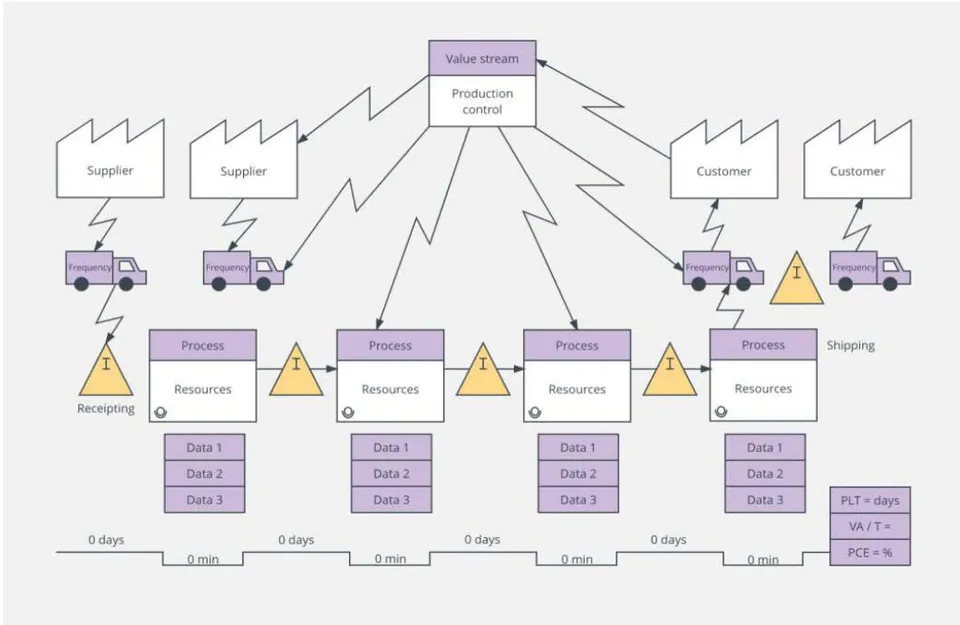
The paper applies value stream mapping (VSM), which is a Lean technique that constructs a process flow diagram of activities and information. The VSM utilizes a systematic method, and it covers all the tasks and activities which bring the project to completion, it also shows all steps needed to the operation, to show accurately any ineffectiveness that may appear in the map (Banawi, M.Bilec, 2014). However, the VSM included the following elements:
Activities steps – The VSM describes each of the process steps in the value stream, either value added or non-value added.
Information flow – The VSM depicts any backup information, schedule and specifications.
Cycle time (CT) – It shows one cycle time required to complete one activity, or it can be one step in a process.
Work in process (WIP) – It is any intermediate time which is not included in the predecessor activity nor the successor activity in the schedule.
VI. LEAN SIX SIGMA (LSS)
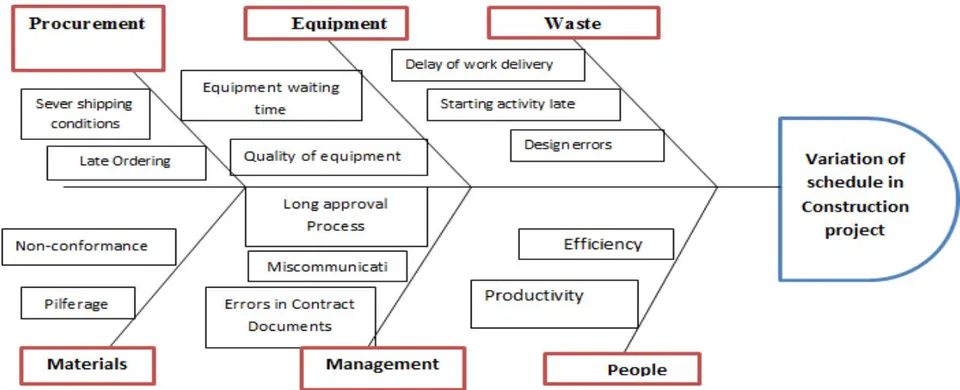
Six sigma is a quality improvement method that aims at optimizing operations while eliminating defects and costs. Six sigma is a quality improvement method that aims to optimize operations while eliminating defects and costs. Six Sigma approach can be relevant to all fields and industries including construction because it searches to improve quality and eliminate variation between upstream and downstream of the process, and errors (Al-Aomar, 2012). This technique focuses on finding out and eliminating process performance variability, and also utilizing several statistical methods to obtain rate of defects close to zero. Six sigma is also a mass improvement method used to help businesses achieve a high level of success. The Six Sigma system focuses on customer requirements, data, statistical analysis and ongoing improvement (Banawi, M. Bilec, 2014). They also state that Sigma indicates to the amount of discrepancy or variance that happening in the process, it equals in statistics to 3.4 defects per millions of opportunities (DPMO). A Fishbone is an optimal tool analysis that can be considered in order to figure out the causes and effects of the variation in the project schedule, as following:
DMAIC is a Six Sigma five-steps improvement paradigm: Define, measure, analyze, improve, control. Specifically, it is a number of ways and tools that can be utilized in each of the five phases. DMAIC can also be arranged into 5 steps as following (Sriram, Revathi, 2016):
DEFINE - To defines customer needs, and any requirements that don't meet these needs are considered as defects. At any time, schedule of project, the activities should be defined with the start and end milestones.
MEASURE - To determine and collect proper data related to the defects and the process to be developed. Specifically, to find out and collect the data regarding the delay in the project.
ANALYZE - To study the data that are collected from the last steps and analyze it in order to figure out the root causes of the defects, or delays.
IMPROVE - To Improve the process by reducing or eliminating the defects. It is also to identify the inputs that cause the variation in the outputs and improve them. It can be to reduce the time that caused the delay gradually.
CONTROL - It just makes sure that the previous procedure is effective, by reviewing the operation as a whole. It is to review the total time allocated to the activity.
VII. METHODOLOGY
The objective of this paper was to help reduce or eliminate the waste resulted from different processes by applying and improving a certain lean six sigma techniques. (VSM) is implemented in an infrastructure construction project at Al-Abyar City.
In order to attain this goal, some objectives were specified as:
Reviewing the detailed time schedule of the above-mentioned project to figure out the delays among the project activities, and extracting the time that caused the waste of waiting. This is in turn considered to use a certain tool which is (VSM), as a technique used in addressing the delay in this project.
Constructing a fish-bone model to display and analyze different types of waste of delay resulted on the project activities.
Considering the Lean Six Sigma as an approach that can be applied by using a unique tool which is DAMIC method, as defined above.
VIII. IMPLEMENTATION OF THE VSM
VSM was applied to the processes of the water distribution project at Al-Abyar city. In this case, the process is consists of four activities which starts with project elaboration, bills of quantities elaboration, review by the client and ends with comment amendments. Each process has its constrain time in which it should be completed within. However, even though one process has been completed within the scheduled completion dates, the others have fallen behind schedule. It should be noted that due to time constrain and the lack of updated information of many construction projects in the Benghazi area the research project was implemented in a small section of a water distribution project in Al- Abyarcity.
The following table shows the estimated duration time, starting and finishing days at each activity as well as actual and delay time:
| S. No. | Activity Name | Original duration | Starting and finishing days Start Finish | Actual work | Delay | |
| 1 | Project elaboration | 27 | 17/8/2009 | 28/9/2009 | 11 | 0 |
| 2 | Bills of quantities elaboration | 7 | 20/6/2010 | 28/6/2009 | 8 | 150 |
| 3 | Review by the client | 4 | 20/6/2010 | 23/6/2010 | 3 | 147 |
| 4 | Comments amendments | 7 | 26/6/2010 | 23/7/2010 | 27 | 149 |
Based on lean philosophy any activities that do NOT change the form, fit, or function of the part and activities the customer does not want to pay for are classified Non-Value added activities (Waste), (Womack and Daniel, 2003, Banawi and Bilec 2014). In this project the original duration time in is classified as value added process which was accurately estimated by experts while the rest are classified as non-value added time. The following table presents the current status of the project activities:
| Time classification | Duration(days) | Percentage of time |
| Total value added time | 45 | 9% |
| Total non-value-added time | 439 | 91% |
| Total processing time | 484 | 100% |
As shown in the table above the total value added time represents just about 9% from the total time of the water distribution project, while the non-value-added activities represent about 91% of the total time. This waste was due the following activities:
Long approval process due to unjustified bureaucracy.
Non-payment of outstanding invoices on time.
The continuous changing of design concepts, which negatively affects the beginning and finishing of the implementation of the activities among the time schedule.
Neglect and lack of carful follow-up of the project schedule.
The late beginnings of the activities within the project due to series of long administrative procedures.
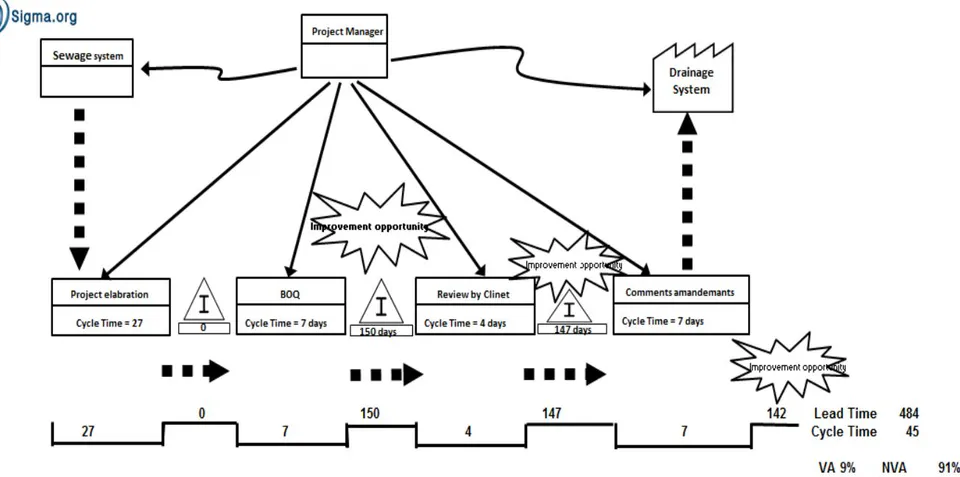
VSE = Value add/Process Lead Time = 45/484 = 0.09 × 100=9%
IX. SUGGESTED FUTURE STATE MAPPING
Some suggested steps for future state mapping should be considered in order to improve overall project efficiency. These steps can be implemented as following:
In the first future plan Process Lead Time (PLT) of the BOQ, Review by client and comments amendments processes was decreased from 484 days to 184 days. Based on the calculation of this suggested step the VSE was improved from 9% to 24%, while the waste was reduced from 91% to 76%.
In the second future plan PLT of the same three processes was decreased from 184 days to 75 days. Consequently, the VSE was improved from 24% to 60%, while the waste was reduced from 76% to 40%.
In the third future plan the PLT of the same three processes was decreased from 75 days to 60 days. Consequently, the VSE was improved from 60% to 75%, while the waste was reduced from 40% to 25%.
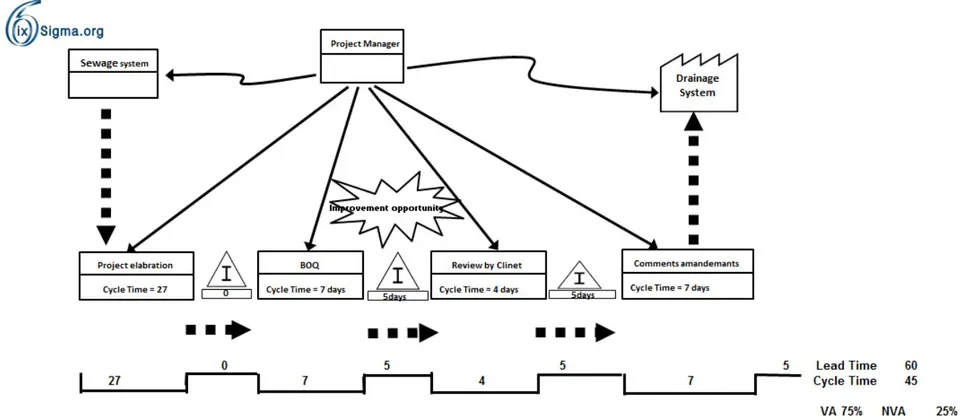
| Time classification | Duration(days) | Percentage of time |
| Total value added time | 45 | 75% |
| Total non- value-added time | 15 | 25% |
| Total processing time | 60 | 100% |
X. CONCLUSION AND RECOMMENDATIONS
In real world construction process is a complex system that involves many interrelated tasks performed by different contractors. In order to overcome such this problem, complex construction project is treated as a collection of small projects. In this research paper, a small part of water distribution system was evaluated to find the major causes of waste that lead to increase the PLT which made the project to fail behind the schedule. Lean Six sigma methodology was implemented the performance in construction operations by finding the main cause of variation and thus lean techniques were used to eliminate the waste which increased the VSE up to 75%. The VSE of any construction project could be improved by clearly identified the process bottleneck that leads to increase the PLT. It is recommended to implement Lean six sigma approaches in construction capital projects to improve overall the performance of construction operations in Libya.