I. INTRODUCTION
A BC company provides equipment and services for forecourt management. Company provides automation solution through which all equipment on fuel station and communicate with each other and push the real time data on host. This study is about the implementation of risk management for execution project in the service field. It mostly refers on how to implement risk management process and where to implement it.
Lack of scope change management, poor communication, poor data handling, planning and prioritization of activities are the important observations of study. Since project is carried out across India and managed from several locations, stakeholder management is also important in the project. Current practices lag in terms of risk management. The purpose is to ensure that all the risks (process, system, people, external events, and financial risk) are managed effectively so that the company mission and vision are not affected and all company Key Performance Indicators (KPI) (Quality, Cost, Delivery, Accountability, and Continuous Improvement) are achieved.
Methods like training, brainstorming, checklist, survey and risk score matrix are used to determine the results. These methods are initially obtained from literature review that has been conducted in the early stage of the study. Lastly, this study also will measure the] effectiveness of the implementation of risk management process.
II. LITERATURE REVIEW
Vandersluis, Chris studied Application agile methodology to non-software enterprise projects. He said, Agile thinking was never designed to be restricted to just software development [4]. Priyam Dhani and Dr. Tanu Sharma studied HISTORY, MODELS AND MEASURES of emotional intelligence. This paper sought to review the literature on emotional by discussing the history of EI to the different theories and measures of EI. Lavanya, N. & Malarvizhi presented paper on risk management. This paper presents the structured Risk Management process followed at Nokia Siemens Networks that helps avoid crisis situations and incorporate learning from past mistakes[2] C. WU and S. H. HSIEH studied Visual Project Management based on questionnaires and industry interviews, the research in this paper prototypes a visual project management information system (VisPMIS) for effectively solving project related problems such as information and system integration among different project participants and engineering application systems.
III. RISK MANAGEMENT PROCESS
Risk management is a process of identifying risk, planning responses to those risks, and monitoring them throughout the project life cycle. On the other hand, a risk management plan is a document which documents the detailed plan to identify risks, analyze the risks, developing responses, and how to manage the responses. It describes how the risk management activities will be carried out in the project.[1]
Steps in a risk management plan are as follows:
Plan Risk Management is the process of defining how to conduct risk management activities for a project. The key benefit of this process is that it ensures that the degree, type, and visibility of risk management are proportionate to both risks and the importance of the project to the organization and other stakeholders. Team meeting was carried out to create this plan. Risk management plan is a component of the project management plan that describes how risk management activities will be structured and performed
- Identify Risks
Identify Risks is the process of identifying individual project risks as well as sources of overall project risk and documenting their characteristics. The key benefit of this process is the documentation of existing individual project risks and the sources of overall project risk. It also brings together information, so the project team can respond appropriately to identified risks.
- Analyze Risks
In order to handle the risk, its prioritization must be done. Quantitative and qualitative analysis is done for all identifies risks.
- Planning the Responses
Plan Risk Responses is the process of developing options, selecting strategies, and agreeing on actions to address overall project risk exposure, as well as to treat individual project risks. The key benefit of this process is that it identifies appropriate ways to address overall project risk and individual project risks. This process also allocates resources and inserts activities into project documents and the project management plan as needed.
• Monitor and Control the Risks In order to maintain the established process proper monitoring of plan is required.
Tools may be used –
Interview – Discussion with expertise and understanding the current scenario through their vision is always helpful. Interview can be taken within the team or from an expert outside the team.
Brainstorming – It is a group creativity technique by which efforts are made to find a conclusion for a specific problem by gathering a list of ideas spontaneously contributed by its members.
Root cause analysis– Root cause analysis is an approach for identifying the underlying causes of an incident so that the most effective solutions can be identified and implemented. It's typically used when something goes badly but can also be used when something goes well. Within an organization, problem solving, incident investigation, and root cause analysis are all fundamentally connected by three basic questions:
What's the problem?
Why did it happen?
What will be done to prevent it from happening again?
- SWOT analysis- SWOT matrix is a strategic planning technique used to help a person or organization identify strengths, weaknesses, opportunities, and threats related to business competition or project planning. Users of a SWOT analysis often ask and answer questions to generate meaningful information for each category to make the tool useful and identify their competitive advantage. SWOT has been described as the tried-and-true tool of strategic analysis.
Strengths: characteristics of the business or project that give it an advantage over others.
Weaknesses: characteristics of the business that place the business or project at a disadvantage relative to others.
Opportunities: elements in the environment that the business or project could exploit to its advantage.
Threats: elements in the environment that could cause trouble for the business or project
IV. CASE STUDY
The proposed plan is implemented in the project. Few steps are changed based on project requirements are team discussion.
1. Project risk Plan
Following areas are covered and planned in project management plan.
Risk strategy: Identify and Prioritize the risk and attempt the highest affecting risk.
Methodology: A risk register will be created and maintained by the risk management team. Regular meetings will be conducted to plan and mitigate the risk.
Roles and responsibilities: During the planning meeting following responsibilities are defined –
- Risk management team members – Director, Project manager, Zonal heads, Cross functional team representatives.
2. Decision making – Risk team
3. Budget approval – Director
4. Data collection – Zonal heads
5. Document maintenance and risk mitigation tracker – Project manager
Funding: No separate fund is needed as it is a parallel activity. If fund is needed for risk mitigation plan, it will be approved by director.
Timing: For this project risk register is reviewed and updated during project planning phase. It will be quarterly reviewed with management.
Risk categories: Provide a means for grouping individual project risks. A common way to structure risk categories is with a risk breakdown structure (RBS), which is a hierarchical representation of potential sources of risk An RBS helps the project team consider the full range of sources from which individual project risks may arise. Pl
| Risk Category | Extended categories |
| Technical | Requirements, Technology, Interfaces, Performance, Quality, etc. |
| External | Customer, Contract, Market, Supplier, etc. |
| Organizational | Project Dependencies, Logistics, Resources, Budget, etc. |
| Project Management | Planning, Schedule, Estimation, Controlling, Communication, etc. |
Definitions of risk probability and impacts: Definitions of risk probability and impact levels are specific to the project context and reflect the risk appetite and thresholds of the organization and key stakeholders. The project may generate specific definitions of probability and impact levels or it may start with general definitions provided by the organization. The number of levels reflects the degree of detail required for the Project Risk Management process, with more levels used for a more detailed risk approach (typically five levels), and fewer for a simple process (usually three). Table provides definitions of probability and impacts against three project objectives. These scales can be used to evaluate both threats and opportunities by interpreting the impact definitions as negative for threats (delay, additional cost, and performance shortfall) and positive for opportunities (reduced time or cost, and performance enhancement) [5].
| Scale | Probability | Impact | ||
| Number of ROs | Cost | Functionality | ||
| Very High | Every day | >150 | >10L | Very significant impact on overall functionality |
| High | once a week | 100 to 150 | 5L-10L | Significant impact on overall functionality |
| Medium | Once a month | 50 to 100 | 1L-5L | Some impact in key functional areas |
| Low | Once a quarter | 10 to 50 | 10K-1L | Minor impact on overall functionality |
| Very Low | Once in year | 10< | 10K< | Minor impact on secondary functions |
Probability and impact matrix: Risk is defined in two dimensions: the uncertainty dimension (assessed as probability of occurrence), and the effect dimension (assessed as impact on objectives. The effect on objectives is relatively simple to estimate, as it involves a simple exercise in imagining the situation where the risk happens. Prioritization rules may be specified by the organization in advance of the project and be included in organizational process assets, or they may be tailored to specific project. Opportunities and threats are represented in a common probability and impact matrix using positive definitions of impact for opportunities and negative impact definitions for threats. Descriptive terms (such as very high, high, medium, low, and very low) or numeric values can be used for probability and impact. Where numeric values are used, these can be multiplied to give a probability-impact score for each risk, which allows the relative priority of individual risks to be evaluated within each priority level.
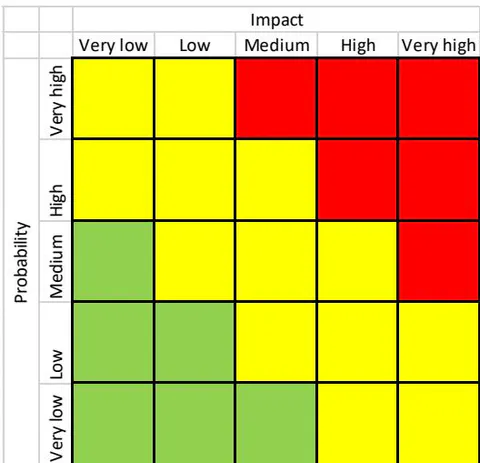
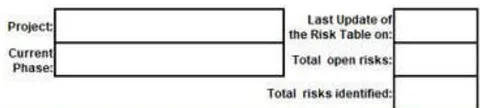
Figure 2: Risk register and tracker
| Risk Type | Risk Description(Risk: what may or could happen) | Risk Impact | Impact Severity | Probability | Overall Rating | Owner | |
| 1 | |||||||
| 2 |
2. Risk identification
This process is performed throughout the project. Following tools are used in the project.
Document review– The tender is reviewed and studied. As the project is tender driven, it is necessary to review the tender. There is may clause related to payment and service which may create the high risk in the project. Thus, proper understanding of tender is required.
Information gathering - Data-gathering techniques that can be used are:
Interview – Discussion has been done with the director and vice president. Risks are identified based on their experience.
Brainstorming – A brainstorming session is done during a 3-day workshop conducted for automation. All state heads, regional head, and head office team were part of this session. Based on quaternary, a list of risks is prepared.
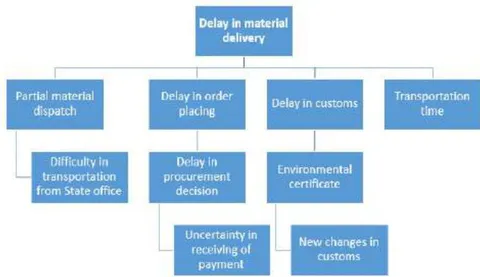
Root cause analysis – Consider the following example of RCA done for delay in material delivery.
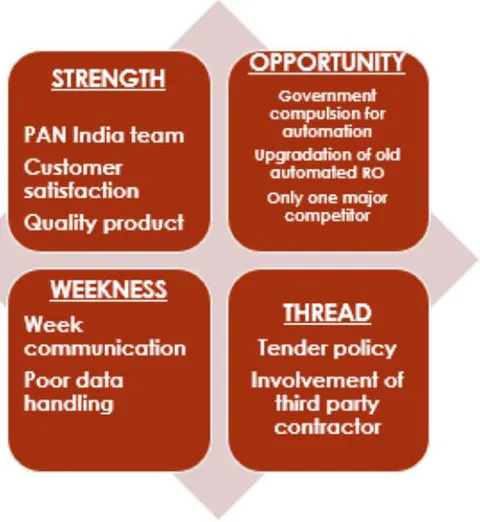
SWOT analysis: SWOT matrix is a strategic planning technique used to help a person or organization identify strengths, weaknesses, opportunities, and threats related to business competition or project planning. Consider the SWOT analysis done for project-
Risk identification output As output of risk identification following risks are recorded in risk register:
| Risk Type | Risk Description | Risk Impact | |
| 1 | Organization/Process | Safety risk Accidents - Road accident during travelling, accident during power on | Death, injury to technician |
| 2 | External | Weather issue in IOAOD, PSO in December | Delay in work completion |
| 3 | Commercial | Change in value of currency | Affects purchase from other countries |
| 4 | External | Dependency on third party vendor | Delay in work completion |
| 5 | External | Vendor monopoly | Increase in payments |
| 6 | External | Custom issues (Environmental certificate) | Delay in getting the shipment |
| 7 | organization/Process | Material theft | Loss of inventory. Monetary loss, delay because of double transportation |
| 8 | Organization/Process | Lack of training to engineer | Poor quality work |
| 9 | External | Poor contractor work | Poor quality work |
| 10 | Organization/Process | Delay in procurement decision | Delay in schedule |
| 11 | Organization/Process | Cross functional team | Delay in decision making, poor communication |
| 12 | External | Scope change by customer | Preplanning, delay in organization targets |
| 13 | Organization/Process | Attrition rate | Delay because of new recruitment and training |
| 14 | External | Elections | Contractor team not available |
| 15 | External | Festival impact | Delay |
| 16 | Technical | Google dashboard failure | Loss of data |
| 17 | Commercial | Tender clauses | Delay in Payment |
| 18 | Commercial | Cost overrun due to rework | Overbudget, delay |
3. Quantitative & Qualitative Risk analysis
As a result of quantitative and qualitative analysis, probability and impact are assigned to identifies risks.
| Risk Type | Risk Description | Risk Impact | Impact Severity | Probability | Overall Rating |
| Organization/Process | Safety risk Accidents - Road accident during travelling, accident during power on | Death, injury to technician | Very high | Low | 10 |
| External | Weather issue in IOAOD, PSO in december | Delay in work completion | Medium | Low | 6 |
| Commercial | Change in value of currency | Affects purchase from other countries | Medium | Medium | 9 |
| External | Dependency on third party vendor | Delay in work completion | Medium | Very high | 15 |
| External | Vendor monopoly | Increase in payments | Medium | Low | 6 |
| External | Custom issues (eg Environmental certificate) | Delay in getting the shipment | Medium | Low | 6 |
| organization/Process | Material theft | Loss of inventory.Monetary loss, delay because of retransportation | Medium | Low | 6 |
| Organization/Process | Lack of training to engineer | Poor quality work | High | Low | 8 |
| External | Poor contractor work | Poor quality work | Medium | Low | 6 |
| Organization/Process | Delay in procurement decision | Delay in schedule | High | Very low | 4 |
| Organization/Process | Working with Cross functional team | Delay in decision making, poor communication | Very low | High | 4 |
| External | Scope change by customer | Replanning, delay in organization targets | Medium | Medium | 9 |
| Organization/Process | Attrition rate | Delay because of new recruitment and training | Medium | Medium | 9 |
| External | Elections | Contractor team not available | Low | Very low | 2 |
| External | Festival impact | Delay | Medium | Low | 6 |
| Technical | Google dashboard failure | Loss of data | Low | Very high | 10 |
| Commercial | Tender clauses | Delay in Payment | Medium | Medium | 9 |
| Commercial | Cost over run due to rework | Overbudget,delay | High | Low | 8 |
4. Risk response
Based on the strategies in table 4, mitigation options are identified for the identified risk.
| Threat | Opportunity |
| Avoid | Exploit |
| Transfer | Share |
| Reduce | Enhance |
| Accept | Reject |
V. RESULTS AND DISCUSSION
The impact or effectiveness of applied risk management plan will be evaluated in 2 ways.
- A checklist will be prepared and circulated among key stake holders to check whether all risks are captured or not.
| Criteria | Progress |
| Do you have risk management plan? | Yes |
| Do you have risk management strategy? | Yes |
| Do you have identified possible stake holders related to automation project? | Yes |
| Are you aware about risk probability and impact scale? | Yes |
| Do you have established risk management committee? | Yes |
| Does the committee have appointed a specific person who is responsible or accountable for risk management? | Yes |
| Do you have identified methods for risk assessment? | Yes |
| Do you have standard format for risk capturing? | Yes |
| Are you capturing newly identified risks in risk register? | Yes |
| Do you have identified risk treatment plan? | Partial |
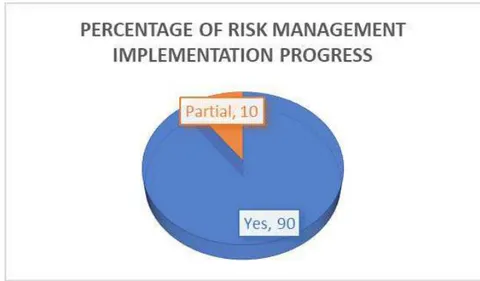
From the above, it is transformed into a pie chart. Risk treatment plan is in progress.
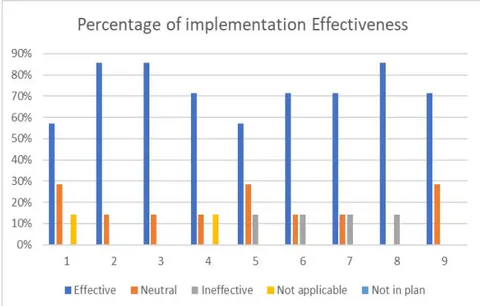
- Another way of measuring effectiveness is by checking whether mitigation plan is effective or not. A key performance index is identified which are affecting a particular risk. The impact of risk mitigation plan is measured on that KPI.
| Sr.No. | Risk Management components |
| 1 | Effective culture and organization |
| 2 | Defined and communicated procedures |
| 3 | Level of understanding risk and risk management |
| 4 | Establishing criteria for evaluation of risk |
| 5 | Identification of risk |
| 6 | Registering of risk |
| 7 | Analysis of risk |
| 8 | Prioritization of risk |
| 9 | Appropriate use of risk recording tool |
| 10 | Monitoring of risk actions |
| 11 | Continues feedback on risk management strategies |
| 12 | Regular report to senior management |
The process followed in the system had many gaps. There was failing in terms of timeline and cost because of poor planning, lack of risk management, poor communication. For smooth execution, process need to be modified. Project management is lacking in execution. As the scope is not going to vary once tender is accepted and there are so many structured things in Agile, it is difficult to implement agile in this project. Since agile and execution project have many differences like lead time, cost of equipment. the method can't be applied directly. Visual Project Management helps in data handling and tracking.
VI. CONCLUSION
ABC company is growing faster in automation business. In order to meet the project targets company is implementing Risk Management plan for the automation project. It can be further expanded to complete service department.
Many problems in project can be avoid or reduced by proper implementation of risk management plan. Many problems in the project can be avoided or addressed in early stage with the help of risk management. A risk management plan is created, and risk analysis is done for the project.
The effectiveness of implemented process is also analyzed. For most of the components, the implemented plan is effective. Risk management may not avoid the problem completely, but it can reduce the impact of problem.