





I. INTRODUCTION
Russian pedagogical journalism has got a long history. The first periodicals, devoted especially to the problems of education, appeared in Russia in the XIX century. They created a distinctive information space that covered issues of education and training. Those mass media were special propagandists of pedagogical innovations. Therefore, today those journals are an exceptionally important source for research on the development of major trends in the history of Russian education. The introduction of a relatively mass national school, the expansion of numbers of teachers, and students in the XIX century required not only a deep modernization of the system but also an understanding of what was going on. It is on the pages of periodicals that the main leading ideas of Russian teachers of that time were reflected in a highly concentrated form. What should school be like? Who can act as a teacher? What is a perfect student? The agenda comprised such issues. The study of the history of pedagogical journals is also interesting as an independent study of the complex process of development of Russian journalism, where the functioning of private journals is highlighted as a unique phenomenon.
II. THE BEGINNING: THE FIRST RUSSIAN PEDAGOGICAL JOURNALS
The first pedagogical journals published by private individuals appeared in Russia in the mid-30s of the XIX century: "Pedagogical journal" (1833-1834, St. Petersburg), "Educational mathematical journal" (1833-1834, Revel). The magazines were very short-lived and had a limited number of subscribers. For example, K. Kupfer's journal "Uchebny matematicheskiy Zhurnal", the first magazine dedicated specifically to the teaching of mathematics, had about 200 subscribers. Due to the limited number of subscribers and the short duration of publication, such magazines could not have a significant impact on the pedagogical audience. The topic of education was not at the center of public attention.
It was only in the late 1850s and early 1860s that a mass publication of pedagogical journals began. The public paid great attention to the pedagogical press at this moment. Enormous changes were taking place in the country. There was a deep need to expand the number of educated professionals. A much larger number of people need to be trained than before. Therefore, it was necessary to move away from pedagogy for elite and move to pedagogy for all. The class is expanding not only for students but also for teachers. For still inexperienced teachers pedagogical knowledge was urgently needed.
The need for periodicals on educational issues is sharply increasing. Of course, there was an official organ of the Ministry of education: "Journal of the Ministry of national education". But it was clear that was not enough. Seeing such a need, individuals use their savings to start publishing educational journals. It was unrealistic to earn a living by publishing a pedagogical magazine, as the publisher often worked at a loss. But the noble cause found its supporters. And it was thanks to them that the full-fledged development of pedagogical journalism in Russia began.
III. OFFICIAL OR PRIVATE? COMPETITION AMONG PERIODICAL PUBLICATIONS
Among the magazines were official ones published, for example, by the Ministry of education, the General Directorate of military educational institutions, etc.1 But a large number of pedagogical journals were published by private individuals at their own expense. In the second half of the XIX century, 89 pedagogical periodicals were published. Of these, 37 were published by various departments, ministries, and associations, and 52 - by individuals. Russian "Russian school" (1890-1917, Saint Petersburg), "Education" (1857-1861, Saint Petersburg), "Teacher" (1861-1870, Saint Petersburg), "People's school" (1869-1889, Saint Petersburg), "Russian primary teacher" (1880-1911, Saint Petersburg), and others were among the latter. These magazines were well known and loved by Russian teachers.
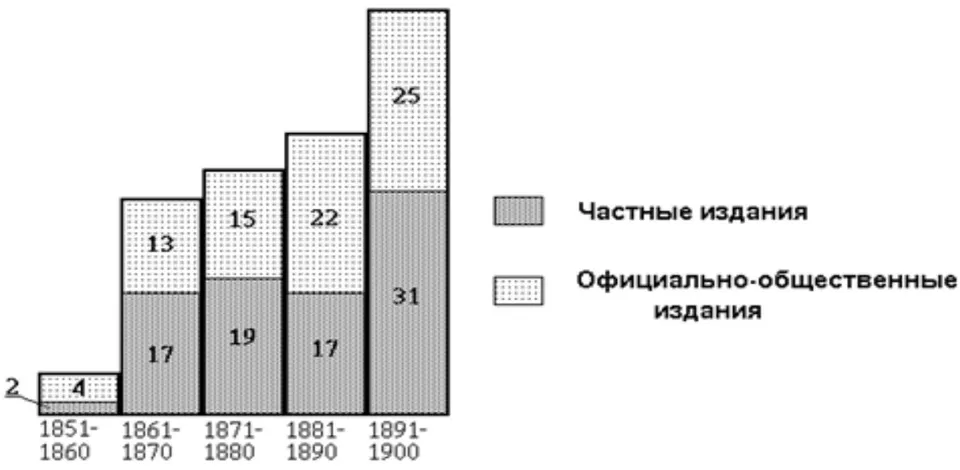
These private pedagogical journals were of importance for the development of pedagogical thought, since it was on their pages that a broad public discussion was held, not constrained by official boundaries. It was private educational publications that boldly promoted the most advanced ideas. On the pages of these publications, there was an open critical discussion of pedagogical issues. The harshest and unflattering criticism took place here. While official publications often avoided discussing controversial issues, limiting themselves to publishing official documents, private journals, on the contrary, focused the attention of the pedagogical community on the most pressing issues.
IV. WHAT DID THE OLD MAGAZINES WRITE ABOUT?
As a rule, private journals had the following departments: 1. Legislation;
Pedagogy and didactics;
History of public schools and public education;
Articles of scientific content;
Bibliography;
History and news;
Appendices.
A large place in the magazines of that time was occupied by the description of foreign experience. The magazines introduced their readers in detail to the organization of the educational process and the state of educational institutions in Italy, France, the USA, England, Japan, and many other countries. The German experience played a major role in publications. Trying to build an ideal model of a school, teachers turned to the experience of other countries. Much attention was paid to the publications of recognized classics of pedagogical thought - Y. Komensky, J. Rousseau, I. Pestalozzi.
Private periodicals widely published criticism. It analyzed educational books or pedagogical literature, reviewed both domestic and foreign children's literature (mainly Western European), and reviewed children's magazines. For example, the magazine "Teacher" has published more than 800 critical reviews of books during its existence (about ten years). The need for a critical review of the published pedagogical and educational literature was so great that there was even a special magazine devoted entirely to these issues — "Pedagogical Museum" (1875-1880).
Private pedagogical journals focused mainly on the needs of professional teachers ("Teacher," "Russian school", etc.). They prepared detailed lesson notes, gave recommendations n on the study of material, the selection of visual AIDS, etc. More general questions were also raised: how to teach a girl? What subjects should be in the school course? There were magazines ("Family and school," "Bulletin of education," etc.) that tried to take into account not only the interests of teachers but also the needs of parents. The magazines provided answers to many of the family's concerns. For example, how to improve the child's health, what is the harm of alcoholism, how to fight infectious diseases, etc. Magazines pointed out ways to combat the overwork of students, patiently explained the inadmissibility of punishments practiced by parents for poor grades, and promoted proper physical education of children.
V. CLASSIC OR REAL?
One of the most important issues discussed on the pages of magazines was the question of the advantages of classical and real directions in education. Ancient languages (the basis of the classical direction) were traditionally included in the course of Russian gymnasiums, taking up a significant part of the school time here. And causing complaints from the public. Parents preferred children to learn French and German more intensively than Latin and ancient Greek. But only the classical gymnasium provided access to the University. Questions about what secondary education should be, who can become a University student, and how to train people in practice-oriented professions were discussed on the pages of periodicals.
VI. IN OPPOSITION
Private journals on many controversial issues took a firmer position than official journals, openly standing in opposition to "official" pedagogy. For example, the magazine "Teacher" opposed classical education. This position led to the exclusion of the magazine from special lists of recommended literature for schools to subscribe to. This was tantamount to banning the magazine. It is not surprising that the magazine "Teacher" was soon forced to close. A similar story happened with the "people's school". It was an admired magazine, which, like the Teacher, had about three thousand subscribers. In connection with the sharp criticism of the "People's school" of the clergy's interference in the work of public schools, the magazine is excluded from the list of recommended literature. Private magazines raised not only acute pedagogical problems on their pages, but also discussed painful social problems that are important both for the national school and society as a whole. Thus, the magazine "Yasnaya Polyana," published by Leo Tolstoy, did not last long and was forced to close not only because of the small number of subscribers (about 400), but also because of the intolerant situation around the publication of the magazine. A strange publication of a pedagogical magazine in a village school, a meeting of teachers and students in Tolstoy's house, aroused suspicion among the authorities. In the summer of 1862, Tolstoy's house was searched . The Ministry of internal Affairs recognized "Yasnaya Polyana" as a harmful magazine. The censors carefully studied every book in the magazine. "Yasnaya Polyana" lasted only one year.
VII. MAGAZINES WITH A "LONG LIVE"
Private magazines were simply stifled by need. Many publications were quickly closed. Financial difficulties forced many private magazines to change their names and expand the program. So, the first magazine on preschool education "Kindergarten" was forced to expand its program and change its name to "Education and training". The magazine "Women's education" also was forced to rename in "Education". Of course, the issues of preschool education and women's education were important and deserved separate magazines. But by expanding the magazine's program, it was easier to survive. Publishers were forced to save every penny. So, the publisher-editor of "Women's education" V. D. Sipovsky for the economy of means "was at the same time the editor, the publisher, the Secretary, and the sworn employee-chronicler... He personally kept the proofreading of all the articles. The magazine took him not only a lot of time but also absorbed a lot of money".
The scarcity of funds explains the short life of many private magazines.
Comparing the publication dates of private and official journals, we can see that more than half of the official journals were published for more than 10 years. Among private magazines, there were barely more than a quarter of such "veterans". But the long life of official and public magazines is explained not so much by their high level, as by state support. The vast majority (16 out of 23) of the official "veterans" published only resolutions and orders, often pedagogical articles were simply absent
Who were their "fathers-founders"?
The creators of pedagogical journals were people of different views, different beliefs, they came from different social strata, but all of them, with a few exceptions, were United by one thing — selfless service to the cause of education.
The son of rich parents, from a very well-known merchant family, young F. N. Mednikov (the future Creator of the "People's school"), after graduating from University, it was time to surprise everyone around him with his determination to go to the province as a teacher. This was really quite unusual for people in his circle. According to tradition, F. N. Mednikov was to become a merchant and inherit his father's business. Entering the University was a completely radical step, and working as a teacher was simply knocked out of all existing class concepts. F. N. Mednikov was a teacher at first in Belozersk, in fact in Tikhvin and a lake Ladoga. Returning to St. Petersburg, he has got a promotion from a teacher in the lower classes of the gymnasium to an inspector . Mednikov started publishing the "people's school" in 1869, while remaining as an inspector of the Vvedenskaya progymnasium.
The publisher of the famous pedagogical journal "Russian school" was Yakov Gurevich. Y. G. Gurevich was born into a wealthy Jewish family, but the family impoverished and I. G. Gurevich teenager began to work, doing tutoring. He studied at Moscow and Saint Petersburg universities, then became a teacher in a secondary school. In 1883, Gurevich purchased the well-known Bychkov private gymnasium and became its Headmaster. It was after becoming the head of an educational institution that Y. G. Gurevich decided to publish his magazine. Here is how his co-editor recalls this editorship."When, in 1890, Yakov Grigoryevich conceived the idea of publishing a pedagogical journal, he knew that it was extremely difficult and financially hopeless. He did not stop at any difficulties, attracted well-known teachers and scientists to the number of employees of the magazine, and the publication of the magazine began... J. G.'s attitude to these manuscripts is remarkable: he read all the manuscripts from beginning to end. He used to say that the main thing is the thought, and the form can be corrected, and he looked for new thought in every manuscript. He corresponded with his employees about their activities.
He never stopped before an authoritative, even if unfavorable, review of a book or work by any of his colleagues or friends... this attitude to the case caused damage to the relationship that he cherished. But he valued the truth more."4
Many publishers of educational journals were not rich. They often came from poor backgrounds. Andrey Ivanovich Anastasiev, publisher of "Urban and rural teacher", also came from poor backgrounds. He was born in the family of a priest in a remote Simbirsk province . He lost his mother when he was seven, and his father – when he was ten years old. He studied at a religious school, there were not enough educational books-they gave out one for three students, and often there was nothing to write with. At the beginning of the course, Anastasiev was among the last students on the class list since he was not prepared for entering the school, but finished the course first. Then there was the Simbirsk Theological Seminary and the University of Kazan. Andrey Ivanovich taught for a long time. Having become the Director of the Kazan Teachers' Institute, Anastasiev started publishing a pedagogical magazine - "Urban and rural teacher".
VIII. CONCLUSIONS
In the second half of the XIX century, thanks to the selfless work of enthusiastic teachers, pedagogical periodicals were created in Russia. The latest achievements of pedagogical thought were reflected in the pages of magazines. The magazines were practice-oriented: teachers and parents had the opportunity to constantly be aware of new pedagogical developments, and they began to participate in the discussion of exciting pedagogical problems on the pages of publications. Trying to find a certain educational ideal, to solve the question of classical or real, teachers tried to take as an example both a foreign school and to develop Russian educational traditions. Based on this, by the end of the century, the traditional gymnasium model of Russian education was formed.
Footnotes
P. 69 (p.3) ↩


